An RMA (return merchandise authorization) is the approval and tracking number that a retailer issues before a customer sends back a product, and it is the single most important control point in ecommerce reverse logistics. The operational goal is simple: build a rule-driven approval process backed by clear service-level agreements, so returns move from request to refund in a predictable, low-cost cycle. Retailers that get this right target an RMA-to-refund cycle time of about a week.
TL;DR:
- Most retailers should aim to keep the RMA-to-refund cycle time under seven days by automating approval, inspection, and resolution stages whenever possible.
- Implementing barcode or QR code scanning on return labels can significantly reduce inbound processing delays, especially at receipt matching.
- A connected system stack including order management, warehouse, help desk, and accounting platforms is essential to prevent delays caused by manual handoffs and data mismatches.
- Using structured reason codes and automated approvals for low-risk returns reduces manual review time and helps lower costs without increasing fraud risk.
- Tracking key metrics such as cycle time, return rate, and refund-to-exchange ratio by SKU and channel offers actionable insights and early warning signals for process issues.
Table of Contents
- What Is an RMA and Why It Matters for Ecommerce Operations
- The Step-by-Step RMA Workflow, From Request to Resolution
- The Systems and Handoffs That Make RMAs Reliable
- Best Practices and Automation Rules That Cut Cost
- Which KPIs Actually Tell You the RMA Process Is Working
- Common RMA Failures and How to Fix Them
- When Managed Operations Solve the RMA Scale Problem
- Building the Self-Service Returns Portal Customers Actually Use
- Treat Return Data as a Merchandising Signal, Not Just an Expense Line
- Scale Your RMA Operations Without Building an Internal Department
- Sources
- FAQ
What Is an RMA and Why It Matters for Ecommerce Operations
An RMA number is a unique identifier assigned to a specific return request. It links a physical box coming back into your warehouse to an order, a customer, a reason, and an approved outcome, before that box ever ships.
Without one, a returned item is just an unmarked package. Your receiving team has no way to know who sent it, why, or what should happen to it. That gap is where refunds get delayed, inventory goes unrecorded, and customers start calling support to ask where their money is.
The RMA number does five jobs at once:
- Confirms the return is eligible under your policy before the customer ships anything
- Gives the customer clear instructions, including where to send the item and what packaging to use
- Routes the physical item to the right internal destination, whether that’s restock, refurbish, or scrap
- Creates a permanent record tying the return to the original order fulfillment transaction
- Acts as a control point that prevents fraudulent or duplicate refund claims
A step-by-step RMA workflow treats every one of these as a stage with its own owner and its own exit criteria, rather than a single vague “returns” bucket.
The Step-by-Step RMA Workflow, From Request to Resolution
A reliable RMA procedure for online shopping breaks into six stages, each with a clear owner and a target turnaround time. Skipping a stage or leaving it undefined is usually where the whole system breaks down.
- Intake. The customer submits a return request through a self-service portal, email, or chat. Require the order number, a structured reason code, and photos for damage or defect claims at the point of intake, not later. Incomplete requests should bounce back automatically rather than sitting in a queue.
- Eligibility check and approval. Rules engines should auto-approve the majority of legitimate cases (wrong item shipped, defective product, size or fit issues within the return window) and route anything ambiguous, like a claim outside the window or a high-value item, to a human reviewer.
- RMA issuance and label generation. Once approved, the system generates the RMA number and a shipping label. Decide upfront whether the label is prepaid or customer-paid based on the reason code; a defective product should never cost the customer return postage.
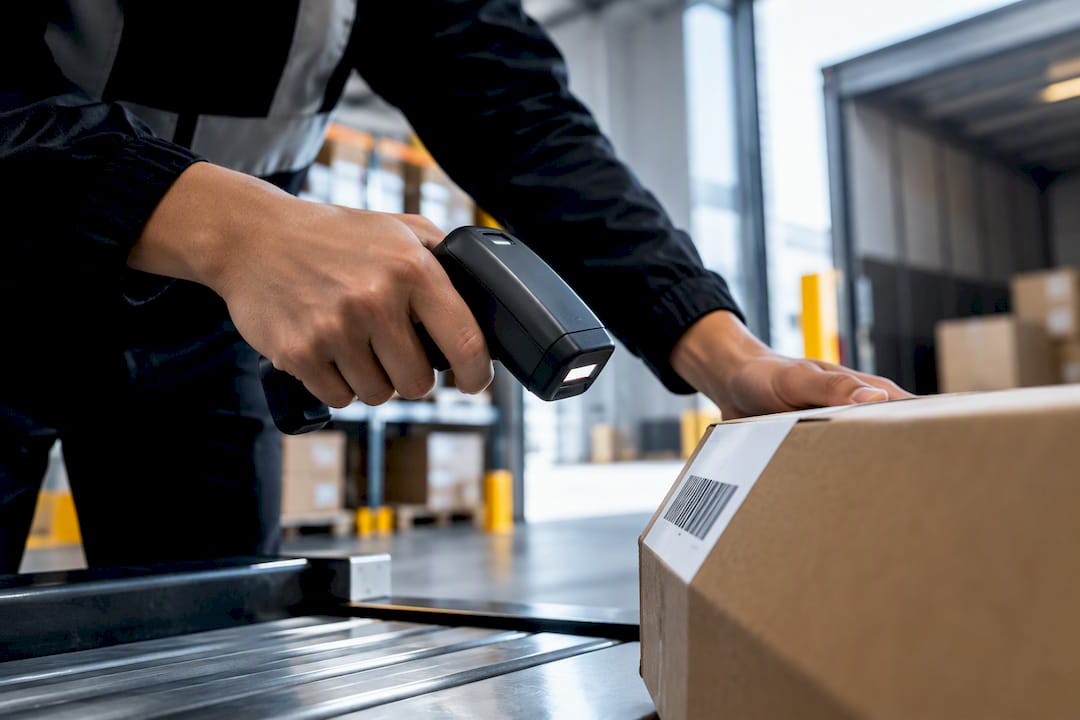
- Inbound tracking and receipt matching. As the package moves through the carrier network, its tracking number should already be linked to the RMA. When it arrives, receiving staff scan the label to confirm the match instead of manually searching for the order.
- Inspection and disposition. The item is checked against the stated reason code and assigned an outcome: restock, refurbish, liquidate, or scrap. This is the stage most retailers under-resource, and it’s usually where backlogs form.
- Resolution and system updates. Refund, exchange, or store credit gets issued, and inventory and accounting systems update simultaneously. A returns management process that doesn’t sync inventory in real time will overstate available stock until someone manually reconciles it.
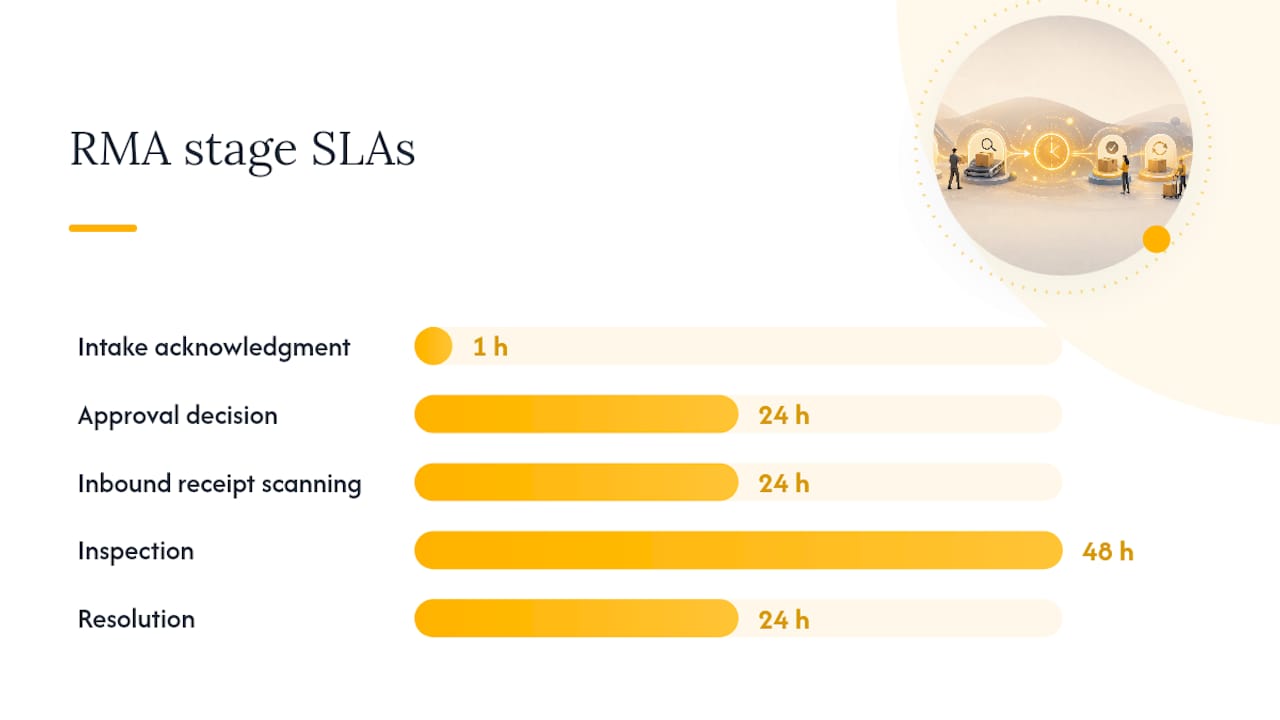
Suggested stage-level SLAs: intake acknowledgment within 1 hour (automated), approval decision within 24 hours, inbound receipt scanning within 24 hours of warehouse arrival, inspection within 48 hours of receipt, and resolution within 24 hours of a completed inspection. Stack those together and a well-run RMA process design keeps total cycle time under a week.
Pro Tip: Print the RMA number as both a human-readable code and a barcode or QR code directly on the return label. It turns your receiving dock into a single-scan operation instead of a manual lookup task, and it’s one of the cheapest fixes available for slow inbound processing.
The Systems and Handoffs That Make RMAs Reliable
An RMA process ecommerce teams can trust doesn’t run on a spreadsheet. It runs on a minimum stack of connected systems, each owned by a specific function, with clean handoffs between them.
You need an order management or ERP system as the source of truth for the original transaction, a warehouse management system to track physical inventory movement, a self-service returns portal for customer-facing intake, a help desk platform for exceptions and disputes, a shipping and labeling tool to generate prepaid or customer-paid labels, and an accounting system to post refunds and adjust cost of goods sold.
The handoffs matter more than the tools themselves:
- Customer service or the portal owns intake and eligibility triage
- Warehouse or receiving owns inbound matching and inspection
- Finance owns the resolution trigger and refund posting
- Merchandising owns what happens to reason-code data downstream
The back-office functions connecting these teams are where most delays actually live, not in any single system. Integration is what closes the gaps: put the RMA number on every label as a scannable code, trigger automatic status updates the moment a carrier scan event fires, and make sure your help desk platform can pull RMA status without an agent switching screens.
Best Practices and Automation Rules That Cut Cost
Automated RMA solutions work best when they’re built around a small set of firm rules rather than case-by-case judgment calls. The retailers with the lowest cost per return tend to follow the same handful of practices.
- Use structured, closed-list reason codes instead of free-text fields, and route that data to merchandising monthly at minimum
- Auto-approve returns for low-risk, high-confidence reasons: wrong item shipped, visibly defective, or size and fit issues inside the return window
- Set a dollar threshold below which refunds process automatically without manual review, since manual review on a $12 return usually costs more than the item
- Default to exchanges or store credit before cash refunds where your policy allows it, since exchanges preserve revenue that refunds simply erase
- Flag serial returners and unusually high-value claims for manual fraud review rather than blanket auto-approval
- Send proactive, branded tracking updates at each stage so customers stop calling support to ask about status
These patterns come directly from what proven return management practices show work at scale: self-service portals paired with rule-based automation cut manual handling time and recover revenue that would otherwise leak out as pure refunds.
Pro Tip: Automating approvals for your top three or four reason codes typically eliminates the majority of manual review tickets. Start there before building rules for edge cases.
Which KPIs Actually Tell You the RMA Process Is Working
Five numbers tell you whether your ecommerce product returns operation is healthy or quietly bleeding money.
Return rate (returns divided by units shipped, segmented by SKU and channel) tells you where product or listing problems concentrate. RMA-to-refund cycle time measures the full span from request approval to money back in the customer’s account; retailers should treat 7 days as the target and 10 days as a warning sign, since customer perception of the experience turns adversarial past that point, according to RMA process design guidance. Cost per return captures shipping, labor, and restocking costs against the item’s recovered value. Refund-to-exchange ratio shows whether your exchange-first policies are actually working. Fraud rate flags abuse patterns like wardrobing or serial high-value claims.
With ecommerce now representing a substantial and growing share of total U.S. retail sales, according to Statista’s retail tracking data, return volume scales right alongside it, making these five metrics a fixed cost of doing business online rather than a seasonal nuisance.
Segment every KPI by SKU, channel, and reason code before you draw conclusions. A rising return rate on one product usually means a listing problem, not a systemic one.
Common RMA Failures and How to Fix Them
Most returns management process breakdowns trace back to four repeat offenders.
- Missing or duplicate RMAs, usually from a portal that lets customers request returns without generating a tracked number, fixed by making RMA issuance mandatory before any label prints
- Manual approval bottlenecks, fixed by auto-approving your top reason codes and reserving human review for genuine exceptions
- Inspection backlogs, fixed by dedicating specific staff and floor space to receiving rather than treating returns as leftover warehouse work
- Misrouted inbound packages, fixed by scanning barcode or QR-coded labels at receipt instead of manual lookup, which is one of the fastest wins available according to return label integration research
If two or more of these show up together, that’s a signal to redesign the workflow rather than patch it piece by piece. A single fix, like adding barcode scanning, is worth doing on its own; three simultaneous failures usually mean the underlying process, not any one step, needs rebuilding.
When Managed Operations Solve the RMA Scale Problem
Volume changes everything about how RMAs should run. A retailer processing a few dozen returns a week can manage with spreadsheets and good intentions. One processing thousands can’t, especially once warranty claims, serialized inventory, or multi-location receiving enter the picture, since each of those adds workflow complexity that a manual setup rarely survives without an expensive rebuild.
Managed CX and operations teams close that gap by supplying trained staff, consistent inspection protocols, and SLA discipline without the retailer having to build an internal department from scratch. Managed CX and operations teams apply this model through:
- Bilingual agent teams trained on structured reason-code intake and eligibility triage
- Consistent inspection and disposition protocols that hold steady even as return volume spikes seasonally
- Back-office capacity that syncs refund and inventory updates without manual reconciliation lag
- Scalable team extension that flexes up during peak return periods (post-holiday, major sale events) without a permanent headcount commitment
If your return volume is outpacing your current team’s ability to hit a 7-day cycle time, that’s the moment to assess where the gaps are and consider piloting a managed returns operation on a defined slice of your volume.
Building the Self-Service Returns Portal Customers Actually Use
A self-service returns portal is the front door to your entire RMA procedure for online shopping, and a clumsy one creates more support tickets than it prevents. The portal’s job is narrow but critical: verify the order, collect a structured reason code, apply your eligibility rules instantly, and issue the RMA number and label without a human touching the request.
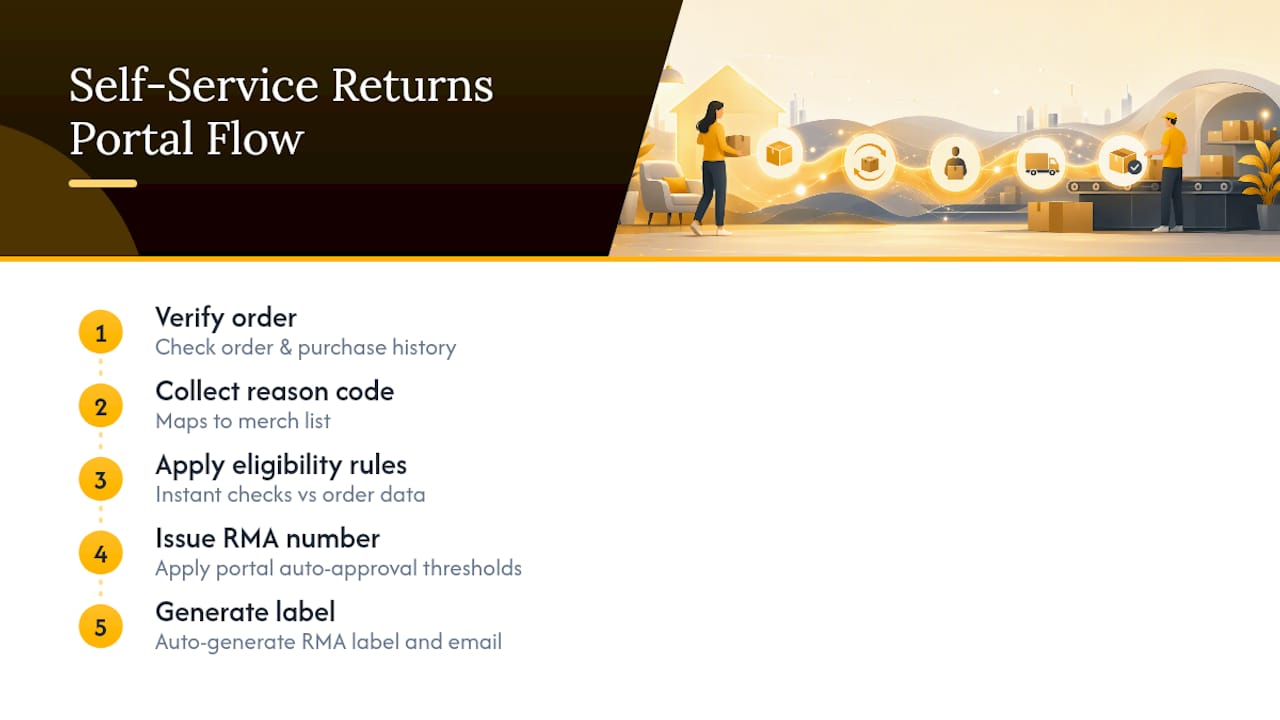
The automation rules behind that portal do the real work. Connect it directly to your order management system so eligibility checks run against real return-window dates and purchase history, not static policy text. Build conditional logic into the reason-code selection, so choosing “wrong size” prompts a size-exchange offer before a refund option even appears. Set your auto-approval thresholds inside the portal itself rather than in a separate spreadsheet, so approvals happen at the moment of submission instead of overnight in batch.
Portals that skip structured reason codes lose their most valuable output. A generic “other” field tells you nothing useful six months later when you’re trying to figure out why return rate spiked on a specific SKU. Every reason code selected in the portal should map to a fixed list your merchandising team already uses, so the data is analysis-ready the moment it’s collected.
The portal should also generate the RMA-coded label automatically and email it immediately, since any delay between approval and label delivery is dead time that stretches your cycle time for no operational benefit. Customers judge the whole return merchandise authorization experience by how fast that first email lands.
Treat Return Data as a Merchandising Signal, Not Just an Expense Line
Every RMA carries a reason code, and reason codes are product feedback most retailers throw away. A spike in “wrong size” claims on one SKU usually means the size guide is off, not that customers are careless.
Fix the guide, and that return rate typically drops within a season. Customer feedback data, including return reasons, belongs on the same dashboard your merchandising team already watches. Build that dashboard once, and every future RMA becomes useful information instead of just a cost.
— Daniela
Scale Your RMA Operations Without Building an Internal Department
Handling more returns without breaking your SLAs takes more than better software. It takes trained people running the same inspection protocol every time, whether it’s a slow Tuesday or the week after a major sale.

Altiamcx supports ecommerce teams through Managed Customer Support and Managed Team Extension, staffing bilingual agents who handle return intake, eligibility triage, and customer communication under the SLA targets you set, not whatever a stretched internal team can manage during peak season. That means faster approval decisions, a consistent inspection and disposition standard across every shift, and back-office capacity that keeps pace when return volume spikes without a permanent hiring commitment. For ecommerce operations leaders who’ve hit the ceiling of what a small internal team can sustain, explore Altiamcx’s customer experience and team extension services and start a conversation about what a pilot managed returns operation could look like for your volume.
Sources
- RMA: 10 Best Practices to Manage Returns in eCommerce
- The Ultimate Guide to Return Merchandise Authorization (RMA)
- E-commerce share of retail sales in U.S. (Statista)
FAQ
What Is RMA in Ecommerce?
RMA stands for return merchandise authorization, the approval and tracking number a retailer issues before accepting a returned item. It confirms eligibility, gives shipping instructions, and links the physical return to the original order.
What Is an RMA Process?
An RMA process is the full workflow from a customer’s return request through eligibility approval, inbound tracking, inspection, and final resolution. A well-designed one uses rule-based automation for common cases and targets an RMA-to-refund cycle time under 7 days.
Who Pays for Shipping in an RMA?
It depends on the reason code. Retailers typically cover return shipping for defective or wrong-item claims, while customer-preference returns, like a simple size change, often carry a customer-paid label under standard policy.
What Does RMA Stand For in Retail?
RMA stands for return merchandise authorization in both retail and ecommerce contexts. The term applies equally to physical stores handling warranty claims and online sellers processing product returns.
How Do I Automate My RMA Process?
Automation starts with a self-service portal connected to your order management system, structured reason codes, and rule-based auto-approval for low-risk claims. Retailers without the internal capacity to build this can extend their team through services like Altiamcx’s managed customer support to run the process at scale.