TL;DR:
- Poor back-office execution undermines the front-end customer experience despite attractive storefronts.
- Key systems include OMS, WMS, ERP, and Inventory Management, which must be integrated via real-time APIs.
- Automation and cloud systems improve order accuracy, reduce costs, and boost productivity within 6 to 18 months.
Your storefront looks great. Navigation is clean, product photos are sharp, and checkout is frictionless. Yet customers still complain about late deliveries, wrong items, and sluggish returns. The problem almost never lives on the front end. As one analysis of digital success confirms, poor back-office execution ruins front-end experience regardless of how attractive your interface is. This guide explains exactly what the ecommerce back-office is, which systems power it, how automation lifts performance, and what best practices separate high-growth operations from ones that stall at scale.
Table of Contents
- What is the ecommerce back-office?
- Core back-office systems: OMS, WMS, ERP, and beyond
- How technology and automation boost back-office performance
- Common back-office challenges and how to solve them
- Bringing it all together: Operational excellence powered by the back-office
- Why most ecommerce leaders underestimate the back-office (and what to do differently)
- Ready to unlock back-office potential for your ecommerce business?
- Frequently asked questions
Key Takeaways
| Point | Details |
|---|---|
| Back-office powers CX | Your unseen order, inventory, and finance processes directly shape customer happiness and loyalty. |
| Modern systems matter | OMS, WMS, ERP, and automation dramatically reduce errors and speed up your operations. |
| Technology boosts ROI | Cloud platforms and automation pay for themselves with big productivity and cost savings. |
| Fix common pitfalls | Proactively address integration, data sync, and returns challenges to avoid scaling pain later. |
| Back-office is a growth lever | Treat your back-office as a strategic asset for lasting e-commerce success—not just an expense. |
What is the ecommerce back-office?
Every click your customer makes on the front end triggers a chain of processes they never see. That chain is your back-office. It is not a department or a single platform. It is the full set of non-customer-facing operations that keep orders moving, products accurate, and finances reconciled.
According to a detailed operations breakdown, the ecommerce back-office covers a wide scope of functions, including:
- Order processing: Validating, routing, and tracking every purchase from payment confirmation to final delivery
- Inventory management: Maintaining accurate stock counts across warehouses, suppliers, and sales channels
- Product data entry and catalog management: Ensuring descriptions, prices, images, and attributes are correct everywhere you sell
- Returns handling: Processing exchanges, restocking, and issuing refunds efficiently
- Payment reconciliation: Matching transactions across payment gateways, banks, and accounting records
- Financial reporting: Generating accurate revenue, cost, and margin data for decision-making
A common misconception among operations directors is that this work is purely administrative, a back-room necessity with little strategic impact. That framing is expensive. Every customer-facing promise, fast shipping, accurate product info, hassle-free returns, is only as good as the back-office process behind it.
“The back-office is the hidden engine powering the front end. A beautiful UI means nothing if the operations beneath it cannot fulfill the promises it makes.” This reality shapes every buying decision your customers make, often without either party realizing it.
Strong back-office efficiency is not a luxury for large enterprises. It is the foundation every growth-stage e-commerce company needs before scaling further. Reviewing back-office solution examples can help you identify the specific gaps in your current setup.
Core back-office systems: OMS, WMS, ERP, and beyond
With the functions clear, let’s break down the specific systems that perform these jobs and how they fit together. The four main platforms every e-commerce operation needs to understand are the Order Management System (OMS), Warehouse Management System (WMS), Enterprise Resource Planning (ERP), and standalone Inventory Management tools.
Key back-office systems each cover a distinct layer of operations. Here is how they compare:
| System | Primary role | Best for |
|---|---|---|
| OMS | Orchestrates orders across all channels | Multi-channel and high-volume sellers |
| WMS | Manages warehouse tasks: picking, packing, shipping | Businesses with their own fulfillment centers |
| ERP | Covers finance, procurement, HR, and business-wide data | Mid-market to enterprise operations |
| Inventory Management | Tracks stock levels, reorder points, and supplier data | Lean teams needing lightweight control |
Research comparing OMS versus ERP/WMS approaches shows that a standalone OMS suits multi-channel complexity better, while ERP-led setups fit simpler, more centralized operations. Neither is universally superior. The right choice depends on your channel mix, order volume, and fulfillment model.
Whichever systems you use, integration is the critical variable. Disconnected platforms create data silos that surface as the exact customer problems you are trying to avoid: wrong stock counts, delayed order updates, and payment errors that nobody catches quickly.

Pro Tip: Connect your OMS, WMS, and ERP through APIs (application programming interfaces) that enable real-time data exchange. Batch-sync integrations updated hourly or daily are no longer sufficient for fast-moving ecommerce. Real-time API connections reduce the lag that causes overselling, mispicked orders, and accounting discrepancies.
The conversation around back-office automation strategies is growing rapidly, partly because AI is now embedded in these core systems. Modern OMS platforms can auto-route orders to the most cost-effective fulfillment location. WMS tools use machine learning to optimize pick paths in real time. Even AI-driven tools in operations are shifting what used to require human judgment into automated decision-making. For a broader view of how these fit together, explore streamlined solutions that others in your space are already deploying.
How technology and automation boost back-office performance
Now that we have mapped out the main systems, let’s see how technology actually moves the needle for your back-office. The performance gains from modern cloud platforms and automation are measurable, significant, and achievable within a reasonable investment window.
The numbers from a 2026 WMS industry guide tell a compelling story:
| Performance metric | Before automation | After cloud WMS |
|---|---|---|
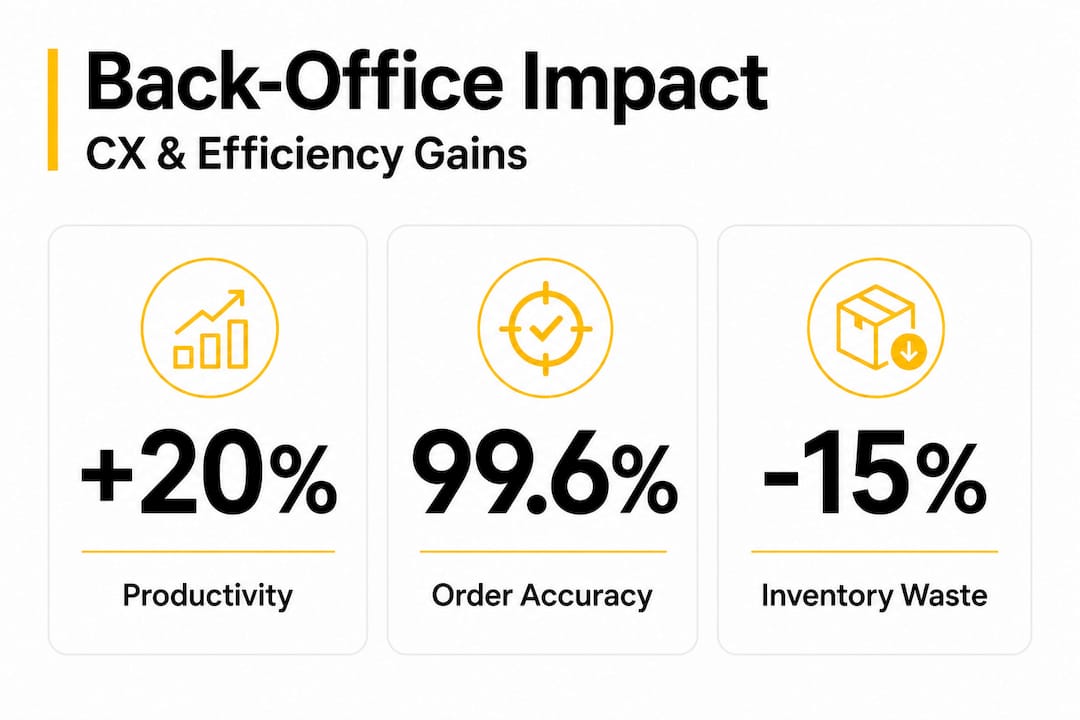
| Labor productivity | Baseline | +20% gain |
| Cost savings (for $10M operation) | None | $400K to $600K annually |
| Inventory levels | Baseline | Reduced by 15% |
| Order accuracy | ~97% | 99.9% |
| Shipping costs | Baseline | Reduced by 8% |
| Payback period | N/A | 6 to 18 months |
These are not theoretical projections. They represent benchmarks from operations that have already made the transition. For an e-commerce director managing a high-growth catalog, a 15% inventory reduction alone frees up significant working capital. A 99.9% order accuracy rate, compared to an industry average closer to 97%, translates directly into fewer customer service tickets, fewer return-shipping costs, and higher customer lifetime value.
Automation delivers the biggest gains in three specific areas:
- Returns processing: Automated classification of return reasons, restocking eligibility, and refund triggers dramatically cuts the time your team spends on manual review
- Multi-channel order routing: Rules-based automation sends each order to the right fulfillment node, balancing speed, cost, and inventory availability without human intervention
- Inventory replenishment: Automated reorder triggers based on real-time depletion rates prevent stockouts that cost you both the sale and the customer relationship
Efficient back-office operations enhance customer experience through faster fulfillment, accurate availability data, and smoother returns, all of which are direct outcomes of the automation investments above. You can also review top ecommerce support services to understand how operational support layers complement technology. Companies exploring nearshoring for faster ops are finding that combining skilled teams with automation creates an even stronger performance baseline. For a broader view of fulfillment and shipping improvements, the data consistently points toward integration as the primary lever.
Common back-office challenges and how to solve them
Benchmarks are impressive, but every system faces real-life complications. Here is how to anticipate and address the most common ones before they damage your customer experience or your bottom line.
Advanced OMS research identifies several critical failure points that scaling ecommerce operations run into:
-
Synchronous system coupling: When your OMS communicates with other systems in real time during checkout, a slow response from any connected platform causes visible delays for your customer. The fix is asynchronous integration, where order placement confirms immediately and backend processing happens in a queue without blocking the buyer.
-
Missing idempotency controls: Without idempotency keys (unique identifiers that prevent the same action from executing twice), network errors or retry logic can create duplicate orders, double charges, or double-shipped items. Build or require idempotency as a baseline standard in any OMS you implement.
-
Inventory sync lag: Stock counts that update hourly instead of in real time allow multiple customers to purchase the same last unit. The result is overselling, which forces painful order cancellations and undermines trust. Real-time API sync, even for third-party marketplaces, is the expected standard now.
-
Returns fraud and classification complexity: Automated returns workflows that lack validation logic become targets for abuse. Returned items may be ineligible for restocking, yet still generate refunds automatically. AI-driven classification systems that verify product condition, return reason codes, and purchase history before approving refunds significantly reduce fraud losses.
-
Address validation failures: Incorrect shipping addresses that slip through without validation create failed deliveries, additional carrier charges, and frustrated customers. Integrate address validation APIs at checkout and again during order processing.
-
Currency and FX handling on refunds: International operations that refund in the original transaction currency can lose or gain money depending on exchange rate movements. Clear refund currency policies and automated FX handling at the platform level prevent accounting errors and customer disputes.
The same research recommends using back-pressure signals to manage system load during peak periods, applying AI for demand prediction and exception routing, and leaning into automation for routine tasks rather than building manual review queues that scale poorly. Tools supporting AI for exception handling are increasingly accessible and cost-effective for mid-market operations.
Pro Tip: Run load-testing simulations that mirror your highest-traffic periods, seasonal promotions, flash sales, and new product launches, before they happen. Systems that perform flawlessly at average volume often break under peak load in ways that only appear during actual events. Proactive load testing is far cheaper than emergency remediation after a high-profile failure.
If your team is stretched thin managing these challenges internally, outsourcing back-office challenges to a specialized partner can be a practical path to resilience without requiring full internal headcount expansion.
Bringing it all together: Operational excellence powered by the back-office
Having covered solutions for common challenges, let’s pull all these threads into a clear strategy for your growth. The back-office is not a cost center to be minimized. It is a growth asset to be invested in, measured, and continuously improved.
Strong back-office operations produce direct customer benefits through faster fulfillment, accurate product availability, and smooth returns experiences. Those benefits translate into measurable business outcomes: higher conversion rates, lower return rates, better reviews, and stronger repeat purchase rates.
A clear operational excellence strategy ties together the following elements:
- System selection and integration: Choose OMS, WMS, and ERP tools that fit your current scale and integrate cleanly through real-time APIs
- Automation-first process design: Build workflows where automation handles the predictable volume and human judgment is reserved for genuine exceptions
- Continuous monitoring: Track queue depths, sync latency, order accuracy rates, and return processing times as leading indicators, not lagging ones
- Process redesign, not just tool replacement: New software running old manual workflows delivers minimal return; redesign the process before deploying the technology
- Regular load and resilience testing: Validate your systems against the stress of peak periods before those periods arrive
Shifting your mental model from “back-office as overhead” to “back-office as competitive advantage” changes where you direct attention and budget. Operations directors who make this shift tend to see compounding returns because every improvement in fulfillment speed, accuracy, or returns handling reinforces customer loyalty. Explore how scalable support operations can anchor this kind of long-term operational strategy.
Why most ecommerce leaders underestimate the back-office (and what to do differently)
Here is an uncomfortable pattern worth naming directly. Most e-commerce budget cycles allocate the largest share to marketing, storefront UX, and sales tools. Back-office improvements are typically funded last, often reactively, after a visible operational failure has already damaged customer relationships or triggered a costly manual scramble.
The underlying assumption is that manual processes are “good enough” until volume forces a change. The problem with that logic is that the transition point always arrives faster than expected and under pressure. A promotional event, a new channel launch, or a sudden viral product creates the kind of load that exposes every gap in your back-office architecture simultaneously.
AI-driven back-office research makes the risk explicit: over-reliance on manual processes leads to errors and team burnout, but moving to AI-powered automation also exposes existing workflow design flaws that manual workarounds were quietly masking. The lesson is not to wait. Redesign workflows proactively, with automation and resilience as primary goals, not cost savings alone.
The contrarian view worth holding is this: your competitors who invest in back-office operations now are not just cutting costs. They are building structural speed and accuracy advantages that compound over time. Better fulfillment creates better reviews, which drive more organic traffic and higher conversion, which fund further investment. The cycle accelerates in their favor.
Treat outsourcing for efficiency not as a last resort but as a strategic option for gaining expertise and capacity quickly, especially in areas like returns management and catalog operations where specialized skills matter more than raw headcount.
Ready to unlock back-office potential for your ecommerce business?
Leading e-commerce brands are not just fixing back-office problems reactively. They are building operational systems that turn fulfillment speed, inventory accuracy, and returns quality into measurable competitive advantages. If you want to see how that looks in practice, the right support infrastructure makes all the difference.

Altiam CX specializes in nearshore CX outsourcing that combines cultural alignment, disciplined execution, and performance frameworks built for scaling e-commerce operations. From back-office team extensions to end-to-end operational support, we help you reduce friction and improve service quality at every stage. See how real brands are doing it through our CX case study, and explore the full range of CX and team extension solutions available to help your operation grow with confidence.
Frequently asked questions
Which back-office system should a fast-growing e-commerce company implement first?
Most should prioritize an Order Management System, since an OMS orchestrates orders across channels and handles fulfillment complexity before ERP integration becomes necessary. Scale to ERP and WMS as volume and operational complexity grow.
How do back-office improvements directly affect customer satisfaction?
Faster fulfillment and smooth returns both depend entirely on back-office accuracy, which means operational improvements translate directly into higher satisfaction scores and repeat purchase rates.
What common back-office pitfalls should ecommerce leaders watch for?
The most damaging issues include checkout delays from OMS coupling, overselling from inventory sync lag, and returns bottlenecks that create customer frustration and fraud exposure. Robust integration and automation address all three.
How quickly do automation and cloud back-office systems pay off?
Most operations see payback within 6 to 18 months, driven by 20% productivity gains, 15% inventory reductions, and order accuracy improvements from 97% to 99.9%.
Is there a risk to outsourcing ecommerce back-office operations?
Outsourcing adds expertise and capacity efficiently, but retaining control over exceptions and maintaining clear performance agreements is essential to avoid losing visibility into critical operational decisions.