Demand for Spanish customer support in the United States is large, durable and still underserved. About 44.9 million residents age 5 and over speak Spanish at home, and surveys keep showing that customers who can manage in English still prefer service in their own language. For operations leaders, the question is no longer whether to offer Spanish support. It is how to staff it so it works at scale.
This guide covers the size of the Spanish-speaking customer base, why demand keeps growing, which industries feel it most, what customers expect beyond translation, and how to build a bilingual team that holds up under real volume.
TL;DR
- About 44.9 million people in the US spoke Spanish at home in 2024, roughly 1 in 7 people age 5 and up, and the group grew faster than the overall population since 2010.
- Language preference outlasts language ability: 60% of even the most confident English readers still preferred customer care in their own language.
- Healthcare, legal, financial services and ecommerce feel the pressure most, because stakes per interaction are high and customers are concentrated by region.
- Finding and keeping bilingual staff is the main operational hurdle, which is why many teams add a nearshore, managed bilingual team.
- Quality depends on training, a governed Spanish knowledge base and clear contract terms, not on headcount alone.
Table of Contents
- How big is the Spanish-speaking customer base?
- Why demand keeps growing
- Where Spanish support matters most
- What Spanish-speaking customers expect beyond translation
- The staffing challenge
- Building Spanish support that works
- Why nearshore fits Spanish support
- Perspective
- Put a Spanish-speaking team to work
- FAQ
- Sources
How big is the Spanish-speaking customer base?
The 2024 American Community Survey 1-Year Estimates put the number of U.S. residents aged 5 and over who speak Spanish at home at 44,867,699, or 13.9% of that population. Within that group, 11,928,962 people reported speaking English less than “very well”. Those are the customers for whom an English-only phone line or chat queue is a real barrier.
The trend matters as much as the total. According to Census figures cited by USAFacts, the Spanish-speaking population grew 21.3% between 2010 and 2024, against 11.2% for the overall 5+ population. A segment growing nearly twice as fast as the whole is a segment your contact center will meet more often every year.
Two points follow for planning:
- The base includes bilingual customers, not only those with limited English. Many will switch languages depending on the topic. A billing dispute or a medical question is often where they want to use Spanish.
- Volume is not evenly spread. Demand clusters by state and metro area, which shapes staffing hours and the Spanish you need to support.
Why demand keeps growing
Purchasing power follows population
The Selig Center at the University of Georgia reported that Hispanic buying power grew 87% from 2010 to 2020 to reach $1.9 trillion, with California, Texas and Florida as the largest markets. Its following report put Hispanic household buying power at $2.1 trillion in 2021, or 11.3% of total U.S. consumer buying power. Customers with that much spending power are customers whose support experience affects revenue.
Language preference is about trust, not ability
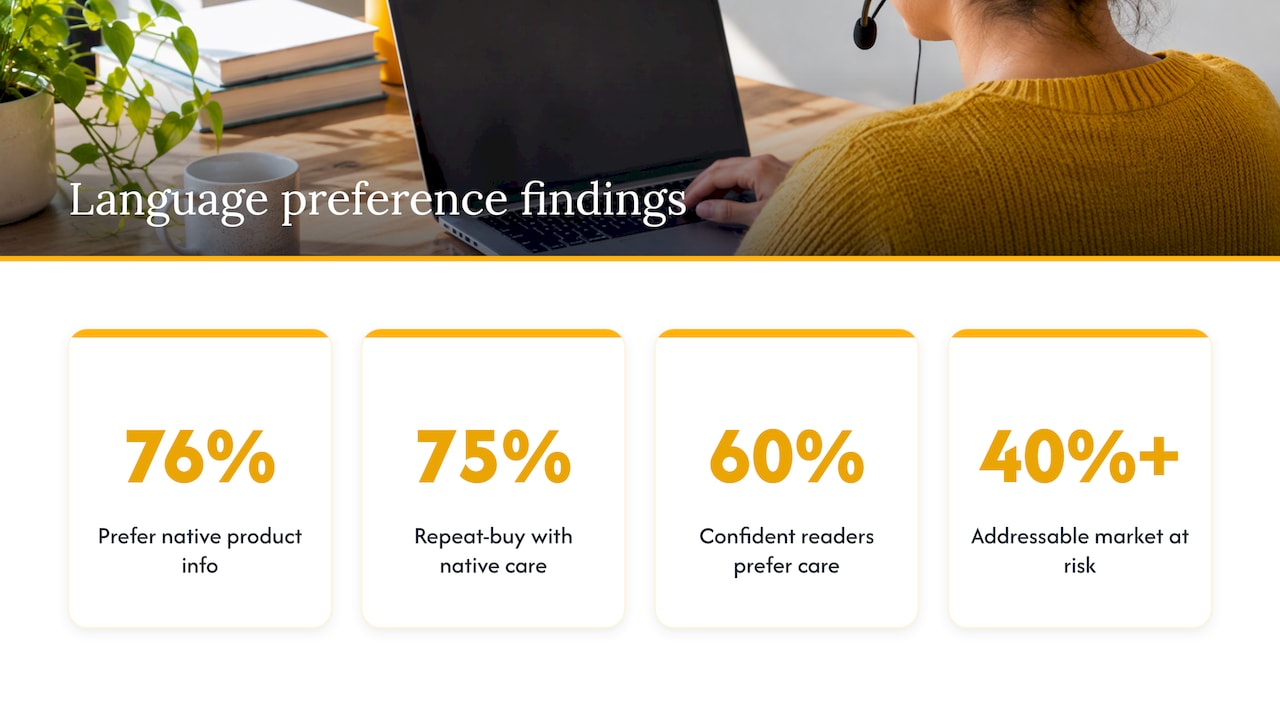
CSA Research surveyed 8,709 consumers in 29 countries. It found that 76% of online shoppers prefer products with information in their native language, and 75% are more likely to buy from the same brand again if customer care is offered in their language. The firm’s chief research officer warned that companies that skip localizing the buying experience risk losing 40% or more of the total addressable market.
The finding that should change your staffing model: even among the most confident English readers, 60% preferred customer care in their own language. You cannot assume a customer who writes fluent English wants to be served in it.
An older industry report on multilanguage support found that 72% of respondents said native-language support increased customer satisfaction and 58% said it increased brand loyalty. It dates from 2014, but the direction matches every newer survey.
Language barriers cost real transactions
A June 2026 InvoiceCloud survey of 1,000 U.S. consumers found that 46% were more likely to use online bill pay if it were offered in their preferred language. The same study reported that 13% said services were shut off or insurance was cancelled because language kept them from completing a payment. This is a company survey, so read it as a signal rather than a national benchmark. The signal is clear: language gaps show up as missed payments, abandoned tasks and churn.
Where Spanish support matters most
The need is sharpest where each interaction carries high value or risk, and where Spanish-speaking customers are geographically concentrated.
| Industry | Why language friction costs more here | Typical Spanish-language contacts |
|---|---|---|
| Healthcare | Clinical instructions, consent and scheduling errors carry real consequences | Appointment scheduling, patient questions, billing and insurance follow-up |
| Legal | First contact often decides whether a prospective client hires the firm | Intake, case status updates, appointment coordination |
| Financial services | Trust and regulatory clarity drive account decisions | Account servicing, payments, disputes |
| Ecommerce and retail | Native-language care drives repeat purchase | Order status, returns, product questions |
| Home services and property management | After-hours demand and urgent requests | Service requests, rent and payment questions |
Healthcare, legal, financial services, home services and property management are consistently flagged as the most exposed, because of high per-customer value, regional concentration and after-hours demand.
A few examples of what this looks like in practice:
- Healthcare. A clinic that only answers scheduling calls in English loses patients who never reach a human they understand. Patient support also needs documented procedures, so Spanish answers match English ones.
- Legal. A caller with an urgent matter rarely leaves a second voicemail. Fast, bilingual intake is often the difference between a signed client and a competitor’s.
- Ecommerce. Order status and returns are high-volume, low-complexity contacts. They suit a trained bilingual team and a good self-service knowledge base.
What Spanish-speaking customers expect beyond translation
Translation converts words. Service resolves problems. Customers notice the difference quickly.
- Natural, respectful register. Spanish has formal and informal address. Agents need guidance on when to use each, and the brand voice should be defined in Spanish, not borrowed from English scripts.
- Resolution authority. A bilingual greeting followed by a transfer to an English-only queue is the pattern customers remember. The agent who answers in Spanish should be able to finish the job.
- Consistent information. If the Spanish web page, IVR menu or help article says something different from the English one, customers will call to ask why.
- Cultural context. Family involvement in decisions, preferences about channel (phone versus text or chat) and attitudes toward paperwork all shape how a good conversation goes.
- Regional fluency. Spanish in the US draws on many national and regional varieties. Agents who are clear and neutral in vocabulary, and who are trained on the terms your customers use, tend to reduce confusion. Test candidates with real call scenarios from your own customer base rather than relying on a self-reported fluency level.
Coverage is often overstated. One 2026 industry study reported that most support teams say they offer multilingual service while far fewer customers say they actually receive it. Whatever the exact figures, the lesson is to measure what customers experience: Spanish queue wait times, Spanish first-contact resolution and Spanish satisfaction scores, tracked separately from English.
The staffing challenge
HDI research found that nearly 55% of organizations route calls to multilingual staff, yet finding and retaining those staff remains a challenge for most support centers. The reasons are familiar to any hiring manager:
- Bilingual candidates are in demand across industries, so they have options.
- Spanish coverage needs to span evenings, weekends and peak periods, which is hard with one or two bilingual employees.
- When a single bilingual agent is the only coverage, absence or turnover creates an instant service gap.
- Bilingual agents are often pulled into translation and escalations on top of their own queue, which burns them out.
The same HDI-era research tracks a second lever: the 2014 multilanguage report found that 57.6% of respondents saw agent productivity and efficiency improve after partnering with a language interpretation service. Interpretation can bridge rare languages and overflow, but for Spanish, where volume is steady, a dedicated bilingual team usually delivers better continuity and brand voice.
For help with the hiring side, see our guide on how to recruit bilingual agents.
Building Spanish support that works
1. Start with your own data
Pull Spanish-language contacts by channel, hour and topic. Check call abandonment for numbers with Spanish IVR options. Look at ZIP-code concentration in your customer file. This tells you where, when and on what topics Spanish demand actually sits.
2. Decide what “Spanish support” means
Define it in writing: which channels, which hours, which issue types, and what the escalation path is. Include whether agents can complete transactions or only take messages.
3. Train for the job, not just the language
Fluency is the entry ticket. Product knowledge, tone, de-escalation and compliance in Spanish decide quality. Our overview of what a strong bilingual agent training program covers outlines the modules to expect.
4. Govern the knowledge base
A Spanish article that drifts from its English source creates inconsistent answers. Assign owners, version both languages together and review them on one schedule. This matters even more before layering in automation, as we explain in our piece on multilingual knowledge base management.
5. Cover the gaps around the clock
Many Spanish-speaking customers reach out after hours. Human agents handle the complex and sensitive contacts, while AI agents for lead follow-up can handle routine booking and re-engagement across channels between shifts. Keep a clear handoff to a Spanish-speaking person for anything involving money, health or legal matters.
6. Measure the Spanish experience separately
Track handle time, first-contact resolution, satisfaction and Net Promoter Score by language. Our article on how bilingual agents influence NPS and handle time shows which metrics to watch.
7. Get the contract right
If you bring in an outsourcing partner, define language assessment, quality scoring, scheduling and escalation before you sign. Two of our guides cover this: three contract priorities for Spanish and English support and five priorities for bilingual support contracts.
Why nearshore fits Spanish support
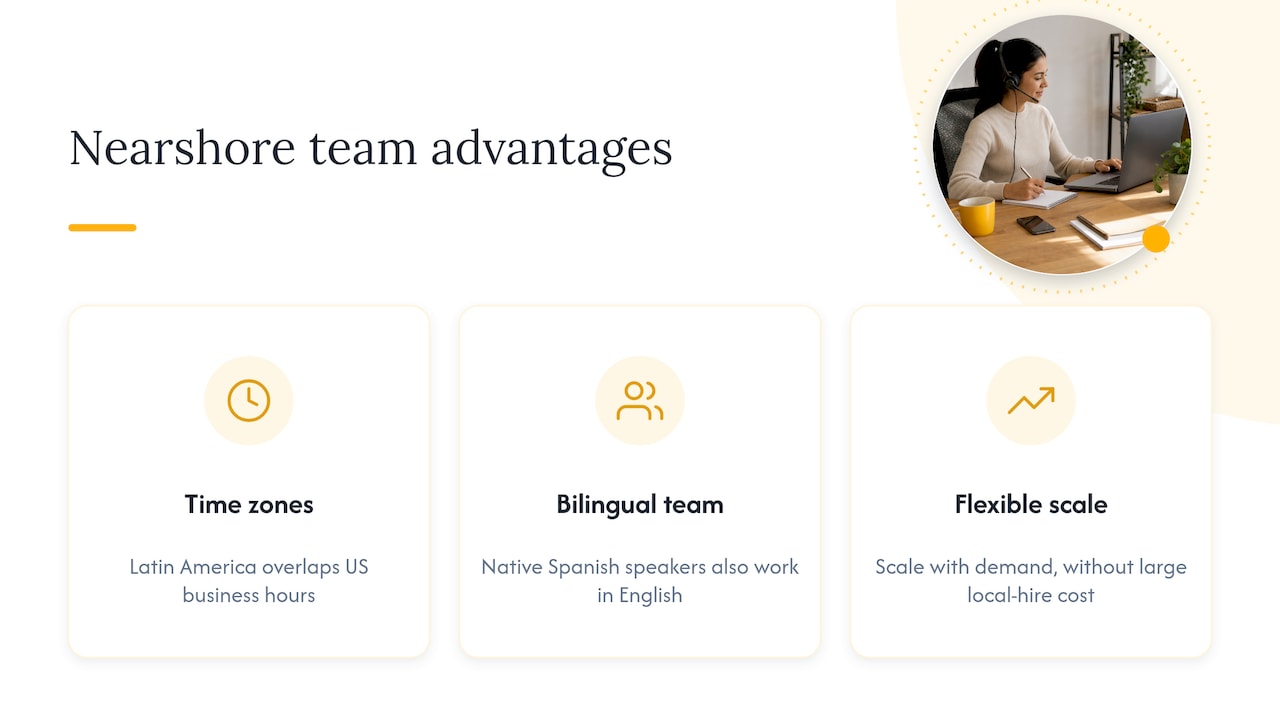
Nearshore teams in Latin America work in time zones that overlap with US business hours, and their agents are native Spanish speakers who also work in English. That combination addresses the two pressure points above: availability of bilingual talent and coverage across extended hours. It also lets you scale a team up or down as demand shifts, without the fixed cost of a large local hire.
If you are comparing options, our roundups of nearshore customer experience services and customer support outsourcing providers set out the criteria that matter: language assessment, training depth, security, reporting and flexibility. For staffing models and efficiency, see these workforce optimization examples.
Perspective
We see the same pattern across the organizations we support: Spanish demand is rarely a project. It is a permanent part of the customer base, and the teams that treat it that way build better operations.
The mistake we see most often is bolting Spanish onto an English process. One bilingual employee covers the queue, quality is scored only in English, and the knowledge base is translated once and never updated. It works until volume rises or that employee leaves.
Our approach is to build Spanish support as a managed function: native-level bilingual agents, shared standards, a single source of truth for content and reporting by language. Cultural alignment is what makes a conversation feel natural rather than scripted, and it is a core reason we deliver from Latin America. Combined with scalable team models, it gives CX leaders the flexibility to add seats when demand grows without rebuilding the program.
If your Spanish-speaking customers are asking for more than your team can give today, the answer is usually structure, not just headcount.
Daniela
Put a Spanish-speaking team to work
Altiam CX is a nearshore customer experience partner that provides customer care, technical assistance, back-office operations and managed team extension, including bilingual agents and scalable team deployment. We build industry-specific programs for healthcare, legal, ecommerce and financial services.
If you run patient access, we offer managed customer support and patient support with SOP management. Law firms can see our legal intake, client follow-up and scheduling services. For other programs, see our customer experience and managed team extension services.
You can also review how we handled a real engagement in our legal services appointment setting and back-office case study.
FAQ
How many people in the US need Spanish customer support?
The 2024 American Community Survey counts about 44.9 million residents age 5 and over who speak Spanish at home. Of those, nearly 11.9 million speak English less than “very well”. Many more are bilingual but still prefer service in Spanish.
Is demand for Spanish support still growing?
Yes. The Spanish-speaking population grew faster than the overall population between 2010 and 2024, and Hispanic household buying power reached $2.1 trillion in 2021, according to the Selig Center. Both point to a larger customer segment each year.
Which industries need Spanish-language support first?
Healthcare, legal services, financial services, home services and property management usually feel it first. Each combines high-value interactions, concentrated Spanish-speaking customers and after-hours contact patterns. Ecommerce and retail benefit from it through repeat purchases and fewer returns-related escalations.
Is a bilingual agent better than a translation tool?
For steady Spanish volume, a trained bilingual agent gives continuity, correct tone and the ability to resolve the issue in one contact. Interpretation services and automation help with overflow and routine tasks. Many teams combine them under one escalation path.
How do I know if my Spanish support is working?
Measure it by language: wait time, first-contact resolution, satisfaction and NPS for Spanish contacts compared with English. If Spanish results lag, review training, knowledge base consistency and the agent’s authority to resolve issues.
Sources
- S1601: Language Spoken at Home, U.S. Census Bureau
- How many people are Spanish speakers at home? USAFacts
- Selig Center Multicultural Economy Report 2021, University of Georgia
- Selig Center consumer buying power, WUGA
- Consumers Prefer their Own Language, CSA Research
- Third Global Survey by CSA Research, Slator
- The Growing Need for Multilanguage Customer Support
- Multilingual Service in the Support Center, HDI
- InvoiceCloud study on online bill pay adoption