
Schedule adherence measures how closely agents do the right activity at the right time, compared with the schedule they were given. You calculate it by comparing scheduled time with the time an agent actually spent in the scheduled activity. Most centers aim for roughly 85% to 90%, and the right number depends on how mature your operation is and how long your contacts run. This guide covers the formula, the targets, the link to staffing and service levels, and the practices that raise adherence without turning it into a punishment tool.
TL;DR
- Schedule adherence tracks whether agents are in the scheduled activity (on the queue, in a break, in training) at the scheduled time. Amazon Connect’s documentation describes it as matching agent status to the scheduled activity.
- Conformance is a different metric: it compares total time worked with total time scheduled, whenever that time occurred.
- Many centers set an objective around 85% to 90%. Targets above 95% invite status gaming and rarely pay off.
- Low adherence leaves queues short of people. Plan for it by adding the inverse of your goal to the staffing forecast.
- Adherence improves when agents understand their effect on the queue, teams manage it locally, and schedules are realistic.
Table of Contents
- What schedule adherence means in a contact center
- Adherence vs. conformance: which one should you track?
- How to calculate schedule adherence
- What is a good schedule adherence target?
- How adherence affects staffing, service levels and cost
- What causes low adherence
- How to improve schedule adherence without hurting morale
- Our perspective
- Run adherence with a managed nearshore team
- Frequently asked questions
- Sources
What schedule adherence means in a contact center
Adherence is a workforce management metric. It reports the percentage of time an agent spends in the activities they were scheduled for, which shows how well they follow the planned day (Verint). If an agent is scheduled to take calls from 8:00 to 8:30 and is actually on a break, that half hour counts against adherence, even if the agent later works extra time.
That last point matters. Brad Cleveland of ICMI makes the case that staying late does not make up for being unavailable when contacts arrive. Your forecast is built interval by interval, typically in 15 or 30 minute blocks, and so is the demand. Coverage at 4:00 p.m. cannot be repaid with coverage at 6:00 p.m.
For a COO or VP of Support, adherence is one of the few agent-level numbers that is fully actionable. ICMI points out that agents cannot control contact volume or customer transaction length, but they can be held accountable for being in the right place at the right time. That is why adherence tends to sit next to service level and occupancy on a real-time dashboard.
Adherence vs. conformance: which one should you track?
The two terms are often confused, and the difference changes what you manage.
| Adherence | Conformance | |
|---|---|---|
| What it asks | Was the agent doing the scheduled activity at the scheduled time? | Did the agent work the total scheduled amount of time? |
| Timing | Interval-level | Whole shift or day |
| Tolerates shifted work? | No, within set thresholds only | Yes |
| Best fit | Volatile demand, tight service-level commitments | Flexible models where daily output matters more |
Genesys Cloud’s documentation frames adherence as following scheduled activities and changes within agreed thresholds, and conformance as a comparison of time worked with scheduled time. A Monitask explainer puts the contrast simply: conformance counts total time in scheduled activities regardless of when it happened.
Which should you use? If your demand spikes in specific 15-minute windows and you owe customers a response-time commitment, adherence is the stronger control, a point made in WFM Labs’ comparison. If your agents have autonomy over their day and your buffers are large, conformance may suit better. One workforce management whitepaper suggests considering conformance for a group when calculated adherence buffers exceed 10% of scheduled hours.
For most customer-facing teams with queue-based service commitments, we recommend tracking both: adherence for real-time control, conformance as a check that the hours you pay for are being worked.
How to calculate schedule adherence
There are two common versions of the formula.
The simple version. Divide actual hours worked in scheduled activities by scheduled hours and multiply by 100. Most centers also apply a shrinkage factor for breaks, training and meetings before calculating (Verint).
The exception-based version. Genesys Cloud calculates adherence as (1 − exception duration ÷ scheduled adherence time) × 100, and returns 0 if the result is not positive (Genesys).
A worked example
Take an agent scheduled for 480 minutes of tracked activity in a day. During the day the agent spends 36 minutes in the wrong state: 12 minutes of extra break, 14 minutes in an unscheduled team chat and 10 minutes with a login problem.
- Exception duration: 36 minutes
- Adherence: (1 − 36 ÷ 480) × 100 = 92.5%
The number alone does not tell you what to fix. The 10 login minutes are a systems problem, the chat is a coordination problem and the extra break may be a coaching topic. Break the exceptions down by cause before anyone has a conversation with the agent.
Thresholds and tolerance
Timing variation is normal. An agent who wraps up a call at 10:01 instead of 10:00 is not off the rails. Amazon Connect lets you set operational tolerance from 1 to 10 minutes for activity starts or ends, so routine variation is not automatically counted as non-adherence. Whatever platform you use, set tolerances deliberately and publish them to agents.
What is a good schedule adherence target?
ICMI reports that many contact centers choose an objective around 85% to 90%. At 90%, agents are expected to be available to handle contacts for 54 of every 60 minutes. Planned lunch, breaks and training are excluded from that contact-handling measure.
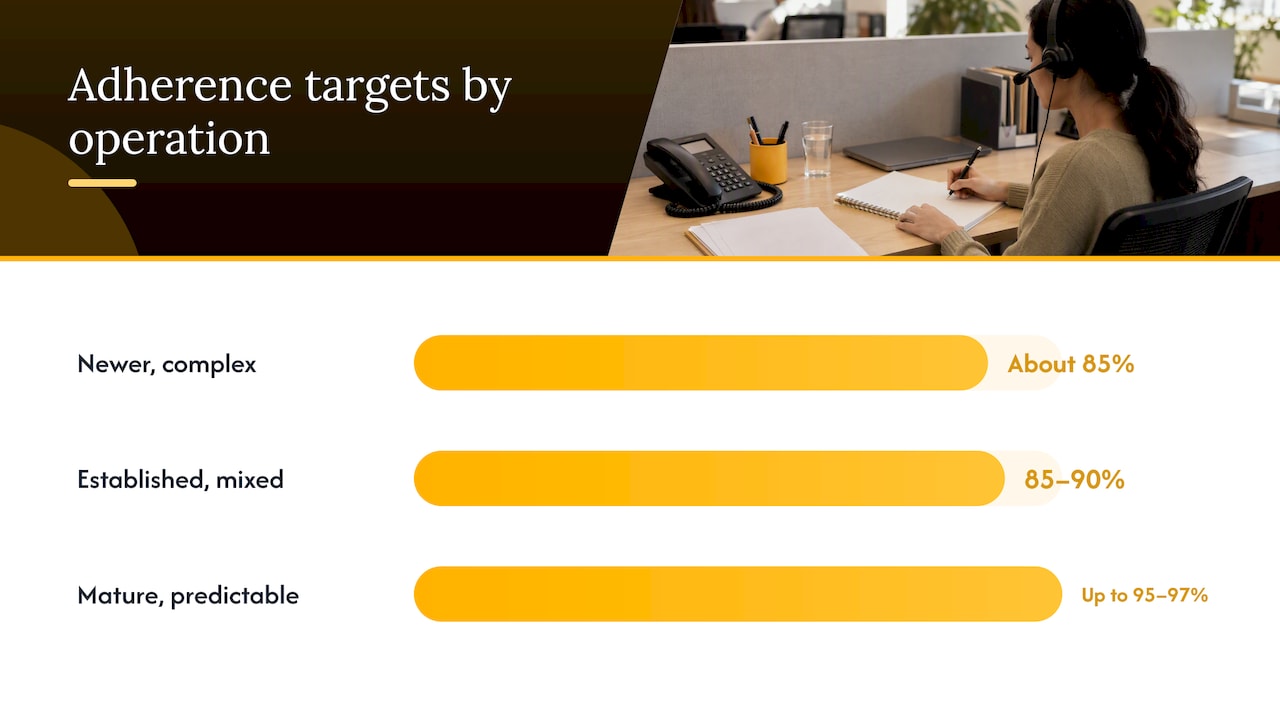
A practitioner guide from Peopleware’s 2023 article adds nuance. It reports typical ranges of about 85% for less mature or high-handle-time centers, and up to 95% to 97% for mature, low-handle-time ones. The same piece argues that 100% is impractical, because calls do not end exactly at break boundaries and people have normal human needs. Its advice is to start from an observed baseline and raise the goal as processes mature.
| Operation type | Reasonable starting range |
|---|---|
| Newer team, long or complex contacts | About 85% |
| Established team, mixed contact types | 85% to 90% |
| Mature team, short and predictable contacts | Up to 95% to 97% |
Treat the table as a place to begin, taken from the ranges above, and then calibrate against your own baseline.
Why a very high target backfires
Talkdesk warns that goals above 95% can lead agents to manipulate status codes, use unnecessary after-call work, drag out talk times or request retroactive schedule changes. You end up with a beautiful adherence score and a worse customer experience. A target should describe good coverage, never reward good-looking data.
Why “busy” schedules score lower
The same Talkdesk guidance notes that schedules full of task switching and meetings naturally produce lower adherence, because there are more transitions where an agent can fall out of sync. If a team’s number is low, look at the design of the day before you look at the people.
How adherence affects staffing, service levels and cost
When adherence slips, the queue is short of people at the very moment demand arrives. Assembled’s guide notes that this can raise hold times and contribute to burnout, as colleagues absorb the overflow. It also describes the “power of one”: in a smaller center, a single agent’s deviation has a bigger effect on service levels than in a large one.
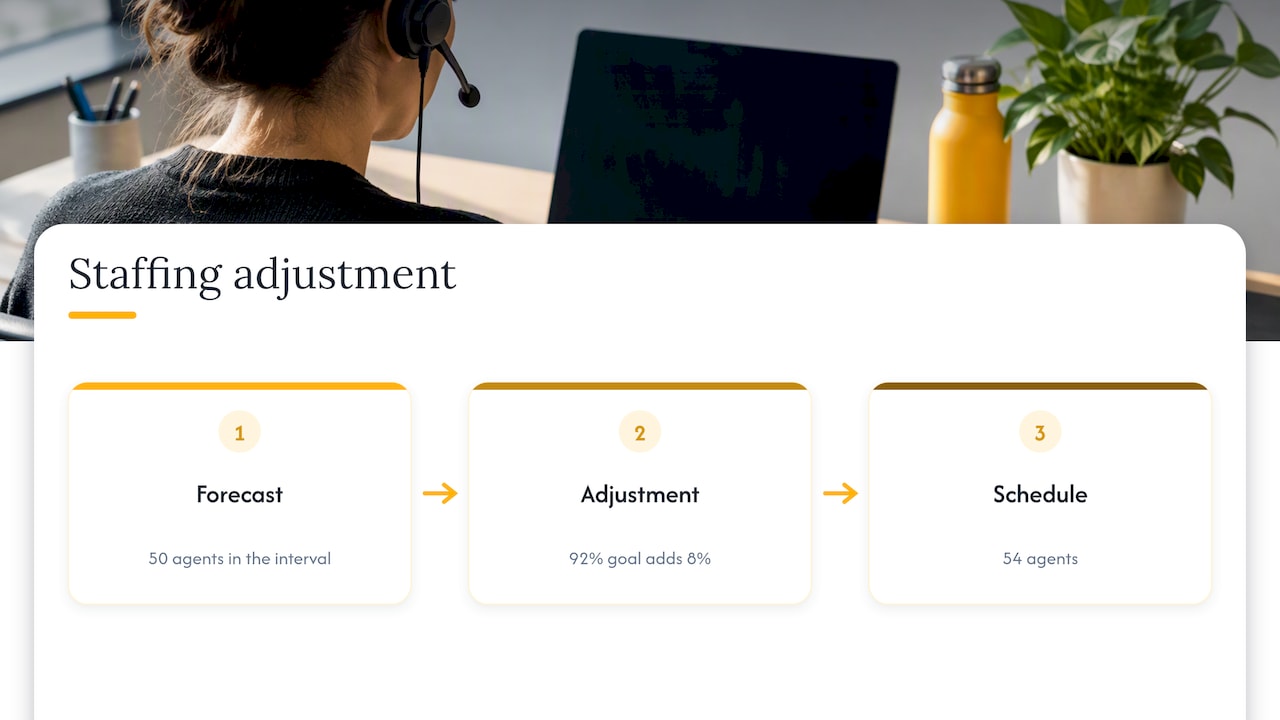
There is a simple planning rule. ICMI suggests adding the inverse of the adherence goal to the required staff forecast. For a 92% goal, add 8%. As an illustration: if your forecast calls for 50 agents on the queue in an interval, an 8% adjustment puts the scheduled number at 54.
This is why adherence and cost are tied. Every point of adherence you gain reduces the buffer you have to schedule, and every point you lose either costs service level or forces you to overstaff. Our guides on contact center staffing models and forecasting accuracy show how those interval forecasts are built, and our piece on call center shrinkage covers the other half of the coverage gap, the time agents are scheduled but unavailable for planned reasons.
What causes low adherence
Before you introduce any new policy, diagnose. A NICE glossary entry lists factors that commonly drag adherence down:
- Calls that run over scheduled break times
- System login issues
- Unplanned coaching requests
- Poorly designed schedules
Notice how few of these are about agent attitude. Calls overrunning into a break is a mix of how breaks are placed and how call endings are managed. Login issues are an IT problem. Unplanned coaching is a supervisor-planning problem. A scorecard that blames agents for all four gets resentment instead of improvement.
How to improve schedule adherence without hurting morale
ICMI’s guidance centers on three moves: educate agents about their impact on the queue, give them transparent service-level objectives, and manage adherence locally, team by team, instead of using it as a purely punitive tool (ICMI). Here is how to turn that into a working plan.
- Measure daily. A NICE whitepaper recommends measuring and reporting adherence daily so management and schedule problems that affect customers surface quickly.
- Start from a baseline. Record two to four weeks of actual adherence before setting a target. Raise it in steps.
- Show agents the queue. Give them real-time service-level information and train them on how to read it. An agent who sees a growing queue understands why the 3:00 break matters.
- Set tolerances and publish them. Agents should know exactly what counts as an exception.
- Fix the system causes. Track login failures and tool outages as separate codes so they do not penalize agents.
- Plan coaching in the schedule. If coaching is a standard activity in the calendar, it stops being an exception.
- Review schedule design. Place breaks away from known peaks, and avoid stacking meetings into the day.
- Coach on patterns, not single events. One late return is noise. Five in a week is a conversation.
Our guides on workforce management, workforce optimization examples and agent retention go deeper on the people side. Adherence and attrition are linked: teams that feel policed leave, and replacing agents lowers your adherence again while new hires ramp up. A strong onboarding plan that teaches schedule expectations from week one helps both.
Our perspective
Adherence is a coverage tool, and the best programs we see treat it that way. When a client brings us a team with a low score, the first question is never “which agents are failing?” It is “what does the schedule ask of them, and what is getting in the way?”
We design nearshore teams around that principle. Agents work shifts aligned with US business hours, which keeps the real-time conversation with your supervisors simple. The schedule, the tolerances and the break placement are agreed up front, so adherence is measurable from day one and not argued about later.
We also believe in flexibility. A managed team extension lets you add seats for a seasonal peak or a new queue without rebuilding your forecast from scratch, and that is often the most practical lever on adherence: when the staffing plan is realistic, the schedule is realistic, and agents can follow it.
Our approach combines disciplined execution with measurable performance frameworks. We would rather help you reach a stable 90% with agents who stay than a 97% that depends on gaming status codes.
Daniela
Run adherence with a managed nearshore team
If your internal team is stretched across peaks and the schedule keeps breaking, adding structured capacity may fix more than another policy memo. Altiam CX provides managed team extension and customer experience services from Latin America nearshore locations, with bilingual agents and scalable team deployment. We build the schedule, the reporting and the coaching rhythm into the engagement.

See our customer experience and managed team extension services, or talk to us about your queues and coverage windows.
If you run a clinical or legal operation, we have focused programs for healthcare CX operations and legal intake and back-office support, where timely answers and appointment coverage depend on agents being in place when the phone rings.
Frequently asked questions
What is call center adherence?
It is the share of time agents spend doing the activity the schedule assigns them, at the time it assigns it. Amazon Connect, for example, treats an agent as adherent when the current status matches a status mapped to the scheduled activity. The result is usually shown as a percentage per agent, team and interval.
What is the difference between adherence and conformance?
Adherence checks whether the right activity happened at the right time. Conformance checks whether the agent worked the total scheduled time, no matter when. Adherence suits queue-based service commitments, while conformance suits flexible models.
What is a good adherence percentage?
Many centers aim for about 85% to 90%, and mature, short-contact operations can reach the mid-90s. At 90%, agents are available for contacts 54 minutes out of each 60, according to ICMI’s example. Begin with your own baseline and raise the target gradually.
How often should we measure adherence?
Daily reporting is recommended so that schedule and management issues are found and fixed before they affect customers. Keep real-time monitoring running during the day, and review patterns weekly with each team.
Sources
- Verint: What is schedule adherence in a call center?
- Amazon Connect: Schedule adherence documentation
- AWS: Configure schedule adherence thresholds in Amazon Connect
- Genesys Cloud: How adherence and conformance are calculated
- Monitask: Schedule adherence formula and targets
- WFM Labs: Adherence and conformance
- ICMI: Critical metrics for standardizing your contact center
- ICMI: 7 ways to improve schedule adherence
- ICMI: Schedule adherence and real-time monitoring
- Peopleware: How to master adherence and conformance
- Talkdesk: Performance management best practices
- NICE: Contact center schedule adherence whitepaper
- NICE: Call center adherence glossary
- Assembled: What is schedule adherence?