
Product catalog enrichment is the work of turning thin, inconsistent supplier data into complete, structured, shopper-ready product records. It fills in missing attributes, standardizes values, improves titles and descriptions, and adds the media and metadata that search engines, on-site search and shoppers rely on. Done well, it makes products easier to find, easier to trust and less likely to come back as a return. Done poorly, or not at all, it quietly drags down every channel you sell on.
This guide covers what enrichment is, what gets added, how the process runs from audit to maintenance, where AI helps and where people must review, and how to measure the result. It also covers a question operations leaders ask next: who does the work at scale?
TL;DR
- Catalog enrichment adds missing attributes, descriptions, imagery and category assignments to product records so they are complete, consistent and usable across channels.
- It is not the same as a PIM. A PIM stores, governs and distributes product data, while enrichment creates the quality data the PIM manages.
- The process is repeatable: audit gaps, collect source data, enrich, standardize, review, publish and refresh.
- AI can speed up the work, but high-risk content such as safety and regulatory specs needs human approval.
- Measure coverage (the share of required attributes with a usable value), then test changes against search, conversion and return metrics.
Table of Contents
- What product catalog enrichment actually means
- What gets added: the attributes that matter
- Why enrichment matters for discovery, SEO and CX
- How the enrichment process works
- Manual, rules-based and AI-assisted enrichment
- Data quality and governance
- How to measure enrichment
- Who does the work at scale
- Extend your catalog and support capacity with Altiam CX
- FAQ
- Sources
What product catalog enrichment actually means
Most catalogs start life as supplier spreadsheets. They arrive in different formats, with different naming conventions, and with gaps. A title says “Blue Jacket” and nothing else. A dimension field is empty. A description was copied from a manufacturer sheet written for distributors, not shoppers.
Enrichment closes those gaps. Shopify’s enterprise guide describes it as turning weak or incomplete supplier data into detailed, structured, customer-facing content that helps shoppers find, understand and buy products. The key word is structured. A paragraph of marketing copy is not enrichment if the underlying attributes (material, size, compatibility) are still missing.
Enrichment versus normalization
The two are often confused. Catalog Intelligence draws the line this way: enrichment adds attributes, descriptions, imagery or category assignments that are missing, while normalization standardizes values that already exist. Turning “BLK,” “black” and “Black/Matte” into one color value is normalization. Adding the missing material and care instructions is enrichment. A healthy catalog needs both, and the order matters: clean first, then fill.
Enrichment versus catalog management and PIM
Catalog management is the broader discipline. Anglera’s glossary describes it as covering ingestion, normalization, enrichment, governance and quality scoring, and syndication. Enrichment is one major activity inside it.
A product information management (PIM) system is something different again: software and an enterprise initiative for collecting, authoring, rationalizing and publishing product information across internal systems and external channels, as IBM’s PIM landscape paper defines it. The practical way to think about it: the PIM is the infrastructure, enrichment is the work that fills it with data worth distributing. Buying a PIM without an enrichment plan gives you a well-organized home for incomplete records.
What gets added: the attributes that matter
There is no universal list, because the right attributes depend on the category. Food needs nutritional data. Electronics need device compatibility. Apparel needs size, fit, fabric and care. Across categories, Shopify’s guide groups the typical additions into four buckets:
- Technical specifications: dimensions, materials, weight.
- Merchandising data: titles, descriptions, use cases.
- Logistical details: shipping and return policies.
- Rich media: lifestyle images, 3D models.
On Shopify, metafields let merchants store specialized attributes such as ingredient lists, care instructions and material breakdowns that default product fields do not support.
What Google expects to see
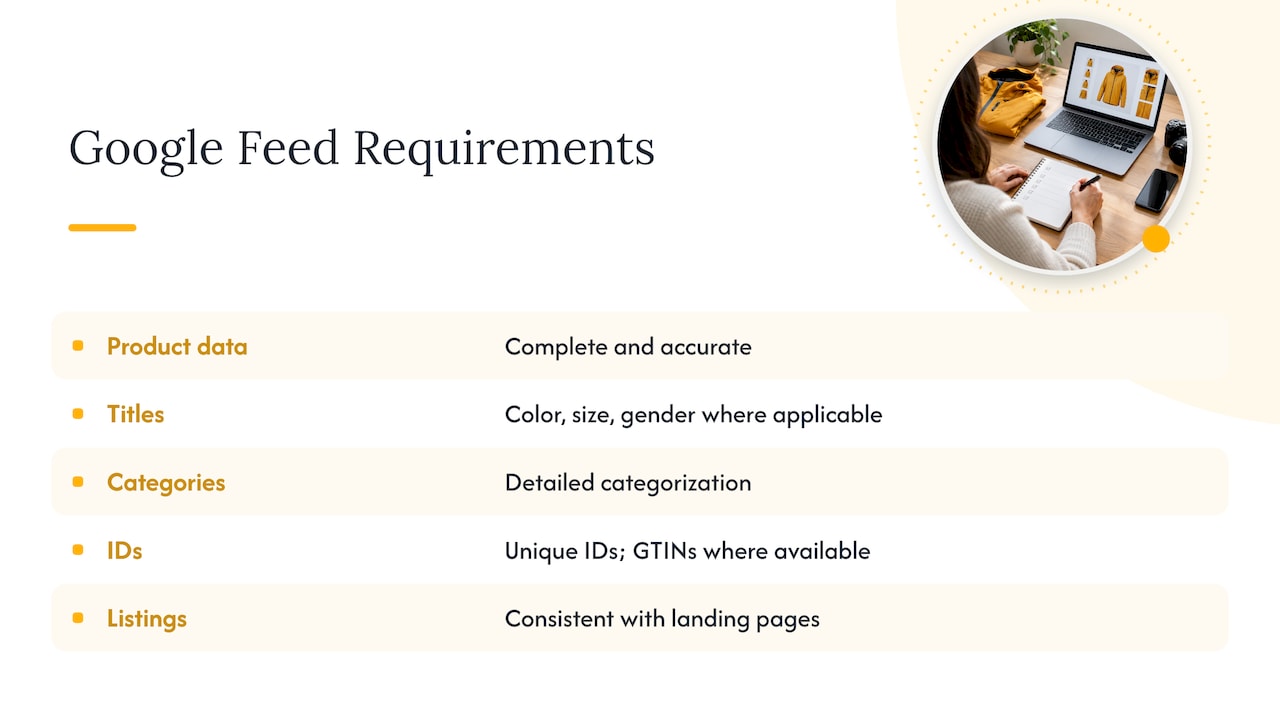
If you advertise or list products in Google surfaces, the feed is the enrichment checklist. Google Merchant Center’s guidance for the US recommends complete and accurate product data, relevant title attributes, detailed categorization, unique IDs, GTINs where available, and consistency between your listings and your landing pages. Those practices help Google match your products to queries and give shoppers confidence that what they see is what they get.
A simple example: an apparel title that reads “Merino Crew Sweater” is weaker than one that includes color, size range or gender where they apply. Google itself suggests running experiments, such as adding color to apparel titles, and then measuring the change in your key metrics.
Structured data on the page
Enrichment does not stop at the feed. The same attributes should appear in markup on the product page. Product structured data makes pages eligible for enhanced appearances such as ratings, pricing and availability, according to the Google documentation as summarized by Shopify. If your team is deciding where to start, this walkthrough of ecommerce schema markup types is a useful companion to the attribute work described here, because markup is only as good as the data behind it.
Why enrichment matters for discovery, SEO and CX
Search and browse
On-site search can only match what the record says. Constructor’s documentation explains that enriched attributes enter search and browse indexes to improve product discovery, and that high-quality, relevant product information can improve customer satisfaction and reduce returns. If a shopper filters by “waterproof” and your jacket never had that attribute filled in, the jacket does not exist for that shopper.
External search
Shopify cites a 2025 Salsify report finding that 65% of shoppers use search engines to research products and brands. That makes precise attributes and descriptions a front-line SEO asset, not back-office housekeeping.
AI-driven discovery
Shoppers increasingly ask AI assistants for product recommendations. Machine-readable catalogs benefit from stable identifiers such as GTIN and MPN, taxonomy paths, typed attributes and structured outputs like JSON or XML, as GetCatalog’s guide notes. The same fundamentals that help a human filter a category page help a machine understand your product.
The customer experience link
This is where catalog work meets support operations. Every missing specification becomes a question someone has to answer by chat, phone or email: “Does this fit the 2022 model?” “What is it made of?” Incomplete data creates inquiries, and inaccurate data creates returns and complaints. GS1 US says product-data quality spans accuracy, completeness, timeliness, consistency and synchronization with trading partners, and that poor data can cause inventory problems and negative customer experiences.
That is why our own guide to product inquiry support treats recurring product questions as a signal. If the same question reaches your agents every day, the catalog has a gap worth fixing at the source.
How the enrichment process works
The specifics vary by tool and team, but the shape is consistent. Anglera describes a typical pipeline that ingests supplier data from varied formats, normalizes it, enriches records, applies category-specific requirements and governance, distributes channel-ready data and refreshes records with downstream feedback. Wisepim’s process overview frames the working steps the same way. Here is a version you can run.
- Audit what is missing. Pick a category and list the attributes a shopper needs to decide. Count how many records lack each one. This gives you a baseline.
- Collect source data. Pull from supplier files, manufacturer spec sheets, packaging and your own returns and support logs.
- Normalize. Standardize units, color names, size formats and brand names so the same value is written one way.
- Enrich. Add the missing attributes, write descriptions around real use cases, assign categories and create SEO metadata. Localized outputs belong here too if you sell in more than one language.
- Review. Check against category rules before anything goes live (more on this below).
- Publish. Send channel-ready data to your storefront, marketplaces and feeds.
- Refresh. Use search terms, filter clicks, returns reasons and customer questions to find what to fix next.
Step seven is the one teams skip. Constructor’s workflow, for example, uses behavioral signals such as searches, filters, clicks and sessions alongside raw catalog data to predict attributes and categories. Your customers are telling you what the catalog lacks. The job is to listen.
A worked example
Say you run a home goods store and your lamp category has 800 SKUs. The audit shows that 60% have no bulb type, 45% have no dimensions, and shoppers keep asking support whether lamps are dimmable. You prioritize three attributes: bulb type, dimensions and dimmability. You pull values from spec sheets, standardize “E26” and “medium base” into one value, and add a dimmable filter to the category page. You also feed the answers back into your support macros. Two weeks later you compare lamp-category inquiries and filter usage against the baseline. That loop (gap, fix, measure) is the whole discipline in miniature.

Manual, rules-based and AI-assisted enrichment
There are three ways to produce the data, and most teams use a mix.
| Approach | Best for | Watch out for |
|---|---|---|
| Manual research and entry | New or complex products, regulated categories, brand-sensitive copy | Speed and cost at volume |
| Rules-based | Values derivable from existing data, such as unit conversion or category mapping | Rules that break on edge cases |
| AI-assisted | Drafting descriptions, extracting attributes from text and images, filling large gaps | Unsupported claims, inconsistent output |
IBM’s guidance on new product introduction (a 2007 whitepaper, but the principle holds) states that enrichment can be partly automated when values are derivable from existing data, yet manually derived category-specific data still needs human intervention and validation before downstream publication.
A tiered review model for AI output
Sitation recommends a tiered review approach for AI-assisted enrichment:
- High risk (safety and regulatory specifications): human approval every time.
- Medium risk (descriptions and attributes): approval through your PIM workflow.
- Lower risk (alt text, for example): validation through sampling.
It adds a rule worth printing: the product record stays the source of truth, and if a language model generates facts the record does not support, reviewers should reject the output. If your marketing and operations groups are drafting rules for this, a framework for AI content governance can help you define who approves what before volume ramps up.
Data quality and governance
Enrichment fails quietly when governance is missing. Three problems come up again and again.
Inconsistency across suppliers. Two vendors describe the same product differently, and your catalog ends up with duplicates. Detecting them takes real effort: one peer-reviewed study notes that duplicate detection requires advanced feature engineering and domain-specific text processing to reconcile varying descriptions and attributes from different suppliers. Plan for human judgment where automation is unsure.
Stale data. Specs change, packaging changes, and suppliers discontinue variants. GS1 US lists timeliness as a core quality dimension for a reason. Assign an owner and a refresh cadence per category.
No definition of done. Without required attributes per category, “enriched” means whatever the last person thought it meant. Write a minimum attribute set for every category and make it a publishing gate.
A governance checklist to start with:
- A required attribute list per category.
- A single source of truth for each product record.
- Named owners for approval and for refresh.
- A log of AI-generated changes and who reviewed them.
- A rule for how supplier updates are accepted or rejected.
How to measure enrichment
Pick two kinds of metrics: quality of the data, and effect of the data.
Quality. Catalog Intelligence defines enrichment success through coverage, meaning the percentage of required category attributes that hold a usable value. Normalization, by contrast, is judged on consistency. Track both by category, not as one catalog-wide average that hides weak spots.
Effect. Choose metrics tied to the attributes you changed:
- On-site search: zero-result rate, filter usage, search-to-cart rate.
- Feed performance: impressions and click-through on enriched versus unenriched products.
- Conversion and returns for the category.
- Support: volume of product-related inquiries per 1,000 orders.
Follow Google’s lead and treat changes as experiments. Enrich one set of products, hold a comparable set steady, and compare over a meaningful period. Our guides on measurable service quality and why measuring service quality matters apply the same logic to the support side of the house.
Our perspective: enrichment is a service operation
Most articles on this topic treat enrichment as a software problem. In our experience working with ecommerce and retail teams, the bottleneck is rarely the tool. It is the steady, detail-heavy human work around the tool: chasing supplier files, resolving conflicting specs, checking AI drafts, and turning customer questions into catalog fixes.
That work sits between the catalog team, the back office and the support floor. It rarely has a clear owner, so it slips. We think it should be run like any other operational function, with defined procedures, quality checks and measurable targets.
This is where a nearshore team extension makes practical sense. Bilingual agents working in time zones close to yours can handle recurring catalog tasks, review queues and support-driven data fixes, while your in-house specialists keep control of taxonomy, brand voice and final approval. Our model is designed for scalable team deployment, so you can add capacity during a supplier onboarding wave or a seasonal launch without rebuilding your org chart.
The principle we would argue for is simple: let the people closest to customer questions feed the catalog, and let the catalog reduce those questions. That loop is where cost efficiency and better customer experience meet.
Daniela
Who does the work at scale
Small catalogs can be enriched by one careful merchandiser. Past a few thousand SKUs, or when you onboard suppliers continuously, you need a team with a process. You have three realistic options: grow in-house headcount, rely on tooling alone, or add a managed team that works to your standards.
A managed team is most useful for the repeatable parts: auditing attribute gaps, entering and standardizing values from spec sheets, working through review queues, and logging recurring customer questions for the catalog owner. It is less useful for decisions that define your brand, such as taxonomy design or tone of voice. Keep those close.
The back office matters here more than most CX leaders assume. Our overview of the ecommerce back office explains how order data, product data and service quality connect, and our ecommerce support services guide covers what a support partner should handle. If your support agents rely on an internal knowledge base, the same governance discipline applies there, as we describe in our piece on multilingual knowledge bases.
Extend your catalog and support capacity with Altiam CX
Altiam CX is a nearshore customer experience and operational services partner. We provide customer care, technical assistance, back-office operations and managed team extension for ecommerce, retail, healthcare, legal and financial services organizations, with bilingual agents and teams that scale to your needs.

If catalog gaps are driving product questions, returns or backlogs in your operation, we can help you build the team around the process. Explore our customer experience and managed team extension services, or contact us through our site to talk through your catalog and support workload.
FAQ
What is the difference between product catalog enrichment and PIM?
Enrichment is the process of creating complete, accurate product data. A PIM is the system that stores, governs and distributes that data across channels. You need both: the PIM manages the data, and enrichment makes the data worth managing.
How long does catalog enrichment take?
It depends on catalog size, how many attributes each category requires, and how clean your supplier data is. A sensible approach is to start with one high-traffic category, measure the result, then expand. Because products and specs change, treat enrichment as an ongoing process with a refresh cadence, not a one-time project.
Can AI enrich a product catalog on its own?
AI can draft descriptions and extract attributes quickly, but it should not publish unchecked. Safety and regulatory specifications need human approval, and any generated fact not supported by the product record should be rejected. Lower-risk content such as alt text can be checked by sampling.
Which attributes should I add first?
Start with the ones shoppers use to decide and filter, and the ones your support team gets asked about most. Align with Google Merchant Center guidance on titles, categories, unique IDs and GTINs if you run product listings. Then fill category-specific attributes like compatibility, materials or dimensions.
How do I know enrichment is working?
Track coverage of required attributes by category, then compare search, conversion, return and inquiry metrics for enriched products against a similar group you have not yet changed. Run changes as experiments so you can attribute the difference.
Sources
- Product Data Enrichment for Ecommerce: A Practical Guide (Shopify)
- What is catalog enrichment? (Catalog Intelligence)
- Catalog Management: Definition, Process, and B2B Best Practices (Anglera)
- A Sell-Side Product Information Management Vendor Landscape (IBM)
- Tips to optimize your product data (Google Merchant Center)
- Constructor Attribute Enrichment
- How to turn your product catalog into machine-readable data (GetCatalog)
- Trusted Data: The Backbone of Digital Supply Chains (GS1 US)
- Product Data Enrichment Process (Wisepim)
- Best practices for new product introduction (IBM)
- AI for product content: enrichment, attribute extraction (Sitation)
- Duplicate product record detection engine for e-commerce (Expert Systems with Applications)
- Ecommerce schema markup types
- AI content governance