
Deploy four script types first: post-discharge follow-up, identity verification and enrollment, medication review, and portal support. Every one of them lives or dies on a single compliance habit: agents must identify themselves, state the call’s purpose, and confirm they’re speaking with the right person before touching any protected health information. Anchor your templates in AHRQ’s teach-back method and HHS guidance on phone-based PHI handling, and you’ve covered both the clinical and legal bases at once.
TL;DR:
- Scripts must start with clear identification, purpose, and permission, using a checklist approach spoken naturally to build trust quickly.
- Identity verification should use two patient-controlled data points, avoiding full SSNs, and limit PHI to only what the call requires for safety and compliance.
- Teach-back is essential at the end of clinical calls, limited to two or three key points, to confirm understanding without overwhelming the patient.
- Post-discharge follow-up calls should last 15 to 20 minutes, while simple inquiries like scheduling take around 2 to 6 minutes, with immediate escalation for severe symptoms.
- Modular script components that include must-say items, personalization prompts, and escalation points improve agent comfort, compliance, and overall call quality.
Table of Contents
- What Should Every Patient Support Call Script Include?
- Ready-to-Adapt Sample Scripts for Common Call Types
- Exact Phrasing for Teach-Back and Medication Reviews
- How Long Should Patient Support Calls Take?
- Making Scripts Modular Instead of Monolithic
- Rolling New Scripts Into Daily Operations
- Balancing Compliance and Empathy in Practice
- A Managed Path to Better Patient Support Calls
- Where to Go for the Official Guidance
- Sources
- FAQ
What Should Every Patient Support Call Script Include?
A script is only as good as its weakest component, and in healthcare call centers, the weakest component is usually identity verification done sloppily or empathy skipped entirely under time pressure. Build every template around six core pieces, and the rest is customization.
Opening. Agents state their name, the organization, and the reason for the call, then ask permission to continue and give a rough time estimate. The CMS outbound enrollment verification model requires exactly this: full name, plan type, and a clear statement of purpose before moving forward. That structure works for far more than enrollment calls.
Verification. Confirm identity with two data points the patient controls, like date of birth and the last four digits of a member ID, never a full Social Security number read aloud. HHS OCR guidance on audio-only telehealth makes clear that covered entities can use phone calls freely, but reasonable safeguards for PHI still apply. The minimum necessary standard means agents should ask for only what the call actually requires. If the purpose is confirming an appointment time, there’s no reason to recite a diagnosis on the line.
Clinical checks. Medications, symptoms, appointment clarity, and a short set of red-flag questions belong in nearly every clinical script.
Empathy. The NURSE mnemonic, Naming the emotion, Understanding it, showing Respect, offering Support, and Exploring further, gives agents a repeatable structure for emotional moments. A short line like “It sounds like this has been a stressful week for you” does more to keep a patient engaged than any amount of clinical accuracy delivered coldly.
Teach-back. Before ending a clinical call, ask the patient to explain the plan in their own words. This isn’t a quiz; it’s a safety net.
Documentation. Agents should log what was covered, whether teach-back succeeded, and flag anything that needs escalation, before moving to the next call.
- Open with identity, organization, purpose, and a time estimate.
- Verify identity with two patient-controlled data points, never a full SSN.
- Limit PHI exposure to what the call purpose actually requires.
- Run clinical checks: meds, symptoms, appointment details, red flags.
- Close clinical calls with teach-back, not a simple “any questions?”
- Document outcomes and escalation triggers before disconnecting.
Pro Tip: Train agents to treat the opening as a checklist they say out loud in their own words, not a script they read verbatim. A stiff, robotic opening undermines trust before the call even starts.
Ready-to-Adapt Sample Scripts for Common Call Types
These templates are built to be copied into a QA library and adjusted for your specialty. Each one follows the core structure above but adds the specific language that call type demands.
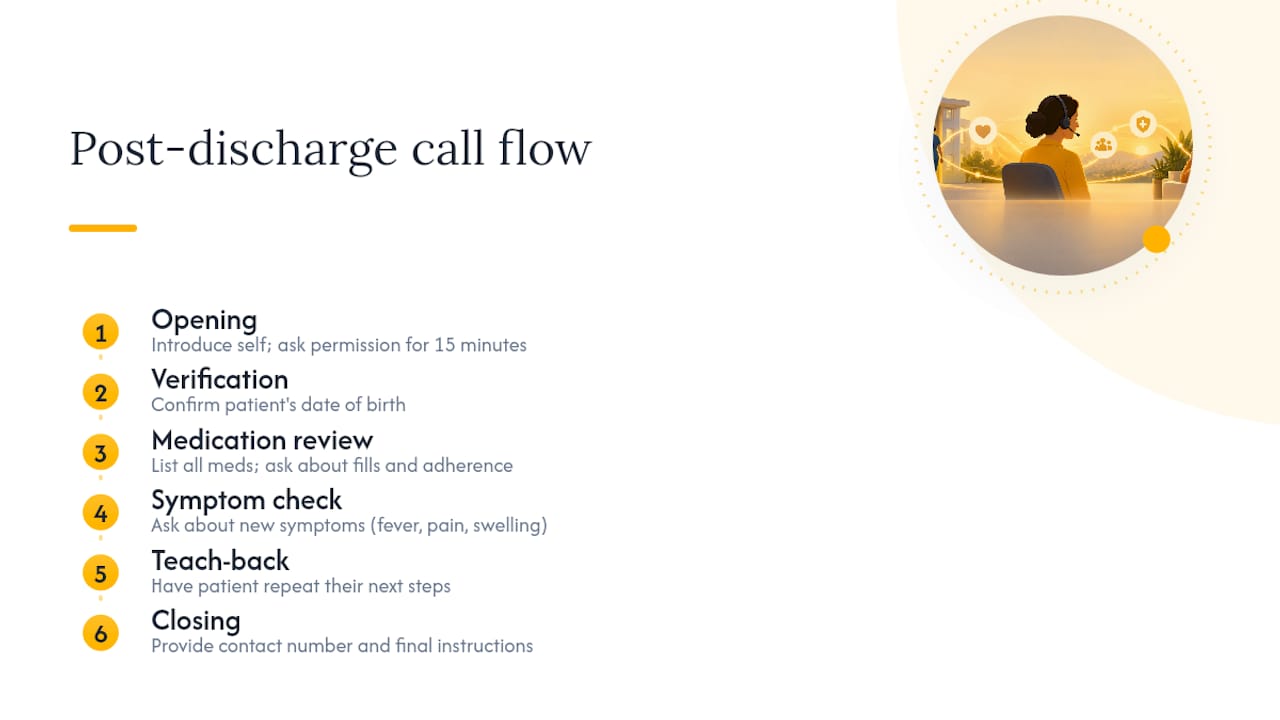
1. Post-discharge follow-up call (15–20 minutes)
This is the highest-stakes call type on the list, and the one most likely to catch a problem before it becomes a readmission. The AHRQ RED toolkit built its post-discharge phone protocol around exactly this timing and structure, and its patient-facing script is worth reviewing directly.
Opening: “Hi, this is [Agent Name] calling from [Organization] on behalf of Dr. [Name]'s office. I’m calling to check in after your recent discharge and make sure everything’s going smoothly. Do you have about 15 minutes to talk?”
Verification: “Before we continue, can you confirm your date of birth for me?”
Medication review: “Let’s go over your medications. Can you tell me what you’re currently taking, including anything over the counter or any supplements?” Follow up with: “Have you had any trouble getting these filled or remembering to take them?”
Symptom check: “Have you noticed any new symptoms since you left the hospital, like fever, unusual pain, or swelling?”
Teach-back: “Just to make sure I explained your follow-up plan clearly, can you tell me in your own words what your next steps are?”
Closing: “You’re all set. If anything changes or you have concerns before your next appointment, here’s the number to call.”
2. Identity verification and enrollment call
Built around CMS’s model phrasing, this script keeps agents inside required disclosure language while still sounding human.
“Hello, this is [Agent Name] with [Organization]. I’m calling to verify your enrollment in [Plan Name]. This call is being made to confirm your understanding of the plan and answer any questions. May I confirm your name and date of birth?” From there, agents walk through plan details using short, plain-language sentences rather than reading benefit summaries verbatim.
3. Patient portal or technical support call
- Open with identity and purpose, then ask what the patient is trying to accomplish in the portal.
- Verify account ownership before discussing any account-specific detail.
- Keep triage short: “Are you seeing an error message, or is the page not loading at all?”
- If the issue is clinical rather than technical (a lab result the patient doesn’t understand), escalate to a clinical line rather than attempting to interpret results.
4. Scheduling and billing inbound call
“Thanks for calling [Organization], this is [Agent Name]. I understand you’re looking to reschedule an appointment, is that right?” Confirm the request, offer two to three specific time options rather than an open-ended “when works for you,” and close with a summary: “You’re confirmed for [date/time]. You’ll get a reminder text 24 hours before.”
Short openers agents can personalize safely include lines like “I want to make sure I get this right for you” or “Take your time, there’s no rush.” Closers work best when they restate the outcome plainly: “So to recap, here’s what we covered today.”
Exact Phrasing for Teach-Back and Medication Reviews
Teach-back only works when it’s framed as a safety check, not a test of the patient’s memory. The AHRQ Teach-Back Quick Start Guide recommends framing it around the agent’s own performance, not the patient’s: “I want to make sure I did a good job explaining this. Can you tell me in your own words what you’ll do when you get home?”
Limit teach-back to two to four key points per call. Trying to confirm understanding of ten different instructions overwhelms the patient and buries the items that actually matter, like a medication dose change or a red-flag symptom to watch for.
Medication review phrasing should always widen beyond prescriptions: “Are you taking anything else, including vitamins, herbal supplements, or anything you buy without a prescription?” Adherence barriers surface with a simple, nonjudgmental question: “Is there anything that’s made it hard to take this as prescribed, cost, side effects, or just remembering?”
- Ask patients to explain the plan in their own words, not to repeat it verbatim.
- Stop at three or four key points; more than that reduces retention.
- Always ask about OTCs and supplements, not just prescribed medications.
- Frame adherence questions around barriers, not blame.
Pro Tip: If a patient can’t teach back correctly, the fix is rephrasing, not repeating. Saying the same sentence louder or slower rarely helps; explaining it a different way usually does.
How Long Should Patient Support Calls Take?
Comprehensive post-discharge calls should run 15 to 20 minutes, long enough to cover medication review, symptom checks, and teach-back without rushing. Simple inbound queries, like confirming an appointment time or resetting a portal password, should take 2 to 6 minutes. If a scheduling call is stretching past 10 minutes, something in the script or the workflow needs a second look.
Certain patient statements should trigger immediate escalation regardless of where the agent is in the script. Chest pain, difficulty breathing, thoughts of self-harm, or signs of a severe allergic reaction all warrant an immediate scripted response: “I want to make sure you get help right away. I’m going to connect you with a nurse now, please stay on the line.”
- Document the escalation reason and time in the queue or EHR before transferring.
- Use a warm handoff whenever possible: introduce the patient to the next person by name and summarize the situation so they don’t have to repeat themselves.
- Pilot new or revised scripts during off-peak hours or with the last patient of a shift, which reduces disruption and gives supervisors room to coach in real time.
Making Scripts Modular Instead of Monolithic
Long-form scripts read like paragraphs, and paragraphs are exactly what agents stop following once they’ve handled fifty calls in the same style. Operational teams that break scripts into modular components see better adoption because agents can personalize language while safety-critical phrases stay locked in place.
- Must-say items stay verbatim: identity, purpose, consent to continue, and any legally required disclosure.
- Personalization prompts give agents flexibility: a short note like “acknowledge patient’s stated concern before moving to verification” rather than a scripted sentence.
- Escalation nodes are flagged clearly in the script itself, not buried in a separate document the agent has to remember exists.
Compare a paragraph like “Please confirm your identity by providing your date of birth and the last four digits of your member ID so that I can access your account and discuss your care plan with you today” against three short cues: “Confirm DOB. Confirm last four of member ID. Then proceed.” The second version says the same thing, takes less cognitive effort to deliver naturally, and still meets the verification requirement.
QA teams can map each must-say item to a binary check, present or absent, and track teach-back usage as a separate metric. That split makes coaching conversations concrete instead of vague. A guide like Altiamcx’s approach to contact center QA covers how to move that kind of check beyond spot-sampling toward full-coverage review.
Pro Tip: Ask agents which lines feel unnatural to say out loud. If three different agents flag the same sentence, rewrite it before it ends up as a training complaint.
Rolling New Scripts Into Daily Operations
Deploying a new script safely takes more than handing agents a document and hoping they read it.
- Run a legal and clinical review before anything goes live, confirming the script meets HIPAA minimum necessary standards and reflects current clinical guidance.
- Pilot with a small group, ideally during off-peak hours, and set a defined sample size before evaluating results.
- Train through coach-led role-play, followed by shadowing, then supervised solo calls.
- Track teach-back rate, escalation rate, adherence to must-say items, and average handle time from day one of the pilot.
- Collect informal feedback weekly during the pilot window.
- Schedule a quarterly review with clinical stakeholders to catch phrasing that’s drifted from policy.
- Update the QA rubric any time the script changes, not just at the next scheduled audit.
Resources like Altiamcx’s guide to improving hospital customer care offer additional operational detail on structuring this rollout across a larger team.
Balancing Compliance and Empathy in Practice
The hardest part of this work isn’t writing the script, it’s getting agents to say it like a person instead of reading it like a legal disclosure. Every manager I’ve talked to about this faces the same tension: fidelity to required language versus language that actually sounds like a human being cares. The fix isn’t choosing one over the other. It’s writing must-say items short enough that they don’t sound scripted, and giving agents room everywhere else.
Pilot programs for patient support scripts typically start small, measure teach-back and escalation rates from day one, and adjust phrasing based on what agents report feels stiff. That loop matters more than getting the first draft perfect.
Three things to do today: audit your current opening line for length, add a teach-back step to any clinical call that lacks one, and ask five agents which sentence in your script they dread saying most.
— Daniela
A Managed Path to Better Patient Support Calls
For healthcare call center leaders who’d rather deploy proven scripts than build a QA library from scratch, Altiamcx offers a faster route: managed patient support built around SOP design, agent training, and measurable quality checks from day one.

A typical engagement starts with a scoped pilot, usually covering one or two call types like post-discharge follow-up or portal support, with clear KPIs for teach-back rate, escalation accuracy, and handle time. Bilingual, nearshore teams train on your scripts, not generic templates, and QA is built around the same must-say versus personalization structure covered above. That means less time spent writing scripts from zero and more time seeing whether they actually work with real patients on the line.
If your team is weighing whether to build this in-house or bring in a partner, review Altiam CX’s healthcare CX operations page for details on patient support and SOP management, or explore Altiam CX’s broader managed team-extension services to see how a pilot could fit your current staffing model. Reach out to scope a pilot and get a KPI framework built around your call volume.
Where to Go for the Official Guidance
For direct downloads, start with the AHRQ RED toolkit for script templates, AHRQ’s teach-back tool for phrasing, HHS telehealth guidance for HIPAA rules, and the VA empathic responses job aid for emotional phrasing.
Sources
- Teach-back: AHRQ communication tool
- HIPAA and audio-only telehealth — HHS OCR
- CY 2011 Outbound Enrollment Verification — CMS
- Empathic responses — VA (VitalTalk contract)
FAQ
What Makes a Good Patient Support Call Script?
A good script opens with clear identification and purpose, verifies identity with minimal PHI exposure, includes empathy phrasing like the NURSE framework, and closes clinical calls with teach-back to confirm understanding. It should read like a checklist an agent internalizes, not a paragraph they recite word for word.
What Should an Agent Say When Answering an Inbound Patient Call?
Agents should state their name, the organization, and ask how they can help, then confirm the caller’s identity before discussing anything account-specific. Keeping the opening under two sentences helps it sound natural rather than scripted.
What Is a Good Call Flow for Healthcare Account Inquiries?
The flow should move from identity verification, to purpose confirmation, to the specific inquiry, and close with a summary of next steps. For enrollment or plan-related calls, the CMS outbound verification model requires stating full name and plan type up front.
How Long Should a Patient Follow-Up Call Take?
Comprehensive post-discharge follow-up calls typically run 15 to 20 minutes, covering medication review and teach-back. Simple inbound requests, like appointment confirmations, usually take 2 to 6 minutes.
Does Altiamcx Offer Support for Building Patient Call Scripts?
Yes. Altiamcx provides managed patient support services, including SOP and script design, agent training, and QA, detailed on its healthcare CX operations page. Current pricing is available directly through the site rather than published as a flat rate.