
Regulated industries like healthcare, legal, and e-commerce are under mounting pressure to deliver faster, more consistent customer experiences without expanding internal headcount. The assumption that external customer experience (CX) partners are reserved for Fortune 500 companies or tech giants is simply outdated. Legal firms outsource CX for scalability during demand spikes, faster responses, and higher lead conversion without internal burnout. Whether you’re managing patient intake, legal case inquiries, or high-volume order support, the right external CX partner can close the gap between operational strain and service excellence.
Table of Contents
- What are external CX partners?
- Top reasons executives choose external CX partners
- How external CX drives scalability and operational agility
- Comparing CX strategies: In-house, external, and hybrid models
- What to look for in an external CX partner
- Case study: External CX in action for legal, healthcare, and e-commerce
- Connect with proven CX partners to transform your operations
- Frequently asked questions
Key Takeaways
| Point | Details |
|---|---|
| Scalability and flexibility | External CX partners allow you to rapidly ramp support up or down based on demand without hiring delays. |
| Access to expertise | Outsourcing to CX specialists gives you advanced tools and compliant processes that most in-house teams lack. |
| Operational efficiency | External partners help streamline workflows, cut fixed costs, and free your internal staff for high-value tasks. |
| Customizable models | Hybrid approaches enable you to balance control, compliance, and scalability for sensitive industries. |
| Measured results | Case studies show improved lead conversion and satisfaction when legal, healthcare, and e-commerce firms use external CX. |
What are external CX partners?
With the context established, it’s critical to understand exactly what external CX partners do and how they differ from typical internal teams.
An external CX partner is an outside firm that specializes in managing and improving customer interactions on behalf of your organization. These are not generic call centers. They bring structured methodologies, trained specialists, and purpose-built technology to handle the full spectrum of customer touchpoints.
Typical services include:
- Omnichannel support across phone, chat, email, and messaging platforms
- Client intake and onboarding for legal and healthcare workflows
- Complaint resolution and escalation management
- Back-office processing and data entry
- Process automation to reduce manual handling and error rates
The key distinction between external partners and in-house teams is access. You gain specialized tools, trained talent, and proven frameworks without the overhead of full-time hires, benefits, or infrastructure investment.
“External CX partners enable scalable support and improved lead conversion without internal resource strain.”
For a deeper look at how this applies to your sector, the CX outsourcing guide for healthcare and legal breaks down the strategic considerations by industry.
Top reasons executives choose external CX partners
Now that the role of an external CX partner is clear, let’s see why so many regulated industries are making this move today.
The business case is not just about cost. It’s about building operational resilience and competitive advantage. Here are the five most compelling drivers:
- Scalability on demand. External partners can rapidly expand or contract support capacity to match surges like open enrollment periods in healthcare or class-action spikes in legal. You don’t hire and train; you activate.
- Cost effectiveness. Fixed internal labor costs convert to variable, usage-based expenses. You pay for what you need, when you need it, which protects margins during slower periods.
- Specialized expertise. 70% of legal firms cite lack of in-house expertise as their primary reason for outsourcing. External partners bring compliance knowledge, sector-specific training, and niche CX process improvement that internal generalists simply can’t match.
- Faster response and resolution rates. Speed matters in every regulated sector. Healthcare portals, law firm intake lines, and e-commerce service queues all suffer when response times lag. External teams are built to perform at volume without sacrificing quality.
- Internal team relief. Burnout is real. Offloading high-volume, repetitive interactions frees your internal staff to focus on strategic, high-value functions where their expertise is irreplaceable.
Explore the latest legal CX outsourcing trends and nearshore CX benefits to see how these drivers translate into measurable outcomes.
How external CX drives scalability and operational agility
Understanding that scalability is a top driver, let’s break down how external CX solutions actually enable operational agility for your organization.

Consider two scenarios. A law firm facing a class-action surge needs 30 additional intake specialists within two weeks. An internal HR process for that would take months. An external CX partner deploys trained agents in days. Similarly, a healthcare organization managing open enrollment can absorb a 400% call volume increase without hiring a single permanent employee.
| Scenario | Internal expansion | External CX partner |
|---|---|---|
| Time to deploy new agents | 6 to 12 weeks | 5 to 10 business days |
| Training and compliance burden | High, internal responsibility | Managed by partner |
| Cost structure | Fixed, ongoing | Variable, scalable |
| Technology setup | Requires IT investment | Cloud-based, ready to use |
| Risk during slow periods | Overstaffing costs | Scale down without penalty |
External partners also bring cloud-based workflows and modern communication tools that integrate with your existing systems. This means faster deployment, fewer disruptions, and better data visibility across every customer interaction.
Nearshore partners add another layer of value. Cultural alignment and language fluency matter enormously in sensitive fields like legal and healthcare, where miscommunication carries real consequences. Enrollment surges and class-action spikes highlight exactly why nearshore cultural fit is a strategic advantage, not just a preference.
For sector-specific guidance, review resources on improving healthcare CX outcomes and customer service best practices for regulated environments.
Pro Tip: When evaluating nearshore partners, ask specifically about their experience in your regulatory environment. A partner who understands HIPAA, attorney-client privilege, or PCI-DSS compliance from day one eliminates weeks of onboarding friction.
Comparing CX strategies: In-house, external, and hybrid models
Knowing how external partners drive agility, let’s see how their model stacks up against keeping CX fully internal or leveraging adaptable hybrid models.
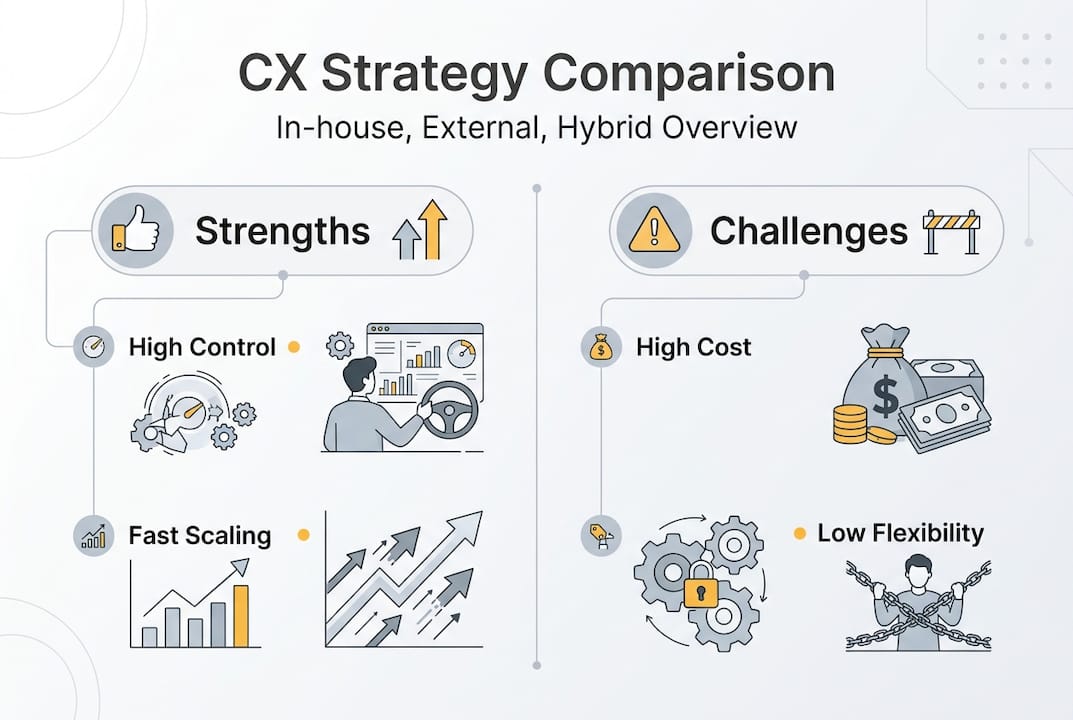
| Factor | In-house | External | Hybrid |
|---|---|---|---|
| Control | High | Lower | Balanced |
| Cost | High fixed | Variable | Mixed |
| Compliance management | Internal | Partner-led | Shared |
| Speed to scale | Slow | Fast | Moderate |
| Flexibility | Low | High | High |
Hybrid and blended models resolve the classic control versus efficiency trade-off, making them ideal for healthcare and legal organizations where sensitivity meets volume needs.
Here’s how each model performs in practice:
- In-house: Best for highly sensitive, relationship-driven interactions where institutional knowledge is critical. Costly to scale and difficult to flex during demand changes.
- External: Best for high-volume, repeatable interactions where speed and cost efficiency matter most. Requires strong SLA governance and clear performance metrics.
- Hybrid: Best for regulated industries that need both control and scale. Keep complex, sensitive CX internal. Let your external partner handle volume, routine inquiries, and overflow.
For executives in healthcare, legal, or e-commerce, the hybrid model often delivers the strongest balance. You maintain oversight where it matters most while gaining the agile customer service capacity to handle demand without strain. Learn more about current business process outsourcing trends shaping these decisions.
What to look for in an external CX partner
As you prepare to evaluate potential partners, keep these selection criteria and expert tips at the forefront.
Choosing the wrong partner in a regulated industry is not just an operational setback. It’s a compliance and reputational risk. Here’s a structured checklist to guide your evaluation:
- Compliance certifications. Verify that the partner holds relevant certifications for your industry, such as HIPAA for healthcare or SOC 2 for data security.
- Sector specialization. A partner with proven experience in legal intake or healthcare patient support will ramp faster and perform better than a generalist.
- Reporting transparency. Demand real-time dashboards, regular performance reviews, and clear SLA definitions before signing anything.
- Scalability architecture. Ask how quickly they can add capacity and what their process is for surge events.
- Disaster recovery and business continuity. Understand their redundancy protocols. Downtime in healthcare or legal CX is not acceptable.
70% of firms cite access to expertise as their primary outsourcing rationale, which means the partner’s knowledge depth is often more important than their price point. Also evaluate cultural fit, language proficiency, and their technology stack. Ask for case studies and industry references before committing.
For legal practices specifically, explore law practice CX intake solutions to understand what a specialized partner brings to client-facing operations. You can also review insights on customer happiness and process efficiency to frame your evaluation criteria.
Pro Tip: Before full commitment, propose a blended pilot. Run a defined segment of your CX volume through the external partner for 60 to 90 days. The data you collect will tell you more than any sales presentation.
Case study: External CX in action for legal, healthcare, and e-commerce
To make these concepts real, let’s see how they play out in law, healthcare, and e-commerce settings.
The results organizations achieve with external CX partners are not theoretical. They show up in conversion rates, patient satisfaction scores, and revenue recovery metrics.
- Legal: A mid-size personal injury firm offloaded intake calls to an external CX partner during a mass tort surge. The result was a measurable increase in qualified lead conversion and a significant reduction in attorney burnout. Internal staff refocused on case strategy rather than phone queues.
- Healthcare: A regional health system implemented 24/7 patient support through an external partner. Patient satisfaction scores improved within the first quarter, and after-hours inquiry resolution increased substantially, reducing next-day call volume.
- E-commerce: A growing direct-to-consumer brand deployed proactive multi-channel support through an external CX team. Cart abandonment recovery improved, and negative review rates dropped as customers received faster, more consistent responses.
The legal outsourcing market has reached $28.5 billion and continues to grow rapidly, driven by measurable improvements in technology adoption, process efficiency, and client outcomes.
For a detailed look at how this plays out in legal services, review the legal CX case study from Altiam CX, which covers appointment setting and back-office transformation.
Connect with proven CX partners to transform your operations
Armed with industry benchmarks, data, and case studies, you’re ready to take the next step.
Altiam CX works with organizations in healthcare, legal, and e-commerce to build CX operations that are scalable, compliant, and measurably effective. Whether you need to handle intake surges, improve patient communication, or recover lost e-commerce revenue, the right nearshore partner makes the difference between reactive firefighting and proactive growth.
Explore nearshore customer experience solutions designed for regulated industries, or review how Altiam CX supports fast-growth tech CX organizations scaling at speed. Legal practices can get started with tailored CX for law practices intake solutions built for high-stakes client interactions. The data is clear, the models are proven, and the operational case is compelling. Connect with Altiam CX to see what a purpose-built CX partnership looks like for your industry.
Frequently asked questions
What is an external CX partner and how is it different from BPO?
An external CX partner specializes in customer experience, focusing on interaction quality and measurable outcomes, while a traditional BPO may handle a broader range of administrative tasks with less emphasis on CX strategy. External CX partners enable scalable support and improved lead conversion with a performance-first approach.
Why do regulated industries like healthcare and legal outsource CX?
They outsource CX to access specialized expertise, scale flexibly during demand changes, and maintain compliance without overloading internal teams. Legal firms outsource for scalability, faster responses, and expertise, and 70% cite lack of in-house expertise as the primary driver.
What is a hybrid CX model?
A hybrid CX model combines in-house and external staff, keeping sensitive or high-touch interactions internal while outsourcing scalable or routine work to an external partner. Hybrid models resolve the control versus efficiency trade-off that regulated industries face most acutely.
How can I evaluate if an external CX partner is right for my business?
Shortlist partners based on compliance certifications, industry specialization, scalability, data security protocols, and verifiable references. Consider starting with a blended pilot program to validate performance before full commitment, using outsourcing strategies benchmarks as your evaluation baseline.