
TL;DR:
- Operational efficiency in regulated industries is about optimizing resources to deliver quality services cost-effectively without sacrificing compliance. Leaders must focus on process redesign, measure KPIs like cycle time and error rates, and balance speed with safety to achieve lasting improvements. Successful approaches involve disciplined methodologies like Lean Six Sigma, staff engagement, and thorough safety reviews before implementing automation.
Operational efficiency is one of the most misunderstood concepts in business strategy. Too many leaders equate it with aggressive cost cutting, which leads to decisions that erode service quality, trigger compliance failures, and ultimately cost more than they save. In regulated industries like healthcare and finance, that misunderstanding is not just costly. It can be dangerous. This guide clarifies what operational efficiency actually means, how to measure it rigorously, which methodologies deliver lasting results, and how to pursue it without trading away the quality and compliance your stakeholders depend on.
Table of Contents
- Defining operational efficiency
- How to measure operational efficiency
- Proven methodologies for operational efficiency
- Balancing efficiency, quality, and compliance
- Practical steps to improve operational efficiency
- What most leaders overlook in operational efficiency
- How Altiam CX helps you achieve operational efficiency
- Frequently asked questions
Key Takeaways
| Point | Details |
|---|---|
| Efficiency is not just cost cutting | True operational efficiency means reducing waste and optimizing resources without lowering quality or compliance. |
| Metrics matter for tracking progress | KPIs like cycle time and resource utilization reveal where improvements are working or needed. |
| Methodologies drive sustainable change | Frameworks like Lean Six Sigma create lasting efficiency when adapted for regulated industries. |
| Balance quality and compliance | Efficiency initiatives must support, not undermine, safety, equity, and regulatory outcomes. |
| Start with process redesign | Lasting improvements begin with simplifying and refining workflows, supported by technology. |
Defining operational efficiency
With the misconception addressed, let’s clarify precisely what operational efficiency means and what it doesn’t.
At its core, operational efficiency is the ability to deliver products or services cost-effectively by optimizing resources such as time, labor, capital, and technology to reduce waste and streamline processes without compromising quality. Notice what that definition does not say. It does not say “spend less.” It says “optimize.” That distinction matters enormously for leaders in healthcare, financial services, insurance, and other regulated fields.
Operational efficiency is not a cost-reduction program. It is a performance discipline that aligns resources with outcomes to generate consistent, measurable value.
Confusing efficiency with cost cutting produces familiar pitfalls: understaffed contact centers, shortcuts in claims processing, or rushed patient registration workflows that generate errors downstream. Real efficiency reduces waste, not value. It targets friction, redundancy, and rework rather than the skilled people and compliant processes that protect your organization.
The key resources at the center of operational efficiency are:
- Time: How long it takes to complete a process from start to finish
- Labor: How effectively your team’s skills and hours are applied
- Capital: Whether financial resources flow toward productive, measurable activities
- Technology: Whether systems support or slow down your core workflows
In regulated environments, there is an additional layer. Any efficiency gain must survive scrutiny from auditors, regulators, and accrediting bodies. Understanding operational services and efficiency in that context means building processes that are both lean and defensible. That requires a more thoughtful approach than simply trimming headcount or accelerating transaction volumes.
How to measure operational efficiency
Once you know what operational efficiency is, it’s crucial to measure it accurately. Here’s how.
Operational efficiency is measured with process and operations KPIs such as cycle time, cost per unit, and resource utilization, and leaders use these metrics to identify bottlenecks and waste. These three indicators form the foundation of any serious efficiency measurement framework.
| KPI | What it measures | Why it matters in regulated industries |
|---|---|---|
| Cycle time | Time from process start to completion | Reveals delays that affect service levels and compliance deadlines |
| Cost per unit | Total cost to deliver one unit of service | Identifies where resources are disproportionate to outputs |
| Resource utilization | Percentage of capacity actually used productively | Highlights overstaffing, underskilling, or misaligned workflows |
| First-contact resolution | Percentage of cases resolved without rework | Tracks quality and efficiency simultaneously |
| Error or rework rate | Frequency of corrections or reprocessing | Directly linked to compliance risk and wasted labor |
A structured approach to gathering and using efficiency data looks like this:
- Define your process boundaries. Choose a specific workflow, such as patient intake, claims adjudication, or loan origination, and document its start and end points clearly.
- Baseline your current state. Capture current cycle times, costs, error rates, and utilization figures before making any changes. Without a baseline, you cannot prove improvement.
- Identify waste categories. Look for rework, waiting time, redundant steps, handoff delays, and unclear ownership. These are the efficiency drains in most regulated environments.
- Set improvement targets. Use benchmarks from your industry or outsourcing strategies for efficiency to set realistic goals that do not compromise compliance requirements.
- Monitor continuously. Efficiency is not a one-time project. Build reporting cadences and governance structures that keep metrics visible and actionable.
Pro Tip: In complex regulated environments, one of the fastest ways to reveal hidden waste is to track rework rate, which is how often a completed task requires correction. High rework rates signal process problems that no amount of automation will fix until the underlying workflow is redesigned.
Focusing on improving back-office operations through disciplined KPI frameworks gives leaders something automation alone cannot provide: visibility into where resources are actually going, not just how much is being spent.

Proven methodologies for operational efficiency
Understanding what to measure is powerful. But improving efficiency requires proven methods.
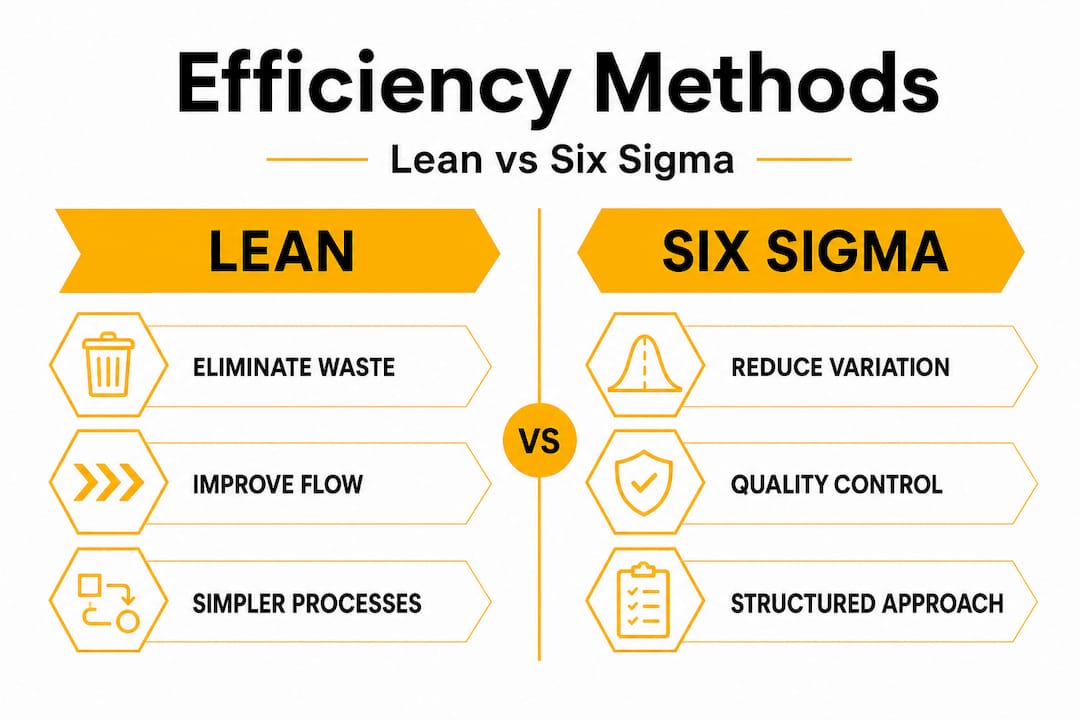
Operational efficiency improvement methodologies commonly use process redesign and structured problem-solving approaches that focus on flow, root-cause analysis, and controlling outcomes. Lean Six Sigma’s DMAIC framework (Define, Measure, Analyze, Improve, Control) is a widely used example in service operations such as healthcare and customer support.
| Methodology | Primary focus | Best application |
|---|---|---|
| Lean | Eliminating waste and improving flow | High-volume, repetitive service processes |
| Six Sigma | Reducing variation and defects | Quality-critical regulated workflows |
| DMAIC | Structured improvement cycle | Root-cause analysis and sustained gains |
| Process redesign | Rebuilding workflows from first principles | Broken or legacy processes in complex environments |
Each methodology brings specific strengths. Lean excels at speeding up flow by removing steps that add time without adding value. Six Sigma drives down error rates in complex, high-stakes processes like billing or compliance documentation. DMAIC provides a disciplined framework that produces both quick wins and lasting structural improvements.
For leaders focused on boosting efficiency in healthcare, the Lean Six Sigma combination is especially powerful. A healthcare registration workflow improved through DMAIC can reduce average intake time by 30% or more while simultaneously lowering data-entry errors that create downstream billing problems and compliance gaps.
Key principles to keep in mind:
- Map before you fix. Visual process mapping exposes waste that verbal descriptions miss entirely.
- Involve frontline staff. The people doing the work know where friction lives. Their input is not optional.
- Control before you automate. Automating a broken process produces faster errors. Fix the process first.
- Measure the right things. Vanity metrics look good in reports but do not reflect real operational health.
Applying operational service methods rooted in these frameworks consistently produces better results than ad hoc fixes or technology deployments that lack a process foundation. The evidence is clear: structured improvement drives both service quality and compliance more reliably than speed-first approaches.
Pro Tip: Before selecting a methodology, assess your organization’s change capacity. A full Six Sigma rollout demands significant training investment. In some cases, a focused Lean rapid improvement event can deliver 60 to 70 percent of the gains at a fraction of the time and cost.
For teams exploring outsourcing strategies alongside internal process improvement, the same logic applies. Choose partners who work within structured performance frameworks rather than those who simply offer lower unit costs.
Balancing efficiency, quality, and compliance
Efficiency must not undermine safety or compliance, especially in sensitive industries.
Efficiency gains should be balanced against safety, equity, and patient-centered outcomes. In healthcare specifically, efficiency is not treated as pure cost cutting, and the same principle applies directly to financial services, insurance, and any other regulated sector where customer or patient harm carries legal and reputational consequences.
The goal is not to be faster at all costs. It is to deliver better outcomes more reliably, with fewer resources wasted on steps that add no value.
What does efficiency without compliance protection look like in practice? Consider a few real scenarios:
- A financial services firm accelerates loan processing by skipping secondary review steps. Error rates rise, regulatory penalties follow, and remediation costs far exceed the savings from faster processing.
- A healthcare contact center reduces headcount to cut costs. Hold times increase, patients miss appointments, and clinical outcomes worsen. The efficiency gain becomes a liability.
- An insurance back-office team automates claims routing without fixing underlying data quality issues. Misrouted claims generate rework, appeals, and customer attrition.
These are not hypothetical edge cases. They are the predictable result of treating efficiency as a cost-reduction target rather than a performance discipline.
To maintain the balance, regulated industry leaders should apply a consistent checklist:
- Are efficiency changes reviewed against applicable regulatory requirements before implementation?
- Do new workflows preserve or improve accuracy, not just speed?
- Is improving financial services workflow producing measurable quality improvements alongside cost reductions?
- Are patient or customer-centered outcomes tracked alongside internal KPIs?
- Are frontline staff and compliance teams involved in redesign, not just consulted after the fact?
- Is there a rollback plan if quality indicators decline post-implementation?
Maintaining a sharp focus on patient-centered outcomes alongside operational KPIs is what separates sustainable efficiency programs from those that generate short-term savings and long-term problems. The same discipline applies to any high-touch, regulated service environment.
Practical steps to improve operational efficiency
Now that you understand the balance, here’s how to take practical steps in your own organization.
Operational efficiency in customer-facing healthcare operations often hinges on reducing wasteful demand and rework in high-volume service processes such as registration, billing, and contact-center triage, not just automation. That insight translates directly to financial services, insurance operations, and any back-office environment processing high transaction volumes.
Here is a practical sequence for launching an efficiency initiative in a regulated environment:
- Select a high-impact, bounded process. Choose something measurable and contained, such as a specific intake workflow, billing queue, or support ticket category. Avoid scope creep at the start.
- Document the current state in detail. Map every step, handoff, decision point, and system touch. Include failure points and known workarounds. Most teams discover significant hidden complexity here.
- Quantify the waste. Calculate current cycle time, error rate, rework frequency, and cost per unit. This is your baseline. Without it, improvement claims are unverifiable.
- Engage the people closest to the process. Hold structured sessions with frontline staff and team leads. Ask where they lose time, what causes errors, and what they wish managers understood about the workflow.
- Redesign for flow, not just speed. Eliminate steps that add time without adding compliance or quality value. Consolidate handoffs. Clarify ownership at each stage.
- Pilot the redesign before scaling. Run the new workflow in a controlled setting, measure against your baseline, and validate improvements before deploying broadly.
- Track sustainment, not just launch. Efficiency gains erode without governance. Assign ownership, set review cadences, and build the metrics into your regular reporting.
Looking at back-office solution examples from organizations that have done this well reveals a consistent pattern. The teams that achieve lasting gains prioritize process clarity and staff engagement before they touch technology. Those that lead with automation frequently find themselves automating the same broken steps at higher cost.
Common pitfalls to avoid:
- Launching efficiency projects without executive sponsorship and clear accountability
- Measuring outputs without also tracking quality and compliance indicators
- Assuming that outsourcing for efficiency will solve process problems that exist upstream
- Skipping compliance tracking review when redesigning regulated workflows
Pro Tip: The single highest-leverage question you can ask at the start of any efficiency initiative is: “What causes rework?” The answer almost always points directly to the process steps most worth redesigning.
What most leaders overlook in operational efficiency
With practical steps in mind, it is vital to challenge industry myths about what really drives efficiency.
The prevailing assumption in many organizations is that technology solves efficiency problems. Invest in a new platform, deploy automation, integrate AI, and efficiency will follow. This belief is both appealing and consistently wrong in regulated, high-complexity service environments.
The uncomfortable truth is that technology amplifies whatever process it supports. A well-designed workflow becomes faster and more scalable with the right tooling. A poorly designed one generates more errors, more rework, and more compliance exposure at higher speed. The platform is not the solution. The process is.
We see this pattern repeatedly in healthcare and financial services organizations that bring in new CRM platforms, robotic process automation tools, or AI-assisted triage systems only to find that adoption stalls or performance fails to improve. The root cause is almost always the same: the underlying workflow was not fixed before the technology was layered on.
The leaders who achieve genuine, sustained efficiency gains share a different orientation. They invest in process redesign as a discipline, not a one-time project. They involve frontline staff as legitimate contributors to improvement, not just recipients of new procedures. And they measure outcomes, not just activities, which means tracking quality, compliance adherence, and customer or patient experience alongside cost and speed metrics.
There is also a false economy in the speed-first mindset. Rushing through patient registration or loan processing to hit throughput targets generates downstream costs in corrections, re-contacts, and regulatory remediation that dwarf the labor hours saved. Real efficiency, as evidenced by case studies on efficiency in regulated industries, produces better outcomes alongside better margins. Those two goals are not in conflict. In fact, pursuing one without the other reliably produces neither.
How Altiam CX helps you achieve operational efficiency
Ready to take action on efficiency? Here’s how Altiam CX supports your journey.
Altiam CX partners with regulated-industry organizations to build and operate efficient, compliant, high-quality service functions across customer care, back-office operations, and technical support. Our approach is grounded in measurable performance frameworks, cultural alignment, and disciplined process execution rather than cost reduction at the expense of outcomes.

Whether you need to scale a support team without sacrificing quality, redesign a back-office workflow burdened by rework, or bring structure to a fragmented CX operation, Altiam CX delivers proven results. Explore our nearshore customer experience outsourcing model or review how we helped a software platform improve productivity by 89% in our tech support productivity case study. Your efficiency improvement starts with the right partner.
Frequently asked questions
What is the difference between operational efficiency and productivity?
Operational efficiency measures how well resources are used to deliver quality outcomes with minimal waste, while productivity focuses on output per input regardless of quality. A team can be highly productive while still operating inefficiently if their outputs require significant rework or correction.
Which KPIs best indicate operational efficiency improvements?
Cycle time, cost per unit, and resource utilization are the leading indicators for operational efficiency enhancement. Tracking error rates and first-contact resolution alongside these metrics provides a fuller picture in regulated environments.
How can regulated industries like healthcare and finance improve efficiency without risking compliance?
They must redesign processes to reduce waste while monitoring quality, safety, and regulatory adherence at every stage. Balancing efficiency gains with safety, equity, and patient-centered outcomes is not optional in regulated sectors. It is the only approach that produces durable results.
Is automation always the answer for better operational efficiency?
No. Process redesign should come first before automation in complex environments, as automating a broken process only generates errors faster. Lasting efficiency gains require clean, well-governed workflows before any technology layer is applied.
What are common pitfalls to avoid when pursuing operational efficiency?
Avoid sacrificing quality for speed, skipping compliance review steps during redesign, and implementing technology before fixing underlying process issues. Involve frontline staff and compliance stakeholders early, and always measure both quality and cost outcomes to confirm that efficiency gains are real and sustainable.