
TL;DR:
- Customer experience should be seen as a primary growth engine rather than just a support function.
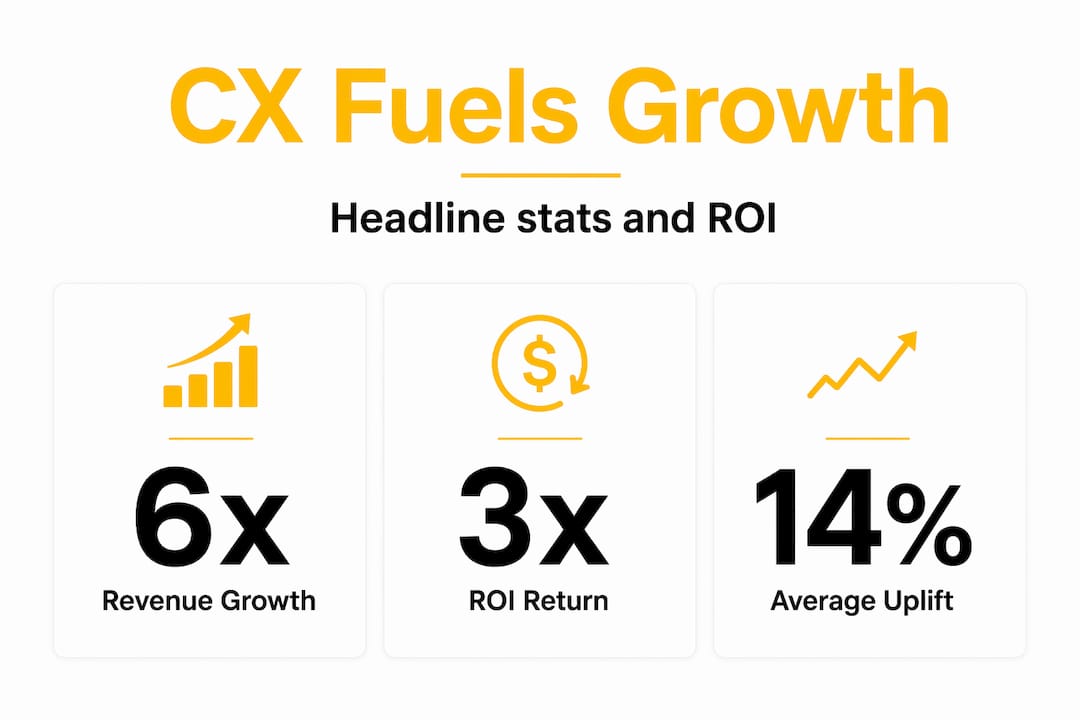
- Investing in CX yields a 3x ROI within 24 months and accounts for up to six times revenue growth for leaders.
Customer experience is no longer a support function. It is a primary growth engine. Yet many organizations still treat CX as a cost center rather than a revenue driver, missing the compounding financial upside that comes with getting it right. CX leaders achieve 6x revenue growth compared to laggards, and that gap is not accidental. It is the direct result of strategic investment, disciplined execution, and a clear-eyed understanding of how customer interactions translate into dollars. This guide breaks down the mechanics behind that gap and gives you a practical path forward.
Table of Contents
- Why customer experience drives exponential business growth
- The ROI of investing in CX: What leaders must know
- From mapping journeys to measurable impact: CX frameworks that work
- Advanced CX: Data science and methodology for sustainable growth
- The uncomfortable truth: CX growth is won in the trenches, not the boardroom
- Take the next step: Elevate your CX and drive growth
- Frequently asked questions
Key Takeaways
| Point | Details |
|---|---|
| CX multiplies revenue | CX leaders see up to six times revenue growth versus laggards. |
| ROI is rapid and clear | Typical CX investments deliver three times ROI within two years. |
| Retention drives results | Focusing on post-acquisition CX boosts loyalty, referrals, and profitability. |
| Frameworks matter | Mapping customer journeys and picking the right metrics accelerates growth. |
| Advanced analytics inform strategy | Data science, like state modeling, reveals new growth levers for leaders. |
Why customer experience drives exponential business growth
Most executives understand that keeping customers happy matters. Fewer understand just how directly CX outcomes connect to compounding financial performance. Retention, referrals, and cross-selling do not operate in isolation. They reinforce each other in ways that create exponential rather than linear growth.
Think about retention alone. Acquiring a new customer typically costs five to seven times more than keeping an existing one. When your CX consistently meets or exceeds expectations, you hold more customers through their natural lifecycle, reducing the constant pressure to replace lost revenue through expensive new acquisition. That freed-up budget can fund service improvements, which further reduce churn. The cycle compounds.
Cross-selling and upselling follow the same logic. Customers who trust your brand and have had positive experiences are significantly more open to expanding their relationship with you. They buy more, buy more often, and require less persuasion. Referrals add another layer: satisfied customers become an organic, low-cost acquisition channel. A single loyal advocate can bring in multiple new customers, each of whom enters the relationship with higher baseline trust than a cold prospect.
The financial evidence is clear. Great CX drives revenue growth through retention, reduced price sensitivity, cross-selling, and referrals, while simultaneously controlling costs through lower acquisition spend and reduced support volume. This is a dual benefit that almost no other business initiative can claim.
“Companies that lead in customer experience outperform laggards across virtually every financial metric, from revenue growth to shareholder returns.”
The executive community has taken notice. 74% of executives rank CX as a top-three priority, and S&P 500 analysis attributes an average 14% revenue variance directly to CX performance. That is a significant slice of total revenue tied to how well you serve your customers.
Here is what separates high-performing CX organizations from average ones:
- They map the full customer journey, not just acquisition touchpoints
- They invest in post-sale experience, where loyalty and expansion revenue actually form
- They connect CX metrics to financial outcomes, not just satisfaction scores
- They align frontline incentives with customer outcomes, not just operational efficiency
- They use retention as a leading indicator, not a lagging measure of damage done
For leaders ready to build or strengthen this kind of CX foundation, exploring proven CX strategies for loyalty offers a useful starting point for aligning effort with impact.
The ROI of investing in CX: What leaders must know
Numbers matter when you are making the case internally for CX investment. Boardroom conversations require hard data, not anecdotes. The good news is that the financial case for CX has never been stronger or more clearly documented.
Typical CX investment returns 3x ROI within 24 months. That is a return profile that compares favorably with many traditional capital investments, and it builds an enduring asset: a loyal, expanding customer base that is harder for competitors to disrupt.
The gap between CX leaders and laggards is even more striking at the revenue level. CX leaders achieve 6x revenue growth compared to laggards, a difference that compounds year over year. Leaders who invest early accumulate structural advantages in retention, referrals, and brand equity that are difficult for slower movers to overcome.

| CX initiative | Typical ROI | Time to return | Primary driver |
|---|---|---|---|
| Retention improvement | 3x to 5x | 12 to 18 months | Reduced churn cost |
| Self-service and deflection | 2x to 4x | 6 to 12 months | Support cost reduction |
| Cross-sell optimization | 2x to 3x | 12 to 24 months | Revenue per customer |
| Full CX transformation | 3x average | 24 months | Combined financial impact |
One of the most common barriers to increased CX budgets is the disconnect between satisfaction metrics and financial performance. Executives who struggle to connect Net Promoter Score (NPS) or Customer Satisfaction (CSAT) scores to revenue outcomes often see CX investment as discretionary rather than essential.
The solution is straightforward: tie every metric you report to a financial outcome. NPS is compelling when paired with data showing that promoters generate 2x the lifetime value of detractors. CSAT matters more when linked to renewal rates or expansion revenue. First-contact resolution becomes a budget argument when translated into cost-per-interaction savings.
Pro Tip: Before your next budget cycle, map your three primary CX metrics to their corresponding financial outcomes. Present each metric with a dollar figure attached. Leaders who do this consistently report faster budget approvals and higher investment levels.
When structuring your measurement approach, investing time in measuring CX success with financial linkages will give your program the credibility it needs to attract sustained funding.
From mapping journeys to measurable impact: CX frameworks that work
Theory does not move revenue. Frameworks that translate insight into action do. The most effective CX leaders share a disciplined approach to structuring their programs around a few core methodologies.
Customer journey mapping is the foundation. It forces your team to view the experience from the customer’s perspective across every stage, from initial awareness through purchase, onboarding, ongoing use, and eventual renewal or expansion. Most organizations map their pre-sale journey reasonably well. Post-acquisition experience is where significant gaps typically emerge, and where the most valuable loyalty and expansion revenue lives.
Gartner research highlights that the mechanics of high-performing CX programs include end-to-end journey mapping, a post-acquisition focus that drives loyalty, integrated feedback systems, and clear linkages between CX metrics and financial outcomes. Organizations that follow this structure demonstrate CX ROI consistently, which fuels additional investment.
The metric overload problem is real and underappreciated. Companies use 50 to 200 CX metrics, and most of them generate data without generating action. A smarter approach aligns a small number of key metrics to specific journey stages, ensuring each metric has a clear owner and a clear action trigger.
| Approach | Metrics tracked | Outcome quality | Actionability |
|---|---|---|---|
| Metric overload | 50 to 200 | Low clarity | Reactive at best |
| Stage-aligned approach | 5 to 10 per stage | High clarity | Proactive and targeted |
Here is a practical numbered process for building a stage-aligned CX framework:
- Map your full customer journey across all touchpoints, including support, onboarding, renewal, and escalation
- Identify three to five key moments that have the highest emotional and financial impact on the customer relationship
- Assign one to two metrics to each high-impact moment, chosen for their direct link to customer behavior
- Establish financial linkages for each metric, such as connecting first-contact resolution to support cost and churn rate
- Create an action trigger for each metric so teams know exactly what to do when performance shifts
Pro Tip: When presenting CX frameworks to your executive team, connect feedback directly to financial outcomes. Every percentage point improvement in CSAT or NPS should be translated into its revenue or cost equivalent. This is the language that wins sustained organizational commitment.
Leaders looking to sharpen how they implement these frameworks can explore both smart CX metrics and the range of customer experience services that support these approaches at scale.
Advanced CX: Data science and methodology for sustainable growth
For organizations that have mastered the fundamentals, the next frontier is predictive analytics and behavioral modeling. This is where the most sophisticated CX programs separate themselves from even strong performers.
One of the most powerful emerging approaches involves customer state modeling. Rather than treating customer loyalty as a binary outcome (retained or churned), advanced programs model customers as existing across a spectrum of states. Research published in the Journal of Retailing outlines a customer expansion journey tracked through Hidden Markov models, which monitor how customers move through states ranging from basic to supreme loyalty. Three dimensions influence these transitions: recency (how recently a customer engaged), peak (their highest level of engagement), and trend (the direction of their engagement trajectory).
“Understanding where customers exist in their loyalty journey, and what is likely to push them forward or pull them backward, changes how you allocate service resources entirely.”
Why does this matter for growth? Because it shifts your CX strategy from reactive to proactive. Instead of responding to churn after it happens, you identify customers whose trajectory suggests risk and intervene before they disengage. Conversely, you identify customers on an upward trend and accelerate their expansion through personalized service.
Practical first steps for leaders exploring data science in CX include:
- Audit your existing data for recency, frequency, and value signals across the customer base
- Segment customers by trajectory, not just current status, to identify early warning signs
- Build a simple state model with two or three loyalty tiers before adding complexity
- Align service resources to highest-leverage intervention points identified through the model
- Test personalization triggers for customers approaching a positive state transition to accelerate expansion
- Review a strong employee retention case study to understand how workforce stability directly enables consistent CX delivery
The connection between people and data is critical here. Models are only as effective as the frontline teams executing on their insights. Pairing advanced analytics with evidence-based CX strategies ensures that your data investments translate into improved interactions rather than impressive dashboards that no one acts on.
The uncomfortable truth: CX growth is won in the trenches, not the boardroom
Here is something most CX literature will not tell you directly. The organizations with the best dashboards are rarely the ones with the best customer experiences. Real CX growth is won through thousands of frontline interactions, escalation handoffs handled with care, onboarding calls that run smoothly because agents are trained and empowered, and support tickets resolved on first contact because the systems behind them are built for resolution, not deflection.
Leaders often pour energy into acquisition metrics, brand positioning, and satisfaction surveys while underinvesting in the everyday execution that determines whether customers actually stay and expand. CX programs exceeding expectations are 2.3x more likely to focus on post-acquisition experience rather than acquisition itself. And organizations that connect satisfaction metrics to business results see 29% higher CX budgets as a direct outcome.
The budget argument writes itself when you frame CX investment in terms of retention revenue protected, not dollars spent on service. But winning that argument at the leadership level still does not guarantee results at the operational level. That requires something harder: aligning frontline incentives with customer outcomes.
Most organizations incentivize speed (handle time, tickets closed) rather than quality (resolution rate, sentiment shift, expansion signals). This creates a systemic misalignment between what the business rewards and what customers actually value. Fixing it means changing how you measure and reward your CX teams, from the ground up.
Pro Tip: Incent CX improvement at the operational level, not just the leadership level. Agents and team leads who see their compensation tied to customer satisfaction and retention outcomes behave differently than those measured purely on throughput.
The leaders getting this right are not always the ones with the biggest budgets. They are the ones who understand that improving client retention strategies requires structural changes to how frontline teams are empowered, measured, and supported every day.
Take the next step: Elevate your CX and drive growth
The financial case for CX investment is clear, but knowing where to focus and how to execute at scale is where most organizations struggle. Partnering with a specialized CX provider accelerates transformation by bringing disciplined frameworks, trained talent, and proven performance models from day one.

Altiam CX delivers nearshore customer experience outsourcing built around cultural alignment, measurable outcomes, and scalable team extension. Whether you are building a retention-focused support operation or scaling your technical assistance function, our teams are structured to deliver results that connect directly to your growth objectives. For fast-growth tech CX companies especially, speed and quality cannot trade off against each other. Our model is designed to deliver both. See how this approach has driven real results in our CX improvement case study for a leading orthodontic services provider.
Frequently asked questions
How much can improving CX increase revenue?
CX leaders achieve 6x the revenue growth of lagging competitors, with S&P 500 analysis attributing an average 14% revenue variance directly to CX performance. These are not marginal gains; they represent a structural competitive advantage.
What is the typical ROI of CX investments?
Typical CX investments return 3x ROI within 24 months, driven by reduced churn costs, lower acquisition spend, and increased revenue per customer. Few business initiatives offer this combination of speed and magnitude.
Where do most CX programs go wrong?
Most programs track too many metrics and over-index on acquisition, when the real ROI sits in post-acquisition loyalty. Companies tracking 50 to 200 CX metrics often generate data without generating action; aligning fewer, well-chosen metrics to specific journey stages is consistently more effective.
How do advanced analytics support CX growth?
Techniques like Hidden Markov model state tracking reveal where customers sit in their loyalty journey and what factors are driving transitions, enabling leaders to intervene proactively to boost retention and accelerate expansion revenue.
What are quick wins for improving CX impact?
Start by mapping your full customer journey with a post-acquisition focus, then connect your three most important CX metrics to their direct financial outcomes. Align frontline team incentives to customer satisfaction and retention results rather than throughput alone, and you will see both behavior and outcomes shift quickly.