
TL;DR:
- Patient experience outsourcing involves contracting external providers to manage patient-facing services like scheduling, billing, and follow-up, enhancing satisfaction and operational efficiency. It reduces staff burnout and improves clinical focus by shifting non-clinical tasks to specialized teams equipped with healthcare-trained personnel and technology. Successful implementation depends on clear goals, strategic framing, strong governance, and thorough risk mitigation measures, such as ensuring data security and stakeholder alignment.
Patient experience outsourcing is defined as the practice of contracting specialized external providers to manage patient-facing interactions, support services, and engagement functions on behalf of a healthcare organization. This is the industry’s broader term for what practitioners also call patient experience management (PXM) outsourcing, and it covers everything from appointment scheduling to post-visit follow-up communications. When executed with clear goals and the right partner, it directly improves patient satisfaction scores, reduces internal staff burden, and gives clinical teams more time for care. Organizations like Altiamcx have built nearshore models specifically designed to deliver this kind of measurable, scalable patient support.
What is patient experience outsourcing and what services does it include?
Patient experience outsourcing covers a defined set of patient-facing and operational functions that healthcare organizations transfer to external specialists. The scope is wider than most administrators initially expect. Understanding the full range of services helps you identify exactly where outsourcing creates the most value for your organization.
Core services typically included are:
- Appointment scheduling and reminders: Inbound and outbound call handling, digital scheduling support, and automated reminder workflows that reduce no-show rates.
- Billing inquiries and financial navigation: Patient-facing billing support, insurance verification assistance, and payment plan guidance that reduces confusion and friction at a sensitive touchpoint.
- 24/7 patient support lines: After-hours coverage for non-clinical questions, triage routing, and urgent care direction that keeps patients connected to your system around the clock.
- Post-visit follow-up communications: Discharge check-ins, care plan reminders, and satisfaction surveys that close the loop on each patient encounter.
- Patient engagement and education: Condition-specific outreach, medication adherence calls, and preventive care campaigns managed by trained specialists.
Outsourced teams also deploy CRM-enabled personalization and real-time analytics to tailor every interaction to the individual patient’s history and preferences. This technology layer is what separates a high-performing outsourced program from a basic call center arrangement. Staff at specialized providers receive training in empathetic communication, healthcare compliance, and de-escalation, which means patient interactions are handled with the same care your internal team would apply.
Pro Tip: Before signing any outsourcing contract, request a detailed service catalog and ask the provider to map each service to a specific patient journey stage. This prevents scope gaps and sets clear performance expectations from day one.

How does outsourcing improve operational efficiency and patient satisfaction?
The operational case for outsourcing patient experience functions is grounded in a straightforward resource equation. Clinical staff are trained and compensated to deliver care, not to manage billing calls or coordinate appointment reminders at scale. When those tasks move to a specialized external team, the result is measurable on both sides of the ledger.
“Outsourcing empowers providers to focus on clinical care while enhancing patient touchpoints with professional, empathetic staff.” — Healthcare Magazines
Outsourcing reduces staff burnout and increases focus on core clinical work, which is one of the most consistent findings across healthcare operations research. This matters because burnout directly degrades care quality and patient satisfaction scores. When nurses and physicians are not fielding administrative calls, they perform better clinically and patients notice.
On the patient satisfaction side, integrated experience programs that connect governance, workforce well-being, and technology demonstrate measurable improvements in trust, loyalty, and outcomes. Outsourcing accelerates this integration by bringing in partners who already have the technology infrastructure, trained staff, and performance frameworks in place. You are not building from scratch. You are plugging into a proven system.
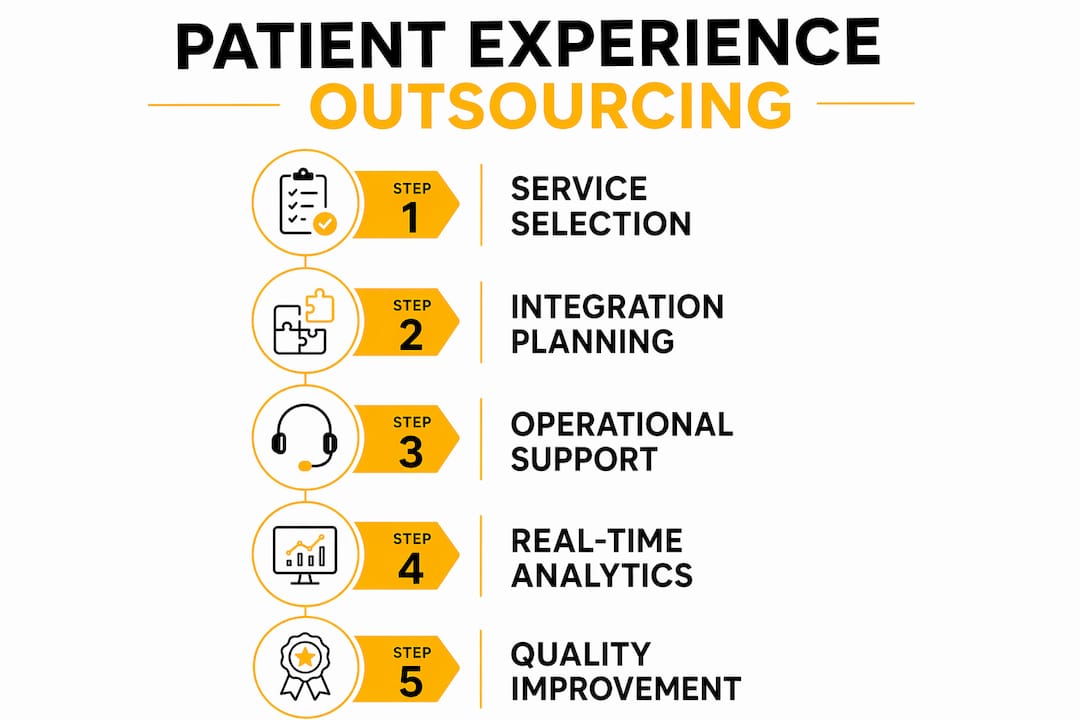
Patient experience management directly correlates with increased patient trust and better business outcomes when positioned as a business objective rather than an altruistic activity. This framing matters for internal budget conversations. Satisfaction scores tied to reimbursement models like HCAHPS make patient experience a direct revenue driver, not a soft metric. Outsourcing partners who understand this connection bring accountability structures that in-house teams often lack.
The data tracking capabilities of outsourced CX teams also generate operational insight that feeds back into your improvement cycle. Real-time dashboards, call analytics, and patient feedback aggregation give administrators visibility into service quality at a granularity that most internal teams cannot replicate without significant technology investment.
What are the risks of patient experience outsourcing and how do you mitigate them?
Outsourcing patient experience functions carries real risks. Acknowledging them upfront is what separates administrators who build successful programs from those who reverse course after 12 months. The good news is that each risk has a defined mitigation strategy.
-
Care quality perception among staff and patients. Clinical staff sometimes interpret outsourcing as a signal that leadership is deprioritizing care quality. Patients may feel they are interacting with a disconnected third party. Address this by communicating the clinical enablement rationale internally before launch and by ensuring outsourced staff are trained on your organization’s specific protocols and culture.
-
Data security and compliance exposure. Compliance and patient data trust are paramount when outsourcing occurs. Any partner handling protected health information must demonstrate HIPAA compliance, SOC 2 certification, and clear data handling protocols. Require a Business Associate Agreement and conduct a security audit before onboarding.
-
Integration with internal processes. Outsourced teams that operate in isolation from your EHR, scheduling system, or internal escalation pathways create friction rather than removing it. Define integration requirements in the contract and test workflows before going live.
-
Stakeholder buy-in and governance gaps. Programs without executive sponsorship and defined governance structures drift. Assign an internal program owner who holds the outsourcing partner accountable to agreed KPIs on a monthly basis.
-
Positioning as cost-cutting rather than clinical enablement. Framing outsourcing strategically aligns stakeholders and promotes sustainable success. When the narrative is “we are freeing our clinical team to focus on patients,” buy-in follows. When the narrative is “we are cutting headcount,” resistance follows.
Pro Tip: Run a 90-day pilot with a defined patient population segment before full deployment. Pilots surface integration issues and cultural misalignments early, when corrections are inexpensive.
Outsourcing vs. in-house patient experience management
The decision between outsourcing and managing patient experience in-house is not binary. Many healthcare organizations run hybrid models. But understanding the direct trade-offs helps you allocate resources where they generate the most return.
| Factor | Outsourcing | In-house |
|---|---|---|
| Scalability | High. Capacity adjusts to patient volume without hiring cycles. | Low. Scaling requires recruitment, training, and infrastructure investment. |
| Cost structure | Variable and predictable. Pay for performance and volume. | Fixed. Salaries, benefits, and overhead regardless of utilization. |
| Technology access | Immediate. Partners bring CRM, analytics, and AI tools already deployed. | Delayed. Procurement and implementation timelines add months. |
| Control over interactions | Moderate. Governed by SLAs and performance frameworks. | High. Direct supervision and real-time intervention possible. |
| Cultural alignment | Requires deliberate onboarding and ongoing calibration. | Natural. Staff share organizational culture from day one. |
| Expertise depth | High. Specialists trained specifically in patient communication and CX. | Variable. Depends on internal training investment and staff retention. |
Outsourcing provides flexibility and scalability that in-house solutions struggle to match, but it does require trade-offs in direct control over patient interactions. The right answer depends on your organization’s volume, budget, and strategic priorities. For health systems managing high patient volumes with constrained administrative budgets, outsourcing typically delivers faster ROI. For smaller practices where patient relationships are deeply personal, a hybrid model often works better.
Best practices for implementing patient experience outsourcing
Execution quality determines whether outsourcing delivers on its promise. The following practices reflect what consistently separates high-performing programs from underperforming ones.
- Define measurable goals before selecting a partner. Identify the specific metrics you want to move: HCAHPS scores, first-call resolution rates, appointment no-show rates, or patient satisfaction index. Partners who cannot tie their services to your specific KPIs are not the right fit.
- Select a partner with healthcare-specific experience. General BPO providers lack the compliance knowledge and clinical communication training that patient-facing work requires. Evaluate patient support outsourcing services based on healthcare client references and HIPAA compliance documentation.
- Build feedback loops into the contract. Closed-loop feedback and governance ensure patient needs and expectations are met over time. Require monthly reporting on patient satisfaction data, escalation logs, and service quality metrics.
- Align internal and external teams on protocols. Conduct joint training sessions that cover your organization’s escalation pathways, clinical terminology, and patient communication standards. This alignment prevents the “disconnected third party” perception that erodes patient trust.
- Embed experience metrics into leadership KPIs. Healthcare organizations embedding experience metrics into leadership KPIs and daily operations build long-term patient trust more effectively. When your internal leaders are accountable for outsourced program outcomes, governance stays sharp.
- Plan for continuous improvement, not a one-time launch. Review performance quarterly, adjust service scope as patient needs evolve, and treat the outsourcing relationship as a long-term operational partnership rather than a vendor transaction.
Key takeaways
Patient experience outsourcing delivers measurable gains in satisfaction, operational efficiency, and clinical focus when it is structured as a strategic partnership with clear governance and defined performance metrics.
| Point | Details |
|---|---|
| Definition and scope | Patient experience outsourcing covers scheduling, billing support, 24/7 patient lines, follow-up, and engagement services managed by external specialists. |
| Primary operational benefit | Outsourcing reduces staff burnout and frees clinical teams to focus on direct patient care, improving both performance and satisfaction. |
| Critical risk to manage | Data security and HIPAA compliance require a verified Business Associate Agreement and security audit before any partner onboarding. |
| Strategic framing matters | Positioning outsourcing as clinical enablement rather than cost-cutting secures staff buy-in and preserves care quality perception. |
| Governance drives outcomes | Monthly KPI reviews, closed-loop feedback, and an internal program owner are non-negotiable for sustained program performance. |
Why the framing of outsourcing determines whether it works
I have seen healthcare administrators approach outsourcing in two fundamentally different ways, and the framing they choose at the start predicts the outcome almost every time. The administrators who lead with “we need to cut costs on patient services” end up with resistant clinical staff, disengaged outsourced teams, and patient satisfaction scores that barely move. The administrators who lead with “we need to free our clinical team from administrative load so they can do what they were trained to do” build programs that actually perform.
The research supports this directly. Patient experience must be managed as a business driver with measurable outcomes, not as a marketing add-on, to generate sustainable organizational support. That principle applies equally to how you frame outsourcing internally.
The other thing I would push back on is the assumption that outsourcing means losing control. The best outsourcing programs I have observed give administrators more visibility into patient interaction quality than they had before, because the partner brings reporting infrastructure that most in-house teams never build. You are not giving up control. You are trading informal, untracked interactions for documented, measured, and improvable ones. That is a better position to be in, not a weaker one.
The organizations that struggle with outsourcing are almost always the ones that treated it as a procurement decision rather than a program design decision. Pick the right partner, build the governance structure, and define what success looks like before you sign anything.
— Daniela
How Altiamcx supports healthcare patient experience programs

Altiamcx delivers nearshore healthcare CX operations built specifically for health systems and healthcare organizations that need measurable, scalable patient support without the overhead of building internal teams from scratch. Altiamcx combines cultural alignment, disciplined performance frameworks, and healthcare-trained specialists to manage patient scheduling, billing support, follow-up communications, and 24/7 patient engagement. The results are documented. A recent productivity improvement case study demonstrates an 89% productivity gain following migration to Altiamcx operations. If your organization is ready to move from evaluating outsourcing to executing it, Altiamcx is the partner built for that transition.
FAQ
What is patient experience outsourcing in simple terms?
Patient experience outsourcing is the practice of hiring an external provider to manage patient-facing services such as scheduling, billing inquiries, follow-up calls, and 24/7 support on behalf of a healthcare organization. The goal is to improve service quality and patient satisfaction while freeing internal clinical staff for direct care.
What functions are most commonly outsourced in patient experience management?
The most commonly outsourced functions include appointment scheduling, billing and insurance support, post-visit follow-up communications, patient satisfaction surveys, and after-hours support lines. These are high-volume, non-clinical touchpoints where specialized external teams consistently outperform stretched internal staff.
How does outsourcing affect patient satisfaction scores?
Outsourcing improves patient satisfaction scores by providing faster response times, 24/7 availability, and trained communication specialists who handle every interaction consistently. Integrated experience programs that include real-time accountability and staff empathy training show measurable improvements in trust and loyalty.
What are the biggest compliance risks in patient experience outsourcing?
The primary compliance risk is improper handling of protected health information under HIPAA. Mitigate this by requiring a signed Business Associate Agreement, verifying SOC 2 certification, and conducting a security audit of the partner’s data handling protocols before any patient data is shared.
Is outsourcing patient experience services better than managing it in-house?
Outsourcing delivers stronger scalability, faster technology access, and lower variable costs compared to in-house management, but requires deliberate governance and cultural alignment to succeed. For health systems with high patient volumes and constrained administrative budgets, outsourcing typically generates faster and more measurable returns than building internal capacity.