
Customer experience is the primary operational lever that converts first-time buyers into repeat customers. Get it right, and you reduce acquisition costs, lift average order value, and build a revenue base that compounds over time.
The evidence is direct. XMI/Qualtrics research shows a Pearson correlation of approximately 0.69 between customer satisfaction and likelihood to repurchase, one of the strongest causal links measured across industries. Qualtrics also estimates that $3 trillion in global revenue is at risk from poor customer experiences. These are not soft metrics. They are the financial stakes of every CX decision your organization makes.
Three immediate business impacts stand out:
- Repurchase rate: Organizations that build systematic post-purchase CX programs can increase repeat purchase rates significantly from a natural baseline toward much higher rates with systematic programs in e-commerce contexts.
- Average order value: Customers who trust a brand spend more per transaction over time, because familiarity reduces the friction of evaluating alternatives.
- Margin and acquisition cost: A repeat customer costs a fraction of a new one to convert. Every CX investment that retains a customer is also a reduction in your cost-per-acquisition.
The sections below cover the causal mechanisms, the research, the prioritized levers, a time-bound roadmap, and a real Altiamcx client case study showing measurable results.
Table of Contents
- How CX actually changes whether a customer comes back
- What the research actually shows about CX and repeat purchases
- A practical roadmap: quick wins, 90-day projects, and 12-month programs
- What CX initiatives actually cost and what ROI to expect
- How Altiamcx helped a software platform improve repeat engagement by 89%
- What to ask before you outsource or prioritize CX programs
- Key Takeaways
- Why CX should be your repeat-purchase engine, not your campaign calendar
- Sources and further reading
How CX actually changes whether a customer comes back
Repeat purchasing is not a loyalty program outcome. It is a behavioral outcome shaped by how a customer feels at every touchpoint after the first transaction. Four mechanisms drive it.
Emotional memory and trust. Customers do not evaluate every purchase from scratch. They rely on memory. A positive post-purchase experience, a resolved issue handled well, or a proactive check-in creates a mental shortcut that makes the next purchase feel lower-risk. Fast Company’s analysis of CX as a growth driver frames this precisely: when CX is treated as a continuous motion rather than a handoff, it preserves post-sale value and builds durable revenue.
Friction reduction at post-purchase touchpoints. The period immediately after a purchase is where most brands go silent. That silence is a missed window. Customers who receive clear delivery updates, easy return processes, and fast answers to product questions are significantly more likely to reorder. Research published on Zenodo confirms that transaction convenience and product reliability are among the strongest empirical drivers of repeat purchase intent, while service responsiveness remains the most common bottleneck.
Personalized signal reinforcement. A generic “thanks for your order” email does almost nothing. A message that references what the customer bought, anticipates their next need, and offers a relevant prompt at the right moment does a great deal. The mechanism is relevance: customers return when they feel understood, not just served.
Context continuity across handoffs. When a customer contacts support and has to re-explain their situation to three different agents, trust erodes. Siloed handoffs are one of the most reliable predictors of churn. Preserving context through every interaction, whether that is a support ticket, a billing question, or a product inquiry, is an operational discipline that directly affects whether someone comes back.
Example: A consumables brand that adds a post-purchase education sequence (usage tips, reorder timing guidance, and a single conditional offer) typically sees faster time-to-second-purchase than brands relying on calendar-based promotional campaigns. The mechanism is simple: the customer is primed to reorder before the need becomes urgent, and the offer arrives when it is relevant rather than arbitrary.
What the research actually shows about CX and repeat purchases
The data on this topic is unusually consistent. Across industries and methodologies, better CX correlates strongly with higher repurchase rates, greater trust, and more referrals.
The XMI/Qualtrics Global ROI of Customer Experience study measured Pearson correlation coefficients between satisfaction and key loyalty behaviors. The repurchase correlation of approximately 0.69 is notable because it holds across multiple industries, not just high-touch categories like hospitality or financial services. That means a CX improvement in e-commerce, healthcare, or SaaS is likely to produce a measurable lift in repeat purchasing, not just satisfaction scores.
Watermark Consulting’s Customer Experience ROI Study adds another dimension: CX leaders do not just earn more revenue. They also reduce operating costs, because customers who have good experiences generate fewer support contacts, fewer escalations, and fewer returns. Memorable experiences, not merely satisfactory ones, drive the outsized retention and referral effects.
The financial risk framing matters for executive conversations. Qualtrics’ estimate of $3 trillion at risk globally from poor CX reframes CX investment from a cost center to a risk mitigation strategy. When consumers cut spending after bad experiences, the revenue impact is immediate and measurable.
For leaders building internal business cases, here is how to translate these statistics into targets:
- Set a baseline repeat purchase rate for your category using published benchmarks (subscription categories run higher; fashion and durables run lower).
- Calculate the revenue impact of a 5-percentage-point lift in your repeat purchase rate across your active customer base.
- Use the XMI correlation data to estimate the satisfaction improvement needed to produce that behavioral shift.
- Frame the CX investment against that revenue opportunity, not against the cost of the program alone.
A significant share of organizations worldwide already name CX as a competitive differentiator, which means the window for differentiation through CX is narrowing. The organizations that build systematic programs now will hold a structural advantage over those still treating CX as a reactive function.
A practical roadmap: quick wins, 90-day projects, and 12-month programs
Execution sequencing matters as much as strategy. Here is a time-bound roadmap that prioritizes speed-to-impact without sacrificing long-term program integrity.
-
Quick wins (0–30 days): post-purchase sequence. Build a three-to-five-touch email or SMS sequence that begins immediately after purchase. Include delivery confirmation, a usage tip or onboarding resource, a check-in at the expected consumption midpoint, and a reorder prompt timed to the product’s natural cycle. This is the single highest-ROI CX action for most e-commerce and consumables businesses.
-
Quick wins (0–30 days): shipment and delivery transparency. Add proactive delivery status updates via SMS or email. Customers who know where their order is contact support less and rate their experience higher. This is a low-cost, high-signal change.
-
Quick wins (0–30 days): one-click reorder prompts. Reduce the friction of the second purchase to a single action. A reorder button in the post-purchase email, the account dashboard, or the order history page removes the decision cost entirely.
-
90-day project: RFM lifecycle segmentation. Segment your customer base by Recency, Frequency, and Monetary value. This gives you the foundation for targeted interventions: win-back campaigns for lapsed customers, upsell sequences for high-frequency buyers, and retention offers for customers showing early churn signals. Lifecycle segmentation frameworks are well-documented and implementable without enterprise-level tooling.
-
90-day project: trigger-based incentive loops. Replace calendar-based promotions with behavior-triggered offers. A customer who has not reordered within 120% of their typical cycle receives a conditional, time-bound offer. This protects margin and increases conversion rates compared to blanket discounts.
-
90-day project: basic recommendation engine rules. You do not need a machine learning model to start. Rule-based recommendations (“frequently bought together,” “replenishment reminder at 30 days”) produce measurable lift and can be implemented in most e-commerce platforms within weeks.
-
12-month program: integrated personalization platform. Once you have segmentation and trigger logic in place, invest in a platform that unifies customer data across channels and automates personalized outreach at scale. The goal is a single customer view that informs every touchpoint.
-
12-month program: subscription options for consumables. If your product has a natural replenishment cycle, a subscription option converts the repurchase decision from active to passive. Even a modest subscription conversion rate has a compounding effect on CLV.
-
12-month program: loyalty tier design. Design tiers that reward behavior beyond spend: reviews, referrals, product registrations, and engagement with educational content. Behavioral loyalty programs build habit, not just transaction frequency.
-
12-month program: end-to-end journey mapping. Map every customer touchpoint from first purchase through the third or fourth transaction. Identify the friction points, the silence gaps, and the moments where customers are most likely to defect. This becomes the master brief for your CX improvement backlog.
Pro Tip: When A/B testing incentive offers, keep the control group receiving no offer and the test group receiving a small, conditional incentive (free shipping on the next order, a 10% credit toward a specific product). This structure lets you measure the true lift of the incentive without training your entire customer base to expect a discount.
What CX initiatives actually cost and what ROI to expect
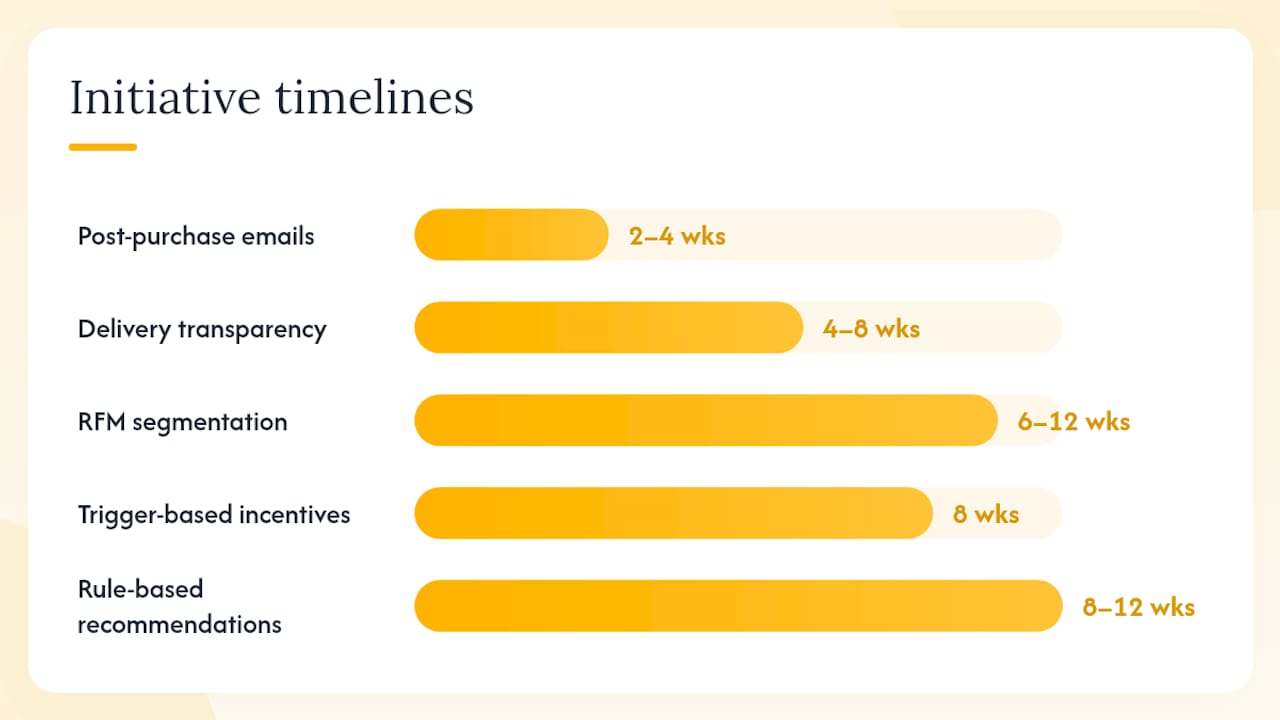
Finance leaders need numbers, not principles. The table below gives realistic cost bands, timelines, and expected outcomes for the most common CX initiatives that affect repeat purchases.
| Initiative | Cost Band | Timeline | Key KPIs |
|---|---|---|---|
| Post-purchase email/SMS sequence | Low | 2–4 weeks | Time-to-second-purchase, repeat purchase rate |
| Delivery transparency tooling | Low–Medium | 4–8 weeks | Support contact rate, CSAT |
| RFM segmentation and lifecycle campaigns | Medium | 6–12 weeks | Cohort retention, CLV by segment |
| Trigger-based incentive automation | Medium | 8 weeks | Repurchase rate, margin per order |
| Recommendation engine (rule-based) | Medium | 8–12 weeks | Average order value, cross-sell rate |
| Loyalty tier program | Medium–High | 3–6 months | Repeat purchase rate, NPS |
| Integrated personalization platform | High | 6–12 months | CLV, omnichannel engagement rate |
| Nearshore managed CX team | Medium–High | 4–8 weeks to deploy | CSAT, first-contact resolution, support cost per ticket |
The business case math is straightforward. Take your current active customer base, apply your baseline repeat purchase rate, and calculate the revenue impact of a 5-percentage-point improvement. For a business with 50,000 active customers and an average order value of $120, that lift is worth $300,000 in incremental annual revenue before any CLV compounding. That figure is the numerator in your ROI calculation.
Without systematic CX programs, natural repeat rates tend to sit at 10–15%. With well-executed lifecycle automation and post-purchase experience improvements, rates of 40–50% are achievable in e-commerce. The gap between those two numbers is the financial case for investment.
On resource models: in-house teams can execute quick wins and 90-day projects with existing staff if the tooling is in place. The 12-month programs, particularly integrated personalization and loyalty design, typically require either dedicated internal headcount or a managed services partner. Nearshore CX teams, like those Altiamcx deploys, offer a faster path to scale than building internal capacity from scratch, with measurable SLAs tied to retention outcomes rather than activity metrics.
How Altiamcx helped a software platform improve repeat engagement by 89%
A software platform company came to Altiamcx with a specific problem: their technical support function was creating friction at exactly the moments when customers were most likely to disengage. Support tickets were taking too long to resolve, agents lacked context on customer history, and the post-onboarding experience had no systematic follow-up. The result was a measurable drop-off in product engagement after the first 60 days, which directly suppressed renewal and upsell rates.
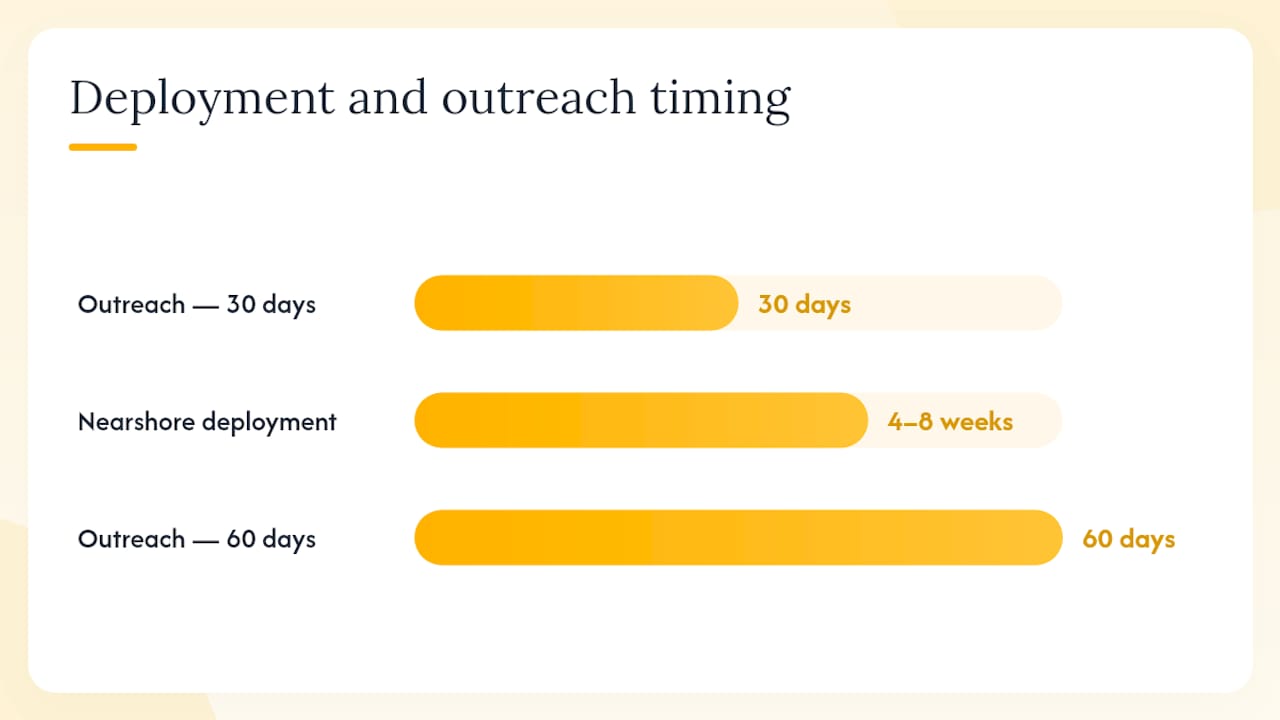
Altiamcx deployed a nearshore managed support team with three structural changes: a unified customer context system so agents had full interaction history before picking up a ticket, a proactive outreach sequence triggered at the 30-day and 60-day post-onboarding marks, and a defined escalation path that resolved complex issues within a single interaction rather than across multiple handoffs.
The outcome: productivity improved by 89% after the nearshore migration, support volume per customer dropped, and the post-onboarding engagement sequence measurably shortened the time between initial activation and the customer’s first upsell or renewal decision.
The transferable lessons are practical:
- Context continuity is non-negotiable. Agents without customer history create friction that erodes trust faster than almost any other single factor.
- Proactive outreach at 30 and 60 days post-purchase or post-onboarding is the highest-leverage automation most organizations are not running.
- Nearshore teams can be deployed in 4–8 weeks with the right partner, faster than building internal capacity and with measurable SLAs from day one.
For leaders in e-commerce or financial services, the same structural principles apply: context, timing, and clean escalation paths are the operational foundation of repeat purchasing.
What to ask before you outsource or prioritize CX programs
Whether you are evaluating a vendor or deciding which internal projects to fund first, the same discipline applies: tie every decision to a measurable retention or repurchase outcome.
Vendor selection checklist:
- Why customer experience is now the primary growth driver — Fast Company
- Organizations naming customer experience as a competitive differentiator — Statista
- What Drives Customers to Come Back? Understanding the Role of Customer Experience in Repeat Purchases — Zenodo (research paper)
- $3 Trillion is at Risk due to Bad Customer Experiences in 2026 — Qualtrics
- Global Study: ROI of Customer Experience (XMI/Qualtrics)
- Repeat Purchase Strategy: Building Systems for Customer Loyalty and Recurring Revenue — Rework resources
- Repeat Purchase Rate: Formula & Benchmarks (2026) — Intempt
- The Customer Experience ROI Study — Watermark Consulting
- Increase repeat purchases in ecommerce — Retentionside
Red flags to watch for:
- No instrumentation or reporting beyond basic ticket counts.
- Single-channel focus with no ability to preserve context across channels.
- A discount-first approach to retention that prioritizes short-term repurchase over margin health.
- Rigid, multi-year contracts with no performance-based adjustment clauses.
Prioritization matrix for common CX projects:
| Initiative | Impact on Repeat Purchases | Implementation Effort |
|---|---|---|
| Post-purchase email/SMS sequence | High | Low |
| Delivery transparency | Medium–High | Low |
| RFM segmentation | High | Medium |
| Trigger-based incentive loops | High | Medium |
| Loyalty tier program | Medium–High | High |
| Integrated personalization platform | High | High |
| Nearshore managed CX team | High | Medium (with right partner) |
For leaders managing customer escalation processes, the prioritization logic is the same: start with the highest-impact, lowest-effort changes, prove the model with data, then invest in the higher-effort programs with a validated business case behind them.
Key Takeaways
CX drives repeat purchases through measurable behavioral mechanisms. Without systematic CX programs, natural repeat purchase rates in e-commerce tend to sit at 10–15%. With well-executed lifecycle automation and post-purchase experience improvements, rates of 40–50% are achievable. Organizations that build systematic programs can increase repeat purchase rates substantially beyond natural baseline levels.
| Point | Details |
|---|---|
| Post-purchase window is highest-leverage | Automate a 3–5 touch sequence starting immediately after purchase to shorten time-to-second-purchase. |
| Use conditional incentives, not blanket discounts | Trigger-based, time-bound offers protect margin and outperform fixed promotions on conversion rate. |
| Measure RPR and time-to-second-purchase | These two metrics directly reflect whether your CX changes are moving repeat buying behavior. |
| Build the business case with CLV math | Calculate the revenue impact of a 5-point RPR lift across your active customer base before any CX investment. |
| Altiamcx delivers measurable results | Nearshore CX teams with context continuity and proactive outreach produced an 89% productivity improvement for a software platform client. |
Why CX should be your repeat-purchase engine, not your campaign calendar
Most organizations treat repeat purchases as a marketing problem. They run a promotion, see a short-term lift, and declare success. Then the lift fades, margins compress, and the cycle repeats. The data tells a different story.
The XMI/Qualtrics correlation data, the Watermark Consulting ROI findings, and the Zenodo empirical research all point to the same conclusion: repeat purchasing is a CX outcome, not a campaign outcome. The customers who come back are not responding to your next discount. They are responding to the memory of how you treated them after the last purchase.
What most leaders underestimate is the compounding effect of operational discipline in the post-purchase window. A single well-timed, context-aware interaction, a proactive check-in, a resolved issue that did not require three transfers, a reorder prompt that arrived exactly when the customer needed it, does more for repeat purchase rate than most promotional calendars. And it does it without eroding margin.
The organizations that will win on repeat purchasing over the next three years are not the ones with the biggest loyalty budgets. They are the ones that treat CX as a continuous growth motion, not a support function that activates when something goes wrong. That shift, from reactive to systematic, is where the real financial leverage lives.
Sources and further reading
The research and operational guidance used throughout this article:
- Organizations naming customer experience as a competitive differentiator — Statista: Global data on how organizations rate CX as a strategic priority.
- What Drives Customers to Come Back? — Zenodo: Empirical survey research linking transaction convenience and service responsiveness to repeat purchase intent.