
TL;DR:
- Effective referral support ensures patients reach the right specialist with proper documentation on time, improving quality and access. Implementing clear workflows, assigning accountability, and tracking closed-loop documentation are key to success. Partnering with operational services like Altiamcx can enhance productivity and patient retention for healthcare organizations.
Referral management support is the combination of people, processes, and systems that move a patient referral from the initial order through specialist scheduling, appointment completion, and closed-loop documentation back into the referring chart. If you are an administrator reading this, the most immediate step is to assign clear ownership: designate a referral manager or coordinator who is accountable for every referral from intake to close. This article covers the full workflow, staffing models, technology requirements, performance metrics, common failure points, and a practical implementation checklist.
Table of Contents
- What is referral management support, and why does the definition matter?
- Why referral management support changes outcomes for health systems and clinics
- How referral management support works in practice
- Who performs referral management support — roles, skills, and team models
- What technology does your referral management system actually need?
- What to measure: KPIs and benchmarks for referral support
- Common referral management problems and how to fix them
- How to implement or upgrade referral management support
- How Altiamcx supports referral management as an operational partner
- Key Takeaways
- What actually determines whether a referral support program succeeds
- Altiamcx delivers the operational backbone referral support requires
- Useful sources and further reading
What is referral management support, and why does the definition matter?
The term “referral management” gets used in two very different ways in U.S. healthcare. One version focuses on utilization controls, essentially gatekeeping to reduce referral volume. The other, which RCGP guidance explicitly favors, centers on quality, appropriateness, and access. Referral support belongs firmly in the second category. It is the operational infrastructure that makes sure the right patient reaches the right specialist with the right documentation, on time.
That distinction shapes every staffing, technology, and process decision you make. An organization optimizing purely for volume reduction will build different workflows than one optimizing for completed visits and closed-loop feedback. The latter approach aligns far better with value-based contracts, patient retention goals, and clinical quality standards.
Why referral management support changes outcomes for health systems and clinics
Poor referral workflows cost organizations in three ways simultaneously: clinically, operationally, and financially. Patients who fall through the cracks face delayed diagnoses. Staff waste hours chasing faxes and authorizations. And when patients seek care outside the network because the referral process felt too slow or confusing, the organization loses downstream revenue it will never recover.
Effective referral support reduces that leakage risk by keeping patients inside the network through a faster, more transparent experience. The hidden ROI is patient retention, not just completed visits. A patient who has a smooth referral experience is far more likely to return for primary care, follow-up, and ancillary services.
Key operational benefits include:
- Reduced referral leakage: Patients are less likely to seek outside-network care when scheduling is fast and communication is clear.
- Faster time-to-appointment: Structured intake and routing cut the days between referral order and specialist visit.
- Higher completion rates: Active follow-up and reminders convert more referrals into kept appointments.
- Stronger value-based contract performance: Closed-loop documentation supports quality reporting and risk adjustment.
- Improved provider relationships: Specialists receive complete, accurate referral packets, which reduces back-and-forth and builds trust.
Referral management software plays a supporting role here, unifying fragmented networks and standardizing workflows. But software alone does not close loops. Process design and staff ownership are what actually move the needle.
How referral management support works in practice
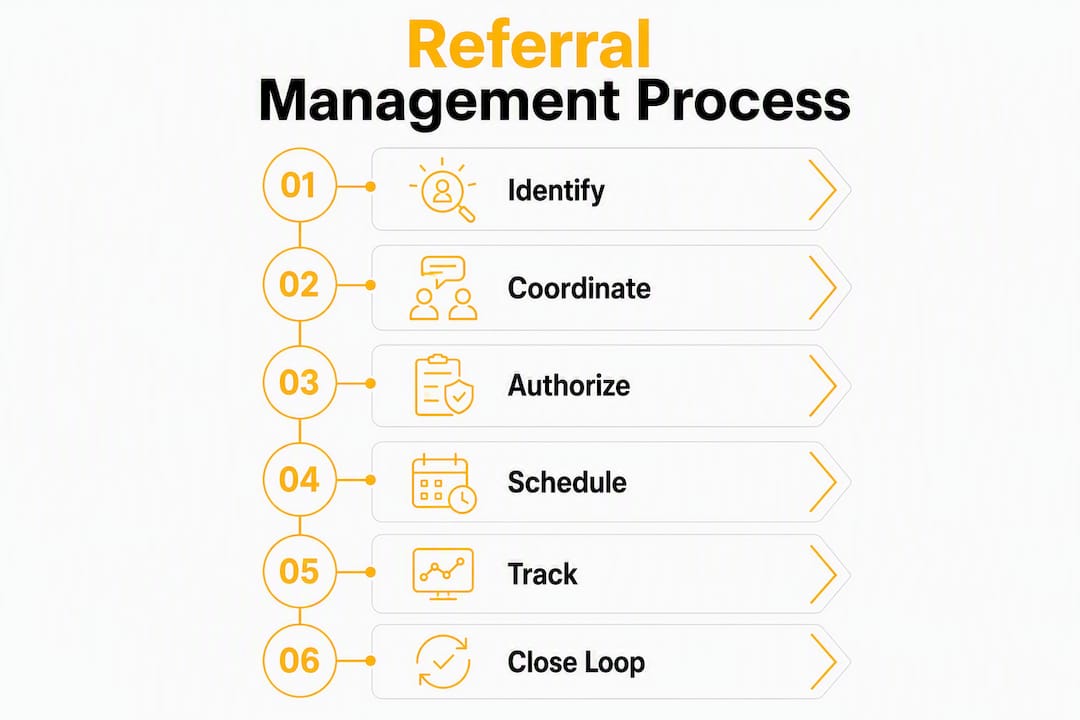
A well-run referral process follows a defined lifecycle. Each step has a clear owner, a time target, and a handoff protocol.
- Referral intake: The referring clinician places the order in the EHR or PM system. Staff capture the clinical indication, urgency level, and any required documentation at this point, not later.
- Clinical triage and appropriateness check: A clinical reviewer or experienced coordinator confirms the referral is appropriate for the requested specialty and urgency tier. This step prevents misrouted referrals and unnecessary specialist visits.
- Insurance verification and prior authorization: Staff verify the patient’s benefits and submit prior authorization requests where required. Authorization turnaround is one of the most common bottleneck points.
- Routing to specialty: The referral is matched to an in-network specialist based on availability, geographic proximity, language preference, and clinical fit.
- Scheduling and patient outreach: Staff contact the patient to confirm the appointment, explain what to expect, and collect any remaining information the specialist needs.
- Reminders and engagement: Automated reminders (text, phone, or portal message) reduce no-shows. Appointment accountability systems that combine automated touchpoints with a human follow-up call perform better than automation alone.
- Appointment completion: The specialist visit occurs. The receiving practice captures the consult note.
- Closed-loop feedback: The consult note and any follow-up orders return to the referring clinician’s chart. This step is where most organizations fail.
Pro Tip: Automate steps 1, 5, and 6 for routine referrals, but keep a designated staff member responsible for steps 3, 4, and 8. Authorization denials, patient barriers, and missing consult notes require human judgment that no workflow tool resolves on its own.
Who performs referral management support — roles, skills, and team models

Designating a referral manager is the single most reliable predictor of higher completed follow-up rates. The role does not need to be a full-time hire at every organization, but the accountability must be explicit.
Common roles:
- Referral manager/coordinator: Owns the full lifecycle, communicates with specialists, and tracks completion.
- Referral specialist: Handles high-volume intake, insurance verification, and scheduling for a specific service line or payer mix.
- Front-desk intake staff: Captures initial referral information and flags urgent cases for escalation.
- Clinical reviewer: Confirms appropriateness, typically a nurse or medical assistant with specialty knowledge.
- Escalation owner: Resolves authorization denials, patient no-contact situations, and provider capacity issues.
Staffing model comparison:
- Centralized team: One dedicated referral unit handles all referrals across the organization. Pros: consistent process, easier to train and audit. Cons: can feel distant from clinical teams, requires strong communication protocols.
- Distributed (clinic-level) model: Each clinic manages its own referrals. Pros: close to the clinical team, faster local decisions. Cons: inconsistent processes, harder to track organization-wide metrics.
- Hybrid model: Clinics handle intake and triage; a central team manages authorization, routing, and closed-loop tracking. This is the most common high-performing configuration.
- Managed partner/outsourced model: A nearshore or external operations team handles defined referral tasks under SLAs. Pros: scalable, cost-efficient, bilingual capacity. Cons: requires strong onboarding, clear data-sharing protocols, and regular performance reviews.
When referral volume grows faster than your hiring pipeline, or when your team spends more time on administrative tasks than patient engagement, a managed partner model is worth evaluating seriously.
What technology does your referral management system actually need?
Software is the foundation, not the solution. Modern referral platforms centralize inbound referrals from multiple sources, including fax, and expose them on a single dashboard where staff can organize, prioritize, assign, and track each case. Here is the feature checklist administrators should use when evaluating tools:
Core features:
- Centralized referral dashboard with status tracking and assignment
- Bidirectional EHR/PM integration (Epic, Cerner, Athenahealth, and similar systems)
- Fax-to-digital intake conversion
- Scheduling and automated patient reminders
- Insurance verification and prior authorization workflow support
- Analytics and reporting by referral type, payer, specialty, and completion status
Integration requirements:
- HL7 or FHIR-compliant data exchange for closed-loop documentation
- API connections to specialist EHR systems where available
- Patient portal integration for appointment confirmation and document upload
Compliance and security:
- HIPAA-compliant messaging and document storage
- Role-based access controls and audit trails
- Secure fax and encrypted communication channels
Pro Tip: When evaluating vendors, ask specifically how the platform handles closed-loop confirmation. Many tools manage outbound referrals well but have no structured mechanism for pulling consult notes back into the referring chart. That gap is where clinical and billing risk accumulates.
For organizations focused on reducing leakage, prioritize routing intelligence and in-network matching. For those focused on speed, scheduling automation and reminder workflows matter most. For quality reporting, analytics depth is the deciding factor.

What to measure: KPIs and benchmarks for referral support
You cannot manage what you do not measure. Tracking the proportion of referrals with consult notes returned to the referring chart is one of the fastest ways to surface systemic gaps. Pair that with the metrics below for a complete performance picture.
| KPI | What it measures | Practical target |
|---|---|---|
| Referral completion rate | Proportion of referrals resulting in a kept specialist appointment | A majority completion rate is considered high-performing |
| Time-to-first-appointment | Time from referral order to specialist visit | Aim for prompt scheduling for routine and urgent cases |
| Referral leakage rate | Proportion of referrals sent outside the network | Maintain low leakage rates |
| No-show rate (referred appointments) | Proportion of scheduled specialist visits not kept | Target minimal no-shows with active reminder programs |
| Prior authorization turnaround | Time from submission to decision | Aim for timely standard request processing |
| Closed-loop documentation rate | Proportion of referrals with consult notes returned to chart | A majority completion rate is considered high-performing |
Measure primary KPIs weekly during a pilot and monthly at steady state. For ROI calculations, tie referral completion rate and leakage rate directly to downstream revenue: a single retained patient across a care episode represents significant lifetime value. Healthcare service quality metrics provide a useful framework for connecting referral KPIs to broader operational performance goals.
Common referral management problems and how to fix them
Most referral failures trace back to a small set of root causes. Identifying which one is driving your leakage or completion gap determines which fix to apply first.
- Open loops (no closed-loop confirmation): Root cause: no structured mechanism for requesting or receiving consult notes. Fix: implement a closed-loop tracking field in your EHR or referral platform, and assign a coordinator to follow up on outstanding notes at a defined cadence.
- Incomplete referral documentation: Root cause: referring staff capture the order but not the supporting clinical information. Fix: standardized referral templates with required fields before submission; EHR-level hard stops for missing data on high-priority referrals.
- Authorization denials and delays: Root cause: incorrect coding, missing clinical criteria, or wrong payer pathway. Fix: dedicated authorization specialist with payer-specific training; pre-authorization checklists by specialty and payer.
- Scheduling delays: Root cause: specialist capacity constraints or poor routing to available providers. Fix: preferred provider agreements with capacity commitments; real-time availability feeds where possible.
- Poor specialist match: Root cause: routing based on geography alone, ignoring language, subspecialty, or payer acceptance. Fix: build a structured provider directory with matching criteria beyond zip code.
- Patient no-contact or no-show: Root cause: single outreach attempt, wrong contact information, or no reminder workflow. Fix: multi-channel outreach (phone, text, portal) with at least two attempts before escalation; health clinic booking best practices recommend confirming appointments 48 and 24 hours in advance.
One caution worth stating plainly:
Referral management programs that focus primarily on reducing referral volume through restrictive controls — rather than improving quality and care pathways — carry weak evidence for safety and cost-effectiveness. The goal of referral support should be appropriateness and access, not gatekeeping. Organizations that conflate the two often damage provider relationships and patient trust without achieving meaningful cost savings.
Source: RCGP referral management guidance
How to implement or upgrade referral management support
Follow this checklist in sequence. Skipping the audit and goal-setting steps is the most common reason implementations stall after the pilot.
- Conduct a current-state audit: Map every step in your existing referral workflow. Identify where referrals are created, tracked, and closed. Measure your current completion rate, leakage rate, and average time-to-appointment before changing anything.
- Define specific goals: Choose two or three primary KPIs from the table above. Set a target for each. “Improve referral management” is not a goal; “reduce time-to-appointment from 21 days to 12 days within 90 days” is.
- Assign ownership: Name a referral manager or coordinator who is accountable for the pilot. Without a named owner, accountability diffuses and the pilot drifts.
- Select a pilot population: Start with one service line, one payer, or one clinic. A focused pilot produces cleaner data and is easier to adjust than an organization-wide rollout.
- Select tooling or a managed partner: Match your technology choice to your primary goal (leakage, speed, or quality). If staffing is the constraint, evaluate a managed partner with defined SLAs before buying more software.
- Train staff: Cover the new workflow, the technology, and the escalation protocol. Include specialists and their staff — closed-loop documentation requires their participation.
- Run the pilot for 60–90 days: Track your chosen KPIs weekly. Flag deviations early. A 90-day window gives enough volume to see trends without locking in a flawed design.
- Set go/no-go thresholds: Before the pilot starts, define what success looks like. If completion rate does not improve by a defined margin, identify the root cause before scaling.
- Iterate and scale: Apply lessons from the pilot to the broader rollout. Update templates, routing rules, and training based on what the data showed.
When contracting with a managed partner, require SLAs on intake turnaround time, authorization submission speed, closed-loop documentation rate, and patient contact attempt frequency. Vague performance language in a contract produces vague results.
How Altiamcx supports referral management as an operational partner
Altiamcx works with healthcare organizations as a nearshore managed operations partner, taking on the staffed, process-intensive work that referral support requires at scale. The service model is designed for health systems, clinics, and FQHCs that need reliable execution without the overhead of building and managing an in-house referral coordination team.
Service scope includes:
- Nearshore team extension: Bilingual referral coordinators and specialists who operate under the organization’s workflows and EHR protocols.
- Intake and scheduling support: Handling inbound referral intake, patient outreach, and appointment scheduling with defined turnaround SLAs.
- Document management: Collecting, organizing, and routing clinical documentation to support complete referral packets and closed-loop confirmation.
- EHR/PM system support: Working within the organization’s existing technology stack rather than requiring a platform change.
- Bilingual patient outreach: Spanish-English communication for patient populations where language is a barrier to scheduling and follow-up.
Organizations that partner with Altiamcx for referral coordination typically see improvements in closed-loop completion rates, reductions in time-to-appointment, and measurable gains in staff capacity for higher-value clinical tasks. Specific outcomes vary by organization size, referral volume, and existing workflow maturity. The approach is illustrative of what disciplined operational execution, paired with the right staffing model, can produce. For a concrete example of how Altiamcx delivers measurable operational gains, the productivity improvement case study shows the performance framework in action.
Key Takeaways
Referral management support succeeds when ownership is explicit, workflows are documented, and closed-loop documentation is tracked as a primary KPI, not an afterthought.
| Point | Details |
|---|---|
| Assign clear ownership | Name a referral manager accountable for every referral from intake to closed-loop confirmation. |
| Track closed-loop rate | Monitor whether referrals have consult notes returned to the referring chart; gaps here signal systemic risk. |
| Choose the right staffing model | Hybrid or managed partner models outperform fully distributed approaches for organizations with high referral volume. |
| Avoid restrictive gatekeeping | Programs focused on volume reduction without quality improvement carry weak evidence for safety and cost-effectiveness. |
| Altiamcx as operational partner | Altiamcx provides nearshore referral coordination teams with bilingual outreach, EHR support, and SLA-backed performance. |
What actually determines whether a referral support program succeeds
Most referral support implementations that stall do so for the same reason: the technology gets selected before the process gets designed. A platform cannot fix a workflow that nobody owns. The organizations that see the fastest gains are the ones that spend the first two weeks of a project mapping their current state honestly, including the steps that are embarrassingly manual, and then assigning a named person to each failure point before a single vendor demo is scheduled.
The second pattern worth noting is the clinical-operations alignment gap. Referral support is an operational function, but it touches clinical decisions at triage and appropriateness review. When operations leaders build the new workflow without clinical input, specialists push back, referring clinicians route around the system, and the program loses credibility before it has a chance to prove itself. Bringing a clinical champion into the design phase, even for two or three working sessions, changes the adoption curve significantly.
Finally, the distinction between referral management and referral support is not semantic. Organizations that frame the program as a way to control costs by reducing referrals tend to create adversarial dynamics with both clinicians and patients. Organizations that frame it as a way to make sure every patient who needs a specialist actually gets there, with the right documentation and a kept appointment, build something that clinical staff want to use and patients notice.
Altiamcx delivers the operational backbone referral support requires
Referral coordination is one of the most labor-intensive back-office functions in healthcare, and it is one of the hardest to scale with in-house staff alone. Altiamcx gives healthcare organizations a faster path to reliable execution: nearshore referral coordination teams with bilingual capacity, EHR workflow experience, and SLA-backed performance frameworks that align directly with the KPIs that matter, including closed-loop documentation rates, time-to-appointment, and patient contact completion.

The difference between a referral program that looks good on paper and one that actually moves patients through the system is disciplined, staffed execution. Altiamcx provides that execution as a managed partner, so your clinical team can focus on care rather than chasing faxes and authorization queues. To see how the performance model works in practice, review the Altiamcx case study and connect with the team about your referral coordination needs.
Useful sources and further reading
The sources below are organized by use case to help you go deeper on the areas most relevant to your organization.
Clinical appropriateness and quality guidance:
- Improving Primary Care: Referral Management — Practical guidance on role design, tracking, and follow-up completion for primary care settings.
Operational implementation and workflow:
Technology and software features:
Scheduling and appointment accountability:
- Build a Client Appointment Accountability System — Practical framework for reducing no-shows through structured reminder and follow-up protocols.
- Health Clinic Booking Best Practices for Managers — Operational guidance on scheduling workflows and confirmation cadences.
Healthcare service quality and measurement:
- Altiamcx: Healthcare Service Quality Explained for Administrators — Connects referral KPIs to broader service quality frameworks for operational leaders.
- Altiamcx: How to Improve Customer Care in Hospitals — Relevant for hospital-based referral workflows and patient experience improvements.