
TL;DR:
- CX continuity planning safeguards revenue and trust by ensuring critical customer journeys remain operational during disruptions. It involves proactive risk assessment, clear ownership, pre-approved communications, and regular testing, which collectively reduce costs from repeat contacts and reputational harm. Embedding governance and automation into daily operations creates a resilient customer experience that is both a competitive advantage and a business necessity.
CX continuity planning protects revenue, customer trust, and operational cost by keeping critical customer journeys functional during disruptions. That is the verdict. Organizations that treat continuity as an IT concern rather than a CX discipline discover the gap the hard way: a platform can be technically “up” while customers cannot authenticate, agents lose case context, and repeat contacts spike. Many customers abandon a brand after a single bad experience, which means a poorly managed outage is not a temporary inconvenience. It is a permanent revenue loss event.
The international standard for business continuity management is ISO 22301. It provides the governance backbone most organizations lack. Altiamcx applies that same discipline specifically to customer experience operations, combining nearshore surge capacity, tested playbooks, and measurable recovery targets.
Three actions to take before the end of the week:
- Audit your critical journeys. Identify the two or three customer tasks (payment, authentication, case escalation) where failure causes the most churn or regulatory exposure.
- Designate a continuity owner. Assign one named person accountable for CX continuity, not a committee.
- Publish a minimum viable service definition for your highest-priority journey so agents know exactly what stays live when systems degrade.
Table of Contents
- Why CX continuity planning matters: the business case
- What does a CX continuity plan actually include?
- How do you build a CX continuity plan in 90 days?
- What ROI can you expect from CX continuity planning?
- What obstacles will you face, and how do you overcome them?
- Who should own CX continuity, and how does governance work?
- Key Takeaways
Why CX continuity planning matters: the business case
Service failures do not just frustrate customers. They generate measurable financial damage across three dimensions: lost revenue, higher operational cost, and reputational harm that compounds over time.
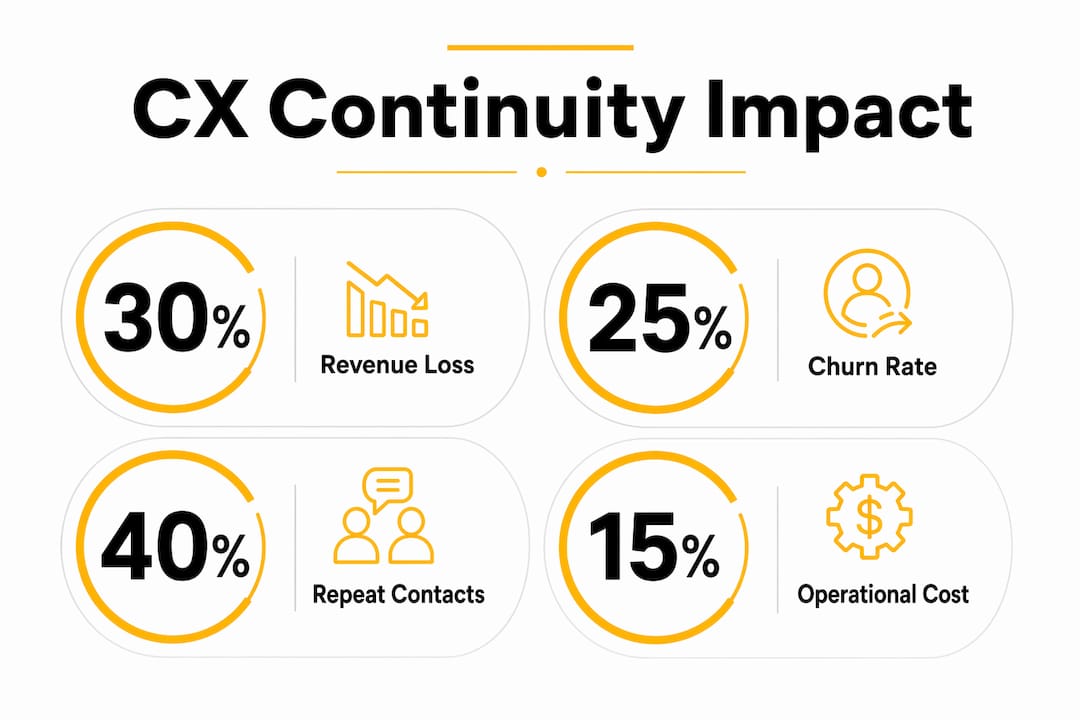
When a critical journey fails, customers who cannot complete a task contact support. Those contacts are expensive. Journey failures cause repeat contacts and rework that continuity planning eliminates, directly lowering cost-to-serve. Each repeat contact represents a cost your team absorbs while also signaling to the customer that your organization is not reliable. Two or three of those signals in a row, and the customer is gone.
The financial risks leaders must account for include:
- Churn acceleration. Customers who experience a broken journey during a disruption are far more likely to evaluate alternatives immediately after.
- Repeat contact rate increase. Unresolved journey failures drive call and chat volume up, inflating handle time and staffing costs.
- Regulatory and complaint exposure. In healthcare and financial services, a failure to maintain service continuity can trigger regulatory scrutiny and formal complaints.
- Reputational damage. Social media amplifies service failures faster than any recovery communication can contain them.
The metrics that reveal continuity risk most clearly are churn rate, repeat contact rate, average handle time during incidents, and what practitioners call “customer-impact minutes” — the total time customers spend unable to complete a task. Good CX observability tracks real user experience, synthetic tests, API behavior, and handoff quality, not just whether servers are responding. Leaders who monitor only uptime are watching the wrong dashboard.
Reframing infrastructure reliability as a CX retention and revenue protection issue, rather than an IT-only concern, changes how budget conversations go. The cost of a continuity program is predictable. The cost of an unmanaged disruption is not.

What does a CX continuity plan actually include?
A CX continuity plan is not a disaster recovery document repurposed for the contact center. It is a purpose-built operational framework that answers one question: when something breaks, which customer outcomes must be preserved, and how?
The essential components are:
- Priority journey inventory. A ranked list of customer tasks by business impact. Payment processing, identity verification, and case escalation typically rank highest.
- Minimum viable service definitions. For each priority journey, a clear statement of what “degraded but functional” looks like. Agents need this before an incident, not during one.
- Dependency mapping. Document every system, vendor, and data feed each journey relies on: identity providers, billing platforms, routing engines, and CRM integrations.
- Degraded-mode designs. Deliberate service states that protect core outcomes (reachability, identity, case context) while nonessential functions are suspended. These prevent improvised fixes that create cascading failures.
- Controlled operational content library. Pre-approved message templates that tell customers what to do, what the organization is doing, and what comes next. This prevents “fast but wrong” communications that erode trust during an incident.
- Testing cadence. A scheduled program of tabletop exercises, simulated outages, and chaos testing in staging environments.
On the technical side, the checklist includes geo-redundancy for critical routing, data replication with defined recovery point objectives, and session persistence so customers do not repeat authentication steps when they switch channels. State management — tracking the current step, last successful action, and eligibility — is what prevents customers from restarting a journey from scratch every time they move between touchpoints.
ISO 22301 maps directly to several of these components: the business impact analysis aligns with dependency mapping and journey prioritization, while the standard’s exercise and review requirements align with the testing cadence. Organizations already pursuing ISO 22301 certification can treat CX continuity planning as an extension of existing governance rather than a separate program.
How do you build a CX continuity plan in 90 days?
The build path is straightforward when scoped correctly. Start with one high-value journey, not the entire service catalog.
Step-by-step:
- Scope. Select the single journey with the highest churn and revenue impact if it fails.
- Map. Document every dependency, failure mode, and customer touchpoint for that journey.
- Design degraded modes. Define what stays live, what simplifies, and what suspends for each failure scenario.
- Define communications. Draft and approve the operational content templates before any incident occurs.
- Assign owners. Name the person who activates each degraded mode and the person who approves communications.
- Test. Run a tabletop exercise, then a simulated outage in staging. Validate that automated failovers trigger without manual intervention.
- Iterate. Add the next-priority journey to the plan and repeat.
| Milestone | Week | Deliverable |
|---|---|---|
| Scope and journey selection | 1–2 | Priority journey inventory, ranked |
| Dependency and failure mapping | 3–4 | Dependency map with single points of failure identified |
| Degraded-mode designs | 5–6 | Minimum viable service definitions per scenario |
| Comms and playbook drafts | 7 | Approved operational content templates |
| Owner assignment and RACI | — | RACI matrix, escalation triggers documented |
| Tabletop exercise | — | Exercise report with gaps identified |
| Simulated outage / chaos test | 11 | Failover validation, plan updated |
The main cost drivers are redundancy level (active-active versus active-passive), testing frequency, and whether surge staffing comes from internal headcount or a nearshore partner. A phased budget approach — fund the MVP sprint for one journey, then expand — is far easier to approve than a full-program ask. Operational efficiency improvements realized through continuity planning often offset a meaningful portion of the program cost within the first year.

What ROI can you expect from CX continuity planning?
The evidence connecting continuity planning to measurable business outcomes is consistent across practitioner research. Three effects show up repeatedly.
Decision latency is the hidden performance killer. When approvals and risk reviews delay response during a disruption, capability drops and service levels fail. Pre-authorized degraded-mode rules eliminate that latency. Agents act immediately because the decision was already made.
Repeat contacts drop when journeys are protected. Journey failures are the primary driver of repeat contacts. When continuity planning keeps a journey functional at a degraded level, customers complete their task. They do not call back. That reduction flows directly into cost-to-serve.
Testing validates what documentation only promises. Simply documenting a plan is insufficient; teams must validate that automated failovers and degraded-mode steps trigger as designed. Organizations that run chaos testing in staging find gaps before customers do.
A practical measurement worksheet for your first 90 days:
- Repeat contact rate: Baseline now, target a reduction after the first journey is protected, review monthly.
- Average handle time during incidents: Baseline from the last two incidents, target reduction through pre-approved playbooks, review after each exercise.
- Customer-impact minutes per incident: Baseline from incident logs, target reduction through faster degraded-mode activation, review quarterly.
- Churn rate post-incident: Baseline from cohort analysis, track the 30-day and 90-day churn rate for customers who contacted during the last disruption.
Assign a named owner to each metric and a review cadence. Without ownership, metrics become reports nobody acts on. Improving client retention is the downstream outcome; these four metrics are the leading indicators that tell you whether the plan is working before churn data confirms it.
What obstacles will you face, and how do you overcome them?
Four objections come up in almost every leadership conversation about CX continuity planning. Each has a defensible response.
“The upfront cost is too high.” Frame it as insurance with a measurable premium. The cost of a continuity program is a known, budgetable number. The cost of an unmanaged disruption — churn, repeat contacts, regulatory exposure, emergency staffing — is not. Continuity becomes a competitive advantage when customers need reassurance, and organizations that can demonstrate recovery capability use it as a differentiator in sales and retention conversations.
“This probably won’t happen to us.” Low-probability thinking ignores the compounding nature of modern CX infrastructure. Every third-party integration, cloud dependency, and API connection is a potential failure point. The question is not whether a disruption will occur, but whether the organization will be ready when it does.
“Nobody owns this.” Siloed ownership is the most common reason continuity plans fail. The fix is a named CX continuity owner with explicit authority, not a shared responsibility across IT, operations, and legal. The governance section below addresses this directly.
“We tested once and it was fine.” A single tabletop exercise does not validate automated failovers. Chaos testing in staging does. Test fatigue is real, but the solution is a scheduled cadence with clear scope, not fewer tests.
Pro Tip: Start with a nearshore partner for surge coverage during your first live incident. Internal teams are often stretched thin during disruptions; a pre-contracted nearshore team extension gives you trained agents who can absorb volume while your core team manages the technical recovery.
Phased implementation makes the program politically viable. Protect one journey, demonstrate the repeat-contact reduction, then use that data to fund the next phase.
Who should own CX continuity, and how does governance work?
Ownership without authority is theater. The governance model for CX continuity must give the right people the right to act, not just the responsibility to report.
Recommended roles:
- Executive sponsor (CRO or CCO). Owns the business case, approves the budget, and escalates to the board when a major incident occurs.
- CX continuity owner. The named individual accountable for plan currency, exercise scheduling, and activation decisions. This role should sit in CX operations, not IT.
- IT/Infrastructure lead. Owns technical failover, geo-redundancy, and system-level recovery point objectives.
- Contact center operations lead. Activates degraded-mode routing and manages agent-level playbook execution.
- Legal and communications lead. Approves operational content templates and manages external communications during incidents.
Contact center activation rights matter more than most plans acknowledge. If agents must wait for IT or legal approval to switch to a degraded mode, decision latency destroys the value of the plan. Pre-authorization is the mechanism that makes continuity planning operationally real.
Sample RACI (for a single journey activation):
| Activity | CX Continuity Owner | Contact Center Ops | IT/Infra | Legal/Comms | CCO Sponsor |
|---|---|---|---|---|---|
| Declare degraded mode | A | R | C | I | I |
| Activate simplified routing | I | R | A | I | I |
| Send customer communications | C | I | I | R | A |
| Log incident and impact metrics | R | C | I | I | I |
| Conduct post-incident review | A | R | R | C | I |
R = Responsible, A = Accountable, C = Consulted, I = Informed
Governance artifacts to maintain on a defined schedule: playbooks (reviewed quarterly), the controlled operational content library (reviewed after each incident and annually), the exercise schedule (minimum twice yearly), and vendor assurance records for every third-party dependency.
“A platform can be technically ‘up’ while the customer experience remains broken due to stale data, identity lapses, or transfer failures. Uptime is not the same as customer reachability, and your SLAs should reflect that distinction.” — CX Today
Specialized CX operations that embed governance discipline into daily execution produce measurably better continuity outcomes than organizations that treat continuity as a separate, periodic exercise.
Key Takeaways
CX continuity planning protects revenue and customer trust by keeping critical journeys functional during disruptions, reducing repeat contacts, and giving agents pre-authorized rules to act without delay.
| Point | Details |
|---|---|
| Churn risk is immediate | Many customers abandon a brand after a single bad experience, making every disruption a retention event. |
| Degraded-mode design is the core discipline | Predefine what stays live, what simplifies, and what suspends for each critical journey before any incident occurs. |
| Decision latency is the hidden failure mode | Pre-authorized activation rules eliminate approval delays that cause service levels to collapse during disruptions. |
| Testing must go beyond tabletop exercises | Chaos testing in staging validates that automated failovers trigger as designed, not just that a plan exists on paper. |
| Altiamcx supports continuity execution | Altiamcx provides nearshore surge capacity, playbook-ready agents, and tested escalation procedures for organizations building or activating a CX continuity plan. |
What a CX partner’s perspective on continuity reveals
Most organizations treat continuity planning as a compliance exercise: build the document, run one tabletop, file it away. The problem is that a plan nobody has practiced is not a plan. It is a liability. When an incident hits and agents are improvising, the cost shows up in repeat contacts, extended handle times, and customers who quietly leave.
What actually separates organizations that recover well from those that do not is pre-authorization. The decision about what to do has already been made. Agents activate a playbook. Communications go out from a pre-approved template. The contact center absorbs the surge because a nearshore partner was already contracted and briefed.
Altiamcx approaches continuity as an operational discipline, not a project. Nearshore teams are trained on client playbooks before incidents occur, escalation procedures are tested, and performance frameworks track the metrics that matter: repeat contact rate, handle time during incidents, and customer-impact minutes. That is what a capable partner brings to the table.
How Altiamcx supports your CX continuity program

When a disruption hits, the organizations that recover fastest are the ones that already have trained agents ready to absorb surge volume, pre-approved playbooks in place, and a nearshore partner who can scale without a lengthy onboarding cycle. That is the concrete advantage Altiamcx delivers.
Altiamcx provides rapid team extension with bilingual agents trained on client-specific playbooks, tested escalation procedures, and multilingual support across healthcare, legal, ecommerce, and financial services. The orthodontic services provider case study demonstrates what measurable CX improvement looks like when operational discipline is applied consistently, not just during incidents.
If you are ready to assess your current continuity gaps or want to see how a nearshore partner fits into your recovery model, request a continuity assessment from Altiamcx today.
Selected sources for further reading
- ISO 22301: Business Continuity Management Systems — the international standard governing continuity program design and governance
- How to Build Resilient CX Infrastructure That Survives Outages (CX Today) — infrastructure resilience framed as a CX and revenue issue, not an IT-only concern
- CX Connectivity Architecture Resilience (CX Today) — chaos testing methodology and failover validation for CX environments
- Business Continuity: The Ultimate Customer Experience Test (Forbes) — ROI framing and competitive advantage of continuity investment