
Order management outsourcing is the practice of delegating your company’s order processing, fulfillment, shipping, returns, and related customer service functions to a specialized external provider. Rather than building and maintaining that infrastructure in-house, you hand the entire fulfillment operation to a partner whose core business is executing it well. The result: your team stops managing warehouses and carrier negotiations and starts focusing on growth.
At its core, outsourced order management covers a predictable set of functions:
- Order entry and validation: capturing and confirming orders across every sales channel
- Picking, packing, and fulfillment: physically preparing and dispatching orders accurately
- Shipping and carrier management: selecting routes, negotiating rates, and tracking shipments
- Returns processing: handling reverse logistics and customer refunds efficiently
- Customer order support: resolving inquiries, delays, and exceptions before they escalate
- Reporting and data visibility: delivering performance metrics that inform operational decisions
What makes this more than simple delegation is the technology layer underneath it. Providers bring warehouse management systems, real-time tracking platforms, and omnichannel order orchestration tools that most mid-market companies could not justify building themselves. Platforms like SAP Order Management Foundation centralize order orchestration across channels, reduce manual workloads, and give operations managers the visibility they need without the capital investment. That combination of expertise, infrastructure, and technology is what separates outsourcing from simply hiring more staff.
Table of Contents
- What is order management outsourcing, and why do companies choose it?
- Key benefits your business gains from outsourcing order management
- Signs it’s time to outsource your order management
- How outsourcing order management drives business growth and agility
- Key Takeaways
- Altiamcx delivers outsourced operational performance you can measure
What is order management outsourcing, and why do companies choose it?
The decision to outsource order management rarely comes from a single pain point. It usually reflects a broader recognition that fulfillment is a specialized discipline, and that trying to compete on logistics while also competing on product, brand, and customer experience stretches most organizations too thin.
The core motivations are consistent across industries:
- Focus on core competencies: when your team spends less time managing carrier disputes and warehouse staffing, they spend more time on product development, marketing, and customer relationships
- Cost structure shift: outsourcing converts fixed logistics costs like warehouses and equipment into variable costs tied to order volume, so you pay for capacity you actually use
- Access to specialized expertise: providers bring years of logistics knowledge, established carrier relationships, and process discipline that takes years to build internally
- Technology without capital outlay: the logistics partner absorbs the cost of warehouse management systems and tracking platforms, removing that burden from your balance sheet
- Scalability on demand: a third-party provider can surge capacity during peak seasons or promotional events without requiring you to hire, train, or later lay off staff
For growing businesses in particular, order management outsourcing functions as a strategic lifeline, preserving margins while managing the complexity that growth inevitably creates. The alternative, building internal fulfillment capacity ahead of demand, ties up capital and creates fixed overhead that punishes you when volume dips.
Pro Tip: Before evaluating providers, map your current order-to-delivery cycle time and error rate. Those two numbers become your baseline for measuring whether an outsourcing partner is actually delivering value.

Key benefits your business gains from outsourcing order management
The benefits of outsourcing order management go well beyond cost reduction. Executed well, it touches every dimension of operational performance.
- Time savings: expert providers handle the daily complexity of fulfillment, freeing your internal team for higher-value work
- Error reduction: specialized providers apply rigorous quality controls that reduce picking errors, mislabeled shipments, and processing mistakes
- Safer shipping and packaging: outsourced providers handle complex packaging and ensure safer shipping, reducing damages and the cost of replacements
- Better delivery performance: providers optimize shipment routes and share transport costs across clients, producing more competitive rates and faster delivery
- Improved returns management: efficient returns handling by outsourced providers improves the customer experience while reducing the internal burden on your team
- International compliance: providers with customs expertise reduce documentation errors and shipment delays for cross-border orders, accelerating clearance
- Data and reporting: outsourced partners deliver performance dashboards and order analytics that surface trends your internal team may never have had time to track
Customer satisfaction sits at the center of all of these. When orders arrive on time, undamaged, and with a frictionless return process behind them, retention improves. That connection between order fulfillment quality and customer loyalty is direct and measurable. Providers who specialize in fulfillment have built their entire operation around getting that right.
Signs it’s time to outsource your order management
Not every business needs to outsource immediately. But certain operational signals make the case clearly:
- Delivery performance is slipping: missed shipping windows and rising customer complaints about late or damaged orders indicate your current process cannot keep pace with demand
- Operational costs are climbing: warehousing, staffing, packaging, and shipping expenses eating into margins signal that your cost structure needs to change
- Peak seasons overwhelm your team: if your internal operation struggles every holiday season or promotional period, you are carrying the wrong kind of fixed capacity
- You lack logistics expertise: if your team is spending time solving carrier problems they were never trained to handle, you are paying for learning that a provider already has
- Technology gaps are creating blind spots: without real-time inventory visibility and order tracking, you cannot catch problems before customers do
- Growth is outpacing your fulfillment capacity: rapid expansion in order volume or new sales channels creates complexity that generalist internal teams rarely manage well
- Order management is consuming leadership time: when operations managers spend their days on fulfillment exceptions instead of growth initiatives, the business is paying a hidden opportunity cost
The outsourcing checklist question worth asking is simple: is your fulfillment operation a competitive advantage, or is it a distraction? For most companies, the honest answer points toward outsourcing.
How outsourcing order management drives business growth and agility
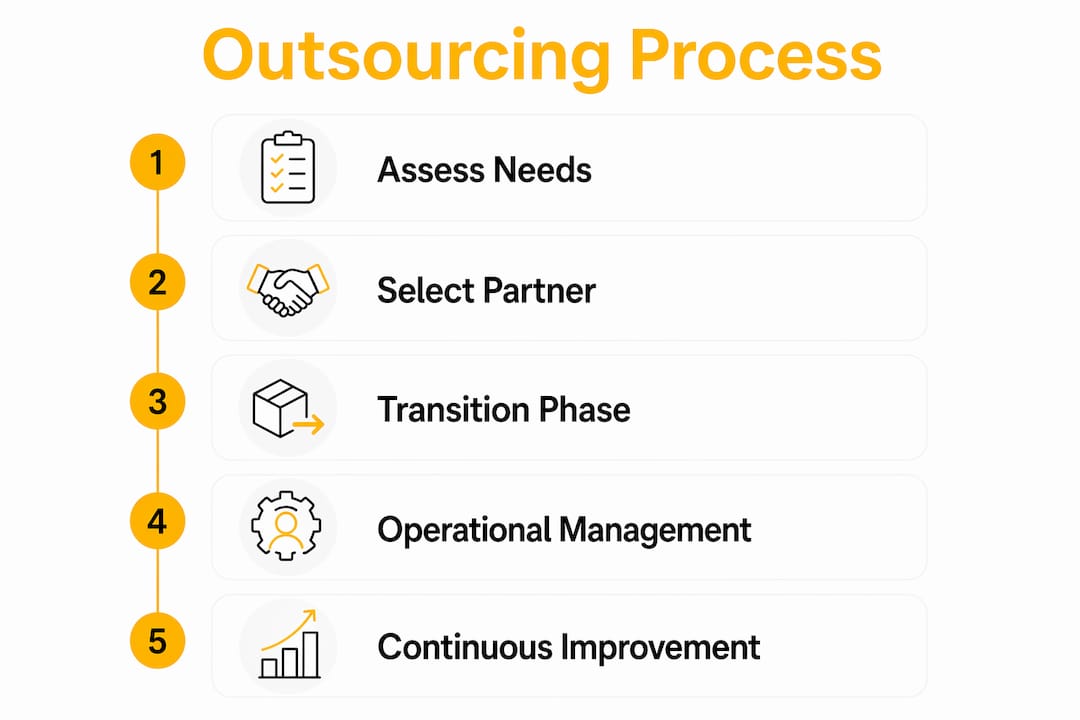
The strategic impact of outsourcing order management extends well beyond operational efficiency. It changes your cost structure, your capacity for growth, and your ability to respond to market shifts.
The most immediate financial effect is the conversion of fixed costs to variable ones. Outsourcing eliminates costly investments in warehouses and equipment, replacing them with costs that scale with your actual order volume. That shift improves cash flow predictability and frees capital for product development, marketing, or market expansion.
Operationally, the agility gains are equally significant:
- Rapid scaling: providers can increase operational capacity during demand surges without requiring capital investment from your side
- New market entry: outsourcing reduces the logistics and inventory management costs associated with entering new geographies, making expansion faster and less risky
- Supply chain integration: a capable provider integrates with your existing ERP, inventory management, and commerce platforms, creating a unified view of orders and stock
- Faster response to disruptions: outsourced order management improves operational agility, allowing businesses to adjust rapidly amid market changes or seasonal demand shifts
The internal benefit is equally concrete. When your operations team is no longer managing fulfillment exceptions, they redirect that capacity toward customer experience improvements, product launches, and process innovation. That reallocation is where business process outsourcing creates compounding returns: each quarter, your team gets better at what you actually sell, while your provider gets better at what they actually do.
The businesses that treat outsourcing as a short-term cost fix tend to underperform those that treat it as a structural decision about where to build capability. The latter group builds faster, spends less on overhead, and delivers a more consistent customer experience across every order.

Key Takeaways
Order management outsourcing delivers the greatest value when treated as a structural operational decision, not a temporary fix for a capacity problem.
| Point | Details |
|---|---|
| Core definition | Outsourcing delegates order entry, fulfillment, shipping, returns, and customer support to a specialized external provider. |
| Cost structure shift | Outsourcing converts fixed logistics costs into variable costs tied to order volume, improving cash flow flexibility. |
| Agility and scaling | Providers surge capacity during peak seasons and support new market entry without requiring capital investment from your team. |
| Customer experience impact | Accurate fulfillment, safer packaging, and efficient returns handling directly improve customer satisfaction and retention. |
| Altiamcx as a partner | Altiamcx delivers nearshore operational services with measurable performance frameworks, helping businesses reduce fulfillment friction and focus on growth. |
Altiamcx delivers outsourced operational performance you can measure
Most outsourcing conversations focus on cost. Altiamcx starts with performance. As a nearshore customer experience and operational services partner, Altiamcx supports businesses through back-office operations, order-related customer care, technical assistance, and scalable team-extension solutions built around measurable outcomes.

What sets Altiamcx apart is the combination of cultural alignment and disciplined execution. Nearshore delivery means your outsourced team operates in a compatible time zone, communicates in fluent American English, and integrates with your internal workflows without the coordination friction that offshore models often create. Every engagement runs on defined performance frameworks, so you always know whether the partnership is delivering against the metrics that matter to your business.
If your order management operation is consuming resources that should be going toward growth, Altiamcx is built for exactly that problem. See how a software platform improved productivity by 89% after partnering with Altiamcx, and reach out to discuss what that kind of operational shift could mean for your team.