TL;DR:
- Legal back-office support includes administrative and financial operations such as bookkeeping, billing, and trust-account reconciliation. Outsourcing to nearshore managed services offers greater resilience and predictability, with specialists handling workflows and compliance requirements like IOLTA and SOC 2. A pilot project is recommended to verify provider capabilities before full migration, ensuring process consistency and audit readiness.
Legal back-office support is the set of administrative and financial operations that keep a legal organization running: bookkeeping, billing and pre-bill review, IOLTA trust-account reconciliation, document management, client intake, and docketing. For operations leaders evaluating their options, a nearshore managed-services model with SOC 2 controls and documented SLAs typically delivers better resilience and cost predictability than adding internal headcount, and partners like Altiamcx are built specifically for that deployment.
Table of Contents
- What does legal back-office support actually cover?
- Why do organizations outsource legal back-office functions?
- Which delivery model fits your organization?
- How do you evaluate and choose a legal back-office provider?
- What does implementation actually look like?
- What pricing models should you expect, and how do you calculate ROI?
- What U.S. privacy and compliance requirements apply?
- When should you keep legal back-office work in-house?
- How Altiamcx delivers legal back-office support
- Key takeaways
- The case for a pilot-first mindset
- Altiamcx: a nearshore partner built for legal operations
- Useful sources and further reading
What does legal back-office support actually cover?
Outsourced back-office scope in legal settings typically spans the full administrative and financial stack, not just data entry. Core functions include:
- Bookkeeping and monthly close: general ledger maintenance, bank reconciliation, and monthly financial statements
- Billing and pre-bill review: time-entry review, invoice preparation, write-off approval, and e-billing submission
- IOLTA and three-way trust reconciliation: matching bank statement, client ledger, and internal book ledger under ABA Model Rule 1.15
- Accounts payable and receivable: vendor payments, collections follow-up, and aging report management
- Payroll coordination: timesheet processing and payroll-provider liaison
- Docketing and calendar management: deadline tracking, court-date calendaring, and statute-of-limitations alerts
- Document management and e-discovery intake: document indexing and workflow tracking, Bates stamping, and discovery production support
- Client intake and contact routing: new-matter intake, conflict checks, and CRM data entry
- Paralegal and litigation support: contract administration, deposition scheduling, and exhibit preparation
Many providers layer optional CFO-level services on top, including budgeting, forecasting, and KPI dashboards for leadership. These give operations leaders the financial visibility they need without hiring a full-time controller.
Why do organizations outsource legal back-office functions?
The primary driver has shifted. Modern outsourcing decisions are less about cutting labor costs and more about accessing specialized expertise and legal-tech fluency that most in-house teams cannot maintain at scale.
Outsourcing back-office functions replaces fragile in-house hiring with process-driven teams and deeper software fluency, giving organizations access to repeatable workflows rather than dependence on a single employee’s institutional knowledge.
Beyond expertise, the operational benefits are concrete. Peer-review teams eliminate single-point-of-failure risk. Backup coverage means a missed deadline due to staff turnover becomes a provider problem, not yours. Commonly cited gains include faster monthly close, improved collections, and the ability to scale resource levels up or down without a hiring cycle. For operations leaders managing multiple practice groups or business units, predictable SLAs and consolidated reporting are often the deciding factors.
Which delivery model fits your organization?
| Model | Contract shape | Who manages QA | Software integration | Resilience |
|---|---|---|---|---|
| Pure in-house | Salary + benefits | Internal management | Direct system access | Low — single-person dependency |
| Staff augmentation | Hourly or project-based | Internal management | Contractor access | Moderate — depends on contractor continuity |
| Nearshore managed service | Per-seat or flat managed fee | Provider with documented SLAs | Provider-managed integration | High — team redundancy and peer review |
| Hybrid | Mixed fee structures | Shared (internal + provider) | Partial integration | High when governance is clear |
Staff augmentation gives you control but leaves QA in your hands. A nearshore managed service, by contrast, brings a structured team with built-in peer review and backup coverage, which is why it suits organizations that need continuity across billing cycles and trust-account deadlines. Hybrid models work well when some functions are too sensitive to move fully external but volume demands relief.

How do you evaluate and choose a legal back-office provider?
Selection criteria should be non-negotiable on a few points. Providers must demonstrate domain specialization in legal financial operations, not just general bookkeeping. They need documented experience integrating with case-management systems like Clio, MyCase, or PracticePanther. Three-way IOLTA reconciliation capability is a hard requirement, not a nice-to-have. SOC 2 Type II certification and HIPAA readiness (for health-related legal matters) round out the compliance baseline.
- Confirm the staffing model: ask whether your account uses a dedicated team or a shared pool, and who covers when a team member is unavailable.
- Request sample SLAs: monthly close turnaround, reconciliation accuracy targets, and invoice aging resolution timelines should all be in writing.
- Test IOLTA competency: ask for a sample three-way reconciliation report and walk through it with your controller.
- Verify data security: encrypted communications, least-privilege access, and audit logging are baseline expectations.
- Ask about escalation paths: who do you call at 4 PM on the last business day of the month if something is wrong?
Red flags to watch for: no documented IOLTA process, vague answers about data encryption, a single named contact with no backup, and reluctance to share sample SLA frameworks before a contract is signed.
Pro Tip: Run a four-week paid pilot on one practice group before committing to a full migration. Ask the provider to reconcile one month’s trust account from scratch and compare it against your internal records. The gap tells you everything.
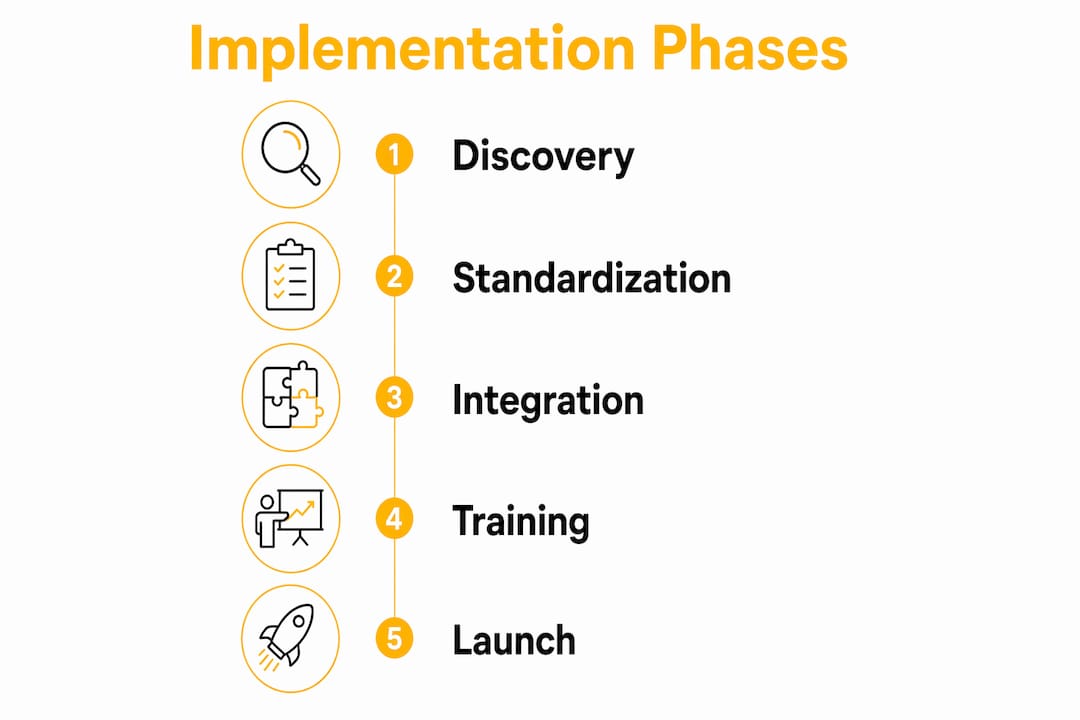
What does implementation actually look like?
| Phase | Typical duration | Key milestones |
|---|---|---|
| Discovery and documentation | Weeks 1–2 | Process maps, RACI, data-access inventory |
| Workflow standardization | Weeks 2–4 | SOPs finalized, software access provisioned |
| Pilot scope | Weeks 4 | One practice group or function live, SLAs active |
| Full migration | Weeks 4–8 | All functions transitioned, reporting cadence set |
| Scale and optimization | Ongoing | Quarterly SLA reviews, continuous improvement loops |
The most common failure mode is outsourcing broken processes. Standardize and document workflows before handing them to a provider. A back-office operations checklist helps confirm nothing is skipped during onboarding. Governance items to lock in early: a named escalation path, a monthly SLA review meeting, and a defined change-management process for system updates.
What pricing models should you expect, and how do you calculate ROI?
Common commercial structures in legal back-office outsourcing:
- Per-seat or per-hour: predictable for defined roles; scales with headcount
- Managed-service flat fee: fixed monthly cost for a defined scope; easiest to budget
- Transaction-based: priced per invoice processed, per reconciliation, or per document; useful for variable-volume work
- Outcome-based: tied to KPIs like days-sales-outstanding reduction or monthly close speed
To estimate ROI, start with your internal baseline: fully loaded salary cost per role, plus overhead, plus the cost of a single error in trust accounting. Add the efficiency gains you expect: faster monthly close, reduced days sales outstanding, and fewer billing write-offs. Compare that total to the provider’s 12-month fee. Back-office outsourcing ROI typically materializes within two to three billing cycles once workflows are stable.
Review every proposal for hidden fees: onboarding costs, minimum-term penalties, software-license pass-throughs, and whether performance credits are actually enforceable.
What U.S. privacy and compliance requirements apply?
SOC 2 Type II is the baseline certification to require. Beyond that, data security in legal work must be treated as part of attorney-client privilege, which means encrypted communications, role-based access controls, secure VPN or RDP connections, and full audit logging are not optional.
Vendors must be prepared to demonstrate how they mirror a firm’s QA and privacy controls to be seen as a true extension of the firm rather than a third-party contractor.
ABA Model Rule 1.15 governs trust-account handling. Any provider touching IOLTA funds must perform disciplined three-way reconciliations and maintain audit-ready trust records. When health-related legal matters are in scope, HIPAA applies and a signed Business Associate Agreement is required. State bar rules vary on outsourcing disclosure and supervision obligations, so confirm your jurisdiction’s requirements before finalizing a vendor agreement.
Pro Tip: During due diligence, ask for actual audit logs and a completed reconciliation report, not just a policy document. A provider confident in their controls will share them without hesitation.
When should you keep legal back-office work in-house?
| Function | Sensitivity | Volume | Recommended approach |
|---|---|---|---|
| Legal strategy and privileged advice | Very high | Low | Retain in-house |
| Trust-account reconciliation | High | Moderate–high | Outsource to specialist |
| Billing and pre-bill review | Moderate | High | Outsource |
| Document management and indexing | Moderate | High | Outsource |
| Client intake and routing | Moderate | High | Outsource |
| Payroll coordination | Moderate | Low–moderate | Hybrid or outsource |
| KPI reporting and CFO oversight | High | Low | Retain or fractional CFO layer |
The clearest signal to outsource is high volume combined with moderate sensitivity and difficulty retaining specialist staff. The clearest signal to retain is low volume, very high sensitivity, or a function where attorney supervision is legally required.
How Altiamcx delivers legal back-office support
Altiamcx operates as a nearshore team-extension partner, deploying bilingual agents and back-office specialists who work within the client’s systems and follow documented SOPs from day one. A legal services appointment setting and back-office engagement typically covers intake routing, billing support, and document processing, with SLA targets set at contract execution.
Typical KPI framework for an Altiamcx legal back-office engagement:
- Monthly close completion within a short timeframe after period end
- Trust-account reconciliation accuracy at a high level
- Invoice aging resolution within agreed turnaround windows per client SLA
- Intake response time aligned to client-defined service levels
The service flow runs from client systems through a secure integration layer to the nearshore team, with peer review built into each function and reporting delivered on a defined cadence. Integration with common case-management platforms is handled during the discovery phase, and the pilot scope is typically one practice group or function for four to eight weeks before full migration.
For paralegal process outsourcing needs specifically, Altiamcx can extend the team to cover document prep, deposition scheduling, and litigation support alongside the core back-office functions.
Key takeaways
Legal back-office support is most effective when delivered by a specialized nearshore managed-services partner with documented SLAs, SOC 2 controls, and proven IOLTA reconciliation capability.
| Point | Details |
|---|---|
| Core scope | Covers bookkeeping, billing, IOLTA reconciliation, document management, intake, and docketing. |
| Primary outsourcing driver | Access to specialized expertise and legal-tech fluency, not just cost reduction. |
| Top evaluation criteria | Require SOC 2 Type II, documented IOLTA process, and sample SLAs before signing. |
| Implementation path | Standardize workflows first, then run a 4-week pilot before full migration. |
| Altiamcx approach | Nearshore team extension with peer review, bilingual agents, and measurable SLA frameworks for legal operations. |
The case for a pilot-first mindset
Most operations leaders I speak with underestimate one thing: the difference between a provider that can do legal back-office work and one that has built repeatable processes around it. The gap shows up immediately in trust-account reconciliation. A generalist bookkeeper can reconcile a bank account. A specialized team reconciles the bank statement, the client ledger, and the internal book ledger simultaneously, flags discrepancies before month-end, and produces an audit-ready report without being asked.
The pilot-first approach matters because it forces that distinction into the open before you are committed. Four to eight weeks on one practice group will tell you whether the provider’s processes are real or whether they are adapting general bookkeeping skills on the fly. That distinction has real consequences when a state bar audit arrives.
My recommendation: do not let a provider skip the pilot. Any partner confident in their legal back-office capability will welcome the test.
Altiamcx: a nearshore partner built for legal operations
Altiamcx gives operations leaders a faster path to a fully staffed, SLA-governed legal back-office without the hiring cycle, training overhead, or single-point-of-failure risk that comes with internal headcount. The model combines nearshore team extension, bilingual agents, and documented performance frameworks across intake, billing, document processing, and trust-account support.

The nearshore team-extension model is purpose-built for organizations that need measurable results from day one. If your team is managing billing backlogs, inconsistent intake, or monthly close delays, a structured pilot with Altiamcx is the most direct way to quantify the gap and close it. Contact Altiamcx at altiamcx.com to scope a pilot engagement for your legal operations team.
Useful sources and further reading
| Source | What it covers | Recommended for |
|---|---|---|
| Law Firm Velocity — Back Office Outsourcing | Service scope, IOLTA controls, outsourcing drivers | Read first — broadest coverage |
| Legal Support Help — Security Protocols | Data security, NDAs, encrypted communications | Read for compliance and vetting criteria |
| Global Matters — Back Office Support | Document management and workflow tracking | Read for implementation planning |
| Paralegal Assistants — Why Lawyers Outsource | Benefits, productivity, and scalability | Read for ROI framing |
| Altiamcx — Legal Services Case Study | Appointment setting and back-office delivery example | Read before a vendor discovery call |
| Altiamcx — Paralegal Process Outsourcing | Paralegal functions and managed-service integration | Read for litigation and document support scope |