
A CX vendor evaluation is a structured process for assessing whether a customer experience provider’s capabilities, operating model, and AI roadmap can deliver your specific business outcomes — not just a feature checklist comparison. Done right, it produces a defensible selection decision backed by evidence, scored criteria, and a governance plan that holds vendors accountable after the contract is signed.
The evaluation covers two broad dimensions:
- Capability fit: Human-centered design (HCD) methodology, AI and automation maturity, data ownership, integration architecture, and measurable delivery track record
- Operational alignment: Commercial model, security and compliance posture, scalability, and long-term roadmap compatibility with your organization’s innovation priorities
According to TechTarget, buyers who anchor selection on defined business outcomes and map vendor capabilities to their AI roadmap consistently outperform those who evaluate on feature lists alone. That principle runs through every section of this guide.
Key Takeaways
A CX vendor evaluation succeeds when buyers define measurable outcomes first, demand evidence over slides, and score vendors on AI readiness, data ownership, and full TCO — not feature lists alone.
| Point | Details |
|---|---|
| Outcomes before features | Define specific business KPIs before issuing any RFP; score vendors against those metrics, not capability breadth. |
| Demand real artifacts | Require journey maps, service blueprints, and pilot metrics — case studies without artifacts are marketing, not evidence. |
| Model full TCO | Include integration, change management, and training costs; these commonly exceed year-one licensing fees. |
| Score AI and data ownership | Many enterprises now prioritize GenAI; verify whether vendors own their AI models or resell third-party layers. |
| Altiamcx as your pilot partner | Altiamcx offers nearshore CX delivery with documented SLAs and measurable outcomes across healthcare, legal, and ecommerce. |
Table of Contents
- What should you verify before advancing a vendor?
- How does the CX vendor selection process actually work?
- What criteria actually matter in a customer experience vendor analysis?
- What do U.S. federal agencies need to know about CX procurement?
- What red flags should you watch for in vendor evaluations?
- How do you build a scoring matrix for vendor selection?
- The part of vendor evaluation most teams get wrong
- Altiamcx delivers the outcomes your evaluation is designed to find
- Sources
What should you verify before advancing a vendor?
Before investing weeks in RFP cycles, run these fast triage checks to eliminate misfits early:
- Outcome alignment: Can the vendor name a specific, measurable result they delivered for a client in your sector — not a satisfaction score, but a business metric like cost-per-contact reduction or first-contact resolution rate?
- AI roadmap fit: Do their GenAI and automation capabilities map to your next 12–18 months, not just today’s state? HFS Research reports that a large proportion of enterprise clients now rank GenAI or agentic AI among their top technology investments.
- Evidence of measurable outcomes: Have they produced journey maps, service blueprints, or pilot metrics — not just slide decks?
- Security and compliance: Do they hold relevant certifications (SOC 2 Type II, HIPAA, PCI-DSS) applicable to your industry?
- Integration capability: Can they demonstrate live API connectivity or pre-built connectors to your core platforms (CRM, telephony, WFM)?
- Reference availability: Will they provide two or more client references you can call — not just written testimonials?
Pro Tip: Ask every shortlisted vendor to scope a 30-day pilot that includes at least one edge-case scenario specific to your operations. A vendor confident in their delivery model will engage with specificity; one selling on slides will deflect or propose a generic proof of concept.
How does the CX vendor selection process actually work?
A repeatable evaluation runs through six phases. Assign an owner and a deliverable to each so nothing stalls in committee.
- Prepare (Weeks 1–2): Define the business outcomes you need the vendor to move. Identify stakeholders: procurement, legal, IT/security, CX operations, and the business owner who will live with the result. Deliverable: a one-page outcome brief and stakeholder RACI.
- Shortlist (Weeks 2–3): Apply the triage checklist above to a long list of eight to twelve vendors. Reduce to three to five. Deliverable: a scored shortlist with rationale documented for procurement records.
- RFI/RFP (Weeks 3–6): Issue a structured request that requires case studies with artifacts, HCD methodology descriptions, AI roadmap documentation, data ownership terms, and TCO breakdowns. Deliverable: vendor responses with scored evidence.
- Demos and pilots (Weeks 6–10): Run structured demos against a fixed scenario. Where possible, run a time-boxed pilot with pre-agreed success criteria. Deliverable: pilot scorecard and stakeholder sign-off.
- Score and select (Weeks 10–11): Apply the weighted scoring matrix (see Section 7). Convene the evaluation panel for a final recommendation. Deliverable: selection memo with scores and rationale.
- Contract and governance (Weeks 11–14): Negotiate SLAs tied to the outcomes defined in Week 1. Include data portability, transition assistance, and roadmap commitment clauses. Deliverable: signed contract with governance cadence documented.
Engage IT and legal no later than the RFP phase. Bringing them in at contracting adds weeks of rework and often surfaces integration or compliance blockers that could have eliminated a vendor earlier.
What criteria actually matter in a customer experience vendor analysis?
Human-centered design capability
Ask for journey maps, service blueprints, and research artifacts from a real engagement — not templates. A credible HCD practice produces documented discovery, synthesis, and iteration evidence. GSA’s Office of Customer Experience explicitly requires federal buyers to request these artifacts and HCD methodology descriptions in procurement.
AI and automation maturity
HFS Research notes that differentiation is shifting away from commoditized CX capabilities toward proprietary data, owned IP, and operating models. Ask vendors to show you what they own versus what they license. A vendor reselling a third-party AI layer with no proprietary training data is a different risk profile than one with domain-specific models built on years of client interaction data. Review how AI is reshaping CX delivery before finalizing your AI criteria.
Data ownership and integration
ISG recommends treating CXM as an enterprise platform decision — evaluate architecture, governance, and cross-functional data ownership, not just individual features. Require vendors to document who owns interaction data, how it is anonymized, and what happens to it at contract end. Request a data flow diagram and a sample data processing agreement.
Operating model and TCO
The Pedowitz Group’s guidance is direct: model full TCO including integration costs, internal change management, training, and data mapping — these commonly exceed implementation fees. Ask vendors for a 36-month cost model, not just year-one licensing.
Security and compliance
Require SOC 2 Type II reports, not just attestations. For healthcare or financial services, verify HIPAA Business Associate Agreement readiness and PCI-DSS scope documentation.
Pro Tip: When a vendor claims proprietary data or owned IP, ask for anonymized examples and run a reference check specifically asking whether the client saw operational results — not just implementation completion. Vendors with genuine IP welcome that conversation.
What do U.S. federal agencies need to know about CX procurement?
Federal buyers operate under OMB Circular A-11, Section 280, which establishes measurement domains for federal CX programs. The GSA CX Evaluation and Buying Guide translates those requirements into concrete procurement expectations.
Include these elements in your RFI/RFP:
- A description of the vendor’s HCD methodology, including how they conduct discovery, synthesis, and usability testing
- Case studies with artifacts: journey maps, service blueprints, research summaries, and pilot metrics
- Measurement approach mapped to A-11 Section 280 domains (trust, ease, efficiency, equity, effectiveness, and employee experience)
- Data ownership and security documentation aligned to FedRAMP or agency-specific requirements
For acquisition vehicles, GSA Schedule 541 (Marketing and Public Relations) and OASIS+ cover CX services. Document vendor responses against each RFI requirement individually so the evaluation record supports a protest-resistant award decision.
Common federal procurement pitfalls:
- Accepting narrative descriptions of HCD without requesting artifacts
- Failing to define measurement baselines before the contract starts
- Omitting data portability and transition assistance clauses
What red flags should you watch for in vendor evaluations?
Spot these warning signs early and act before advancing a vendor to the pilot stage:
- Pre-packaged solutions presented as custom: The vendor leads with a platform demo before understanding your journey or outcomes. Ask: “Walk me through how you adapted your approach for a client whose needs changed mid-engagement.”
- Method mislabeling: A vendor claims “human-centered design” but cannot produce research artifacts or name a synthesis method. Ask: “What affinity mapping or synthesis technique did your team use on your last project, and can you show us the output?”
- No measurable outcomes in case studies: Every case study ends with satisfaction scores but no business metrics. Ask: “What specific KPI moved, by how much, and over what period?”
- Vague governance: SLA language references “best efforts” rather than defined metrics with remedies. Ask: “What happens contractually if you miss an SLA target in month three?”
- Consolidation risk: Viewpoint Analysis advises treating vendor ownership and M&A risk as a primary selection factor. Ask: “Has your ownership structure changed in the last 24 months, and what roadmap commitments survive an acquisition?”
When a red flag appears, escalate to a structured pilot with pre-agreed exit criteria, or require contractual remedies — escrow of transition documentation, data portability guarantees, or performance bonds — before advancing.
How do you build a scoring matrix for vendor selection?
A weighted matrix removes subjectivity from the final decision. Adapt the weights below to your organization’s priorities: enterprise buyers typically weight platform architecture and TCO more heavily; government buyers weight HCD evidence and compliance.
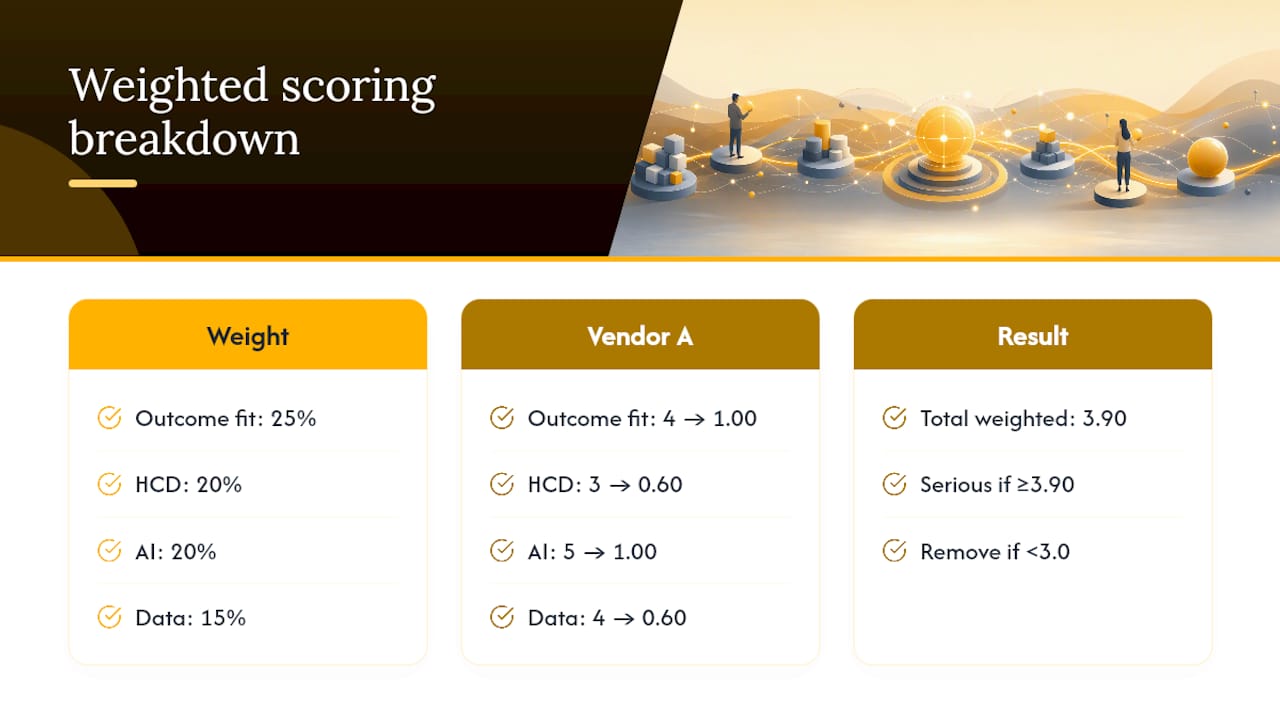
To calculate: multiply each raw score by its weight, sum the weighted scores, and rank vendors. A vendor scoring 4.2 weighted beats one scoring 4.8 raw on a single criterion. ISG Research’s framework validates this weighted approach for shortening RFP cycles without sacrificing rigor.
For a worked example: if Vendor A scores 4 on outcome fit, 3 on HCD, 5 on AI, 4 on data, 3 on TCO, and 4 on security, the weighted total is (4×0.25) + (3×0.20) + (5×0.20) + (4×0.15) + (3×0.10) + (4×0.10) = 1.00 + 0.60 + 1.00 + 0.60 + 0.30 + 0.40 = 3.90. A vendor scoring 3.90 or above on this scale warrants serious consideration; below 3.0, remove them from the shortlist.
The part of vendor evaluation most teams get wrong
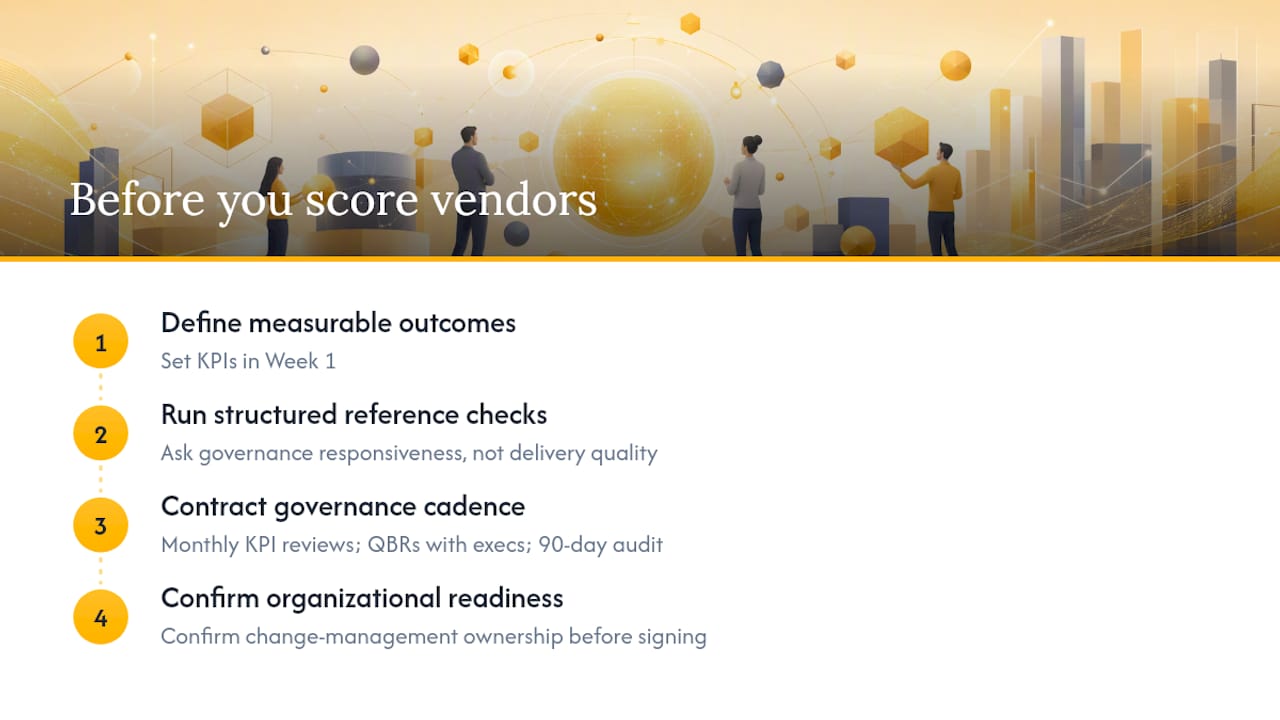
The scoring matrix matters less than what you do before you score. Most evaluation failures I’ve observed trace back to two moments: teams that never defined a measurable outcome before issuing the RFP, and teams that skipped the reference check because the vendor’s demo was impressive.
A vendor’s demo is their best day. A reference call is their average Tuesday. Always call references with a structured question set — ask specifically about governance responsiveness, not just delivery quality.
Pro Tip: Build your governance cadence into the contract before signing: monthly performance reviews tied to the KPIs you defined in Week 1, a quarterly business review with executive attendance, and a 90-day post-launch audit. Vendors who resist this structure are telling you something important.
Organizational readiness is also a selection risk. The best vendor in the world cannot compensate for an internal team that has not aligned on what success looks like. Confirm internal change management ownership before you sign.
Altiamcx delivers the outcomes your evaluation is designed to find
Selecting the right CX partner is only half the work. Altiamcx gives operations leaders and CX directors a nearshore delivery model built around measurable performance from day one — bilingual agents, scalable team deployment, and operational governance frameworks that map directly to the scoring criteria in this guide.

Altiamcx supports evaluations with pilot-ready teams, documented SLAs, and sector-specific experience across healthcare, legal, ecommerce, and financial services. See how a software platform improved technical support productivity by 89% after migrating to Altiamcx’s managed nearshore model. Ready to put Altiamcx through your own scoring matrix? Contact the team to scope a pilot with pre-agreed success criteria.
Sources
- HFS Horizons: Customer Experience Services, 2026 - HFS Research
- How to choose a CX provider: A practical buyer’s guide | TechTarget
- Performance
- Voice of the customer: software options (Viewpoint Analysis)