TL;DR:
- Tier two support outsourcing involves delegating complex technical issues to external providers to improve efficiency and reduce internal workload. It requires careful planning, standardized documentation, full system access, and ongoing governance to ensure quality and minimize risks. Hybrid models are often preferred for balancing control, cost, and flexibility in evolving product environments.
Tier two support outsourcing is defined as the delegation of advanced technical customer support tasks to external providers who handle complex issues beyond the scope of frontline agents. Also called outsourced tier two helpdesk or second-level support outsourcing in the industry, this model sits between basic troubleshooting and specialized engineering. 73% of organizations outsource at least some portion of their IT or customer support, with tier one and tier two tickets representing 70–90% of total ticket volume. That concentration makes tier two support services a primary target for outsourcing in SaaS, managed services, and enterprise IT environments.
What is tier two support outsourcing?
Tier two support outsourcing refers to contracting an external team to manage technical issues that require investigation, configuration analysis, and root cause diagnosis. These are not password resets or basic FAQs. Tier two tasks include configuration issues, permissions problems, known bug workarounds, log analysis, and multi-step technical troubleshooting. The external team operates as a functional extension of your support organization, not a separate entity fielding random tickets.
The “outsourcing” element means a third-party provider supplies the agents, management, and infrastructure. Your organization defines the scope, provides system access, and sets performance expectations through service level agreements (SLAs). New outsourced teams can be deployed within weeks, which makes this model a practical option for companies scaling fast or managing seasonal demand spikes.
How does tier two differ from tier one and tier three?
Understanding where tier two sits in the support hierarchy is critical before you outsource it. Each tier carries a distinct responsibility profile, and confusing them leads to misaligned contracts and poor outcomes.

Tier one handles scripted, high-volume interactions: password resets, account unlocks, basic navigation questions, and known-issue scripts. Agents follow decision trees and resolve issues without deep product knowledge. Tier two requires genuine technical investigation. Agents must replicate bugs, read system logs, interpret error codes, and apply product-specific fixes. Tier three is reserved for software engineers, architects, and product specialists who address root-level defects or infrastructure failures.
| Support Tier | Primary Responsibility | Skill Level | Example Issues |
|---|---|---|---|
| Tier One | Scripted troubleshooting, first contact resolution | Entry-level, process-driven | Password resets, basic navigation, account access |
| Tier Two | Advanced investigation, configuration, root cause analysis | Mid-level technical expertise | Bug replication, log analysis, permissions errors, API issues |
| Tier Three | Engineering-level fixes, architectural decisions | Senior engineers, developers | Code defects, infrastructure failures, product architecture |
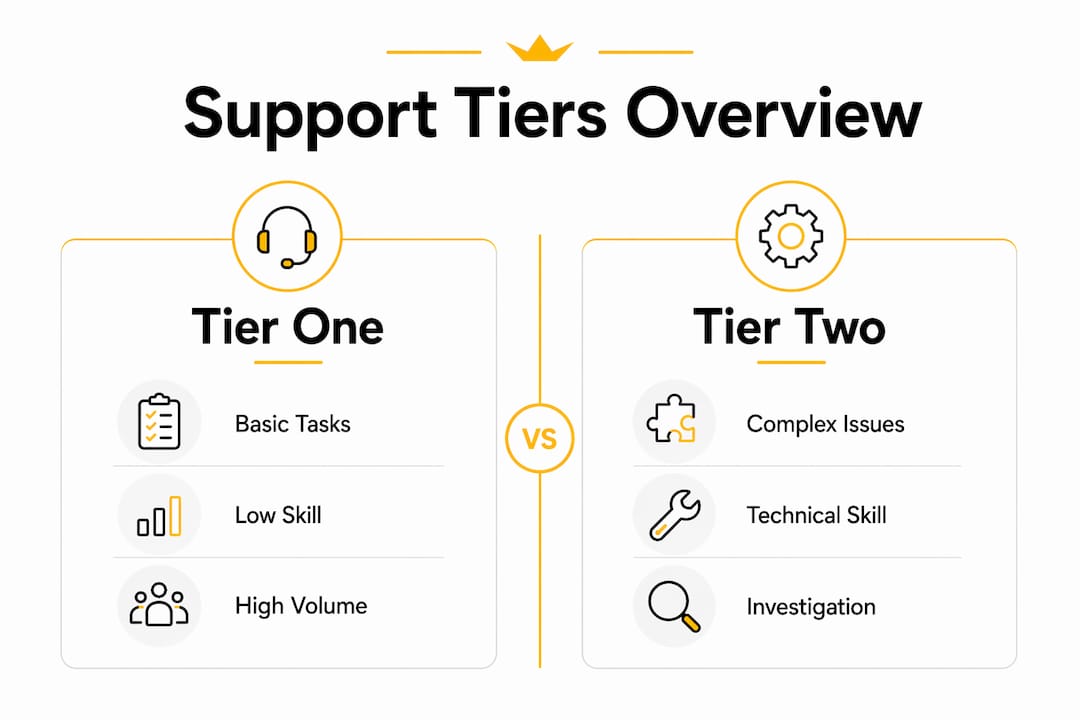
Properly empowered tier two teams resolve complex issues before they reach tier three, reducing unnecessary escalations and protecting your senior engineers’ time. That protection is one of the most underappreciated benefits of outsourcing tier two helpdesk operations.
Why do organizations outsource tier two support?
The core driver is strategic, not just financial. Outsourcing tier two protects internal senior engineering focus by offloading repetitive diagnostics to a trusted external team. When your best engineers spend hours on configuration tickets, they are not building product. Outsourcing breaks that cycle.
Cost efficiency is a secondary but real benefit. External providers in nearshore or offshore markets deliver mid-level technical expertise at a lower fully loaded cost than equivalent domestic hires. Round-the-clock coverage becomes achievable without overnight shift premiums. Comanaged 24/7 support models use offshore tier one and tier two teams to deliver continuous service while domestic staff focus on tier three work and client relationships.
Three outsourcing models dominate the market:
- Full outsourcing: The external provider owns all tier two operations, staffing, and quality management. Best for organizations with mature documentation and stable product lines.
- Comanaged hybrid: Internal and external agents work the same queue under shared management. Best for companies in transition or with complex, evolving products.
- Offshore specialist teams: Dedicated offshore agents trained specifically on your product. Best for SaaS companies needing scalable support coverage without building regional offices.
Pro Tip: Before signing any outsourcing contract, map your current tier two ticket types by volume and complexity. This exercise reveals whether your documentation is ready and which model fits your actual support profile.
What are the benefits and risks of tier two outsourcing?
The benefits of tier two outsourcing are concrete and measurable when the model is set up correctly. The risks are equally real when it is not.
| Benefits | Risks |
|---|---|
| Faster resolution times through dedicated technical focus | Reduced control over agent behavior and quality |
| 24/7 coverage without internal shift costs | Dependency on vendor stability and staffing continuity |
| Internal engineering freed for product development | Communication barriers across time zones or cultures |
| Cost savings on mid-level technical headcount | Handoff friction when system access is insufficient |
| Faster scaling during product launches or demand spikes | Knowledge gaps if documentation is incomplete |
The risk that causes the most operational damage is handoff friction. Without direct system access, external tier two teams lose efficiency and become reliant on internal staff for logs or permissions. This defeats the purpose of outsourcing entirely. Setting access levels before go-live is non-negotiable.
SLA design is the primary mitigation tool for most other risks. Define first response time, resolution time, escalation thresholds, and quality score targets in writing. Shared quality assurance frameworks, where both internal and external teams review the same ticket samples weekly, catch drift before it becomes a pattern. Organizations that standardize diagnostic workflows before outsourcing consistently outperform those that hand over undocumented processes.
How to successfully implement tier two support outsourcing
Successful implementation follows a defined sequence. Skipping steps in this process is the most common reason outsourcing engagements underperform in the first 90 days.
- Audit your current tier two tickets. Categorize by issue type, resolution complexity, and average handle time. This data defines scope and sets realistic SLA targets.
- Standardize your documentation. Lack of documented workflows is the primary cause of failure when outsourcing tier two support. Build runbooks, known-issue libraries, and escalation decision trees before the external team touches a single ticket.
- Define system access requirements. List every tool, platform, and admin panel the external team needs. Provision access before training begins, not after.
- Select and onboard your provider. Evaluate providers on technical depth, cultural alignment, and their experience with your product category. Joint training sessions between internal subject matter experts and the external team are mandatory, not optional.
- Run a parallel period. Operate internal and external teams on the same queue for two to four weeks. Compare resolution rates, escalation rates, and customer satisfaction scores before full handoff.
- Establish ongoing governance. Weekly ticket reviews, monthly performance reporting, and quarterly SLA renegotiation keep the engagement aligned with your evolving product and customer base.
Workflow preparation is the most overlooked phase. Organizations that invest in customer care workflow design before outsourcing reduce ramp time and avoid the costly re-training cycles that plague underprepared transitions.
Pro Tip: Assign one internal technical lead as the dedicated liaison for the outsourced team during the first 60 days. This person resolves ambiguity in real time and prevents small knowledge gaps from becoming recurring escalation patterns.
Key takeaways
Tier two support outsourcing succeeds when organizations standardize processes, provision system access, and treat the external team as an integrated part of their support operation.
| Point | Details |
|---|---|
| Define scope before outsourcing | Audit ticket types and complexity to set realistic SLA targets and select the right model. |
| Documentation is the foundation | Undocumented workflows are the leading cause of outsourcing failure at the tier two level. |
| System access prevents handoff friction | External teams need direct admin access to operate efficiently without relying on internal staff. |
| Comanaged models offer the most control | Hybrid teams let you scale coverage while retaining oversight during complex product transitions. |
| Governance sustains performance | Weekly reviews and shared quality frameworks prevent drift and keep vendor performance on track. |
The case for treating tier two outsourcing as a strategic decision
I have seen organizations approach tier two outsourcing as a cost-cutting exercise and then wonder why quality drops within six months. The framing is wrong from the start.
Tier two is where your product’s complexity meets your customer’s frustration. The agents handling these tickets need real technical depth, genuine familiarity with your platform, and the judgment to know when to escalate. You cannot buy that with a low-cost contract and a two-day onboarding. What you can do is build it deliberately with the right provider.
The organizations I have watched get this right share one trait: they treat the outsourced team as an extension of their internal operation, not a vendor at arm’s length. They share product roadmaps. They include external agents in internal training sessions. They give feedback in real time, not in monthly reports.
The hybrid comanaged model is, in my view, the most underused option in this space. It gives you the coverage and cost benefits of outsourcing while keeping enough internal visibility to catch problems early. SaaS companies in particular should look at hybrid support arrangements before committing to full outsourcing, especially if the product is still evolving rapidly.
The future of tier two outsourcing is not cheaper agents. It is better-integrated teams with shared accountability for customer outcomes. The companies that build that now will have a structural advantage in service quality that is very hard to replicate.
— Daniela
How Altiamcx delivers measurable tier two outsourcing results
Altiamcx is a nearshore customer experience and operational services partner that specializes in technical support outsourcing with measurable performance outcomes. One software platform that migrated its tech support operations to Altiamcx achieved an 89% productivity improvement in the transition. That result came from disciplined onboarding, shared quality frameworks, and cultural alignment between internal and external teams.
If you are evaluating tier two support outsourcing for your organization, Altiamcx offers structured engagement models designed to integrate with your existing workflows from day one. Explore the Altiamcx fact sheet to see how the operational model works in practice and what performance benchmarks you can expect from a well-structured outsourcing engagement.
FAQ
What is tier two support outsourcing?
Tier two support outsourcing is the practice of delegating advanced technical support tasks, such as root cause analysis, configuration troubleshooting, and bug replication, to an external provider. It sits between frontline tier one support and specialized tier three engineering.
How does tier two support differ from tier one?
Tier one handles scripted, high-volume issues like password resets and basic navigation. Tier two requires technical investigation, system access, and product-specific knowledge to resolve complex issues that tier one cannot address.
What are the main risks of outsourcing tier two helpdesk operations?
The primary risks are handoff friction from insufficient system access, knowledge gaps from undocumented workflows, and reduced quality control. Organizations mitigate these risks through detailed SLAs, shared quality assurance programs, and provisioning full system access before go-live.
How long does it take to deploy an outsourced tier two team?
New outsourced tier two teams can be deployed within weeks when documentation and system access are prepared in advance. Organizations with undocumented processes typically face longer ramp times and higher error rates during the transition period.
What is a comanaged tier two support model?
A comanaged model runs internal and external agents on the same support queue under shared management and quality frameworks. It gives organizations coverage and cost benefits while retaining operational oversight during complex or evolving product environments.