
TL;DR:
- Scalable CX onboarding involves repeatable, owner-assigned workflows that guide customers from contract signing to measurable value. Building clear triggers, roles, sequential steps, and measurable milestones ensures consistent quality at any volume, aided by automation and AI. Continuous review and ownership prevent process drift, reducing churn and accelerating customer satisfaction effectively.
Scalable CX onboarding steps are repeatable, owner-assigned workflows that move customers from contract signed to measurable value without requiring your team to reinvent the process each time. Tools like Vitally, Moxo, and Zendesk have formalized this into lifecycle playbooks that define triggers, assign roles, and track completion criteria such as time-to-value and feature adoption. When built correctly, these workflows reduce churn, accelerate customer satisfaction, and free your team to focus on high-value conversations rather than administrative follow-up. This guide covers every layer of the process, from foundational structure to AI integration, KPI measurement, and continuous improvement.
What are the essential building blocks of a scalable CX onboarding process?
A scalable onboarding process is defined as a repeatable lifecycle playbook that specifies trigger events, ownership assignments, sequential steps, and measurable completion criteria. Without these four elements, onboarding becomes ad hoc, and quality degrades as volume increases. The good news is that building this structure does not require a complete technology overhaul. It requires discipline and clear documentation first.
Here are the five foundational building blocks every CX team needs:
- Trigger events. Onboarding starts at a defined moment, such as a contract signed, a new stakeholder added, or a CRM stage change. Ambiguous start points create delays and missed handoffs.
- Ownership and roles. Every step needs a named owner. Zendesk’s 7-part onboarding sequence places ownership assignment as the first priority, before goals or tools, because accountability drives execution.
- Sequential workflow steps. Steps must follow a logical order with defined collaboration points and escalation paths. A customer success manager (CSM) completing a kickoff call before the technical team has finished data migration, for example, creates confusion and erodes trust.
- Measurable completion criteria. Each phase needs a clear exit condition. Time-to-value, feature adoption milestones, and training completion rates all serve as objective gates that prevent premature progression.
- Flexibility within structure. The workflow defines what happens, not exactly how every conversation goes. Lifecycle workflows should enable consistent execution while giving your team room to adapt based on customer context.
Pro Tip: Start by documenting your best-performing onboarding from the past quarter. That single example becomes the baseline template. Standardize from what already works, then refine.
The distinction between a rigid script and a structured playbook matters enormously at scale. A script breaks when customers deviate. A playbook holds because it governs process, not dialogue.

How can automation and AI accelerate your onboarding workflow?
AI-driven automation reduces the manual workload in customer experience onboarding by handling data validation, identity verification, routine messaging, and progress tracking without human intervention. IBM’s research shows that AI-driven automation reduces time-to-value by customizing welcome messaging, guiding setup steps, monitoring adoption signals, and triggering timely interventions when customers stall. That last capability, proactive intervention, is what separates AI-assisted onboarding from simple task automation.
The practical applications break down into three categories:
- Data and verification tasks. AI agents auto-fill forms using CRM data, validate submitted documents, and flag inconsistencies before they reach a human reviewer. This eliminates a common bottleneck in regulated industries like financial services, where support workflow efficiency depends on clean data from day one.
- Communication and follow-up. Automated sequences send kickoff confirmations, training reminders, and milestone acknowledgments at the right time without requiring a CSM to track each customer manually. An automation blueprint that triggers from CRM stage changes can assign CSMs, schedule kickoff calls, and escalate delays, all without manual input.
- Personalized guidance. AI surfaces relevant tutorials, next steps, and feature recommendations based on a customer’s role, industry, or usage pattern. This is where AI content personalization techniques translate directly into onboarding outcomes, because a new user in finance needs different guidance than one in operations.
Pro Tip: Do not automate your first human touchpoint. The kickoff call or welcome check-in should always involve a real person. Automate everything around it, not the moment itself.
The result of well-deployed automation is a consistent experience at any volume. Whether you are onboarding 10 customers or 500 in a quarter, the process executes with the same quality, and your team’s attention goes where it creates the most value.
What KPIs and milestones should measure onboarding success?
Onboarding measurement starts with four core metrics: time-to-first-value, activation rate, completion rate, and retention rate. Each metric answers a different question about where your process is working and where customers are dropping off. Tracking all four gives you a complete picture rather than a partial signal.
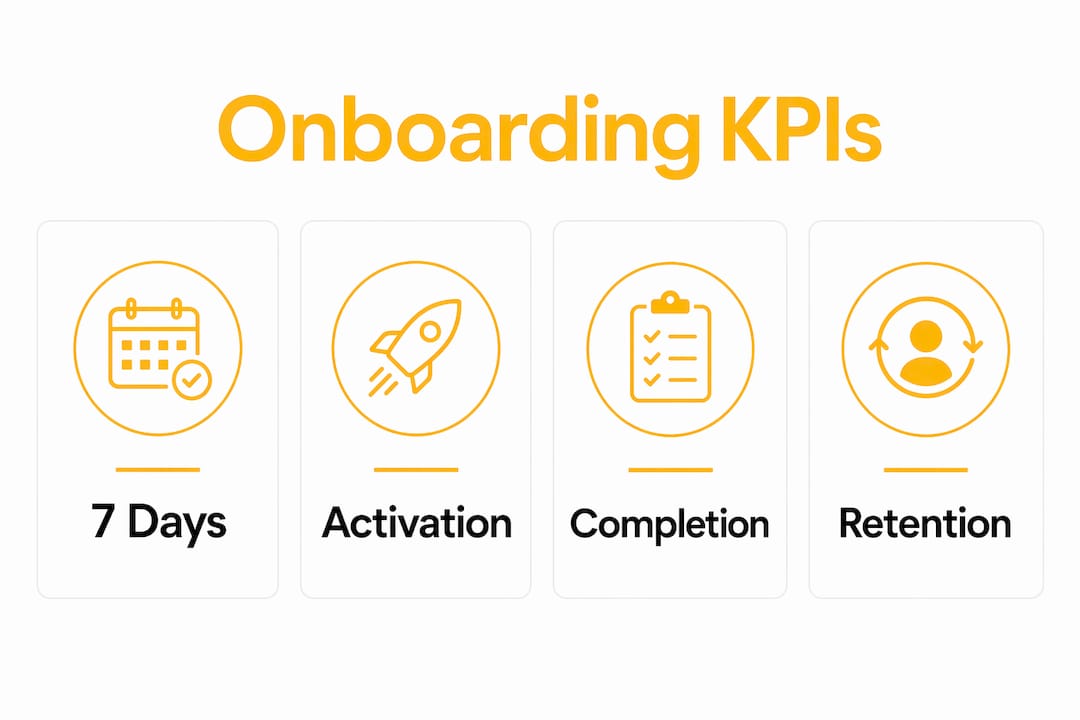
The most critical benchmark is time-to-first-value. Customers who achieve first value within 7 days show 4x higher adoption rates and 60% lower churn. That single data point reframes onboarding as a retention strategy, not just a setup process. Every day of delay in reaching that first value moment is a measurable risk to long-term revenue.
The table below maps each KPI to its purpose and a practical tracking method:
| KPI | What it measures | How to track it |
|---|---|---|
| Time-to-first-value | Speed from signup to first meaningful outcome | Milestone timestamps in your CRM or CS platform |
| Activation rate | Percentage of customers completing key setup steps | Completion tracking in Vitally or Moxo dashboards |
| Completion rate | Percentage finishing the full onboarding sequence | Checklist completion data from your onboarding tool |
| Retention at 90 days | Whether onboarded customers stay active | Cohort analysis in your analytics platform |
Beyond these four, SaaS onboarding metrics like feature adoption depth matter because customers who adopt multiple features show significantly lower churn than single-feature users. This means your onboarding checklist should not stop at account setup. It should guide customers toward the second and third features that create stickiness.
A common mistake is marking onboarding tasks complete before the customer has confirmed value. Premature closure inflates your completion rate while masking real adoption gaps. Build a quality gate, such as a customer-confirmed milestone or an NPS survey, before closing each phase. The KPIs in CX that matter most are the ones tied directly to customer behavior, not internal task completion.
How to implement and continuously improve a scalable CX onboarding playbook?
Building a scalable onboarding playbook is a phased process, not a one-time project. Vitally structures this as a 90-day implementation across three phases, and this framework applies well beyond SaaS to any industry where customer experience onboarding requires repeatability at scale.
- Phase 1: Document and standardize (Days 1 to 30). Map your current onboarding process by interviewing your best CSMs and documenting what they actually do. Identify the steps that appear in every successful onboarding and formalize them into a written playbook. This phase produces your baseline template.
- Phase 2: Build handoffs and templates (Days 31 to 60). Create standardized handoff documents between sales, implementation, and customer success. Build email templates, kickoff agendas, and training materials that any team member can use. Moxo’s 40-step onboarding checklist enforces verification of deliverables, SLA tracking, and real-time dashboard monitoring at each handoff point.
- Phase 3: Automate and scale (Days 61 to 90). Embed the documented workflows into your technology platforms. Automate task creation, notifications, and escalations. At this stage, Vitally’s capacity planning benchmark applies: if your team is handling 6 to 8 onboardings per person per quarter, you have room to expand. Above that threshold, automation or headcount additions become necessary.
Continuous improvement requires two feedback loops running in parallel. The first is internal: your onboarding team reviews completion rates, escalation frequency, and time-to-value data monthly. The second is external: customers complete NPS or CSAT surveys at the end of onboarding, and their responses feed directly into playbook revisions. Back-office optimization principles apply here too. The same discipline that drives operational efficiency in back-office functions, clear ownership, documented steps, and regular review cadences, produces the same results in onboarding.
The comparison below shows the difference between a static onboarding process and a living playbook:
| Dimension | Static process | Living playbook |
|---|---|---|
| Update frequency | Ad hoc, when problems arise | Monthly review cycle with data triggers |
| Ownership | Informal, team-dependent | Named owner per step and phase |
| Feedback integration | Rarely incorporated | Built into review cadence |
| Scalability | Degrades under volume | Holds quality at any volume |
What are the most common challenges in scaling onboarding?
Scaling onboarding surfaces predictable failure points. Recognizing them early prevents the kind of quality erosion that damages customer satisfaction and retention at exactly the moment your business is growing.
- Over-automation that removes the human element. Customers who receive only automated messages during onboarding report lower satisfaction scores than those who receive at least one personal touchpoint per phase. Automation should handle logistics. Humans should handle relationships.
- Handoff confusion between teams. When sales, implementation, and customer success operate without a shared handoff document, customers repeat themselves, information gets lost, and trust erodes. A named owner at every transition point eliminates this. Scaling support teams without clear handoff protocols is one of the fastest ways to degrade CX under growth pressure.
- Workflow rigidity that cannot adapt. A playbook that cannot accommodate a customer’s unique technical environment or organizational structure will fail. Build decision branches into your workflow so CSMs can route customers through the appropriate path without abandoning the process entirely.
- Data silos that block insight. When your CRM, onboarding platform, and support system do not share data, you cannot see the full customer picture. Onboarding decisions made without support history or product usage data are incomplete by definition.
- Capacity blind spots. Teams that do not track onboarding load per CSM cannot predict when quality will drop. Monitoring active onboardings per person and setting escalation thresholds before problems occur is a basic operational discipline that many teams skip until it is too late.
Key takeaways
Scalable CX onboarding requires defined triggers, named ownership, measurable milestones, and a continuous feedback loop to maintain quality as volume grows.
| Point | Details |
|---|---|
| Start with documentation | Map your best existing onboarding before building any automation or new tooling. |
| Automate around human touchpoints | Use AI for data tasks and follow-ups, but keep kickoff calls and milestone reviews personal. |
| Measure time-to-first-value | Customers reaching first value within 7 days show 60% lower churn rates. |
| Build a living playbook | Monthly review cycles driven by completion rate and NPS data prevent process decay. |
| Assign ownership at every step | Named owners at each handoff eliminate the most common source of onboarding failure. |
What I’ve learned scaling CX onboarding across industries
The most consistent mistake I see CX teams make is treating onboarding as a project with a defined end date rather than a system that requires ongoing ownership. Teams invest heavily in the first 90 days of playbook development, then let the process drift as priorities shift. Six months later, the playbook no longer reflects reality, and new CSMs are improvising again.
The second pattern I notice is an over-reliance on technology as a substitute for process clarity. Platforms like Vitally and Moxo are genuinely powerful, but they amplify whatever process you put into them. A poorly defined workflow automated at scale produces poor outcomes faster. Get the process right on paper before you automate it.
What actually works is starting small, with one customer segment or one product line, and iterating quickly with a cross-functional team that includes sales, implementation, and support. AI works best as a facilitator in this context, surfacing signals and removing friction, not replacing the judgment calls that experienced CSMs make every day. Adaptive onboarding, where the workflow adjusts based on customer behavior signals, is the direction the industry is moving. But the teams that will benefit most are those who already have clean, documented processes to adapt from.
— Daniela
How Altiamcx helps you build onboarding that scales
Altiamcx works with organizations that need onboarding to perform consistently at scale, not just in ideal conditions. A software platform that migrated tech support to Altiamcx improved productivity by 89%, a direct result of combining disciplined process design with measurable performance frameworks. Altiamcx brings the same approach to customer experience onboarding: clear ownership, real-time visibility into onboarding progress, and a nearshore team built for cultural alignment and operational resilience.

If your onboarding process is producing inconsistent results or struggling to hold quality as your customer base grows, Altiamcx can help you design and operate a system that scales. Explore how the team works and request a conversation tailored to your industry and growth stage.
FAQ
What are scalable CX onboarding steps?
Scalable CX onboarding steps are repeatable, owner-assigned workflows that guide customers from contract signed to first value, using defined triggers, sequential tasks, and measurable completion criteria. They are designed to maintain consistent quality regardless of onboarding volume.
How long should customer experience onboarding take?
Customers who reach first value within 7 days show 4x higher adoption and 60% lower churn, making the first week the most critical window in any onboarding process.
What tools support a scalable onboarding process?
Vitally, Moxo, and Zendesk each offer structured frameworks for building scalable onboarding playbooks, covering workflow automation, milestone tracking, SLA monitoring, and NPS collection within a single operational system.
How do you measure onboarding success?
Track time-to-first-value, activation rate, completion rate, and 90-day retention as your core metrics. Each one identifies a different failure point in the onboarding journey and guides specific improvements to your playbook.
When should you automate versus add headcount?
Vitally’s benchmark suggests that 6 to 8 onboardings per CSM per quarter indicates available capacity. Above that threshold, automation of routine tasks or additional headcount becomes necessary to protect onboarding quality.