
Response time is the single most measurable driver of lead conversion, client satisfaction, and firm reputation in legal customer experience. Firms that respond within five minutes are 21x more likely to qualify a lead than those responding after 30 minutes, and responding within one hour produces a 7x qualification uplift versus waiting 24 hours. The gap between knowing these numbers and acting on them is where most firms lose revenue.
Three benchmarks every practice leader should memorize:
- Sub-5 minutes: 21x qualification uplift vs. 30-minute response
- Within 1 hour: 7x uplift vs. a 24-hour response
- Market reality: Many U.S. firms still take multiple hours or never respond at all, even as the typical response improved to roughly a dozen minutes in early 2025
The immediate implication: automate compliant first-acknowledgment and scheduling before doing anything else to improve response times.
Key Takeaways
Response time is the highest-leverage, most measurable driver of legal client conversion: sub-5-minute acknowledgment produces a 21x qualification uplift, and firms that do not track this metric are leaving signed matters on the table.
| Point | Details |
|---|---|
| Sub-5-minute benchmark | Firms responding within 5 minutes are 21x more likely to qualify a lead than those responding after 30 minutes. |
| Market gap | Clio’s 2024 data shows median firm response around 3 days and a 27% no-response rate — the opportunity is large. |
| Compliance first | Every automated flow needs UPL-safe language, TCPA consent, and conflicts clearance before qualification proceeds. |
| Measure to improve | A minority of firms actively track response time; adding timestamps to your CRM immediately changes behavior. |
| Altiamcx as partner | Altiamcx provides 24/7 nearshore intake staffing, UPL-safe flows, and SLA-backed operations to reach sub-5-minute targets in 4–8 weeks. |
Table of Contents
- How response time shapes conversion, satisfaction, and firm reputation
- Where in the client journey does response time matter most?
- Building the system architecture to hit sub-5-minute targets
- KPIs, SLAs, and how to calculate the ROI of faster intake
- How Altiamcx accelerates legal intake and sustains SLAs
- The firms that wait are already losing clients
- Altiamcx helps law firms respond faster and convert more leads
- Useful sources and further reading
How response time shapes conversion, satisfaction, and firm reputation
The evidence is not ambiguous. Clio’s 2024 Legal Trends Report documents a clear decay curve: median firm response time runs around several days, and a notable portion of inquiries receive no response at all. Meanwhile, the ABA and MyCase reporting confirm that 42% of lawyers take three or more days to reply to some inquiries, and half of firms surveyed identify intake as an operational challenge.
The downstream effects compound quickly. Slow intake reduces qualification rates, which lowers consultation bookings, which shrinks signed matters. Clients who do not hear back within hours often contact the next firm on their search results page.
| Response window | Qualification uplift | Key risk of missing it |
|---|---|---|
| Under 5 minutes | 21x vs. 30-minute response | Lead contacts a competitor |
| Under 1 hour | 7x vs. 24-hour response | Intent decays; lead goes cold |
| Same business day | Baseline expectation | Negative review or complaint |
| 3+ days / no response | Significant drop-off | Permanent reputation damage |
Reputation compounds the conversion problem. The 2026 Case Status Legal CX Report finds that clients weigh how they were treated as heavily as the legal outcome itself. Clients who engage via a client portal app are significantly more likely to leave a review; those whose NPS was measured and clients asked for feedback at settlement show higher likelihoods of posting reviews. Speed at intake sets the tone for all of that.
Where in the client journey does response time matter most?
Speed is not equally valuable at every stage. The intake funnel has seven distinct stages, and the first three are where response time drives or kills conversion.
| Funnel stage | Recommended response window | Automation feasibility |
|---|---|---|
| Initial inquiry / acknowledgment | — | High — fully automatable |
| Qualification + conflicts check | — | Medium — automated scripts, attorney review |
| Scheduling | 3–5 minutes | High — calendar integration |
| Consultation delivery | Scheduled time | Low — attorney judgment required |
| Engagement / retainer signing | Same day | Medium — DocuSign-style automation |
| Case delivery / updates | Proactive, weekly minimum | Medium — templated updates |
| Closure / follow-up | Within 24 hours of resolution | Low — personal attorney touch |
The first three stages are where speed yields the highest return. Once a client has signed a retainer, the quality of communication matters more than its speed. Proactive “no-news” updates during case delivery reduce client anxiety and improve perceived responsiveness without requiring faster attorney turnaround.
Building the system architecture to hit sub-5-minute targets
A four-step intake architecture covering immediate acknowledgment, qualification plus conflicts, scheduling, and attorney handoff is the proven framework for reaching sub-5-minute and 1-hour benchmarks without UPL exposure.
Required components:
- Webform / webchat trigger: Fires the acknowledgment the moment a form is submitted or a chat is initiated.
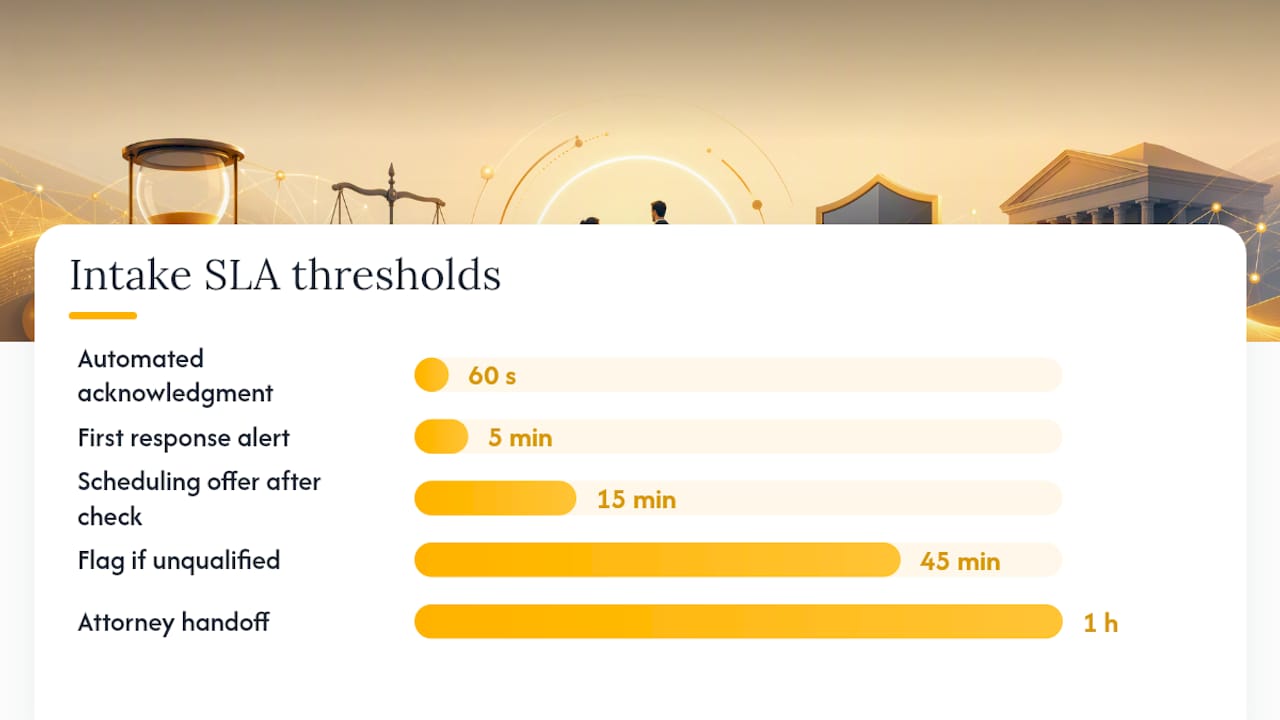
- Automated acknowledgment engine: Sends a UPL-safe confirmation via email and SMS within 60 seconds.
- Qualification script: Collects matter type, jurisdiction, and key facts via chatbot or IVR — no legal assessment.
- Real-time conflicts check: Queries the CRM against existing clients and adverse parties before routing.
- Calendar integration: Offers self-scheduling for consultations immediately after qualification clears.
- CRM tagging and routing: Timestamps every touchpoint and routes to the correct practice group.
- Attorney handoff notification: Pushes a summary to the assigned attorney via SMS or Slack within the 1-hour window.
Monitoring rules to enforce SLAs:
- Alert operations if first response exceeds 5 minutes on any channel
- Flag any lead that reaches 45 minutes without a qualification record
- Escalate to a supervisor if scheduling is not offered within 15 minutes of conflicts clearance
Pro Tip: Separate administrative automation from attorney judgment at every step. The system handles data collection and scheduling; the attorney handles legal assessment. That boundary is what keeps you UPL-compliant at speed.
KPIs, SLAs, and how to calculate the ROI of faster intake
A minority of firms actively track response time, which means most lack visibility on their highest-leverage intake metric. Visibility alone drives improvement.
Primary KPIs to track:
- Time-to-first-response (by channel: web, phone, email)
- Qualification rate by response window (under 5 min, 5–60 min, 1–24 hr, 24+ hr)
- Conversion-to-signed-matter rate
- Consultation show rate
- NPS score and Google review rate
Simple ROI calculation:
| Input | Example value |
|---|---|
| Projected qualification rate (sub-5-min response) | 21% (21x uplift applied) |
Dashboard cadence: Track time-to-first-response and qualification rate daily. Review conversion-to-signed-matter and show rates weekly. Pull NPS and review scores monthly.
How Altiamcx accelerates legal intake and sustains SLAs
Altiamcx delivers 24/7 nearshore intake staffing, templated UPL-safe qualification flows, integrated scheduling, and measurable SLA-backed operations for law firms that cannot afford to build these capabilities from scratch.
Relevant capabilities for legal intake:
- Bilingual agents trained on legal intake protocols and UPL boundaries
- Automated acknowledgment within 60 seconds, qualification within 15 minutes
- Real-time conflicts-check integration with leading legal CRMs
- Calendar integration for immediate self-scheduling post-qualification
- Client communication workflows that cover intake through case closure
The 2026 Case Status Legal CX Report confirms that operational investments in faster responses and proactive updates directly lift satisfaction scores and review rates. Altiamcx builds those operational investments into every engagement, with KPI dashboards that make the ROI visible from week one.
When speed to value, compliance expertise, and 24/7 coverage are all required, a managed nearshore partner outperforms an internal build on every dimension in the comparison table above.
The firms that wait are already losing clients
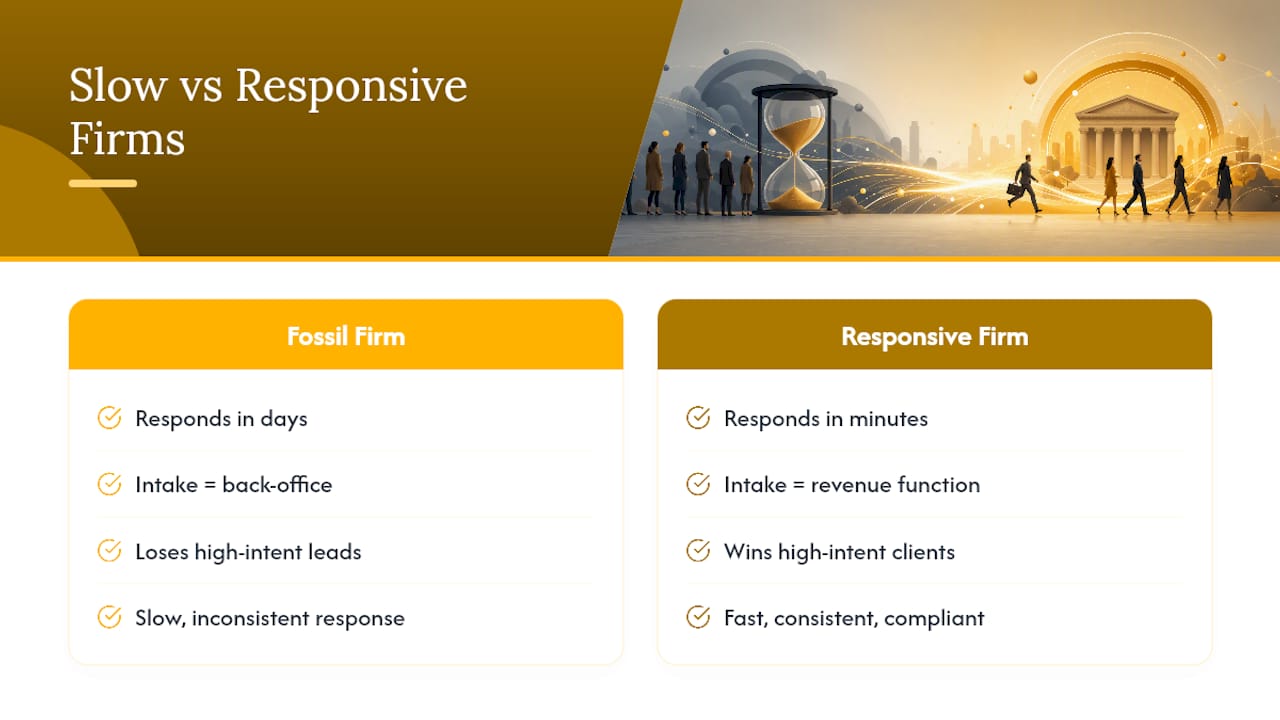
The data on response time in legal CX is not new, but the gap between awareness and execution remains wide. What strikes me most is not the 21x uplift figure itself — it is that the median firm still responds in days, not minutes, in 2026. That is not a technology problem. It is a prioritization problem.
Firms that treat intake as a back-office administrative task will keep losing high-intent leads to firms that treat it as a revenue function. The “Fossil Firm” model — where a potential client submits a form and waits two days for a callback — is not just inefficient. It is a competitive liability. The firms pulling ahead are not necessarily the ones with the best attorneys. They are the ones with the fastest, most consistent, most compliant first response.
Practice leaders who want to close that gap do not need a six-month technology project. They need a clear benchmark, a measurement system, and a staffing model that can sustain 24/7 coverage without burning out their paralegals. The architecture exists. The ROI math is straightforward. The only remaining question is whether your firm acts before your competitors do.
Altiamcx helps law firms respond faster and convert more leads
Law firms that need sub-5-minute intake response without a six-month build should look at what Altiamcx delivers: a fully managed nearshore intake team, UPL-safe qualification scripts, real-time conflicts integration, and SLA-backed performance from the first week of engagement.
The contrast with an internal build is concrete: Altiamcx reaches operational SLAs in 4–8 weeks versus the 3–6 months a typical in-house deployment requires, with 24/7 bilingual coverage included in the managed service fee. No additional headcount, no compliance training overhead, no gap in overnight or weekend coverage.
Practice leaders ready to run a focused intake pilot can review Altiamcx’s nearshore team extension case study to see the operational model in detail, then contact Altiamcx to scope a 90-day pilot for your firm.
Useful sources and further reading
The findings in this guide draw on the following primary industry sources. Each one is worth consulting directly for deeper methodology and data.
- Lead response time statistics
- 2025 lead form response time study
- Clio Legal Trends Report 2024
- Four tips for lawyers to provide exceptional client service
- How clients are treated is as important as the legal outcome itself, new 2026 Legal CX Report® finds
- Lead response time: intake architecture and automation guidance
- Legal Client Experience Report 2026 | Case Status
- Law Firm Client Service: 8 ways to improve your firm’s customer service