TL;DR:
- Optimized financial support workflows require clear evidence chains, explainability, and human oversight.
- Organizational accountability and cross-department alignment are critical for successful workflow redesign.
- Continuous verification and external expertise enhance efficiency, compliance, and customer satisfaction.
When a fraud dispute lands in your support queue at the wrong moment, and your team lacks a clear escalation path or defensible evidence chain, the cost is immediate. Customer trust erodes, regulatory exposure grows, and your operations team scrambles to contain the fallout. These are not hypothetical risks. They are the daily reality for financial services executives managing high-volume, high-stakes support environments. This guide walks you through a practical, step-by-step approach to optimizing your support workflows, covering gap assessment, evidence-driven design, automation implementation, and continuous improvement.
Table of Contents
- Assessing current workflow gaps and requirements
- Designing an evidence-driven workflow for financial support
- Implementing automation and monitoring for operational excellence
- Verifying results and continuous improvement
- The uncomfortable truth about workflow optimization in financial services
- Next steps: Enhance your financial support workflow with specialist help
- Frequently asked questions
Key Takeaways
| Point | Details |
|---|---|
| Edge-case handling focus | Special workflows for fraud and disputes prevent costly errors and boost customer trust. |
| Evidence chain importance | Strong evidence chains and human review paths make support decisions defensible and reliable. |
| Balanced automation | Automation boosts efficiency, but critical cases demand human oversight for quality outcomes. |
| Continuous improvement | Ongoing workflow reviews and upgrades ensure lasting performance gains in financial services support. |
Assessing current workflow gaps and requirements
After understanding the stakes, executives must pinpoint exactly where their workflows falter and what they require to modernize support operations.
Most financial services organizations carry workflow debt. That is, processes built in layers over time, often without a unified design. The result is a patchwork of tools, hand-offs, and manual workarounds that work well enough in normal conditions but break under pressure. Fraud surges, regulatory inquiries, and high-volume dispute seasons expose every seam.
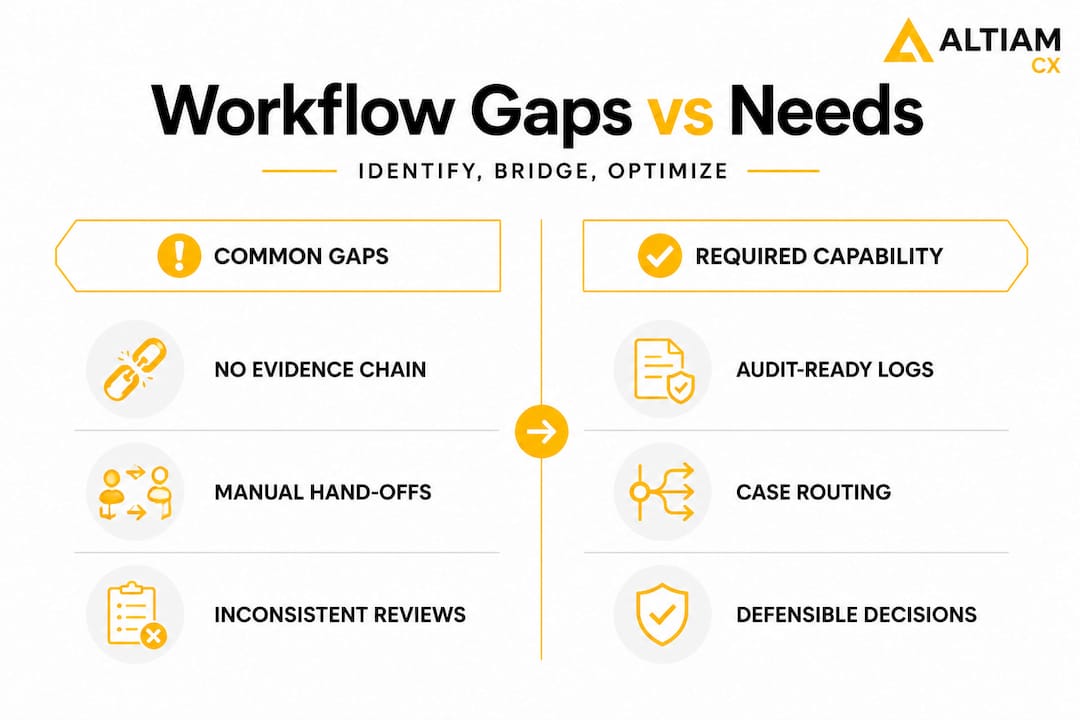
Edge-case handling in financial support is critical, especially for fraud disputes and other high-stakes moments. Workflow systems must support defensible evidence chains and human review paths. Without those foundations, your team cannot produce the audit-ready outcomes regulators and customers expect.
Common workflow gaps in financial services support include:
- No clear evidence chain linking customer interactions to risk outcomes
- Insufficient human review triggers for low-confidence or ambiguous cases
- Siloed tools that prevent real-time visibility across case states
- Inconsistent escalation criteria that vary by team or shift
- Limited explainability in automated decisioning, making it hard to defend outcomes
Critical requirements for an optimized workflow:
- Explainability at every automated step
- Defensible, time-stamped evidence records
- Configurable human review thresholds
- Scalable technology infrastructure
- Continuous staff training on edge-case protocols
| Common gap | Required capability |
|---|---|
| No evidence chain | Audit-ready, time-stamped case logs |
| Inconsistent escalation | Defined review triggers and criteria |
| Siloed tools | Integrated platform with real-time dashboards |
| Limited explainability | AI models with interpretable outputs |
| Manual-only review | Hybrid automation with human oversight |
Understanding back-office automation ROI is essential before committing to a redesign. Many executives underestimate the efficiency gains available simply from addressing the gaps listed above, often without a complete technology overhaul.
Pro Tip: Begin your workflow assessment in the highest-risk areas first, specifically fraud detection, payment disputes, and account access issues. These zones carry the most regulatory exposure and the greatest potential for costly errors if processes are unclear or undocumented.
When evaluating your current state, consider building a gap inventory. Document every hand-off point, every manual workaround, and every case type that regularly causes delays or escalations. That inventory becomes your roadmap. Looking at back-office solutions that other organizations have used to address similar gaps can accelerate this process considerably.
Some financial services firms also leverage SaaS solutions for advisors to automate parts of their intake and case routing, reducing manual triage time and freeing experienced staff for complex cases that genuinely require human judgment.
Designing an evidence-driven workflow for financial support
With clear requirements, executives can now design a workflow that operationalizes explainability and defensible decision-making, particularly for edge cases.
Design is where strategy becomes structure. A well-designed financial support workflow does more than route tickets. It creates a verifiable record of every decision, flags uncertainty before it becomes error, and ensures that humans remain in the loop when the stakes are highest.
Explainability for fraud and AML-adjacent workflows is needed not only for model accuracy but for defensible evidence chains that connect telemetry to risk outcomes. This principle should guide every design decision you make.
Steps to build an evidence-driven support workflow:
- Map your current process end to end. Identify every step from initial customer contact to case resolution. Document who does what, when, and using which tools. Do not skip the informal steps your best agents carry in their heads.
- Integrate explainable AI where appropriate. Select tools that provide interpretable outputs, meaning the system can tell a reviewer why a case was scored or routed a certain way. Opaque models create compliance risk.
- Build evidence chains into every case type. Every interaction, decision, and data point should be logged with a timestamp and a system or agent identifier. This creates the audit trail you need for regulatory review or dispute resolution.
- Set human review triggers based on confidence thresholds. Define the conditions under which a case automatically escalates to a human reviewer. Low model confidence, conflicting data signals, or case value above a defined threshold are all valid triggers.
- Test with real edge-case scenarios. Before going live, run your workflow against historical cases that were difficult to resolve. Identify where the design fails or creates friction, then iterate.
Here is how different workflow approaches compare on key dimensions:
| Approach | Explainability | Scalability | Human oversight | Regulatory readiness |
|---|---|---|---|---|
| Fully manual | High | Low | High | Moderate |
| Hybrid (automation + human) | High | High | Targeted | High |
| Fully automated | Variable | Very high | Low | Risk-dependent |
The hybrid model consistently delivers the best balance for financial services. Routine, low-risk cases move quickly through automated channels. Complex, ambiguous, or high-value cases route immediately to experienced reviewers with full context already assembled.
“If a model uses an evidence modality, it must provide a human-review path for conflicting cases.” This principle, drawn from explainable fraud detection models, captures the non-negotiable standard for financial support workflows in regulated environments.
A well-designed customer care workflow in 2026 can reduce average handling time significantly while also improving case accuracy. The key is not choosing between speed and quality but designing a system where both reinforce each other. When you optimize operations efficiency through design rather than individual heroics, results become repeatable and scalable.
Implementing automation and monitoring for operational excellence
Once the workflow blueprint is in place, implementation becomes a matter of balancing automation and human expertise for operational excellence.

Implementation is where good intentions meet operational reality. Even a well-designed workflow can fail if rollout is rushed, monitoring is an afterthought, or staff are not prepared for the change. Structured implementation, with clear ownership and real-time oversight built in from day one, makes the difference between a workflow that performs and one that adds new complications.
Workflow systems must support human review paths for low-confidence or conflicting outputs in financial support. Automation should accelerate resolution, not bypass accountability.
Key components to automate in a financial support workflow:
- Routine inquiry routing: Use AI-driven triage to categorize and route standard cases automatically, freeing agents for complex work.
- Audit log generation: Automate the creation of case logs at each step to ensure completeness without relying on manual entry.
- Anomaly alerts: Set automated triggers that notify supervisors when case volumes spike, resolution times extend, or edge-case rates increase.
- Status updates to customers: Automate acknowledgment messages and progress updates for open cases to reduce inbound inquiry volume.
- Quality scoring on resolved cases: Use automated sampling to score resolved cases against defined criteria, feeding continuous improvement cycles.
Oversight tools are equally important. Real-time dashboards that show case queue depth, escalation rates, and average handling time give your operations leaders the visibility they need to intervene before problems compound. Pairing those dashboards with weekly review loops for critical case types ensures that emerging patterns get addressed systematically.
Pro Tip: Use real-time monitoring not just to track performance but to proactively detect edge-case incident clusters. A sudden rise in fraud-related escalations, for example, may signal an active attack or a process breakdown that requires immediate intervention. Early detection is significantly less expensive than post-incident remediation.
Understanding how to scale support teams without sacrificing quality is essential during implementation. Growth in case volume should trigger a calibrated response, not a frantic scramble to hire and onboard. Build capacity triggers into your monitoring framework so you can act proactively.
Streamlining support operations at the execution stage also means standardizing agent training around the new workflow. Every reviewer needs to understand what triggers escalation, how to document their decisions, and how to use the evidence chain tools at their disposal. The best workflow design means little if the people operating it lack confidence or consistency.
Effective back-office outsourcing for efficiency can accelerate implementation timelines by bringing in experienced operational partners who have done this before and can help avoid common rollout mistakes.
Verifying results and continuous improvement
Effective implementation demands ongoing verification and refinement, ensuring workflows stay robust as demands evolve.
A workflow is not a finished product. It is a living system that must be measured, reviewed, and updated as your business grows, regulations change, and customer expectations shift. Executives who treat optimization as a one-time project rather than an ongoing discipline tend to find themselves back at square one within 18 to 24 months.
Verification steps for financial support workflow outcomes:
- Define and baseline your KPIs before going live. Core metrics include average case handling time, evidence chain completeness rate, customer satisfaction scores on resolved cases, and frequency of edge-case escalations.
- Audit evidence chains on a regular schedule. Pull a random sample of resolved cases each week and verify that the evidence chain is complete, time-stamped, and meets your defined standards.
- Review edge-case logs monthly. Analyze patterns in cases that required human review. Are the same case types recurring? Is the escalation criteria still calibrated correctly?
- Gather structured feedback from front-line agents. Your reviewers and support agents see workflow friction that dashboards often miss. Build a formal channel for surfacing that feedback.
- Conduct a full workflow audit quarterly. Reassess your gap inventory from the assessment phase and measure progress against each item.
Workflow optimization delivers measurable results. Organizations that implement structured, evidence-driven support workflows see efficiency increases of up to 40% compared to unoptimized baseline operations. That figure reflects faster handling times, fewer rework cycles, and reduced escalation costs. The compounding effect over multiple quarters is substantial.
Workflow systems must support defensible evidence chains that connect telemetry to risk outcomes, and your verification process should confirm this at regular intervals, not just at launch.
Continuous improvement also requires a structured schedule for technology review. Tools that were leading-edge 18 months ago may now have better alternatives. Building a bi-annual technology assessment into your operations calendar keeps your workflow competitive without requiring constant disruption.
Staff retraining is the third pillar of continuous improvement. As your workflow evolves, agents need updated guidance on new procedures, revised escalation criteria, and any technology changes. Investing in that training pays dividends in case accuracy and compliance readiness. If you want to improve customer support steps systematically, building retraining into the operating calendar is one of the highest-return activities available to your operations leadership.
The uncomfortable truth about workflow optimization in financial services
Here is the reality that most workflow optimization discussions avoid: technology is rarely the primary reason these projects fail. The more common culprit is organizational behavior. Specifically, unclear process ownership, inconsistent accountability, and the tendency to treat workflow redesign as an IT project rather than an operations leadership mandate.
Most workflow upgrades that underperform share a common pattern. The design phase was rigorous. The technology selection was sound. But nobody owned the edge-case escalation path with genuine accountability. When a disputed transaction arrived outside normal parameters, teams deferred to informal norms instead of the defined process. Over time, those informal norms became the actual workflow, and the designed workflow became a document nobody followed.
Human review is irreplaceable. This is not a critique of automation. It is a recognition that financial services support involves judgment calls that current AI models cannot reliably make on their own, particularly in fraud disputes, account takeover scenarios, and cases with conflicting evidence signals. Executives who design workflows that depend on automation to handle these cases without meaningful human oversight are accepting regulatory and reputational risk that is difficult to quantify and harder to defend.
Executive buy-in and cross-departmental alignment are not soft requirements. They are operational necessities. Compliance, operations, technology, and customer experience teams all have a stake in how the workflow functions. If those stakeholders do not align on standards, escalation paths become contested territory rather than clear lanes.
Supporting this kind of alignment in legal services and back-office functions follows similar principles. Clear ownership, documented processes, and regular cross-functional review are what separate organizations that sustain workflow improvements from those that revert.
Pro Tip: Assign a named individual, not a team or a committee, as the accountable owner for each edge-case escalation path. When accountability is distributed, it effectively belongs to no one. A named owner creates a clear point of contact, faster resolution, and a stronger feedback loop for continuous improvement.
Next steps: Enhance your financial support workflow with specialist help
Executives who have followed this framework know that the path from assessment to continuous improvement requires both disciplined internal leadership and the right external partners. Complex financial support workflows, especially those involving fraud, dispute resolution, and regulatory compliance, benefit enormously from operational partners who bring both specialized expertise and proven execution frameworks.

Altiam CX delivers nearshore customer experience solutions specifically designed for organizations managing high-stakes, high-volume support environments. From evidence-driven case management to real-time monitoring and scalable team extension, our operational frameworks are built to reduce friction, strengthen compliance readiness, and improve customer satisfaction at every touchpoint. Whether you need targeted support for edge-case handling or a broader workflow transformation, our managed team extension services give you experienced operational capacity without the overhead of building it from scratch.
Frequently asked questions
What is a financial services support workflow?
It is a coordinated set of steps, tools, and review processes that manage customer support cases, including complex edge cases such as fraud disputes, account issues, and compliance-sensitive inquiries, from initial contact through to resolution.
How can explainability be ensured in financial support workflows?
Workflow systems must connect evidence chains to risk outcomes and provide clear human review paths for any case where automated outputs are low-confidence or conflicting, ensuring every decision can be audited and defended.
Why are edge-case incidents such as fraud disputes hard to manage?
Edge-case handling requires defensible evidence and often involves conflicting data signals, making human review essential alongside automated processes to ensure accurate, compliant, and auditable outcomes.
What KPIs should executives track in support workflow optimization?
Track average case handling time, evidence chain completeness rate, customer satisfaction scores on resolved cases, and the frequency of edge-case escalations, as these metrics together give a complete picture of workflow health and improvement over time.