
Customer experience leaders in healthcare, legal, and e-commerce face mounting pressure from fragmented service models that drive churn and erode trust. Regulatory complexity, cultural disconnects, and inconsistent service quality compound these challenges. Nearshore customer experience partnerships offer a structured path to resolve these pain points through cultural alignment, compliance rigor, and measurable performance gains. This guide walks you through a proven, step-by-step process tailored to optimize CX outcomes in your sector.
Table of Contents
- Introduction To Customer Experience Optimization And Nearshoring
- Prerequisites: What You Need Before Starting Your CX Optimization Process
- Step-By-Step Customer Experience Optimization Process
- Common Mistakes And Troubleshooting
- Measuring Success And Expected Outcomes
- Operational Scalability And Performance Management
- Advanced Techniques And Technology Integration
- Discover Expert Nearshore CX Services To Accelerate Your Success
- Frequently Asked Questions
Key takeaways
| Point | Details |
|---|---|
| Structured nearshore CX process | Increases satisfaction by up to 30% over offshore alternatives through cultural and compliance alignment. |
| Essential prerequisites | Include HIPAA certifications, documented SOPs, baseline journey maps, and cultural fit assessments before launch. |
| Stepwise optimization approach | Map journeys, identify friction, train teams, measure KPIs, and iterate continuously for sustained improvement. |
| Common mistakes to avoid | Neglecting cultural alignment, defining vague KPIs, and over-relying on automation without human empathy. |
| Measurable outcomes | Target 25% churn reduction, 30% satisfaction boost, and clear ROI within 6 to 12 months. |
Introduction to customer experience optimization and nearshoring
Fragmented customer experiences create costly friction in sectors where trust and compliance are non-negotiable. Healthcare organizations juggle HIPAA requirements and patient expectations while legal firms balance confidentiality with responsiveness. E-commerce businesses demand flexibility to scale support during peak seasons without sacrificing quality. Offshore models often fall short on cultural nuance and regulatory expertise, leading to miscommunication and compliance gaps.
Nearshore CX achieves up to 30% higher customer satisfaction in healthcare, legal, and e-commerce sectors compared to offshore alternatives. Geographic proximity enables real-time collaboration across similar time zones, while shared cultural contexts improve empathy and communication authenticity. Nearshore partners understand North American customer expectations intuitively, reducing training cycles and improving first-contact resolution rates.
Compliance alignment is critical in regulated industries. Healthcare and legal sectors require partners who hold current certifications and understand evolving privacy standards. Nearshore providers typically maintain nearshore customer experience benefits through rigorous audit trails and staff training aligned with U.S. and Canadian regulatory frameworks. This reduces liability risk and builds customer confidence.
E-commerce thrives on agility and personalization. Nearshore team-extension models allow you to scale support capacity quickly during product launches or seasonal spikes, then flex down without long-term overhead. Teams integrate seamlessly with your internal systems, adopting your brand voice and processes faster than offshore counterparts.
“AI enhances customer interactions, but authentic human empathy remains the foundation of trust in complex, high-stakes service moments.”
Artificial intelligence tools improve efficiency by automating routine inquiries and surfacing predictive insights. However, healthcare customer service expects instant, AI-powered digital support combined with authentic human empathy to navigate sensitive conversations about health outcomes or legal matters. Technology amplifies your team’s capabilities but cannot replace the judgment and compassion trained professionals provide.
Prerequisites: what you need before starting your CX optimization process
Successful CX optimization begins with solid groundwork. Jumping into execution without baseline data and clear compliance standards leads to misaligned efforts and wasted resources. Gather these essentials before engaging a nearshore partner.
First, establish baseline customer journey data. Map existing touchpoints across awareness, consideration, purchase, and post-sale support. Collect quantitative metrics like average handle time, first-contact resolution, and satisfaction scores. Add qualitative insights through customer interviews and support ticket analysis to identify recurring pain points. This baseline allows you to measure improvement accurately and prioritize high-impact areas.
Compliance certifications are mandatory in healthcare and legal contexts. HIPAA and confidentiality certifications are mandatory in healthcare and legal sectors to protect sensitive information and avoid costly penalties. Verify that potential nearshore partners hold current certifications and conduct regular audits. Request evidence of staff training on privacy protocols and incident response procedures. Non-negotiable compliance protects your reputation and ensures continuity.
Cultural alignment assessment ensures your nearshore team connects authentically with customers. Evaluate language proficiency beyond basic fluency, including regional idioms and communication styles. Test problem-solving approaches through role-play scenarios that mirror real customer interactions. Strong cultural fit reduces escalations and improves customer trust from the first interaction.
Document your current process workflows and standard operating procedures. Even informal processes should be captured in writing before transitioning work to a nearshore partner. Clear documentation accelerates onboarding, ensures consistency, and provides a reference point for continuous improvement. Include decision trees for common scenarios, escalation protocols, and quality standards.
Essential prerequisites checklist:
- Baseline customer journey maps with quantitative and qualitative data
- Current compliance certifications verified for healthcare or legal requirements
- Cultural alignment assessment including language and problem-solving evaluation
- Documented SOPs covering workflows, escalations, and quality benchmarks
- Defined KPIs tied directly to customer outcomes and business goals
Define key performance indicators before launch. Align KPIs with business outcomes like customer retention, lifetime value, and net promoter score rather than activity metrics alone. Establish measurement tools and reporting cadences so both your team and the nearshore partner track progress transparently. Accountability from day one prevents drift and keeps optimization efforts focused.
| Prerequisite | Purpose | Validation Method |
|---|---|---|
| Baseline journey data | Measure improvement accurately | Survey scores, ticket analysis, call recordings |
| Compliance certifications | Ensure regulatory protection | Audit reports, staff training logs, third-party verification |
| Cultural alignment | Improve authentic customer connections | Role-play assessments, language proficiency tests, reference checks |
| Documented SOPs | Accelerate onboarding and consistency | Process walkthroughs, decision trees, quality checklists |
| Defined KPIs | Focus efforts on business outcomes | Dashboard setup, reporting schedule, stakeholder alignment |
Step-by-step customer experience optimization process
Mapping and analyzing customer journeys enables targeted elimination of friction points that degrade satisfaction and drive churn. Follow this structured approach to optimize CX systematically.
-
Map current-state customer journeys in detail. Document every touchpoint from initial awareness through post-purchase support. Capture both digital and human interactions. Use analytics tools to track drop-off points and time spent at each stage. Supplement quantitative data with customer interviews to understand emotional highs and lows. Identify moments that matter most to loyalty and retention.
-
Identify friction points and root causes. Analyze journey maps to pinpoint where customers struggle or disengage. Look for patterns in support tickets, negative reviews, and churn data. Distinguish between symptoms and underlying causes. For example, long wait times may stem from understaffing, poor routing logic, or inadequate self-service options. Prioritize friction points by impact on satisfaction and business outcomes.
-
Develop tailored training combining empathy with personalization. Design training programs that teach your nearshore team both technical product knowledge and soft skills like active listening and de-escalation. Include sector-specific scenarios relevant to healthcare, legal, or e-commerce contexts. Blend classroom instruction with shadowing experienced agents and handling live interactions under supervision. Reinforce cultural alignment by explaining your brand values and customer expectations explicitly.
-
Implement clear, measurable KPIs linked to outcomes. Establish metrics that reflect customer satisfaction, operational efficiency, and business results. Track customer satisfaction scores, net promoter scores, first-contact resolution rates, and average handle times. Monitor churn rates and customer lifetime value to assess long-term impact. Ensure nearshore partners have real-time access to dashboards so they can course-correct quickly.
-
Set continuous feedback loops and iterative testing. Schedule regular reviews with your nearshore partner to analyze performance data and customer feedback. Test process changes in controlled pilots before full rollout. Encourage frontline agents to suggest improvements based on recurring customer questions or complaints. Create a culture of experimentation where small refinements compound into significant gains over time.
-
Establish governance and communication frameworks. Define decision-making authority, escalation paths, and meeting rhythms. Assign executive sponsors on both sides to resolve strategic issues quickly. Use collaborative tools that provide visibility into work status and performance trends. Maintain open channels for informal communication to build trust and surface problems early.
Pro Tip: Start with a small pilot team handling a single customer segment or product line. Prove the model works before scaling broadly. This approach reduces risk and generates internal buy-in through early wins.
Integrating a nearshore team successfully requires intentional onboarding and ongoing collaboration. Integrate nearshore team successfully by treating them as an extension of your internal staff rather than an outsourced vendor. Include nearshore team members in strategy discussions, product launches, and training updates. This inclusion improves engagement and service quality.
Follow effective nearshore CX steps that align with your sector’s unique requirements. Healthcare teams need deep knowledge of medical terminology and patient privacy. Legal teams must understand confidentiality protocols and case management workflows. E-commerce teams require agility to adapt to promotional campaigns and inventory changes. Tailor your process to these nuances for maximum impact.

Common mistakes and troubleshooting
Even well-planned CX optimization efforts encounter obstacles. Recognizing common pitfalls early allows you to correct course before they derail progress. Up to 40% of CX projects underperform due to poor cultural alignment and unclear KPIs, wasting time and eroding stakeholder confidence.
Neglecting cultural alignment limits customer trust and satisfaction. When nearshore agents lack cultural context, they misinterpret customer tone, miss conversational cues, and respond in ways that feel robotic or disconnected. Customers in healthcare and legal sectors especially value empathy and understanding during stressful interactions. Prioritize cultural alignment in CX by investing in thorough onboarding and ongoing cultural training. Test alignment regularly through quality monitoring and customer feedback.
Underdocumenting processes hinders scalability and consistency. When knowledge lives only in the heads of a few experienced agents, new team members struggle to ramp up and service quality varies widely. Create comprehensive SOPs that cover standard scenarios, edge cases, and escalation protocols. Update documentation continuously as processes evolve. This foundation allows you to scale confidently without sacrificing quality.
Failing to define clear, quantifiable KPIs causes lack of focus and poor outcomes. Vague goals like “improve customer satisfaction” provide no actionable guidance. Specify target metrics with timelines, such as “increase net promoter score by 15 points within six months” or “reduce average handle time by 20 seconds while maintaining first-contact resolution above 80%.” Align KPIs across internal and nearshore teams so everyone works toward the same objectives.
Over-relying on automation and AI without preserving human empathy reduces impact. Chatbots and self-service portals handle routine inquiries efficiently, but complex or emotionally charged situations require human judgment. Customers who feel frustrated by repetitive bot interactions or impersonal responses churn faster. Balance technology with live support, routing high-stakes or nuanced inquiries to trained agents who can provide personalized attention.
Common troubleshooting actions:
- Conduct quarterly cultural alignment reviews with role-play assessments and feedback sessions
- Maintain a living knowledge base accessible to all team members and updated weekly
- Audit KPI definitions every quarter to ensure they remain relevant and actionable
- Analyze escalation patterns to identify gaps in self-service or automation logic
- Schedule monthly process improvement workshops where frontline agents propose refinements
Pro Tip: Create a dedicated Slack channel or communication thread where nearshore agents can ask questions in real time. This reduces errors, speeds problem resolution, and builds team cohesion across geographies.
Regularly review and update SOPs and measurement frameworks to troubleshoot issues proactively. As customer expectations shift and your business evolves, static processes become outdated. Build time into monthly or quarterly reviews to assess what’s working and what needs adjustment. Involve both internal stakeholders and nearshore partners in these discussions to surface insights from multiple perspectives.
Avoiding CX mistakes nearshore requires discipline and continuous learning. Stay connected to common CX mistakes and fixes through industry research and peer networks. Apply lessons from other sectors to your own context, adapting proven practices rather than reinventing solutions.
Measuring success and expected outcomes
Quantifying CX optimization impact builds stakeholder confidence and justifies continued investment. Realistic benchmarks help you set expectations and celebrate progress. Up to 25% reduction in customer churn and 30% improvement in satisfaction scores are typical benchmarks for well-executed nearshore CX optimization.
Track customer satisfaction score improvements of 20 to 30% within six to 12 months. Use consistent survey methodologies before and after optimization to ensure valid comparisons. Monitor trends across customer segments to identify which groups benefit most and where additional refinement is needed. Satisfaction gains translate directly into retention and referral rates.
Measure customer churn reduction targets up to 25% post-optimization. Analyze churn by cohort to understand whether improvements affect new customers, long-term customers, or both. Dig into exit interviews and cancellation reasons to verify that CX enhancements address root causes. Reducing churn improves lifetime value and lowers acquisition costs.
Monitor revenue increases from hyper-personalized CX, sometimes reaching up to 40%. Personalization drives higher conversion rates, larger average order values, and more frequent repeat purchases. Track revenue per customer and compare cohorts that experienced optimized CX against those who did not. Attribute revenue lift carefully to avoid overstating impact.
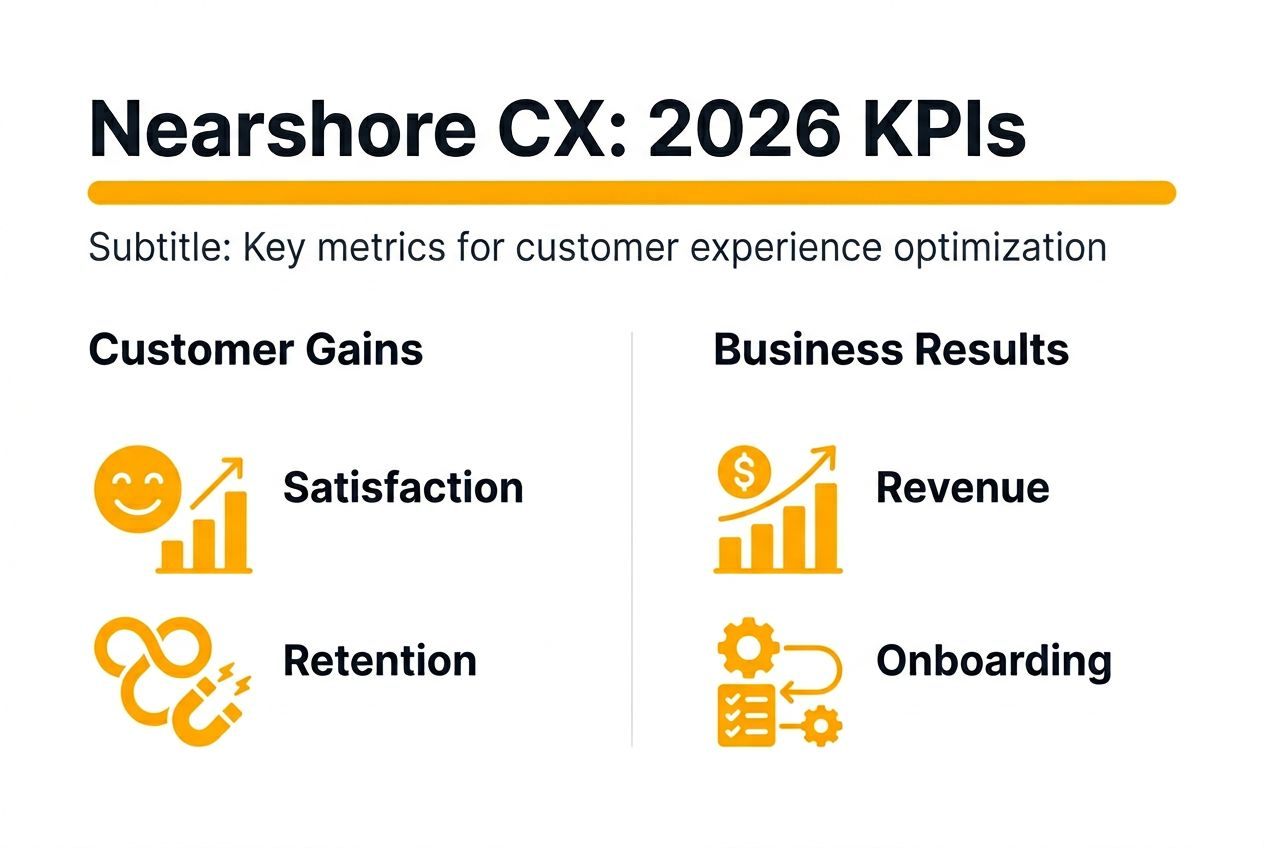
Evaluate faster onboarding efficiencies via SOPs and clear roles. Measure time to full productivity for new nearshore agents compared to your baseline. Reduced ramp time lowers training costs and accelerates your ability to scale support capacity. Document onboarding improvements as evidence of operational maturity.
Use referral and willingness-to-pay metrics as indicators of long-term ROI. Net promoter score captures customer willingness to recommend your brand. Willingness to pay reflects perceived value and reduces price sensitivity. Both metrics predict sustainable growth better than transactional measures alone.
| Metric | Target Improvement | Timeframe | Measurement Method |
|---|---|---|---|
| Customer satisfaction score | 20 to 30% increase | 6 to 12 months | Post-interaction surveys, quarterly benchmarks |
| Customer churn rate | 25% reduction | 6 to 12 months | Cohort analysis, cancellation tracking |
| Revenue per customer | Up to 40% increase | 12 months | Purchase data, lifetime value calculations |
| Agent onboarding time | 30% reduction | 3 to 6 months | Time to productivity, quality scores |
| Net promoter score | 15-point increase | 6 to 12 months | Quarterly NPS surveys |
Measuring CX success requires disciplined data collection and transparent reporting. Establish dashboards that provide real-time visibility into KPIs for both internal teams and nearshore partners. Schedule monthly business reviews to discuss trends, celebrate wins, and address underperformance collaboratively.
Calculate ROI by comparing CX investment against measurable gains in retention, revenue, and operational efficiency. Include both hard costs like nearshore partner fees and soft costs like internal staff time spent on integration. Offset these against churn reduction value, revenue lift, and cost savings from improved first-contact resolution. Communicate ROI clearly to executives using their preferred financial frameworks.
Realistic expectations prevent disappointment and maintain momentum. Early wins in the first three to six months validate your approach and build internal support. Larger gains compound over 12 to 24 months as processes mature and cultural alignment deepens. Stay patient and committed to continuous improvement rather than expecting instant transformation.
Benchmark your results against industry standards and peer companies. CX success metrics and ROI vary by sector, but tracking relative performance helps you understand whether you’re leading, lagging, or keeping pace. Use external benchmarks to set stretch goals and identify areas for further optimization.
Operational scalability and performance management
Clear role definitions and SOPs accelerate onboarding and maintain quality at scale. As your nearshore partnership grows, structured operations prevent chaos and preserve the personalized service customers expect.
Define roles clearly to speed ramp-up and reduce errors. Distinguish between tier-one agents handling routine inquiries, tier-two specialists managing complex cases, and quality assurance coaches monitoring performance. Document responsibilities, required skills, and escalation criteria for each role. Clear boundaries prevent duplication of effort and ensure customers reach the right resource quickly.
Use comprehensive SOPs to ensure consistent service delivery across teams. SOPs should cover standard workflows, troubleshooting steps, communication templates, and quality standards. Include screenshots, decision trees, and example interactions to make procedures easy to follow. Version control and regular updates keep SOPs relevant as products and policies evolve.
Balance flexibility with control in team-extension versus fully managed nearshore models. Team-extension gives you direct oversight and deep integration with internal processes, ideal when you have strong internal management capacity. Fully managed models delegate day-to-day supervision to the nearshore partner, freeing your team to focus on strategy while the partner handles execution. Choose based on your internal resources and desired level of control.
Culturally aligned teams improve communication, compliance, and customer satisfaction. Nearshore partners in Latin America share similar work cultures, holidays, and time zones with North American clients. This alignment reduces misunderstandings, simplifies scheduling, and fosters stronger working relationships. Cultural fit also enhances compliance adherence as teams intuitively understand regulatory context and customer expectations.
Implement performance dashboards tracking KPIs and customer feedback continuously. Dashboards provide transparency and accountability, surfacing issues before they escalate. Share dashboards with both internal stakeholders and nearshore partners so everyone sees the same data. Use visualizations that highlight trends and exceptions, making it easy to spot opportunities for improvement.
Operational scalability best practices:
- Maintain a 10:1 agent-to-coach ratio to ensure consistent quality oversight
- Run quarterly calibration sessions to align quality standards across internal and nearshore teams
- Use workforce management tools to optimize scheduling and capacity planning
- Create career paths for nearshore agents to reduce turnover and retain institutional knowledge
| Nearshore Model | Best For | Control Level | Integration Effort |
|---|---|---|---|
| Team-extension | Organizations with strong internal management | High direct oversight | High; deep integration with internal systems |
| Fully managed | Organizations seeking turnkey solutions | Partner-managed operations | Medium; defined interfaces and reporting |
Scaling nearshore CX successfully depends on proactive capacity planning. Forecast support volume based on seasonal patterns, product launches, and growth projections. Communicate forecasts to your nearshore partner months in advance so they can recruit and train additional agents. Flexibility to scale up or down quickly without long-term commitments is a key nearshore advantage.
Nearshore performance management requires regular feedback loops and coaching. Conduct weekly one-on-one sessions between coaches and agents to review performance data, discuss challenges, and set improvement goals. Recognize top performers publicly to reinforce desired behaviors. Address underperformance quickly through targeted coaching or additional training.
Advanced techniques and technology integration
AI and machine learning drive 22% growth in conversational support; hyper-personalization boosts revenue by 40% when implemented thoughtfully. Modern CX optimization blends cutting-edge technology with human judgment.
Leverage AI and machine learning for real-time personalized customer interactions. AI analyzes customer history, purchase patterns, and browsing behavior to recommend relevant products or solutions. Machine learning models predict customer needs before they articulate them, enabling proactive outreach. Chatbots handle routine inquiries instantly, freeing human agents to focus on complex cases requiring empathy and creativity.
Adopt predictive analytics to proactively address potential issues and reduce friction. Predictive models identify customers at risk of churn based on engagement patterns and satisfaction signals. Intervene early with personalized offers or support to retain these customers. Predictive maintenance alerts e-commerce customers about upcoming subscription renewals or reorder opportunities, reducing manual effort and improving convenience.
Use hyper-personalization to tailor experiences beyond basic segmentation. Move past demographic groupings to individual-level customization based on behavioral data. Address customers by name, reference past interactions, and anticipate preferences in real time. Hyper-personalization makes customers feel understood and valued, strengthening emotional connections to your brand.
Maintain balance by retaining human empathy in complex, regulated interactions. AI excels at efficiency and pattern recognition but struggles with nuanced judgment and emotional intelligence. Healthcare patients navigating treatment decisions or legal clients facing high-stakes situations need human compassion and expertise. Reserve AI for tasks where speed and consistency matter most, and deploy trained agents for high-touch moments.
Continuously update technology tools aligned with evolving customer expectations. Customer preferences shift rapidly as new channels and capabilities emerge. Stay current with messaging platforms, video support, and self-service portals that customers increasingly prefer. Invest in integration platforms that unify customer data across touchpoints, providing agents with complete context during interactions.
Advanced CX technology tactics:
- Implement sentiment analysis to flag frustrated customers for immediate escalation
- Use AI-powered knowledge bases that surface relevant articles to agents in real time
- Deploy voice biometrics for secure, frictionless authentication in healthcare and legal contexts
- Test conversational AI that adapts tone and language based on customer emotional state
Pro Tip: Pilot new technologies with a small customer segment before full deployment. Gather feedback from both customers and agents to refine functionality and ensure seamless integration with existing workflows.
Technology in nearshore CX amplifies your team’s capabilities when implemented strategically. Nearshore partners who invest in modern tools and training deliver superior outcomes. Evaluate potential partners based on their technology stack and commitment to continuous improvement.
Stay informed about AI and hyper-personalization trends through industry publications and conferences. Experiment with emerging technologies in controlled pilots to assess fit for your business. Balance innovation with stability, ensuring new tools integrate smoothly with your existing infrastructure and processes.
Discover expert nearshore CX services to accelerate your success
Optimizing customer experience requires expertise, discipline, and the right partnership model. Altiam CX specializes in nearshore customer experience outsourcing tailored to healthcare, legal, and e-commerce sectors. Our culturally aligned teams combine compliance rigor with authentic empathy to deliver measurable improvements in satisfaction, retention, and operational efficiency.

We offer flexible engagement models to fit your internal resources and strategic goals. Choose team-extension for deep integration with your processes and direct oversight, or select fully managed services for turnkey solutions that free your team to focus on core business priorities. Our HIPAA-certified teams understand the unique demands of regulated industries and maintain audit trails that protect your reputation.
Explore our range of types of nearshore CX services designed to address specific pain points. From customer care and technical support to back-office operations and scalable team extension, we deliver results that matter. Our proven process follows the step-by-step optimization framework outlined in this guide, ensuring rapid onboarding and continuous improvement.
Discover how healthcare CX expertise drives patient trust and loyalty. We understand the sensitivity of healthcare interactions and train our teams to navigate clinical terminology, privacy protocols, and emotional complexity with professionalism and compassion. Partner with Altiam CX to elevate your customer experience and gain a competitive edge in 2026.
Frequently asked questions
What key compliance standards must a nearshore partner meet for healthcare and legal?
Nearshore partners serving healthcare must hold current HIPAA certifications and demonstrate secure data handling through regular audits and staff training. Legal sector partners need confidentiality protocols aligned with attorney-client privilege and jurisdiction-specific privacy laws. Verify certifications annually and request evidence of incident response plans to ensure continuous compliance.
How can nearshore CX partners help reduce customer churn effectively?
Nearshore partners reduce churn by delivering culturally aligned, empathetic service that builds trust and resolves issues quickly. Nearshore CX benefits for legal sector include improved first-contact resolution and proactive engagement based on predictive analytics. Consistent, high-quality interactions increase satisfaction and loyalty, directly lowering churn rates.
What role does cultural alignment play in CX optimization success?
Cultural alignment ensures nearshore agents understand customer communication styles, expectations, and emotional context. Misaligned teams miss conversational cues and respond inappropriately, frustrating customers and damaging trust. Strong cultural fit improves empathy, reduces escalations, and accelerates relationship building, which are critical in healthcare and legal sectors where trust is paramount.
How do you measure ROI on CX process improvements?
Measure ROI by comparing CX investment costs against quantifiable gains in customer retention, revenue per customer, and operational efficiency. Measuring success in nearshore CX involves tracking metrics like churn reduction value, lifetime value increases, and cost savings from improved first-contact resolution. Calculate net benefit over 12 to 24 months to capture compounding improvements.
What are the main differences between team-extension and fully managed nearshore CX models?
Team-extension integrates nearshore agents directly into your operations under your management and oversight. This model provides high control and deep integration but requires internal management capacity. Fully managed models delegate day-to-day supervision to the nearshore partner, offering turnkey solutions with less internal effort but reduced direct control. Choose based on your resources and desired involvement level.
How quickly can nearshore CX optimization deliver measurable results?
Early improvements in customer satisfaction and operational metrics typically appear within three to six months as processes stabilize and teams gain proficiency. Larger gains in churn reduction and revenue lift compound over 12 to 24 months as cultural alignment deepens and continuous improvement cycles mature. Set realistic expectations and celebrate incremental progress to maintain momentum.
Recommended
- Why Nearshore CX Is the Smartest Growth Move for North American Companies in 2026
- Types of customer experience services: 30% better nearshore
- What Is Nearshore Customer Experience? 15% Legal Trust Gains
- Nearshore Customer Experience Outsourcing | Altiam CX
- Business Technology Optimization Guide | TECHTRON