
TL;DR:
- First contact resolution (FCR) measures the percentage of support issues fully resolved during the initial interaction without follow-up. Achieving an 80% or higher FCR rate indicates world-class performance, reducing costs and improving customer satisfaction. Accurate measurement requires clear definitions, unified omnichannel tracking, and alignment across teams to avoid inflated or misleading data.
First contact resolution (FCR) is defined as the percentage of customer support issues resolved entirely during the initial interaction, with no follow-up contact, transfer, or re-open required. Also called first call resolution or first touch resolution, FCR applies across every support channel: phone, live chat, email, and social media. It is one of the most direct indicators of service quality and operational efficiency available to customer service managers. Organizations that track FCR consistently find it predicts customer satisfaction scores and repeat contact rates more reliably than almost any other single metric.
What is first contact resolution and how is it calculated?
FCR is calculated using a straightforward formula: divide the number of tickets resolved on first contact by the total number of tickets received, then multiply by 100 to express the result as a percentage. A team that resolves 750 out of 1,000 contacts without any follow-up activity achieves a 75% FCR rate. That number sounds simple, but the definition of “resolved” and “first contact” requires precise organizational agreement before the formula means anything useful.

The timing window matters significantly. Most organizations define “first contact” as a single interaction within a set period, typically 24 to 72 hours, with no subsequent contact on the same issue. If a customer emails on Monday and calls back Thursday about the same billing error, that original ticket counts as unresolved. Some teams also exclude transfers from FCR counts, since routing a customer to a specialist mid-interaction technically breaks the “first contact” standard.
Industry benchmarks place average FCR rates between 70% and 79%, with 80% or higher considered world-class performance. Only 5% of contact centers reach that 80% threshold consistently, which means the majority of support operations are leaving measurable customer satisfaction gains on the table.
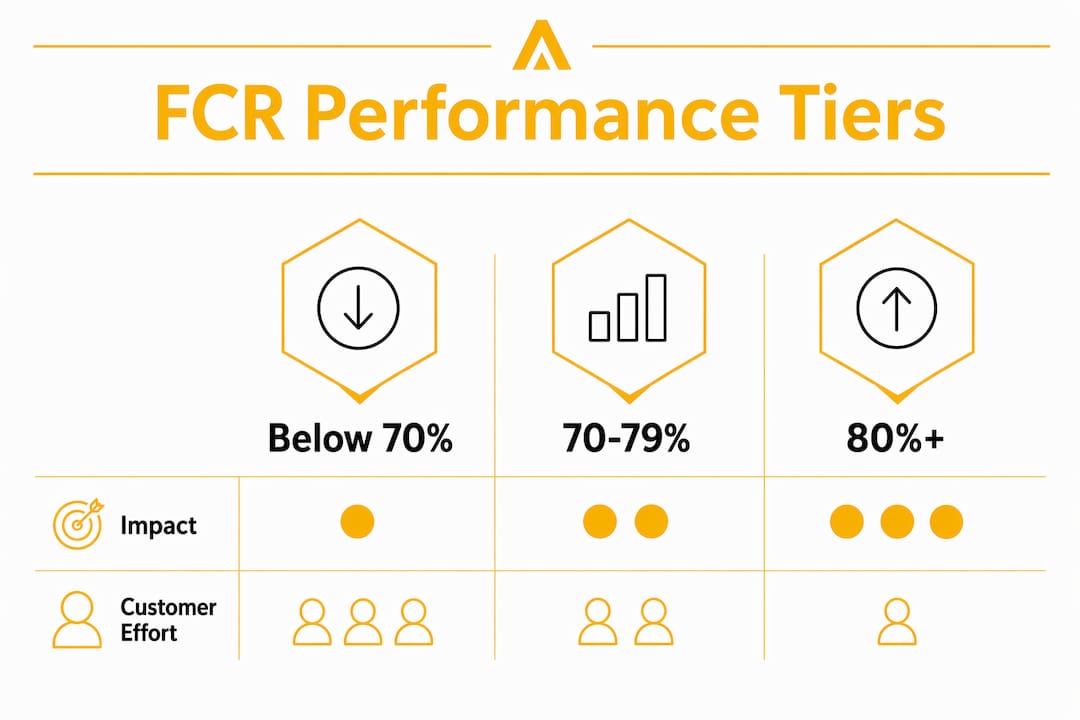
| Performance tier | FCR rate | What it signals |
|---|---|---|
| Below average | Under 70% | High repeat contact volume, process friction |
| Industry average | 70% to 79% | Acceptable but room for improvement |
| World-class | 80% and above | Strong agent capability and process design |
| Top 5% of centers | 85%+ | Exceptional training, routing, and knowledge systems |
Why does first contact resolution matter for your business?
The importance of first contact resolution extends well beyond a single KPI on a dashboard. For each 1% improvement in FCR, operating costs and inbound contact volume both decline by approximately 1%, while customer satisfaction rises correspondingly. That relationship makes FCR one of the few metrics that simultaneously improves the customer experience and reduces the cost to deliver it.
The business case for prioritizing FCR includes several interconnected outcomes:
- Reduced repeat contacts. Every unresolved issue generates at least one follow-up interaction. Cutting repeat contacts by even 10% frees agent capacity for new volume without adding headcount.
- Lower ticket volume. When issues stay resolved, customers stop calling back. This directly reduces workload and allows better workforce planning.
- Higher customer retention. Customers who get their problem solved on the first try are significantly more likely to remain loyal. Repeated contacts signal effort and frustration, both of which accelerate churn.
- Improved agent satisfaction. Agents who have the tools and authority to resolve issues fully experience less frustration and lower burnout rates than those who must escalate or defer constantly.
- Stronger CSAT and CES scores. FCR improvements feed directly into Customer Satisfaction (CSAT) and Customer Effort Score (CES) results, since both metrics reflect how easy and effective the resolution experience felt.
FCR acts as both a cost and quality lever that influences staffing, routing, and workload management simultaneously. That dual function is what separates it from narrower metrics like average handle time, which can improve while resolution quality declines.
Pro Tip: Track FCR alongside CSAT rather than in isolation. A team with a 78% FCR rate and a low CSAT score likely has a definition problem: agents are marking tickets resolved before customers agree they are.
What are the biggest challenges in measuring FCR accurately?
Measuring FCR sounds mechanical, but misalignment between agent perception and true customer satisfaction is the most common source of inflated rates. An agent closes a ticket believing the issue is resolved. The customer, still confused or dissatisfied, simply stops reaching out rather than escalating. That silence registers as a successful resolution in most systems, even though the customer’s problem persists.
Several specific challenges complicate accurate FCR measurement:
- Customer silence versus true resolution. Customers who give up rather than call back inflate FCR artificially. Post-interaction surveys from tools like Medallia or Qualtrics help distinguish genuine resolution from passive disengagement.
- Multi-channel journeys. A customer who contacts support via chat, then follows up by email the next day, may be tracked as two separate interactions in siloed systems. Without unified contact history, the repeat contact goes undetected.
- Multi-step issues. Complex technical problems or billing disputes often require internal processing time before resolution is possible. Strict FCR rules must account for these cases without penalizing agents unfairly.
- Loose definitions of “resolved.” If agents can self-report resolution status without customer confirmation, FCR rates reflect agent optimism rather than customer outcomes.
“FCR is diagnostic beyond agent performance. Low FCR can reveal process friction or knowledge gaps that create customer effort and call for review.” — Zendesk
Edge cases such as transfers, multi-step requests, or customer non-engagement require strict calculation rules to avoid misrepresenting rates. The solution is a written FCR policy that defines the measurement window, channel scope, resolution criteria, and how exceptions are handled. Every team member and every reporting system should operate from the same document.
How can organizations improve first contact resolution rates?
Improving FCR requires a combination of agent capability, process design, and technology. Speed alone does not drive FCR. An agent who closes a ticket in three minutes but leaves the root cause unaddressed has not improved the metric. The goal is end-to-end completeness: the issue is understood, addressed, and confirmed resolved before the interaction ends.
Here are the most effective approaches, ordered by impact:
- Invest in role-playing and scenario training. Training agents with role-playing builds the confidence and judgment needed to handle complex issues without escalating. Agents who practice edge cases perform better under real conditions.
- Centralize data with a CRM. Agents who can see full customer history, previous interactions, and account details resolve issues faster and more completely. A custom CRM solution that surfaces relevant context at the start of each interaction removes the most common cause of incomplete resolutions.
- Implement skills-based routing. Matching incoming contacts to agents with the right expertise reduces transfers and escalations. Automated routing systems from platforms like Salesforce Service Cloud or Zendesk Suite apply this logic at scale.
- Build and maintain a knowledge base. Agents who can access accurate, current answers during an interaction resolve issues without placing customers on hold or deferring to supervisors. Self-service options like structured FAQs also deflect straightforward contacts before they reach an agent.
- Apply next issue avoidance (NIA). NIA means proactively addressing the likely next question before the customer asks it. If a customer calls about a billing change, the agent also confirms the updated payment method is on file. This prevents a second contact on a related issue.
- Automate process steps where possible. Automating organization processes such as ticket categorization, status updates, and follow-up notifications reduces manual errors that generate unnecessary repeat contacts.
Pro Tip: Give agents explicit authority to resolve issues within defined parameters without supervisor approval. Agents who must escalate routine decisions for sign-off will never achieve high FCR rates, regardless of their skill level.
You can find additional strategies for reducing friction in customer care workflows that complement FCR improvement programs directly.
How does FCR fit within omnichannel customer service?
The term “first call resolution” originated in voice-based contact centers, but FCR now encompasses chat, email, social media, and self-service touchpoints. This distinction matters because customers rarely stay within a single channel. A customer might start with a chatbot, escalate to live chat, and then send a follow-up email. Each touchpoint is a separate system event, but the customer experiences it as one continuous interaction.
| Metric | First call resolution | First contact resolution |
|---|---|---|
| Channel scope | Voice calls only | All channels: phone, chat, email, social |
| Measurement source | Call center logs | Unified CRM or omnichannel platform |
| Customer journey alignment | Partial | Full journey |
| Relevance in 2026 | Declining | Standard for modern CX operations |
Omnichannel FCR strategies align KPIs with the full customer journey, recognizing that a first contact may begin with automated self-service and progress through multiple touchpoints before true resolution occurs. Organizations that measure FCR only within their phone channel are systematically undercounting repeat contacts and overestimating their resolution performance.
The practical requirement is a unified contact history that links interactions across channels by customer identity, not by ticket number. When a customer contacts support through any channel, the system should surface all prior interactions on the same issue regardless of where they occurred. This is the foundation of accurate omnichannel FCR measurement and the basis for improving customer care at an operational level.
Key takeaways
First contact resolution is the single most direct measure of whether your support operation solves problems or just processes contacts.
| Point | Details |
|---|---|
| FCR definition | FCR measures the percentage of issues fully resolved in one interaction with no follow-up needed. |
| Industry benchmark | Average FCR sits between 70% and 79%; only 5% of contact centers reach the 80%+ world-class threshold. |
| Dual business impact | Each 1% FCR improvement reduces operating costs and contact volume by approximately 1% while raising satisfaction. |
| Measurement accuracy | Clear written definitions of “first” and “resolved” are required to prevent inflated rates and misleading data. |
| Omnichannel scope | Modern FCR must be measured across all channels using unified customer history, not call logs alone. |
FCR in 2026: what I’ve learned from working with service teams
Working closely with customer service operations across industries, I have seen one pattern repeat itself more than any other: teams that treat FCR as a speed metric consistently underperform compared to teams that treat it as a completeness metric. The pressure to reduce average handle time is real, but when agents rush to close tickets rather than confirm resolution, FCR numbers look good on paper while repeat contact rates quietly climb.
The second pattern I see regularly is the definition gap. A team will report an 82% FCR rate, which sounds excellent, until you audit the data and find that agents are self-reporting resolution status with no customer confirmation step. The actual rate, measured against post-interaction surveys, is closer to 68%. That gap represents thousands of unresolved customer issues and the operational cost of handling them again.
What actually works is cross-functional alignment. FCR cannot be owned by the contact center alone. Product teams need to know which issues generate the most repeat contacts. Operations teams need to understand how routing decisions affect resolution rates. Technology teams need to build systems that surface complete customer context at the start of every interaction. When those functions work from the same FCR definition and the same data, improvement follows. You can see how high-touch service strategies reinforce this kind of alignment in practice.
The organizations that achieve world-class FCR are not necessarily the ones with the most advanced technology. They are the ones with the clearest definitions, the most consistent training, and the strongest commitment to resolving the customer’s actual problem rather than closing the ticket.
— Daniela
How Altiamcx helps you build a higher-FCR operation
Altiamcx is a nearshore customer experience partner built around measurable performance frameworks, which makes FCR a natural centerpiece of every engagement. Altiamcx combines skills-based agent training, CRM-integrated workflows, and omnichannel contact management to help organizations resolve more issues on the first interaction without adding headcount.

One software platform that migrated its technical support operations to Altiamcx improved productivity by 89% while simultaneously reducing repeat contact rates. That result reflects what happens when agent capability, process design, and technology alignment work together under a single performance framework. If your FCR rate is below the 75% mark or your measurement methodology needs a rebuild, Altiamcx has the operational infrastructure to close that gap.
FAQ
What is FCR in customer service?
FCR, or first contact resolution, is the percentage of customer issues resolved entirely during the first interaction with no follow-up, transfer, or re-open required. It applies across all support channels including phone, chat, email, and social media.
What is a good first contact resolution rate?
An FCR rate between 70% and 79% is considered industry average, while 80% or higher is classified as world-class performance. Only 5% of contact centers consistently achieve the 80% threshold.
How do you calculate first contact resolution?
Divide the number of tickets resolved on first contact by the total number of tickets received, then multiply by 100. For example, 800 first-contact resolutions out of 1,000 total tickets equals an 80% FCR rate.
Why is first contact resolution hard to measure accurately?
FCR measurement is complicated by customer silence being mistaken for resolution, multi-channel journeys that fragment contact history, and loose internal definitions of what “resolved” means. A written FCR policy with clear criteria and a customer confirmation step is the most reliable fix.
What is the difference between first call resolution and first contact resolution?
First call resolution measures resolution rates on voice calls only, while first contact resolution covers all channels including chat, email, and self-service. First contact resolution is the current standard for omnichannel customer service operations.