TL;DR:
- Scaling a legal support team involves designing workflows, adopting legal operations early, and hiring based on actual workload. Proper sequencing of roles and technology deployment enhances efficiency, reduces outside counsel costs, and increases productivity. Documented processes and strategic resource management enable teams to scale effectively and achieve significant cost savings.
Scaling a legal support team is the process of deliberately growing and structuring your legal function to meet expanding business demands without proportional cost increases. The industry term for this discipline is legal operations, or “legal ops,” and it covers everything from workflow design to vendor management to technology adoption. Research shows that 60–75% of legal support tasks can be performed remotely or by virtual staff, which means most teams are carrying fixed overhead they do not need. Organizations that adopt legal ops early and hire against actual workload, not org-chart templates, build teams that scale without breaking.
What does a legal support team scaling guide actually cover?
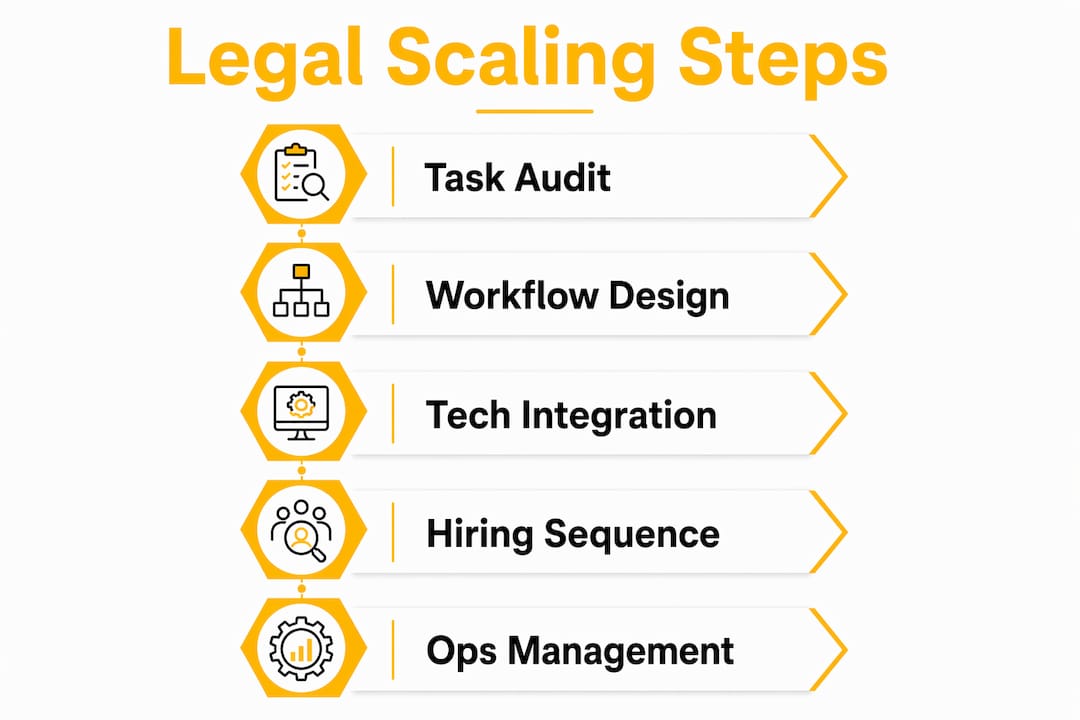
A legal support team scaling guide covers four core disciplines: task auditing, workflow documentation, technology integration, and hiring sequencing. Each discipline builds on the last. You cannot hire well if you have not documented your workflows. You cannot document workflows if you have not audited your tasks. The sequence matters as much as the individual steps.
Start with a task audit
Auditing your weekly legal tasks is the first concrete step in any scaling effort. The audit reveals which tasks require bar admission and which do not. Tasks that do not require bar admission, typically 60–75% of total weekly volume, are candidates for remote support, virtual staff, or automation. That finding alone reframes the scaling conversation from “how many lawyers do we hire” to “how do we build the right mix of roles.”
Build the technology layer before you hire
Technology manages intake, triage, and communication routing before a human ever touches a matter. Without it, every new hire inherits a manual coordination burden that grows with headcount. Legal matter management platforms, contract lifecycle management tools, and e-signature systems each reduce the time lawyers spend on administrative work. The table below maps the foundational tools to their primary benefit.

| Tool category | Primary benefit |
|---|---|
| Matter management platform | Centralizes intake and tracks matter status across the team |
| Contract lifecycle management | Reduces contract cycle time and manual version tracking |
| E-signature solution | Eliminates paper routing and speeds execution |
| Legal spend management | Controls outside counsel costs and surfaces billing anomalies |
| Workflow automation | Routes routine requests without manual triage |
Pro Tip: Set up your matter management platform before your first non-lawyer hire. New staff who onboard into a documented system learn faster and make fewer routing errors.
The technology layer also creates the data you need to make defensible hiring decisions. When your matter management platform shows 200 new contract requests per month and a 12-day average cycle time, you have a business case for a contracts specialist. Without that data, hiring decisions default to gut feel.
How to sequence legal support team hires effectively
Most teams sequence hires based on org-chart templates rather than actual deal volume and risk exposure. That approach fills titles without solving bottlenecks. The right sequence ties each hire to a specific, measurable pressure point in the current workload.
A well-sequenced legal team typically builds in this order:
- General Counsel (GC). The GC sets the team’s operating model, risk tolerance, and communication standards. Every subsequent hire should fit the model the GC defines, not the other way around.
- Commercial or contracts counsel. Contract volume is the most common early bottleneck in growing organizations. A dedicated contracts attorney or senior paralegal with contract authority relieves the GC and reduces outside counsel spend immediately.
- Legal operations manager. Once contract volume justifies a second or third attorney, a legal ops manager prevents the team from drowning in coordination work. This role owns intake, vendor relationships, and process documentation.
- Specialists. Employment, IP, regulatory, and litigation specialists join only when the volume in their area justifies a dedicated resource. Premature specialization creates underutilized headcount.
- Support staff and virtual roles. Paralegals, legal assistants, and virtual support staff fill execution capacity as volume grows. Flexible remote workforce models increase capacity without the fixed cost of full-time equivalents.
Pro Tip: Let the GC write the job descriptions for the first three hires. The GC knows which tasks consume the most time and which skills are genuinely missing. Descriptions written by HR alone tend to replicate generic templates.
The most common sequencing mistake is hiring a second senior attorney before hiring a legal ops manager. Two senior attorneys without operational infrastructure create twice the coordination overhead. The legal ops manager multiplies the output of every attorney on the team.
How to design workflows that support scaling legal departments
Legal ops should be integrated from the start, not added after the team feels overwhelmed. Teams that wait until they are struggling to document processes find that documentation competes with active work. The result is partial documentation that creates more confusion than clarity.
Effective workflow design for legal teams covers five areas:
- Intake standardization. Every matter enters the team through one channel with a consistent intake form. Ad hoc requests by email or chat create invisible work that never gets tracked or measured.
- Triage criteria. Define in writing which matters go to which role. A triage matrix eliminates the daily judgment calls that slow down the team and create inconsistent outcomes.
- Vendor integration. Outside counsel and legal service providers work best when they receive matters with documented context, not cold calls. Outsourcing only adds value when it is based on documented, repeatable processes. Without documentation, vendors increase coordination work rather than reducing it.
- Tuning notes. A “tuning note” is a short written record of how a process was adjusted and why. Teams that maintain tuning notes preserve institutional knowledge when staff turns over and avoid repeating the same process mistakes.
- Review and approval routing. Define who approves what and at what dollar or risk threshold. Undefined approval paths create bottlenecks at the most senior level of the team.
Pro Tip: Document your three highest-volume processes before you hire anyone new. New staff who onboard into documented processes reach full productivity faster and ask fewer clarifying questions.
The payoff from early workflow design compounds over time. A team of five with documented processes handles more volume than a team of eight without them. That is not an abstraction. It shows up in cycle times, outside counsel spend, and attorney satisfaction scores.
What are the common challenges in scaling legal support teams?
Scaling legal support teams fails in predictable ways. Recognizing the patterns early lets you correct course before they become expensive.
- Overbuilt leadership, under-resourced execution. Legal teams often build too many senior roles before they have enough execution capacity. A team with three directors and two paralegals cannot process high contract volume efficiently. Execution roles, paralegals, legal assistants, and ops staff, need to outnumber leadership roles at early growth stages.
- Delayed legal ops adoption. Teams that treat legal ops as a luxury for large departments pay for it later in coordination friction, missed deadlines, and duplicated work. Legal ops is a function, not a headcount level.
- Undocumented workflows. When processes live in individual attorneys’ heads, every departure or leave creates a knowledge gap. Undocumented workflows also make it impossible to hand work to vendors or virtual staff effectively.
- Reactive hiring. Hiring in response to a crisis, a lost deal, a compliance failure, or a departing attorney, produces misaligned roles. Reactive hires solve yesterday’s problem, not tomorrow’s workload.
- Poor vendor integration. Outside counsel and legal service providers perform best when they receive structured briefs, defined scope, and clear escalation paths. Teams that send unstructured work to vendors get unstructured results.
Scaling a legal support team is a design problem before it is a hiring problem. The teams that scale well spend more time on process architecture than on headcount planning. The teams that struggle do the opposite.
Managing a flexible remote workforce adds a coordination layer that undocumented teams cannot absorb. Remote and nearshore staff need written processes, clear escalation paths, and regular calibration sessions to perform at the level of in-house staff.
What measurable benefits can organizations expect from scaling legal support well?
The financial case for well-designed legal team scaling is concrete. Replacing traditional AmLaw 20 firm support with a scaled legal operations model delivered over $1 million in annual savings while maintaining governance standards. That outcome required documented processes, defined vendor relationships, and a legal ops function that managed spend actively.
Legal AI adoption enables in-house lawyers to reclaim an average of 14 hours per week and reduce outside counsel spend by 14%. Those hours shift from routine contract review and document drafting to higher-value advisory work. The reduction in outside counsel spend compounds annually as the in-house team handles more work that previously went to external firms.
The table below summarizes the measurable benefits of a well-scaled legal team compared to a traditional model.
| Benefit area | Well-scaled team outcome |
|---|---|
| Outside counsel spend | Reduced through in-house capacity and spend management tools |
| Contract cycle time | Shortened by intake standardization and workflow routing |
| Attorney time on routine tasks | Reduced by 14 hours per week with AI and ops support |
| Annual cost savings | $1M+ achievable by replacing high-cost firm support with ops models |
| Knowledge retention | Preserved through tuning notes and documented processes |
Legal AI compresses routine tasks from hours to minutes, which means the productivity gains from scaling are not linear. A team that adopts AI-assisted contract review and document drafting can handle significantly more volume without adding headcount. That is the core efficiency argument for investing in technology before hiring.
Key Takeaways
Scaling a legal support team requires deliberate workflow design, early legal ops integration, and workload-driven hiring, not org-chart templates or reactive headcount increases.
| Point | Details |
|---|---|
| Audit tasks before hiring | Identify the 60–75% of tasks suitable for remote or automated support before adding headcount. |
| Sequence hires by workload | Hire against actual deal volume and risk exposure, starting with GC, then contracts counsel, then legal ops. |
| Integrate legal ops early | Document intake, triage, and vendor processes before the team feels overwhelmed. |
| Use tuning notes | Record process adjustments in writing to preserve institutional knowledge and reduce onboarding time. |
| Measure financial outcomes | Well-scaled teams reduce outside counsel spend, reclaim attorney time, and can deliver $1M+ in annual savings. |
Why I think most legal teams scale in the wrong direction
The conventional advice on scaling legal teams focuses almost entirely on headcount. Add a contracts attorney. Hire a paralegal. Bring in outside counsel for overflow. That advice is not wrong, but it treats scaling as a staffing problem when it is actually a design problem.
Every team I have seen struggle with growth had the same root cause: they hired before they documented. They added people to a system that was not ready to absorb them. New hires inherited chaotic intake processes, unclear triage criteria, and no written record of how decisions got made. The result was a larger team that moved slower than the smaller one it replaced.
The teams that scaled well did something counterintuitive. They slowed down before they sped up. They spent time writing intake forms, defining triage criteria, and documenting vendor relationships before they posted a single job description. That investment paid back within the first quarter of the new hire’s tenure.
The other mistake I see consistently is treating legal ops as a reward for growth rather than a prerequisite for it. Teams say, “We will hire a legal ops manager once we have five attorneys.” The right answer is the opposite. Hire the legal ops manager when you have two attorneys and a growing contract volume. The ops manager multiplies the output of every attorney on the team. Waiting until the team is already overwhelmed means the ops manager spends their first six months firefighting instead of building.
Adaptive roles matter more than fixed titles. A contracts specialist who can also manage vendor relationships and run the intake process is worth more than two narrowly defined roles at an early growth stage. Build for flexibility first, specialization second.
— Daniela
How Altiamcx supports legal support team growth

Legal teams that have documented their workflows and identified their execution gaps are ready to extend capacity without adding fixed headcount. Altiamcx provides nearshore team extension for legal support operations, combining cultural alignment with disciplined execution frameworks. One client deploying Altiamcx’s nearshore model improved productivity by 89% after migrating support operations to the Altiamcx model. For legal teams managing high contract volume, intake operations, or back-office legal support, Altiamcx offers flexible nearshore staffing that scales with your workload. Learn how Altiamcx’s legal team extension solutions can reduce your fixed overhead while maintaining service quality.
FAQ
What is the first step in scaling a legal support team?
Audit your weekly legal tasks before making any hiring decisions. Research shows 60–75% of legal support tasks can be performed by remote or virtual staff, which means most teams can extend capacity without adding full-time attorneys.
When should a legal team hire a legal ops manager?
Hire a legal ops manager when you have two or more attorneys and a growing contract or matter volume. Legal ops multiplies attorney output by managing intake, vendor relationships, and workflow routing before the team reaches capacity.
How much can a scaled legal team save annually?
Replacing high-cost outside firm support with a scaled legal operations model has delivered over $1 million in annual savings while maintaining governance standards. Legal AI adoption also reduces outside counsel spend by an average of 14%.
What is a tuning note in legal operations?
A tuning note is a written record of how a process was adjusted and why. Teams that maintain tuning notes preserve institutional knowledge, reduce onboarding time, and avoid repeating process mistakes after staff turnover.
How do remote and nearshore staff fit into a legal support team?
Remote and nearshore staff fill execution capacity for high-volume, repeatable tasks such as contract intake, document preparation, and matter tracking. They perform best when onboarded into documented processes with clear triage criteria and escalation paths.