
TL;DR:
- CX directors actively oversee outsourced customer experience operations to ensure quality and performance.
- They manage governance, integration, and AI deployment, emphasizing strategic partnerships over simple contract management.
CX director oversight of outsourcing is defined as the active governance, performance management, and strategic alignment that customer experience leaders apply to externally managed service operations. This oversight role exists because outsourcing a customer-facing function without dedicated leadership creates brand risk, service degradation, and misaligned priorities. CX directors are the single point of accountability between what the business promises customers and what an external partner actually delivers. Understanding why cx directors oversee outsourcing means understanding that the role has moved well beyond contract management. It now covers AI governance, workflow integration, vendor relationship design, and continuous performance calibration.
The industry term for this function is CX outsourcing governance, and it sits at the intersection of operations leadership and customer strategy. CX directors who treat it as a procurement task consistently underperform those who treat it as a core leadership discipline.
Why CX directors oversee outsourcing: the core responsibilities
The role of CX directors in outsourcing is not passive. Outsourcing requires clear design and leadership to avoid service degradation. That means CX directors carry four distinct responsibilities when managing outsourced functions.
- Governance beyond SLAs. Service level agreements measure speed and volume. They do not measure customer outcomes. CX directors must define quality benchmarks tied to satisfaction scores, first-contact resolution, and escalation rates, then hold vendors accountable to those metrics.
- Cost, quality, and scalability trade-offs. Every outsourcing decision involves a three-way tension. Cutting cost often compresses quality. Scaling fast can fragment the customer experience. CX directors make the call on where to draw each line.
- Integration with internal operations. Outsourced teams do not operate in isolation. CX directors coordinate data sharing, technology access, and decision-making alignment so external agents function as an extension of the internal team, not a separate entity.
- Workflow modernization. Outsourcing partnerships increasingly require CX directors to lead the adoption of AI-assisted tools, automated routing, and process redesign across vendor workflows.
The balancing act of cost, quality, and scalability through operating model design is one of the most complex responsibilities in CX leadership. It requires both analytical rigor and a clear understanding of what customers actually value.
Pro Tip: Build a governance scorecard that tracks customer sentiment, repeat contact rate, and escalation resolution time alongside traditional SLA metrics. Vendors respond to what you measure.

How does AI change the oversight role for CX leaders?
AI adoption is reshaping what CX directors must govern. 79% of senior CX leaders consider switching outsourcing providers specifically to find partners with stronger AI expertise and workflow modernization capabilities. That figure signals a fundamental shift in what CX directors expect from vendors.
The challenge is that expectation and execution are far apart. Consider the current state of AI in outsourced CX:
- High satisfaction, low operationalization. 84% of CX leaders say AI initiatives meet expectations, but only 23% have actually operationalized AI within their workflows. The gap between “AI works in testing” and “AI works at scale in production” is where most governance failures happen.
- Rushed deployment creates performance risk. Poor AI implementation depresses customer satisfaction when organizations adopt AI without clear processes. CX directors must require staged rollouts with defined quality gates before any AI-driven function goes live with customers.
- Brand risk from AI-assisted tools. AI-assisted tools shift outsourcing boundaries, requiring governance to manage brand risk and escalation properly. When an AI tool gives a wrong answer or misroutes a complaint, the customer blames the brand, not the vendor.
- Governance must precede automation. CX directors who define clear escalation paths, fallback procedures, and human override protocols before deploying AI protect both the customer experience and the vendor relationship.
The practical implication is direct: CX directors cannot delegate AI governance to the vendor. They must own the framework, set the standards, and audit the outcomes. Outsourcing the execution is appropriate. Outsourcing the accountability is not.
What are the trade-offs between internal and outsourced CX models?
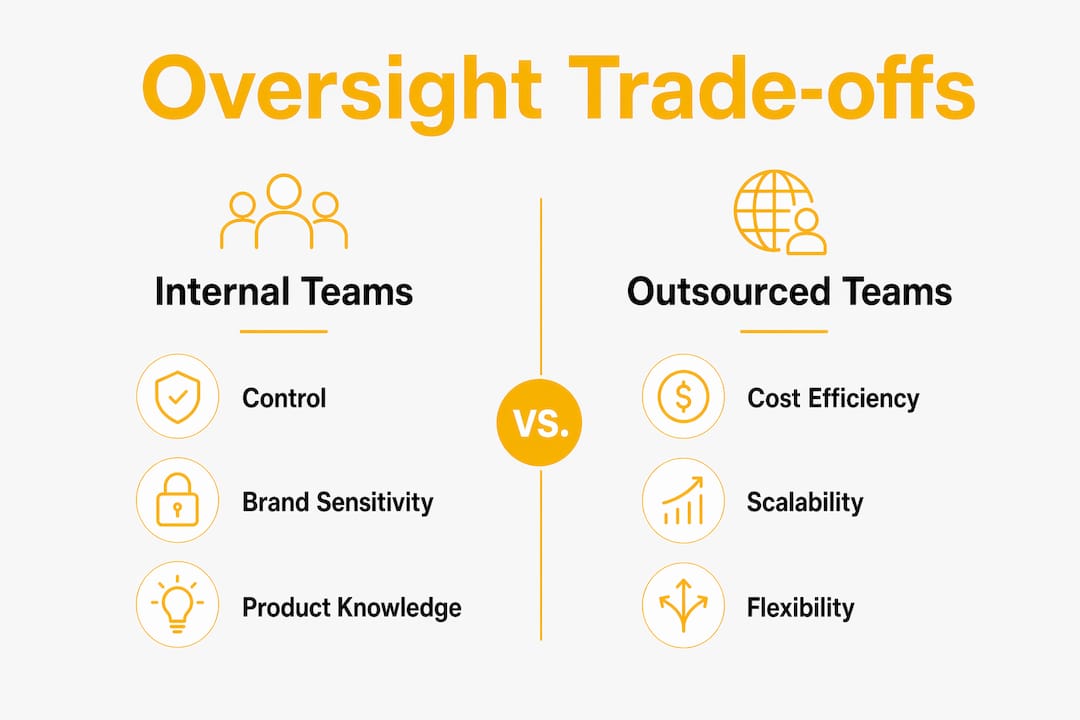
CX directors evaluate the build-versus-buy question constantly. Neither model is universally superior. The right answer depends on the specific function, the business stage, and the governance capacity available.
| Factor | Internal teams | Outsourced teams |
|---|---|---|
| Control | High. Direct management of agents, tools, and processes | Moderate. Governed through contracts and performance reviews |
| Product knowledge | Deep. Agents are embedded in the business | Requires investment in onboarding and brand immersion |
| Cost structure | Fixed. Headcount, benefits, and infrastructure costs are constant | Variable. Scales with volume, reducing risk during demand shifts |
| Specialized capability | Limited by internal hiring and training budgets | Access to enterprise-grade CX technology and trained agents that in-house teams may not replicate |
| Scalability | Slow. Hiring and training cycles take months | Fast. Established vendors can deploy trained teams quickly |
Internal teams provide stronger control and deeper product knowledge, but that advantage erodes when volume spikes or specialized skills are needed. Outsourcing delivers scalability and cost efficiency, but brand misalignment and channel fragmentation become real risks without strong CX director leadership.
The most effective model for most organizations is a hybrid. Core functions with high brand sensitivity stay internal. High-volume, process-driven functions move to outsourced partners. CX directors design the boundary and govern both sides.
Pro Tip: Before outsourcing any customer-facing function, document the exact customer journey for that function. If you cannot describe the desired outcome in measurable terms, you are not ready to hand it to a vendor.
What governance practices make outsourcing partnerships work?
Governance failures stem from misalignment and lack of accountability mechanisms, not vendor incompetence. That distinction matters because it places the responsibility squarely on the CX director, not the outsourcing partner.
Effective governance requires four practices:
- Dedicated relationship ownership. Every outsourcing relationship needs a named owner on the CX director’s team. This person runs weekly performance reviews, manages escalations, and serves as the primary contact for the vendor. Shared ownership means no ownership.
- Performance reviews focused on customer outcomes. Effective governance requires performance reviews beyond SLAs that focus on customer outcomes and clear escalation paths. Review sentiment scores, repeat contact rates, and resolution quality, not just handle time and abandonment rate.
- Brand immersion for outsourced agents. Regular brand immersion training for outsourced agents and clear escalation procedures improve outsourced CX quality and customer retention. Agents who understand the brand’s values and tone deliver a fundamentally different experience than agents who only know the script.
- Contract evolution. Failing to update contracts as business needs change causes deterioration in outsourcing effectiveness. Contracts written at launch rarely reflect the business 18 months later. CX directors must schedule formal contract reviews at least annually.
“Outsourcing relationships must be managed as strategic partnerships, not mere cost-cutting measures. Effective outsourced CX is an extension of internal teams, requiring data sharing and decision-making alignment.” Outsourced Omnichannel CX
The importance of cx oversight in outsourcing comes down to this: a vendor can only perform as well as the governance structure around them allows. Build the structure first.
Key Takeaways
CX directors oversee outsourcing because governance, not vendor selection, determines whether outsourced customer experience protects or damages the brand.
| Point | Details |
|---|---|
| Governance defines outcomes | CX directors must set quality benchmarks tied to customer outcomes, not just SLA metrics. |
| AI requires director-level ownership | Only 23% of CX leaders have operationalized AI; directors must own the governance framework, not delegate it. |
| Hybrid models outperform pure outsourcing | Keep brand-sensitive functions internal and outsource high-volume, process-driven work with clear boundaries. |
| Brand immersion protects quality | Regular training and escalation clarity for outsourced agents directly improve customer retention. |
| Contracts must evolve | Annual contract reviews aligned to current business needs prevent outsourcing effectiveness from eroding over time. |
The shift I keep seeing CX directors miss
I have watched CX directors spend months selecting the right outsourcing vendor and then spend almost no time building the governance model that makes the relationship work. The vendor evaluation gets a cross-functional team, a scoring matrix, and executive sign-off. The governance design gets a kickoff call and a shared spreadsheet.
That imbalance explains most outsourcing failures I have seen. The vendor was not the problem. The accountability structure was.
The shift happening right now is that CX directors are moving from SLA-focused management to orchestrating strategic partnerships that drive business transformation. That is the right direction. But it requires investing in internal governance capabilities before you outsource, not after the relationship starts to drift.
My honest advice: treat your outsourcing governance model as a product. It needs an owner, a roadmap, and regular iteration. The benefits of nearshore outsourcing are real, but they only materialize when the CX director builds the operating model that captures them. Technology adoption, AI integration, and vendor performance all follow from governance quality. Get that right first.
— Daniela
How Altiamcx supports CX directors in outsourcing governance
CX directors managing outsourced operations need a partner who brings disciplined execution, measurable performance frameworks, and cultural alignment from day one.

Altiamcx delivers nearshore customer care, technical assistance, and back-office operations designed to function as a true extension of your internal team. The results are measurable. One software platform improved productivity by 89% after migrating tech support to Altiamcx, with governance structures built to scale alongside the business. If you are a CX director building or refining your outsourcing model, Altiamcx provides the operational foundation and the CX outsourcing expertise to make it work at scale.
FAQ
Why do CX directors oversee outsourcing rather than operations teams?
CX directors own the customer experience strategy, which means they are accountable for outcomes regardless of who delivers the service. Outsourcing management by CX directors ensures vendor performance stays aligned with brand standards and customer expectations, not just operational metrics.
What metrics should CX directors track in outsourced operations?
CX directors should track customer satisfaction scores, first-contact resolution rates, repeat contact rates, and escalation resolution time. These customer outcome metrics reveal service quality far more accurately than handle time or volume-based SLAs.
How does AI affect the CX director’s role in outsourcing oversight?
AI adoption requires CX directors to govern deployment standards, define escalation protocols, and audit outcomes directly. With only 23% of CX leaders having operationalized AI in workflows, the governance gap is significant and cannot be delegated to the vendor.
What is the biggest risk of outsourcing CX without strong director oversight?
Brand misalignment and channel fragmentation are the primary risks. Without active CX director leadership, outsourced agents default to script compliance rather than brand-consistent customer outcomes, which erodes trust over time.
How often should CX directors review outsourcing contracts?
CX directors should conduct formal contract reviews at least once per year. Business needs, technology capabilities, and customer expectations shift faster than most contracts are written to accommodate, and outdated agreements directly reduce outsourcing effectiveness.