
TL;DR:
- Most CX leaders mistakenly equate ticket closure speed with operational success, which is costly.
- Specialized CX operations encompass end-to-end systems managing the full customer journey, beyond support queues.
- Implementing structured frameworks, proactive engagement, and clear accountability improves outcomes and reduces risk across regulated sectors.
Most CX leaders assume their customer experience operation is performing well if tickets are getting closed on time. That assumption is expensive. Specialized CX operations are far more than support queues; they are the operating system for delivering consistent customer outcomes across the entire customer journey, from first contact through resolution, retention, and renewal. For decision-makers in healthcare, legal, and e-commerce, this distinction is not a matter of preference. It is a competitive necessity. This guide breaks down what makes CX operations truly specialized, how they differ from standard setups, and how your organization can use them to reduce risk and improve measurable results.
Table of Contents
- What are specialized CX operations?
- How the operational layer transforms support
- Key frameworks and metrics for specialized CX
- Managing risk, ambiguity, and accountability in specialized CX
- Our perspective: Why most CX operations fail to scale real accountability
- Explore nearshore CX operations solutions with Altiam CX
- Frequently asked questions
Key Takeaways
| Point | Details |
|---|---|
| Beyond ticket handling | Specialized CX operations coordinate the entire customer journey, not just individual support tickets. |
| Operational layer advantage | An operations layer speeds up complex issue resolution and fosters true accountability for better outcomes. |
| Metrics and feedback drive growth | Continuous measurement with CSAT, NPS, and retention metrics informs constant CX improvement. |
| Manage complexity and risk | Specialized CX workflows include clear escalation paths and accountability to navigate regulatory and emotional challenges. |
| Nearshore expertise adds value | Nearshore CX teams offer scalable, compliant, high-quality customer experience tailored for demanding industries. |
What are specialized CX operations?
With common misconceptions addressed, let’s precisely define what specialized CX operations are and the pillars that set them apart.
Specialized CX operations are not a department. They are a structured, end-to-end system that governs how your organization interacts with customers at every touchpoint. Think of it this way: traditional support answers questions. Specialized CX operations ensure the right answer reaches the right customer at the right time, while also capturing what went wrong and improving the process before the next interaction. As research confirms, specialized CX operations use standardized processes, measurement, and continuous feedback loops over the entire customer journey, not just during a single support event.
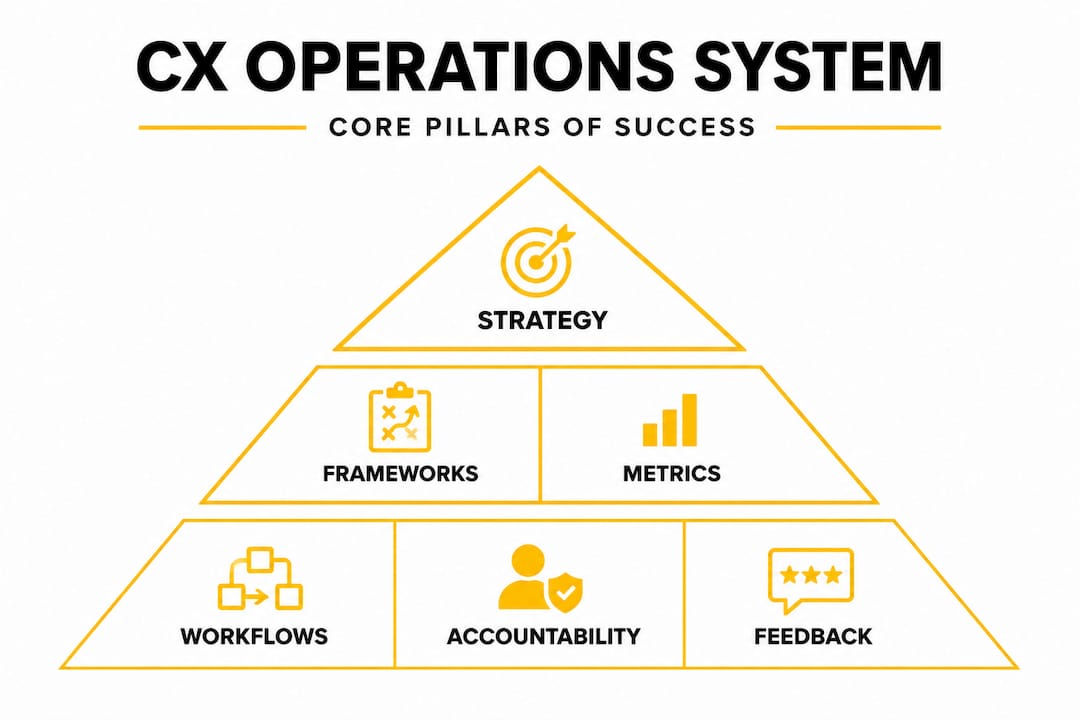
The core components of a specialized operation go well beyond a help desk. They include structured customer journey mapping, voice-of-customer (VoC) feedback management, proactive outreach, cross-functional escalation protocols, and continuous process optimization. Each of these components plays a specific role. Journey mapping, for example, identifies friction points before customers even raise a complaint. VoC programs collect real sentiment data that feeds back into workflow decisions. Proactive support means reaching out to a patient before a billing dispute spirals, or flagging a legal client when a deadline is approaching.
The metrics that define success in specialized CX operations also differ. Traditional teams track ticket volume and average handle time. Specialized operations track:
- CSAT (customer satisfaction score): Measures how a single interaction is perceived, enabling rapid feedback on agent or process quality.
- NPS (Net Promoter Score): Gauges long-term loyalty and the likelihood of referrals, especially important for healthcare and legal services where word of mouth drives growth.
- Customer effort score (CES): Quantifies how hard a customer had to work to get their issue resolved. Lower effort consistently predicts higher retention.
- Retention rate signals: Identifies early warning patterns that predict churn, giving operations teams time to intervene.
| Activity | Traditional CX | Specialized CX operations |
|---|---|---|
| Primary focus | Resolving tickets | Managing the full customer journey |
| Feedback system | Post-call surveys (occasional) | Continuous VoC loops integrated into workflow |
| Escalation process | Ad hoc, manager-dependent | Defined, documented, compliance-tested |
| Proactive engagement | Rare | Structured and triggered by real-time signals |
| Cross-team coordination | Minimal | Built-in through operations layer |
| Performance measurement | Volume and speed | CSAT, NPS, CES, retention outcomes |
The shift from reactive to proactive support is where specialized CX operations generate their most significant business value. Instead of managing damage after it occurs, proactive frameworks prevent the damage entirely.
For organizations pursuing CX improvement steps at scale, building this structured layer first is what makes every downstream effort more effective. Healthcare organizations, in particular, benefit from proactive models because patient journeys span multiple departments, timelines, and care decisions. Reviewing healthcare CX examples makes clear why a transactional approach simply cannot handle the complexity of coordinating care, billing, and patient communication simultaneously.
How the operational layer transforms support
Now that you understand the core mechanics, see how a true operations layer accelerates outcomes, especially for complex or regulated journeys.
The operations layer is a concept that is gaining significant recognition in forward-thinking CX organizations. Rather than a linear support queue, it functions as a connective framework that bridges frontline agents, back-office teams, compliance functions, and leadership. As analysts at CustomerThink have noted, specialized CX teams incorporate an operations layer for faster resolution and workflow problem-solving, moving away from the traditional contact center model toward an integrated, outcomes-driven architecture.

What does this look like in practice? Consider a healthcare inquiry involving insurance verification, a sensitive diagnosis, and a billing discrepancy. In a traditional setup, each of these issues routes to a different team. The patient calls multiple times, repeats their story, and experiences significant frustration. In an operations-layer model, a single accountable workflow ties all three touchpoints together. The agent has access to the right information, escalation paths are pre-defined, and the patient receives a coordinated response without needing to chase down three departments.
Here is how specialized CX operations handle a complex regulated inquiry, step by step:
- Initial intake and triage: The agent collects core information and immediately tags the inquiry with the appropriate workflow category, compliance requirements, and urgency level.
- Ownership assignment: A specific team member or function takes accountability for resolution, eliminating the “it’s not my department” failure point.
- Cross-functional coordination: The operations layer routes relevant data to billing, clinical records, or legal review simultaneously, rather than sequentially.
- Compliance checkpoint: Before any resolution is communicated, a built-in review step verifies that the response meets HIPAA, GDPR, or other relevant standards.
- Resolution and documentation: The agent communicates the outcome clearly and logs the full interaction for quality assurance and future process improvement.
- Feedback capture: A brief, automated follow-up collects the customer’s satisfaction rating, which feeds directly into operational dashboards.
Compare this to what most organizations still operate with:
| Factor | Traditional ticket handling | Operations-layer approach |
|---|---|---|
| Accountability | Diffuse, team-dependent | Assigned, documented, trackable |
| Resolution path | Sequential, often disconnected | Parallel, coordinated across functions |
| Compliance integration | Post-hoc review | Built into every step |
| Feedback loop | Optional or absent | Automated and continuous |
| Escalation speed | Slow, manager-gated | Fast, pre-authorized pathways |
Pro Tip: When designing escalation paths, map your highest-risk inquiry types first. For healthcare, that means HIPAA-sensitive data requests. For legal, it means matters involving privilege or active litigation. Build pre-authorized escalation tiers so agents never have to improvise under pressure. This directly reduces resolution time while maintaining compliance. Explore how balancing human and AI in CX supports faster, safer escalation decisions, and review handling time reduction strategies to see how well-designed workflows cut average handle time by up to 30%.
Key frameworks and metrics for specialized CX
Let’s look at how these operations use specific frameworks and measurements to drive performance and customer satisfaction.
Frameworks are the backbone of any specialized CX operation. Without them, even a talented team defaults to improvisation, and improvisation does not scale. The three most effective frameworks for healthcare, legal, and e-commerce organizations are customer journey mapping, real-time feedback loops, and score-based performance dashboards.
Customer journey mapping goes deeper than a flowchart. It documents every interaction a customer has with your organization, including the emotional state at each stage. A legal client anxious about the outcome of a case is in a fundamentally different state than an e-commerce shopper excited about a purchase. Journey mapping captures these distinctions and allows operations teams to calibrate tone, urgency, and process accordingly.
Real-time feedback loops close the gap between what customers experience and what leadership sees. Traditional quarterly satisfaction surveys are too slow for regulated sectors where a single bad interaction can trigger a compliance review or damage a long-term client relationship. Real-time tools collect feedback immediately after resolution, enabling supervisors to identify and correct issues within hours, not months.
Score-based dashboards give operations managers a live view of CSAT, NPS, CES, and retention signals in one place. As CX metrics including CSAT and customer effort remain core to specialized operations, dashboards make these numbers actionable by triggering workflow changes automatically when scores fall below defined thresholds.
Practical methods for collecting and implementing feedback include:
- Post-interaction micro-surveys: Single-question surveys sent immediately after resolution, achieving higher response rates than traditional forms.
- Agent-initiated VoC capture: Training frontline teams to document unsolicited customer sentiment during interactions, creating a qualitative data layer.
- Escalation pattern analysis: Tracking which inquiry types most frequently require escalation and using that data to redesign upstream processes.
- Cohort-based retention tracking: Grouping customers by segment (new patient, long-term legal client, repeat e-commerce buyer) and monitoring satisfaction trends over time.
- Threshold-triggered alerts: Automated notifications when scores drop below a defined level, enabling immediate operational response.
For e-commerce, real-time metrics directly impact loyalty program design and return management workflows. For healthcare, they reveal where patients disengage from care plans or billing processes. For legal firms, they show where client communication breaks down during extended case timelines. Reviewing CX best practices 2026 and understanding nearshore CX optimization demonstrates how these metrics translate into tangible operational decisions.
Managing risk, ambiguity, and accountability in specialized CX
Understanding measurement is one piece; addressing real-world uncertainty and accountability in complex sectors takes specialized focus.
This is where many CX operations fail. Automation and standardized scripts work well for predictable interactions. But what happens when a patient calls in distress about a denied claim, or a legal client raises concerns about attorney-client privilege mid-conversation, or an e-commerce customer escalates a fraud complaint involving compromised personal data? These are edge cases. They are also the interactions that define your organization’s reputation.
Research confirms that when interactions become ambiguous, emotional, or heavily regulated, autonomy can fail without guardrails, escalation paths, and clear ownership built into the workflow. This is not a theoretical risk. It is a documented failure mode across industries where CX teams rely on automation without sufficient human oversight.
The key risk areas that specialized CX operations must actively manage include:
- HIPAA and GDPR exposure: Sharing the wrong data, even unintentionally, can trigger regulatory penalties that far outweigh the cost of building proper guardrails.
- Emotional escalation: Customers in distress require trained human judgment, not scripted responses. An agent who cannot deviate from a script when speaking with a grieving patient or a panicked legal client will create more harm than good.
- Ambiguous ownership: When it is unclear which team or function is responsible for a resolution, interactions stall, accountability dissolves, and the customer suffers.
- AI and automation overreach: Deploying agentic tools without defined limits creates situations where the system confidently provides incorrect or non-compliant responses.
- Documentation gaps: In regulated sectors, the absence of proper interaction records creates liability. Specialized CX operations mandate documentation as a built-in step, not an afterthought.
Pro Tip: Build a tiered accountability model. Tier 1 handles routine inquiries with defined scripts and automation support. Tier 2 manages complex but predictable issues with access to cross-functional resources. Tier 3 is reserved for sensitive, regulated, or emotionally charged interactions requiring senior human judgment. Document which inquiry types belong to which tier and review assignments quarterly as your product or service mix evolves.
A real-world example: a legal services firm receives a call from an upset client who believes sensitive case documents were shared inappropriately. This interaction involves potential privilege concerns, emotional distress, and a possible compliance incident simultaneously. An operations-layer model routes this immediately to Tier 3, notifies legal operations and compliance, and documents the interaction in real time. Standard ticket handling would fail to coordinate these functions fast enough to protect the firm and the client. Reviewing resources on designing CX escalation paths gives operations teams a practical starting point for building these protocols.
Our perspective: Why most CX operations fail to scale real accountability
With best practices in mind, here is what experience has taught us about why most CX operations underperform and what success actually looks like.
The most common failure point we observe is not a technology gap. It is a design gap. Organizations invest in CX platforms, hire capable agents, and still see declining satisfaction scores because the underlying operation was built around ticket closure, not customer outcomes. Closing tickets is easy to measure. Owning the customer outcome is harder, and most CX architectures never get there.
The second major gap is between frontline intelligence and leadership decisions. Agents who handle calls every day accumulate enormous insight into what customers actually need. In most organizations, that knowledge never reaches the people designing processes or setting policy. Specialized CX operations build explicit feedback pathways that turn agent observations into process improvements on a cycle measured in weeks, not years.
There is also a fundamental misunderstanding about where accountability lives. When a complex interaction crosses team boundaries, as it almost always does in healthcare, legal, and enterprise e-commerce, responsibility diffuses. Nobody owns the outcome. Specialized CX operations resolve this by assigning ownership at the start of the interaction and maintaining it through resolution, regardless of how many functions are involved.
What most discussions about CX miss is this: compliance, speed, and customer outcomes are not competing priorities. They reinforce each other when the operation is designed correctly. An accountable, well-structured CX operation in a regulated sector resolves issues faster precisely because compliance requirements are built into the workflow rather than added after the fact. For a sector-specific view, exploring healthcare CX operations perspective shows how these principles translate into real patient and operational outcomes.
Explore nearshore CX operations solutions with Altiam CX
If the frameworks above describe where you want to go but not where you currently are, you are not alone. Most organizations in healthcare, legal, and e-commerce are managing complexity with CX infrastructure that was designed for simpler problems.

Altiam CX specializes in nearshore customer experience outsourcing that delivers the accountability, compliance readiness, and operational discipline described throughout this article. Our teams bring cultural alignment and measurable performance frameworks to every engagement, whether you need to build a new CX function or extend an existing one. From patient communication to legal client support to high-volume e-commerce care, we design operations that scale without sacrificing quality. Explore our full range of managed CX team extension services and connect with our team for a consultation tailored to your sector’s specific requirements.
Frequently asked questions
What is the difference between specialized CX operations and traditional contact centers?
Specialized CX operations address the entire customer journey using standardized processes, measurement, and proactive workflows, not just reactive ticket handling. Traditional contact centers primarily focus on resolution volume and speed, while specialized operations deliver consistent outcomes across every customer touchpoint.
How does the operations layer improve problem resolution?
The operations layer enables faster, cross-functional solutions by focusing on workflow and accountability rather than simply resolving individual tickets. As the operations layer demonstrates, this approach connects teams, pre-defines escalation paths, and maintains ownership from intake through resolution.
What metrics do specialized CX operations track?
Key metrics include CSAT, NPS, customer effort scores, and retention signals, each adjusted for industry context. CX metrics like NPS and customer effort are essential because they predict long-term loyalty and reveal where processes need redesign, not just where tickets were closed.
Why is accountability critical in regulated sectors’ CX operations?
Without guardrails and defined ownership, automated and human workflows struggle to manage ambiguity, compliance risks, and emotional conversations effectively. Research confirms that autonomy can break down when interactions become complex or regulated unless escalation paths and clear ownership are built into every workflow.
How can nearshore CX operations benefit my organization?
Nearshore specialized CX provides efficient, compliant service delivery with specialized talent that understands both your sector’s requirements and your customers’ expectations. The combination of cultural alignment, structured performance measurement, and scalable team models improves retention outcomes while reducing the overhead of building these capabilities entirely in-house.