TL;DR:
- HIPAA compliant outsourcing involves delegating healthcare tasks involving protected health information to vendors who meet all privacy and security standards. It requires signed Business Associate Agreements, comprehensive risk assessments, and ongoing compliance monitoring to prevent violations. Failure to do so can lead to significant penalties and operational risks.
HIPAA compliant outsourcing is the delegation of healthcare tasks involving protected health information (PHI) to third-party vendors who meet all HIPAA Privacy Rule, Security Rule, and HITECH Act standards for data privacy and security. This practice, formally called covered entity outsourcing under HIPAA, requires mandatory Business Associate Agreements (BAAs), formal risk assessments, and continuous compliance monitoring. For healthcare administrators and compliance officers, understanding what is HIPAA compliant outsourcing is not optional. It is the foundation of every vendor relationship that touches patient data. Whether you are outsourcing patient experience functions or back-office billing, the same regulatory obligations apply.
What is a Business Associate Agreement and why is it essential?
A Business Associate Agreement is a legally binding contract required before any PHI is disclosed to a third-party vendor. Under the HIPAA Privacy, Security, and Breach Notification Rules, a BAA is mandatory for any entity acting as a Business Associate. That means any vendor who creates, receives, maintains, or transmits PHI on your behalf must sign one before work begins.
A compliant BAA must address several specific elements:
- Permitted uses of PHI: The agreement must define exactly how the vendor may use patient data, limiting access to what is necessary for the contracted service.
- Safeguarding obligations: The vendor must commit to implementing the same administrative, physical, and technical safeguards required of covered entities under the HIPAA Security Rule.
- PHI return or destruction: At contract end, the vendor must either return all PHI or certifiably destroy it, with no copies retained.
- Breach reporting obligations: The vendor must notify the covered entity of any breach or security incident without unreasonable delay.
- Subcontractor requirements: The vendor must flow down BAA obligations to any subcontractor who accesses PHI on their behalf.
That last point is where many organizations get caught. A chain of trust requires that every subcontractor handling PHI also has a HIPAA-compliant BAA in place. Skipping this step creates a compliance gap that regulators treat as a direct violation by the covered entity, not just the vendor.
The consequences of a missing or incomplete BAA are significant. Civil penalties under HIPAA range from $100 to $50,000 per violation, depending on the level of culpability. Criminal penalties apply when violations involve willful neglect or intentional disclosure. A BAA does not transfer liability away from your organization. It documents shared responsibility and creates an enforceable legal record.
Pro Tip: Review your BAA template annually. HIPAA regulations evolve, and a BAA written in 2020 may not reflect current breach notification timelines or subcontractor requirements. Schedule a legal review every 12 months.
What regulatory steps are required before outsourcing PHI?
Healthcare organizations must complete a formal HIPAA Security Risk Assessment before transferring any PHI to an outside vendor. This is not a best practice. It is a regulatory requirement under the HIPAA Security Rule. A risk assessment must document data flows, vulnerabilities, risk classifications, and planned corrective actions before outsourcing begins.
The pre-outsourcing compliance process follows a clear sequence:
- Map your data flows. Identify every system, file, and workflow that contains PHI. Know exactly what data the vendor will access, where it will travel, and how it will be stored.
- Classify risk by sensitivity and criticality. Not all PHI carries the same risk. Mental health records, HIV status, and substance abuse data carry heightened sensitivity under federal law and require additional controls.
- Assess vendor security posture. Request the vendor’s SOC 2 Type II report, NIST framework alignment documentation, and most recent penetration test results before signing any agreement.
- Apply the minimum necessary standard. Limit vendor access to only the PHI required to perform the contracted service. Role-based access controls must enforce this at the system level, not just through policy.
- Document everything. HIPAA requires retention of policies and audit logs for six years, per 45 CFR §164.316(b)(2)(i). Your pre-outsourcing risk assessment is part of that documentation record.
Compliance does not stop at contract signing. Effective HIPAA compliance requires ongoing audits, training renewals, and incident response drills throughout the vendor relationship. Build quarterly compliance check-ins into every outsourcing contract from day one.
Pro Tip: Do not rely on a vendor’s self-attestation of HIPAA compliance. Request third-party audit reports and verify that their last assessment covered the specific services you are purchasing, not just their general infrastructure.
Which technical and administrative safeguards do HIPAA-compliant vendors implement?
HIPAA-compliant vendors build security into their infrastructure from the start. Automated evidence collection, audit trails, and compliance frameworks like SOC 2 Type II or NIST are the baseline expectation, not a premium feature. When evaluating a vendor’s technical posture, the following safeguard categories matter most.

| Safeguard Category | Requirement | Verification Method |
|---|---|---|
| Encryption at rest | AES-256 or equivalent for all stored PHI | Request encryption policy documentation |
| Encryption in transit | TLS 1.2 or higher for all data transmission | Review network architecture diagram |
| Audit logging | Automated logs capturing all PHI access events | Request sample audit log and retention policy |
| Access controls | Role-based permissions enforcing minimum necessary | Review user provisioning and deprovisioning process |
| Workforce training | Annual HIPAA security awareness training for all staff | Request training completion records |
| Incident response | Documented breach response plan with defined timelines | Review incident response plan and test history |
Breach notification timelines are non-negotiable. Vendors must assist covered entities with breach notifications within a 60-day window of breach discovery involving unsecured PHI. That clock starts at discovery, not at the point when the vendor informs you. Build contractual language that requires the vendor to notify you within 24 to 48 hours of discovery so your organization has time to meet the federal deadline.
Administrative safeguards are equally critical. Workforce training is not a one-time onboarding event. Every staff member with PHI access must complete annual HIPAA security awareness training, and training records must be retained as part of the vendor’s compliance documentation. When you audit a vendor, ask for training completion rates and the date of the most recent security awareness program.
Real-time compliance dashboards integrated into vendor infrastructure give your team direct visibility into risk indicators without waiting for quarterly reports. This capability separates mature compliance programs from vendors who treat HIPAA as a checkbox exercise.
What common pitfalls should compliance officers watch for?
The most costly HIPAA outsourcing mistakes are not technical failures. They are process failures that compound over time. Compliance officers who manage multiple vendor relationships face specific risks that deserve direct attention.
- Missing downstream BAAs. The most overlooked compliance gap in outsourcing is the failure to verify that a vendor’s subcontractors have signed HIPAA-compliant BAAs. Your organization is legally exposed when a vendor’s cloud storage provider, translation service, or IT support firm accesses PHI without a BAA in place.
- Stale agreements and lapsed training. BAAs signed at contract start and never reviewed become liabilities. Regulatory updates, staff turnover, and service scope changes all create gaps between what the BAA says and what is actually happening. Annual reviews are the minimum standard.
- Inadequate documentation retention. HIPAA mandates a six-year retention period for policies, procedures, and audit logs. Vendors who cannot produce documentation from prior years during an audit create direct exposure for the covered entity.
- Delayed breach notification. The 60-day federal notification window is tight. Organizations that lack a coordinated incident response plan between their internal team and the vendor routinely miss this deadline, which triggers additional penalties.
Pro Tip: Build a vendor compliance calendar. Track BAA renewal dates, training completion deadlines, audit schedules, and breach notification test dates in a single system. Treat compliance milestones the same way you treat contract renewal dates.
Outsourcing healthcare compliance functions to specialized partners reduces these risks significantly. Organizations that rely on in-house staff alone to manage HIPAA vendor oversight often lack the bandwidth to catch gaps before regulators do.
Key Takeaways
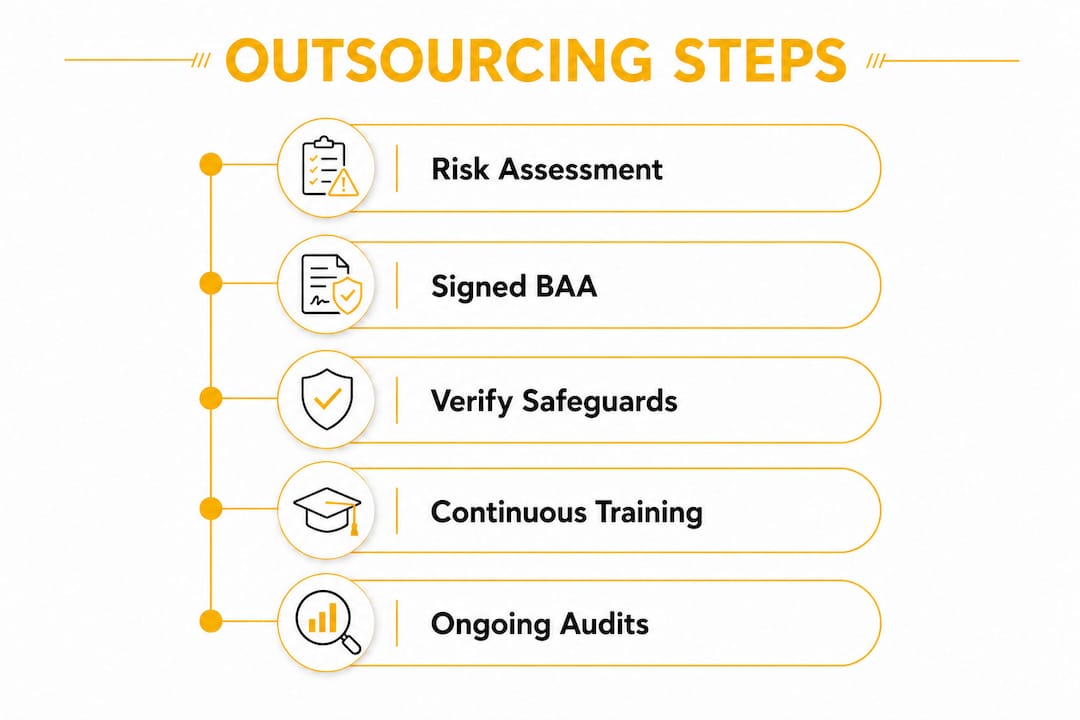
HIPAA compliant outsourcing requires a signed BAA, a formal risk assessment, verified vendor safeguards, and continuous monitoring throughout the entire vendor relationship.
| Point | Details |
|---|---|
| BAA is mandatory before PHI sharing | No PHI may be disclosed to a vendor without a signed, current Business Associate Agreement. |
| Chain of trust covers subcontractors | Every subcontractor who accesses PHI must also have a HIPAA-compliant BAA in place. |
| Risk assessment precedes outsourcing | A formal HIPAA Security Risk Assessment must document data flows and vulnerabilities before work begins. |
| Six-year documentation retention | Vendors must retain policies and audit logs for a minimum of six years per 45 CFR §164.316(b)(2)(i). |
| Breach notification has a 60-day deadline | Vendors must support breach notifications within 60 days of discovery for unsecured PHI. |
What I have learned from years of watching HIPAA outsourcing go wrong
The compliance failures I see most often are not dramatic data breaches. They are quiet administrative breakdowns. A BAA that was never updated after a vendor expanded its service scope. A subcontractor who accessed PHI for three years without anyone realizing they needed their own agreement. A training program that lapsed because the compliance officer changed roles and no one picked up the calendar.
What strikes me most is how organizations treat HIPAA outsourcing as a one-time legal event rather than an ongoing operational discipline. You sign the BAA, you check the box, and you move on. Then 18 months later, the vendor has added two new subprocessors, the original compliance contact left the company, and your audit trail has gaps you cannot explain.
Outsourcing compliance expertise to specialists who focus on HIPAA full-time changes this dynamic. Outsourced Chief Compliance Officers can address gaps and deliver action plans within days, which is a speed that most in-house teams cannot match when they are also managing daily operations. The benefits of HIPAA outsourcing go well beyond cost savings. You gain access to people who track regulatory changes as their primary job, not as a side responsibility.
My honest advice: treat your vendor compliance program as a living system, not a filing cabinet. Build review cycles into your contracts, not just your internal calendar. Require vendors to notify you proactively when their subcontractor list changes. And never assume that a vendor’s SOC 2 certification covers the specific PHI workflows you have contracted them to perform. Verify the scope every time.
— Daniela
How Altiamcx supports HIPAA-compliant healthcare outsourcing
Healthcare organizations that need a trusted partner for compliant outsourcing have specific requirements: verified BAAs, documented security controls, trained staff, and a track record of audit readiness. Altiamcx delivers on all of these through its nearshore customer care and back-office operations model, built with healthcare compliance requirements at the center.

Altiamcx combines disciplined execution with measurable performance frameworks, giving healthcare administrators clear visibility into compliance status without the overhead of managing it alone. The team brings cultural alignment, structured training programs, and documented incident response protocols to every engagement. See how Altiamcx helped a software platform improve productivity by 89% while maintaining full compliance standards. If your organization is ready to outsource with confidence, Altiamcx is the partner built for that work.
FAQ
What is HIPAA compliant outsourcing?
HIPAA compliant outsourcing is the practice of delegating healthcare tasks involving PHI to third-party vendors who meet all HIPAA Privacy Rule, Security Rule, and HITECH Act requirements. It requires a signed BAA, formal risk assessment, and ongoing compliance monitoring.
Is outsourcing HIPAA compliant by default?
Outsourcing is not HIPAA compliant by default. Compliance depends on a signed BAA, verified vendor safeguards, and documented risk assessments completed before any PHI is shared.
What must a HIPAA Business Associate Agreement include?
A BAA must define permitted PHI uses, safeguarding obligations, breach reporting timelines, PHI return or destruction requirements, and flow-down obligations for any subcontractors who access PHI.
How long must HIPAA outsourcing documentation be retained?
HIPAA requires retention of policies, procedures, and audit logs for a minimum of six years, per 45 CFR §164.316(b)(2)(i). Vendors must maintain this documentation and make it available during audits.
What happens if a vendor breaches PHI during outsourcing?
The vendor must notify the covered entity without unreasonable delay, and federal law requires breach notifications to affected individuals within 60 days of discovery. The covered entity remains responsible for meeting the federal notification deadline.