
TL;DR:
- Healthcare leaders often assume rising patient satisfaction scores indicate improved quality, but true quality depends on clinical outcomes, process reliability, and equity. Effective measurement tools like CAHPS, SERVQUAL, and benchmarking, combined with advanced analysis such as importance-performance analysis, help prioritize targeted improvements. Sustainable progress requires integrating quality into organizational structures, addressing disparities, and translating data insights into specific behavioral changes at the frontline.
Most healthcare leaders assume that if patient satisfaction scores are trending up, quality is improving. That assumption is costly. Healthcare service quality explained properly reveals a multi-dimensional system where clinical outcomes, process reliability, and equity all intersect. Understanding this full picture is not optional for administrators who want to sustain performance, meet reimbursement thresholds, and genuinely serve their populations. This article unpacks the definitions, measurement frameworks, and practical improvement strategies you need to make quality data work for your organization.
Table of Contents
- Key Takeaways
- Healthcare service quality explained: definitions and components
- Measuring healthcare service quality: key metrics and tools
- Advanced measurement: importance-performance analysis
- Turning measurement into improvement: practical strategies
- Challenges and opportunities in quality improvement
- My perspective on what actually moves the needle
- How Altiamcx supports healthcare quality improvement
- FAQ
Key Takeaways
| Point | Details |
|---|---|
| Quality is multi-dimensional | Healthcare service quality spans clinical outcomes, patient experience, and operational process reliability. |
| Measurement tools matter | Frameworks like SERVQUAL, CAHPS surveys, and IPA each capture different dimensions of quality. |
| Benchmarking requires follow-through | Compare performance against peers, then build hypothesis-driven improvement cycles to act on the gaps. |
| Equity gaps hide in averages | Aggregate scores can mask disparities; segmenting by subgroups like disability status reveals priority areas. |
| Structure drives sustained improvement | Leadership, culture, and standardized processes are the structural levers that reduce variation over time. |
Healthcare service quality explained: definitions and components
Quality in healthcare is not a single metric. CMS defines healthcare quality as the degree to which health services increase the likelihood of desired health outcomes, consistent with current professional knowledge. That definition is precise for a reason. It ties quality directly to evidence, outcomes, and the populations served, not just to how a visit felt.
Administrators and clinicians often work from three distinct layers of quality:
- Clinical quality: The degree to which care processes reflect evidence-based standards and produce measurable health outcomes. Examples include readmission rates, surgical complication rates, and medication adherence.
- Patient experience quality: How patients perceive their interactions across every touchpoint, from scheduling to discharge communication. This dimension is tied to surveys and public reporting.
- Operational quality: The reliability and efficiency of the systems behind care delivery, including staffing ratios, wait times, care coordination, and administrative accuracy.
The structure-process-outcomes model, attributed to Avedis Donabedian, gives these layers a working architecture. Structure refers to the conditions under which care is delivered: staffing, technology, physical environment, and organizational culture. Process describes what providers and staff actually do during care delivery. Outcomes are the results for patients and populations. Gaps at the structure or process level consistently predict poor outcomes, which is why quality improvement mechanisms target standardization at both layers to reduce variation.
Understanding healthcare quality at this level gives administrators a clear diagnostic lens. When outcomes disappoint, you start by interrogating process reliability. When processes break down, you look at structural supports. That chain of causality is what separates targeted improvement from guesswork.

Measuring healthcare service quality: key metrics and tools
Measuring healthcare service quality starts with knowing what each tool is actually designed to capture. No single instrument covers every dimension. Skilled administrators use multiple frameworks in parallel.
The CAHPS survey family
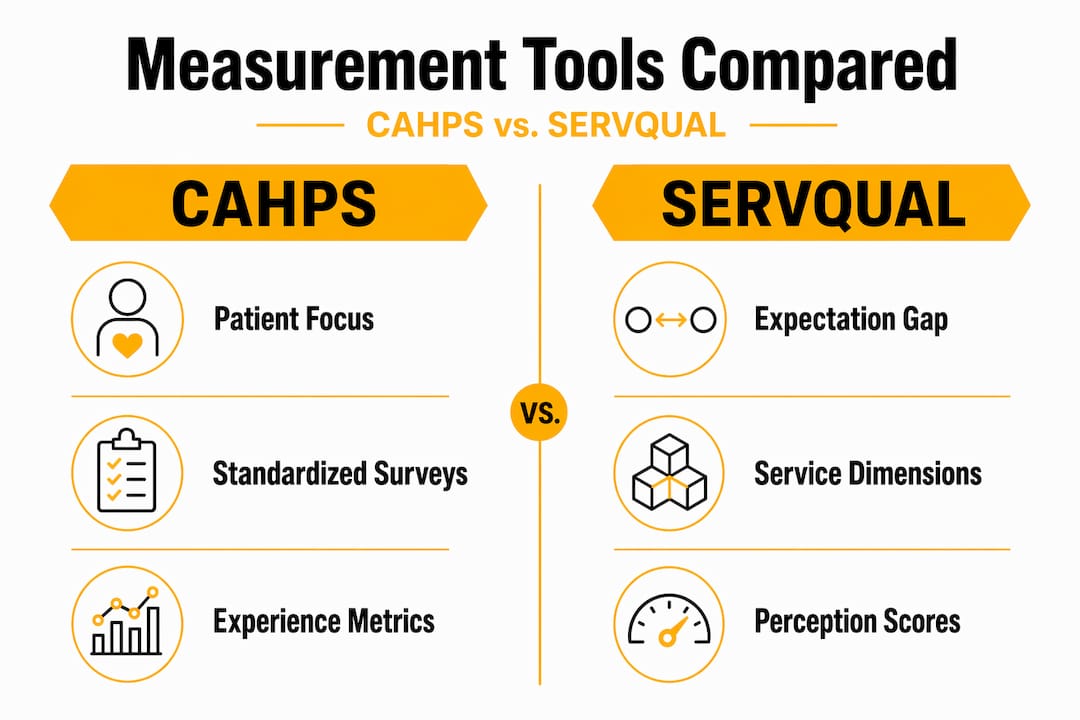
CAHPS surveys measure patient experiences by focusing on what patients themselves identify as important. They use standardized questions that allow statistically reliable comparisons across providers and health systems. CAHPS results are tied directly to public reporting and payment programs, making them high-stakes data for any organization participating in value-based care arrangements.
The key discipline CAHPS imposes is focus. Patient experience surveys rely on patient-identified importance, which reinforces the multi-dimensional nature of quality beyond clinical outcomes alone.
The SERVQUAL model in healthcare
The SERVQUAL model measures service quality through five dimensions that apply directly to healthcare settings:
- Tangibility: Physical facilities, equipment, and staff appearance
- Reliability: Ability to perform promised services dependably and accurately
- Responsiveness: Willingness to help patients and provide prompt service
- Assurance: Staff knowledge and courtesy that builds patient trust
- Empathy: Individualized attention and genuine concern for patients
SERVQUAL identifies gaps between what patients expect and what they actually receive. In practice, healthcare organizations use it to pinpoint whether performance gaps are driven by staff behavior, communication protocols, or physical environment, each of which requires a different intervention.
Benchmarking as a measurement tool
The table below contrasts two of the most common measurement approaches healthcare organizations use when evaluating service quality:
| Approach | Primary focus | Key strength | Limitation |
|---|---|---|---|
| CAHPS surveys | Patient experience and perception | Standardized, payment-linked, comparable | Does not capture clinical outcomes directly |
| SERVQUAL | Gap between expectation and delivery | Identifies specific service failure dimensions | Requires consistent survey administration |
Quality measures function as decision-support tools, helping patients choose providers and helping organizations track their own performance over time. Benchmarking against peer institutions adds critical context, turning raw scores into improvement priorities. For a broader framework on why measurement matters organizationally, the executive perspective is worth understanding before you build a measurement program.
Advanced measurement: importance-performance analysis
Aggregate scores are convenient. They are also misleading if you rely on them exclusively. Importance-Performance Analysis (IPA) solves a specific problem that standard surveys cannot: it tells you not just how you are performing, but whether you are performing well in the areas patients actually care about most.
IPA plots performance ratings against importance ratings across service dimensions. The output is a priority matrix with four quadrants:
- High importance, low performance: Concentrate improvement resources here first
- High importance, high performance: Maintain these strengths
- Low importance, high performance: Consider whether resources are being over-allocated
- Low importance, low performance: Monitor but deprioritize
The equity dimension of IPA is where it becomes particularly powerful. Average patient experience scores can mask disparities across subgroups. Research shows that patients with disabilities, for example, consistently rate certain service dimensions as highly important while receiving lower performance scores in those same areas. An aggregate score that looks acceptable across the full population can conceal a significant equity gap that only segmented analysis reveals.
Pro Tip: When running IPA, always segment results by disability status, race, primary language, and insurance type before reviewing aggregate scores. Improvement targets that look marginal in aggregate often become urgent when viewed through a subgroup lens.
Integrating IPA results into Plan-Do-Study-Act (PDSA) cycles closes the loop between insight and action. You identify the priority gap through IPA, design a targeted intervention in the Plan phase, implement it, study the effect on both the overall and subgroup scores, and then adjust. This iterative structure prevents you from investing in improvements that move average scores without reducing disparity.
Turning measurement into improvement: practical strategies
Data does not improve care. What you do with data does. Translating healthcare service quality measurement into genuine improvement requires applying the right framework at the right level of your organization.
-
Start with structural diagnosis. Before designing process changes, examine what structural factors are limiting performance. Leadership commitment, staff training infrastructure, technology support, and organizational culture all determine whether process changes stick. Quality improvement mechanisms that focus exclusively on process without addressing structural deficits tend to produce short-term gains followed by regression.
-
Use benchmarking to generate hypotheses, not conclusions. Knowing that a peer institution outperforms yours on a specific measure tells you where to look, not what to do. Pair benchmarking data with a structured analysis of which process or structural differences explain the gap. Then design a PDSA cycle to test a targeted change.
-
Select operationally influenced domains for patient experience work. Improving patient experience requires selecting measurable domains where workflow or communication changes can actually shift perception. Without that operational focus, organizations measure perception without generating improvement. For example, discharge communication is a CAHPS domain directly influenced by a structured nurse teach-back protocol, a concrete process change with a measurable outcome.
-
Connect quality data to frontline staff behavior. Performance data that stays at the administrator level rarely changes what happens at the point of care. Build feedback loops that translate aggregate scores into specific, observable behaviors that clinical and support staff can modify.
Pro Tip: Do not launch multiple PDSA cycles simultaneously across different quality dimensions. Isolate one priority improvement at a time so you can clearly attribute results to specific changes rather than noise from overlapping initiatives.
For a detailed look at how healthcare CX best practices translate quality measurement into frontline behavior change, the operational examples are directly applicable to administrative decision-making.
Challenges and opportunities in quality improvement
Healthcare service quality improvement is not straightforward, even when you have the right frameworks. Several persistent challenges complicate the work:
- Perception versus action gap: Measuring how patients feel about care is not the same as measuring whether care delivery improved. Organizations sometimes invest heavily in survey programs without building the operational changes that would actually shift scores.
- Aggregate masking: As IPA research confirms, subgroup-specific priorities reveal equity gaps that average scores hide. Quality assurance in healthcare services that does not segment data systematically underserves vulnerable populations while reporting acceptable averages.
- Reimbursement alignment: Value-based care programs increasingly link payment to quality performance, creating financial urgency around improvement. This creates opportunity for organizations that have strong measurement and improvement infrastructure.
The opportunities are equally significant. Research on value-based outsourcing in a regional health system showed that outsourced hospitals achieved lower mortality, fewer complications, shorter stays, and higher patient experience scores compared to publicly managed counterparts. This finding challenges the assumption that operational support functions should always be managed internally. Scalable team extension and external operational partnerships can accelerate quality improvement when internal capacity is the binding constraint.
Technology also plays a growing role. Real-time data dashboards, automated survey administration, and AI-assisted analysis reduce the lag between data collection and decision-making, giving administrators a faster feedback loop for iterative improvement.
My perspective on what actually moves the needle
I have spent years watching healthcare organizations invest heavily in measurement programs and still struggle to improve outcomes in a sustained way. The pattern is almost always the same. Leadership treats quality scores as a communications challenge rather than an operational one. Scores go up for a quarter because staff awareness increased. Then the initiative loses momentum, staff attention moves elsewhere, and scores drift back.
What I have learned is that the organizations that consistently improve quality share one characteristic: they build quality into the structure of work, not the calendar of initiatives. They do not launch quality campaigns. They redesign workflows, accountability structures, and feedback loops so that the right behavior is the path of least resistance at every level.
The multi-dimensional measurement frameworks are genuinely useful, but only if leadership is willing to act on what the data reveals, including when it reveals that a specific population is being systematically underserved. That is where real quality improvement gets uncomfortable. Aggregate scores are easy to report. Subgroup disparities require decisions about resource reallocation that touch organizational values and budget priorities.
My honest take: if your quality improvement program has not surfaced a finding that made leadership uncomfortable in the last 12 months, your measurement program is not going deep enough.
— Daniela
How Altiamcx supports healthcare quality improvement

Healthcare quality improvement requires measurement infrastructure, trained teams, and the operational capacity to act on data quickly. Many organizations have the measurement tools but lack the operational bandwidth to close the loop between insight and action. Altiamcx supports healthcare organizations by providing scalable, nearshore team extension solutions that integrate directly with quality improvement workflows, from back-office quality assurance in healthcare services to patient experience program support. The productivity and quality gains documented in Altiamcx case studies demonstrate what happens when disciplined execution meets the right operational model. If you are working to scale your healthcare quality improvement program, explore how Altiamcx’s nearshore team extension approach can give you the capacity to move from measurement to meaningful change.
FAQ
What is service quality in healthcare?
Healthcare service quality is the degree to which health services increase the likelihood of desired outcomes, consistent with professional knowledge. It spans clinical quality, patient experience, and operational reliability, not just satisfaction scores.
How is healthcare service quality measured?
Organizations measure healthcare service quality using tools like CAHPS surveys for patient experience, SERVQUAL for service gap analysis, and benchmarking to compare performance against peer institutions across clinical, operational, and experiential dimensions.
What is Importance-Performance Analysis in healthcare?
IPA identifies gaps between what patients value most and how well an organization performs on those dimensions. It helps administrators prioritize improvement resources by focusing on high-importance, low-performance service areas, including those that affect specific patient subgroups.
What factors affect healthcare service quality?
Key factors include structural elements like leadership commitment, technology, and staffing, as well as process factors like care protocols and communication standards. Culture and training determine whether improvement initiatives translate into lasting behavior change at the point of care.
How does benchmarking support quality improvement?
Benchmarking reveals where performance gaps exist relative to peer organizations and best-practice standards. When paired with structured PDSA cycles, it moves beyond comparison to generate testable hypotheses about what structural or process changes will close identified gaps.