
TL;DR:
- Customer loyalty depends heavily on consistent service quality, which requires structured standards, procedures, and ongoing measurement. Implementing the SERVQUAL model helps identify gaps across key dimensions, while involving frontline staff in procedure design enhances compliance and ownership. Regularly reviewing procedures and measuring both objective and subjective metrics ensures continuous improvement and sustainable retail excellence.
Customer loyalty lives and dies on service quality. 79% of consumers would switch to a competitor after just one bad experience, and expectations keep climbing year over year. For retail managers and business owners, that stat is not a warning. It is a call to act with structure and intention. This retail service quality guide walks you through every critical stage: setting the right foundations, designing procedures your team will actually follow, measuring what matters, and fixing the gaps before they cost you customers.
Table of Contents
- Key Takeaways
- Building the right foundation for service quality
- Designing service procedures that actually get used
- Measuring service quality in your retail operation
- Common mistakes that undermine service quality
- What I have learned about real service quality excellence
- How Altiamcx helps retail teams sustain service excellence
- FAQ
Key Takeaways
| Point | Details |
|---|---|
| Define standards before execution | Establish clear, written service standards aligned to your brand values before rolling out any training or procedures. |
| Use SERVQUAL as your framework | Map your service gaps across all five dimensions: tangibles, reliability, responsiveness, assurance, and empathy. |
| Involve frontline staff early | Including your floor team in procedure design dramatically increases compliance and cuts retraining time. |
| Measure with a balanced scorecard | Pair objective metrics like CSAT and NPS with subjective dimensions like empathy to get a complete picture. |
| Review procedures continuously | Static procedures create bad habits. Build in regular review cycles and update based on frontline feedback. |
Building the right foundation for service quality
Most retail service improvement initiatives fail not because of bad intentions, but because managers skip the groundwork. Before you redesign your checkout experience or roll out a new training program, you need to get clear on the architecture underneath.
Standards, guidelines, and protocols: know the difference
These three terms get used interchangeably, and that creates real problems on the floor. Distinguishing standards from guidelines directly improves service consistency across locations. Here is how to think about it:
- Standards define the outcome. For example: “Every customer will be greeted within 15 seconds of entering the store.”
- Guidelines define the approach. For example: “Use a warm, conversational tone. Avoid scripted greetings that sound robotic.”
- Protocols define the exact process. For example: “If a customer requests a refund, verify the receipt, check the return window, and escalate to a supervisor if the item is over $150.”
Getting these three layers right gives your team both the structure and the flexibility they need to deliver consistent service.
The SERVQUAL model: your diagnostic tool
The SERVQUAL model measures service quality as the gap between what customers expect and what they actually perceive. It organizes that gap across five dimensions:
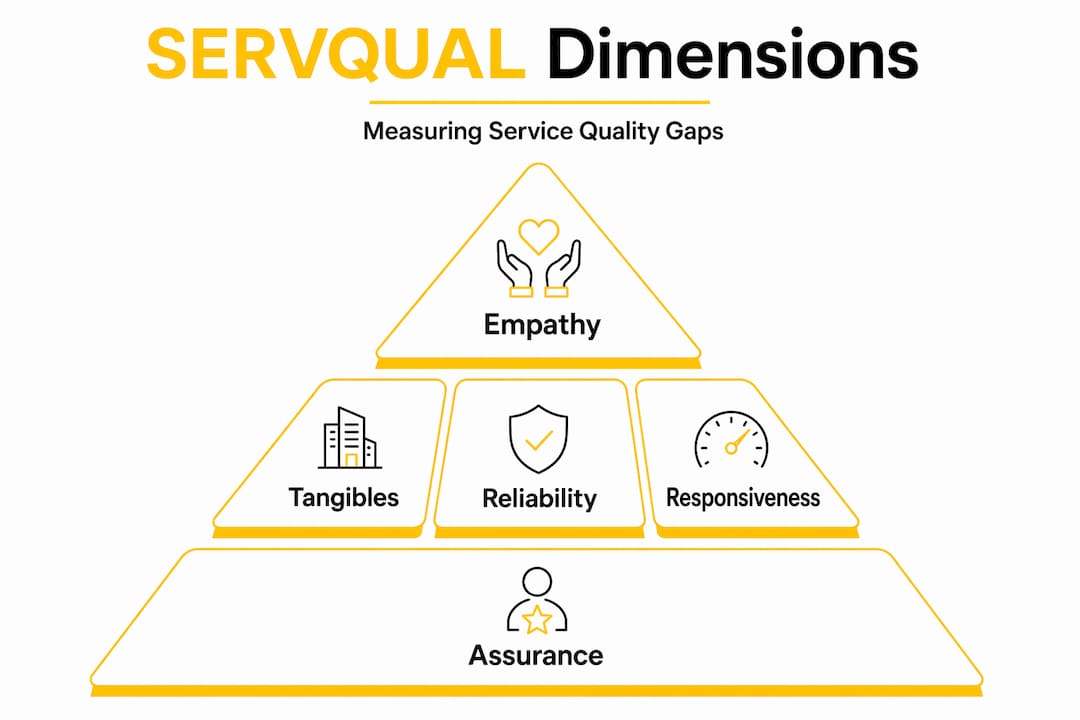
| Dimension | What it measures | Retail example |
|---|---|---|
| Tangibles | Physical environment and appearance | Store layout, signage, staff presentation |
| Reliability | Delivering on promises consistently | Accurate pricing, product availability |
| Responsiveness | Speed and willingness to help | Time to greet, queue wait times |
| Assurance | Knowledge and trustworthiness | Staff expertise on products |
| Empathy | Personalized attention and care | Remembering repeat customers, handling complaints graciously |
Before you execute any changes, run a gap analysis using these dimensions. Survey your customers on their expectations and their actual experience. That gap is where your service quality investment needs to go.
Baseline data and tools you need
Start by pulling together your current feedback data: post-purchase surveys, online reviews, return rates, and any complaint logs. Identify which SERVQUAL dimensions your customers score you lowest on. 90% of customers value immediate responses, so responsiveness gaps tend to surface fast. You will also need staff training infrastructure, a centralized place to store procedures, and a method for collecting ongoing feedback from both customers and employees.

Designing service procedures that actually get used
A procedure that lives in a binder no one opens is not a procedure. It is wasted effort. This section gives you a step-by-step service quality guide for creating, documenting, and deploying retail service procedures that your team follows consistently.
-
Map the customer journey first. Identify every touchpoint where staff interact with customers, from entry to checkout to post-sale follow-up. Each touchpoint is a candidate for a documented procedure.
-
Involve your frontline staff. Including frontline employees in procedure development increases compliance and reduces retraining needs significantly. Your floor associates know where the current processes break down. Ask them directly.
-
Write in plain language. Procedures should be clear enough that a new hire on day one can follow them without a manager at their shoulder. Use numbered steps, not paragraphs. Keep each step to one action.
-
Apply the PDCA cycle. Plan the procedure, deploy it, check adherence and results after 30 days, then adjust. Using PDCA to refine procedures is one of the most effective ways to build a service excellence framework that actually improves over time rather than stagnating.
-
Make procedures accessible. Post laminated quick-reference cards at the register, in the stockroom, and at any key service station. If your store uses digital tools, add them to your internal wiki or communication app so staff can pull them up on any device.
-
Reinforce regularly. Do not train once and expect lasting behavior. Build brief, weekly refreshers into your team huddles. Reference specific procedures when you recognize good service or correct a miss.
-
Document complaint and escalation protocols. Clear complaint protocols reduce variability and improve resolution speed. Every team member should know exactly what to do when a customer is upset, without having to find a manager first.
Pro Tip: Optimize the first 10 seconds of your customer’s in-store experience. Research shows that greeting customers immediately and making them feel seen is a more cost-effective service lever than adding extra staff. Train your team on a specific, non-scripted acknowledgment within 15 seconds of any customer entering their zone.
Measuring service quality in your retail operation
You cannot improve what you do not track. This is where retail managers often underinvest. Good measuring service quality practice combines hard numbers with the softer, perception-based dimensions of the SERVQUAL model.
Key metrics to track
- CSAT (Customer Satisfaction Score): Measures satisfaction with a specific transaction or interaction. Best collected immediately after checkout or service resolution.
- NPS (Net Promoter Score): Measures likelihood to recommend. Useful for tracking brand-level loyalty trends over time.
- CES (Customer Effort Score): Measures how easy it was for a customer to get their issue resolved. High effort scores predict churn.
- First Contact Resolution (FCR): The percentage of issues resolved without a follow-up visit or call.
- Response and resolution times: Track how quickly staff acknowledge and resolve issues in-store and across any phone or digital channels you operate.
Subjective quality dimensions matter too
Effective service quality programs that combine objective metrics with subjective dimensions like empathy and tangibles give you a far more accurate picture than numbers alone. Use mystery shopping to evaluate empathy and responsiveness firsthand. Direct observation during peak traffic hours reveals patterns that surveys miss entirely.
Pair your quantitative data with regular qualitative feedback sessions where staff share what they are hearing from customers. This frontline intelligence often surfaces issues weeks before they show up in survey scores. Retail customer satisfaction is rarely one-dimensional, so your measurement approach should not be either.
Once you have your data, segment it by location, time of day, product category, or staff team to identify where the gaps are sharpest. That specificity lets you prioritize improvements rather than trying to fix everything at once.
Common mistakes that undermine service quality
Even well-designed programs break down. Here are the most common failure points in retail service quality initiatives and how to avoid them.
-
Confusing standards with guidelines. When teams treat outcome-based standards and approach-based guidelines as the same thing, you get inconsistent delivery. One associate greets customers with warmth; another rushes them because they think the 15-second rule is about speed, not connection.
-
Never updating your procedures. Static procedures breed bad habits. If a process has not been reviewed in six months, it is already out of date. Build a quarterly review into your calendar as a non-negotiable.
-
Ignoring staff feedback. Your frontline team sees service failures in real time. If you are not building a formal channel for that input, including brief written feedback forms or regular one-on-one check-ins, you are solving yesterday’s problems with incomplete information.
-
Adding headcount instead of fixing processes. Scheduling more staff during busy periods is sometimes the right call. But if wait times and frustration scores stay high regardless of staffing level, the issue is in the process, not the headcount. Optimize queue management and first-contact protocols before hiring.
-
Skipping proactive communication. When customers cannot find information quickly, they escalate. Lack of clear signage, unhelpful staff, and absent product knowledge all signal the same failure: your team is reactive when it needs to be proactive.
Pro Tip: Build a centralized knowledge base your staff can access on the floor, whether that is a shared digital document, an in-store tablet, or even a structured quick-reference binder. Reducing the time it takes a staff member to find an answer is one of the fastest ways to improve your customer service standards in measurable terms.
What I have learned about real service quality excellence
Over the years, I have watched well-funded retail service initiatives collapse for one reason: managers focused entirely on delivery while ignoring expectation management. The SERVQUAL model makes this point clearly. The gap that matters is between what customers expect and what they actually experience. If you never address what your customers are walking in expecting, even excellent delivery can feel disappointing.
The other uncomfortable truth? Throwing more staff at service problems almost never works without a process change underneath it. I have seen stores with generous staffing ratios still score poorly on service quality because no one had documented what “good” looked like at each touchpoint. When the procedure is clear and the standard is written down, even a new hire can deliver a consistent experience from day one.
What genuinely transformed inconsistent service delivery in every context I have observed was frontline involvement. When floor associates help design the procedures they are expected to follow, they own them. Compliance stops being a management problem and starts being a team culture.
The last lesson is one most managers resist until they have been burned: your procedures need a retirement date. Build in a review cadence. What worked last season may not fit this season’s customer mix, product lineup, or staffing structure. The best practices for retail service are always evolving, and your procedures should reflect that reality.
— Daniela
How Altiamcx helps retail teams sustain service excellence

Implementing this kind of structured service quality program is demanding. Altiamcx works with retail operations teams to design, deploy, and measure customer experience programs that hold up under real-world conditions. One software client improved productivity by 89% after migrating their support operations to the Altiamcx platform. For retail teams that need scalable support without the overhead of rapid in-house hiring, the Altiamcx nearshore team extension model delivers culturally aligned, performance-driven service capacity you can grow on demand. If you are serious about turning this guide into real results, Altiamcx has the frameworks and the execution experience to get you there.
FAQ
What is a retail service quality guide?
A retail service quality guide is a structured framework that helps store managers and owners define, implement, measure, and improve the standards of customer service across their retail operation. It typically covers service standards, staff procedures, measurement tools like SERVQUAL, and continuous improvement practices.
What are the five dimensions of SERVQUAL?
The five SERVQUAL dimensions are tangibles, reliability, responsiveness, assurance, and empathy. Together they measure the gap between what customers expect from a service and what they actually experience.
How do I measure retail customer satisfaction?
Track CSAT scores immediately after transactions, NPS for overall loyalty trends, and CES to evaluate how easily customers resolved issues. Complement these with mystery shopping and direct observation for a complete picture of service quality in your store.
What is the fastest way to improve in-store service quality?
Optimizing the first 10 seconds of customer interaction and reducing the effort required for staff to find answers are two of the most cost-effective improvements. Clear, accessible procedures and proactive staff acknowledgment have an outsized impact on customer perception.
How often should retail service procedures be reviewed?
Procedures should be reviewed at minimum once per quarter. Static procedures create inconsistency over time. Build a formal review schedule and use frontline staff feedback as your primary input for updates.