
TL;DR:
- Healthcare back-office functions now act as vital links between financial performance and clinical outcomes, extending beyond simple administrative tasks. Modern models utilize hybrid AI-enabled approaches to improve revenue cycle management, compliance, and patient access while managing emerging risks like EHR integration and AI errors. Implementing structured frameworks, continuous monitoring, and strategic investments in capabilities positions organizations to lead healthcare transformation and enhance patient experiences.
Most healthcare executives think of the back office as a place where claims get processed and paperwork gets filed. Quietly. Efficiently. Without much strategic significance. That assumption is now outdated and expensive to hold. New operational models show that healthcare back-office functions now serve as the connective tissue between financial performance and clinical outcomes. This guide walks you through what these operations actually include, how management models are shifting, what risks are emerging, and which frameworks consistently separate high performers from the rest.
Table of Contents
- Defining healthcare back-office operations
- Traditional models vs modern approaches
- Common challenges and risks in healthcare back-office operations
- Best practices and proven frameworks
- Why tomorrow’s back-office must lead healthcare transformation
- Connect your back-office strategy with specialized support
- Frequently asked questions
Key Takeaways
| Point | Details |
|---|---|
| Back-office drives outcomes | Modern back-office operations are strategic drivers of clinical quality and financial performance. |
| Hybrid models balance control | Combining in-house and outsourced functions enhances scalability while maintaining compliance and patient experience. |
| Integration is essential | Successful back-office transformation requires multidisciplinary integration with quality, analytics, and clinical workflows. |
| Track leading indicators | High performers monitor leading indicators like first-pass acceptance to optimize performance, not just lagging financials. |
| Capacity crisis needs action | Address administrative and staffing challenges to prevent backlogs and burnout and improve care timeliness. |
Defining healthcare back-office operations
Back-office operations in healthcare cover everything that keeps the organization running without directly involving patient contact. Think of it as the engine underneath the care delivery vehicle. It runs constantly, and when it misfires, the effects ripple across billing, compliance, staffing, and ultimately patient satisfaction.
Core functions typically include:
- Revenue cycle management: billing, coding, claims submission, denial management, and collections
- Scheduling and patient access: appointment coordination, prior authorizations, and referral processing
- Human resources and payroll: credentialing, workforce planning, benefits administration
- Compliance and documentation: HIPAA reporting, audit support, regulatory filing
- Data management: EHR maintenance, reporting, and analytics support
These functions are clearly distinct from front-office work, which focuses on patient-facing interactions such as check-in, triage coordination, and direct care delivery. Front-office teams depend on back-office accuracy to do their jobs well. When a prior authorization is delayed or a billing code is incorrect, the front office absorbs the friction and the patient feels it.
“Value-based care is shifting BPO from pure back-office to clinical-adjacent functions like remote patient monitoring triage, fundamentally changing what ‘back-office’ means for health systems.”
That shift is critical. Under fee-for-service models, back-office operations were siloed. Under value-based care, those same teams now support population health management, chronic care coordination, and outcome reporting. Organizations that have already made this pivot are seeing measurable gains in both compliance and care quality. Those that have not are managing the consequences.
Exploring back-office solutions examples can help you see precisely where these integrations create the most value for health systems of different sizes.
Traditional models vs modern approaches
Understanding where you are requires knowing where the field has been. For decades, healthcare organizations managed back-office operations through one of two approaches: keeping everything in-house with dedicated administrative staff, or outsourcing specific tasks to large BPO vendors focused primarily on cost reduction. Both approaches worked, to a point. Neither was built for what the industry is facing now.
Here is how the two paradigms compare directly:
| Dimension | Traditional model | Modern model |
|---|---|---|
| Primary goal | Labor cost reduction | Revenue protection and clinical support |
| Technology | RPA and basic automation | AI augmentation and agentic workflows |
| Staffing model | In-house or fully outsourced | Hybrid: nearshore plus in-house oversight |
| Performance metric | Cost per transaction | First-pass acceptance rate, denial reduction |
| Integration level | Siloed from clinical teams | Embedded in care coordination workflows |
| Risk management | Reactive | Predictive with real-time analytics |
The numbers are compelling. Traditional outsourcing models deliver roughly 30% labor savings. Modern hybrid models that incorporate AI and clinical-adjacent workflows achieve up to 65% denial reduction, which translates directly to revenue recovery, not just cost avoidance. That is a fundamentally different value proposition.
Modern approaches also rely on multidisciplinary management platforms that integrate contract oversight, credentialing, and compliance functions into unified operational dashboards. These tools reduce manual handoffs and give executives real-time visibility into performance across functions that were previously invisible.
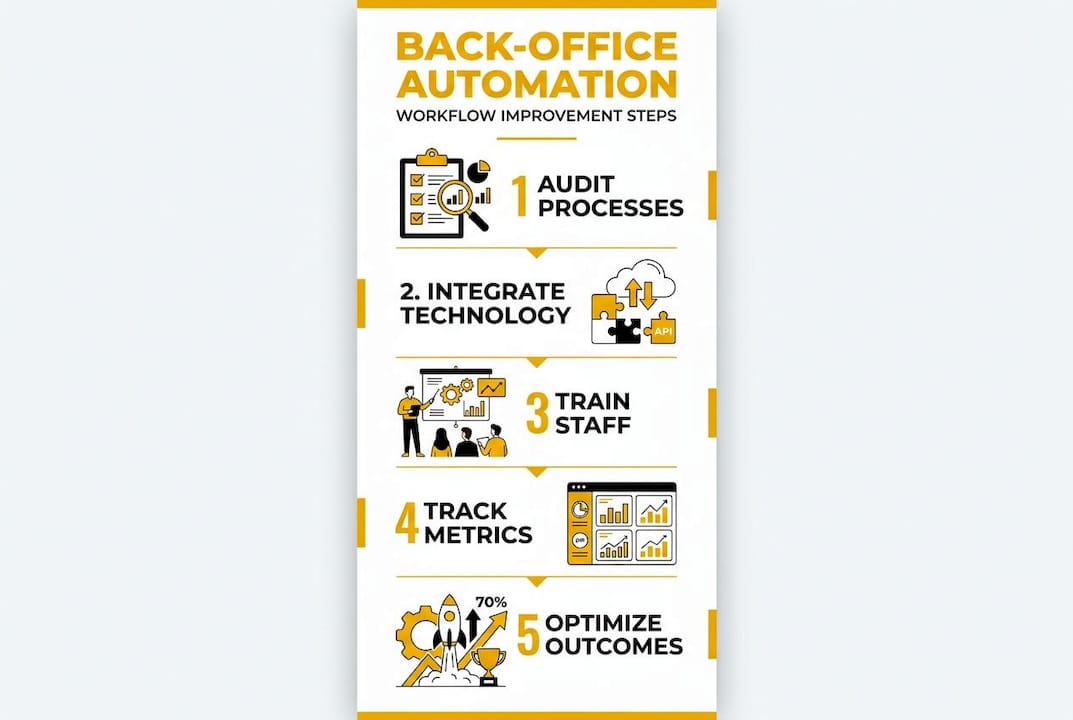
Four steps define the shift from traditional to modern:
- Audit current workflows to identify manual touchpoints, error rates, and lag times in billing and authorization processes.
- Segment functions by complexity, mapping which tasks are suited for automation, which need human judgment, and which benefit from hybrid handling.
- Pilot AI tools in isolated workflows before broader rollout, tracking accuracy, exception rates, and processing speed against baseline data.
- Build hybrid capacity using nearshore teams to absorb volume spikes while retaining internal oversight for compliance-sensitive functions.
Pro Tip: Hybrid models that combine nearshore talent with AI-assisted workflows offer the best balance of scalability and revenue protection. Full outsourcing creates dependency risk; full automation without oversight creates compliance risk. The middle path wins.
Reviewing back-office automation strategies gives you a practical framework for sequencing these changes without disrupting existing revenue cycle operations.
Common challenges and risks in healthcare back-office operations
Modern approaches bring real advantages. They also introduce new categories of risk that many healthcare organizations are underprepared to manage. Recognizing these risks early gives you a significant operational advantage.
EHR and legacy integration challenges sit at the top of most CIOs’ concern lists. Many health systems are running EHR platforms that lack modern APIs, making it difficult to connect new automation tools without custom middleware development. This creates data silos, increases manual reconciliation, and slows the adoption of AI tools even when the organizational will is there.

AI documentation errors require active oversight. AI models used in clinical documentation and coding can produce what the industry calls “hallucinations,” which are confident but incorrect outputs. AI errors in documentation require human-in-loop validation at every stage where the output affects a patient record or a billing transaction. Organizations that deploy AI without structured review processes are trading one risk for another.
The risk landscape includes several additional pressure points:
- HIPAA alignment gaps: Outsourcing partners who lack HIPAA-compliant infrastructure create liability for the contracting health system, regardless of contractual language.
- Loss of patient-centered interactions: When administrative processes become too automated or depersonalized, patient trust erodes. Back-office functions like financial counseling and prior authorization communication directly affect patient experience.
- Staffing shortages and burnout: 43% of healthcare administrative staff report burnout, with overtime and backlog accumulation as primary drivers. This shortage is not a temporary staffing cycle. It is a structural gap.
“The administrative staffing crisis is not a hiring problem alone. It is an operational design problem. When workflows are inefficient, every staffing shortfall gets amplified.”
Understanding the types of healthcare outsourcing helps you make informed decisions about which functions are safe to externalize and which require in-house control. Knowing why organizations choose to outsource back-office tasks for growth also helps frame the strategic rationale rather than treating it purely as a cost decision.
The impact of BPO partnerships on both quality and efficiency is well-documented, but success depends entirely on selecting partners who meet your compliance standards and operational culture.
HIPAA compliance tools provide a useful layer of verification when vetting outsourcing vendors and auditing current data handling practices.
Pro Tip: Before implementing any new technology or outsourcing arrangement, establish baseline metrics for error rate, processing time, and denial rate. Without a baseline, you cannot measure improvement or catch regression early. Pilot all changes in a controlled environment for a minimum of 60 days before full deployment.
Best practices and proven frameworks
High-performing health systems are not simply working harder on back-office operations. They are working differently. The frameworks they use are replicable, and the performance data supporting them is increasingly clear.
The first principle is centralize goals, decentralize execution. Top-performing organizations set unified performance targets at the organizational level but give department leads and operational teams the autonomy to determine how those targets are achieved. This creates accountability without micromanagement, and it allows faster local adaptation when workflows change.
The second principle is integrate quality and analytics directly into operations. Most organizations track financial performance through lagging indicators like net collection rates, which are reported weeks after the work is done. Top performers use leading indicators that allow real-time course correction.
| Performance indicator | Top quartile benchmark | Average health system |
|---|---|---|
| First-pass claim acceptance | 96 to 98% | 85 to 90% |
| Days in accounts receivable | Under 35 days | 45 to 55 days |
| Denial rate | Under 5% | 8 to 12% |
| Prior auth turnaround | Under 24 hours | 48 to 72 hours |
| Staff overtime rate | Under 8% | 15 to 20% |
First-pass acceptance rates between 96 and 98% are the hallmark of top-quartile revenue cycle performance. If your organization is below 90%, that gap represents real, recoverable revenue.
The third principle is treat administrative capacity as a critical resource. The administrative capacity crisis is not just an HR problem. It directly delays care delivery when prior authorizations stall, referrals queue up, or billing disputes consume staff time that should go toward patient access. High performers close this gap by engineering capacity through a three-part model: global talent for volume work, AI for routine processing, and senior in-house staff for oversight and exception handling.
Here is a six-step framework for building operational resilience:
- Map your current state: Document every administrative workflow, its owner, its error rate, and its connection to revenue or compliance.
- Identify capacity constraints: Pinpoint where backlogs form, where overtime concentrates, and where handoffs between teams create delays.
- Segment by automation readiness: Classify each function as automatable, hybrid, or human-required based on complexity and compliance sensitivity.
- Pilot with baselines: Run changes in parallel with existing processes for 60 to 90 days, tracking leading indicators from day one.
- Scale what works: Use pilot results to build the business case for broader rollout, including staffing model changes and technology investments.
- Build continuous review cycles: Set quarterly performance reviews using the leading indicators from the table above, and tie them to team-level accountability.
Operational support for health systems structured around this framework shows measurable gains, with pilot changes yielding 2 to 4% net collection improvements when executed with proper baseline tracking.
Contract management tools support the governance layer of this framework, ensuring vendor agreements, credentialing timelines, and compliance obligations are monitored proactively rather than reactively.
Reviewing back-office outsourcing for business efficiency gives you additional benchmarks for evaluating whether your current operational model is delivering competitive returns.
Pro Tip: Track leading indicators weekly, not monthly. Denial rates and first-pass acceptance rates move fast, and a two-week lag in spotting a coding error can cost a mid-size health system tens of thousands of dollars in rework and delayed cash flow.
Why tomorrow’s back-office must lead healthcare transformation
Here is the view that rarely makes it into the standard operational improvement conversation: the back office is not a support function waiting to be optimized. It is the most underutilized strategic asset most health systems own.
Consider what the back office actually controls: access to care through scheduling and authorization, financial sustainability through revenue cycle management, workforce stability through HR and credentialing, and compliance posture through documentation and audit readiness. That is not a support function. That is the command center.
The modern view of back-office infrastructure recognizes it as the mechanism for both revenue protection and denial reduction, directly affecting the organization’s ability to fund clinical initiatives, recruit talent, and serve patients well. Yet most strategic planning conversations still treat it as a line item to manage down rather than a capability to build up.
The organizations that will lead healthcare in the next decade are the ones making deliberate investments in back-office capability now. Not because it cuts costs, though it does. But because it creates the operational foundation for everything else to work. Clinical programs cannot scale without administrative infrastructure that keeps pace. Technology investments fail without the human and process architecture to support them.
The CX outsourcing strategy most relevant to healthcare is one that treats the back office as both a performance engine and a patient experience driver. When administrative processes are fast, accurate, and patient-centered, the entire care experience improves. That is not an operational efficiency story. That is a clinical outcomes story.
The executives who recognize this connection will build organizations that outperform on every dimension that matters.
Connect your back-office strategy with specialized support
The frameworks in this article are actionable and proven. But building the internal capacity to execute them, especially during a staffing shortage and a period of rapid technology change, is a significant challenge.

Altiam CX helps healthcare organizations bridge that gap. As a nearshore operational services partner, we provide managed team extensions that embed directly into your revenue cycle, compliance, and administrative workflows. Our teams are culturally aligned, trained to your protocols, and measured against the same leading indicators that top-performing health systems use. Whether you need to scale authorization processing, reduce denial rates, or build a more resilient back-office model, our fast-growth solutions and the broader Altiam CX platform are built to deliver measurable performance improvements from day one.
Frequently asked questions
What are the most critical functions of healthcare back-office operations?
Key functions include billing, scheduling, HR, compliance management, and supporting clinical workflows for efficient care delivery. These functions collectively determine an organization’s financial health, regulatory standing, and capacity to scale services.
How does outsourcing impact back-office operations and compliance?
Outsourcing improves scalability and efficiency but introduces compliance risk if the vendor is not HIPAA-aligned and operationally equipped to maintain the personalized patient experience your organization requires.
What are the advantages of hybrid in-house/outsourced models?
Hybrid models deliver the best of both worlds: scalability and cost efficiency from external capacity, combined with internal oversight that protects revenue integrity and compliance posture.
How can technology integration improve back-office performance?
AI and automation accelerate processing and reduce manual error rates, but they require human-in-loop validation, especially for clinical documentation. Piloting with baseline data ensures you can measure real gains and catch issues before they scale.