Healthcare team extension and staff augmentation are staffing models that embed skilled external professionals directly into your existing team, under your leadership, following your standards. You retain full control of delivery, quality, and clinical direction. The external members work inside your workflows, not alongside them as a separate vendor unit.
The industry term for this approach is “team extension” or “extended care team,” and it applies across both clinical and healthcare IT settings. In clinical primary care, it means adding behavioral health specialists, pharmacists, or care coordinators to a core provider team. In healthcare IT, it means embedding external developers, data engineers, or technical specialists into your internal operations. Both applications share the same core principle: external talent integrates into your structure, your processes, and your accountability systems.
This guide to healthcare team extension covers every dimension healthcare managers need in 2026, from operational models and timing to partner selection, compliance, and measuring outcomes.
What is healthcare team extension and staff augmentation?
Healthcare team extension is the practice of expanding a core clinical or operational team with external professionals who work under existing internal leadership, follow established workflows, and contribute to defined outcomes. Staff augmentation is a closely related term, though it tends to be shorter in duration and more task-specific. Team extension implies deeper integration, sustained engagement, and knowledge retention over time.
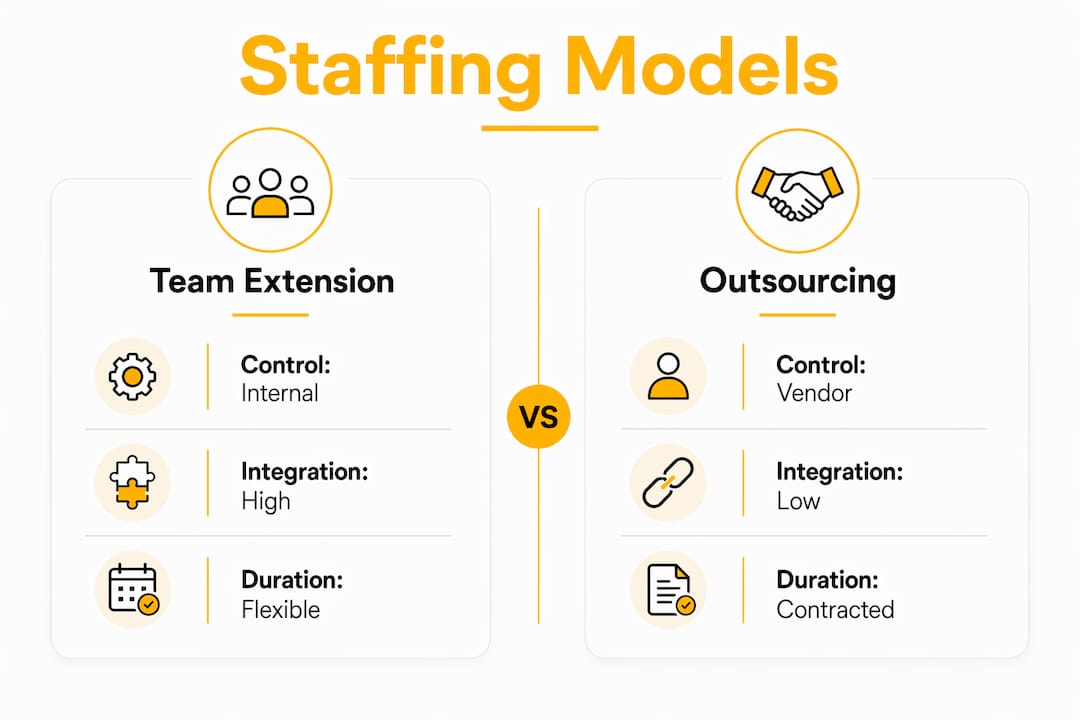
The distinction from traditional outsourcing is ownership. In outsourcing, a vendor manages delivery independently. In team extension, your clinical or technical leadership retains full ownership of decisions, standards, and outcomes. External specialists report directly to internal leadership, not through a vendor intermediary.
The clinical case for this model is concrete. A single primary care provider needs 26.7 hours daily to cover all recommended care, making task redistribution through team extension a clinical necessity. No individual clinician can close that gap alone. Team extension redistributes tasks across professionals working at the top of their licenses, so physicians focus on diagnosis and treatment while pharmacists, nurses, and care coordinators handle the work they are fully qualified to do.
Key features of healthcare team extension:
- External professionals integrate into your team’s daily workflows, stand-ups, and performance reviews
- Internal leadership retains control of clinical standards, architecture, and delivery decisions
- Engagements typically run 3–24 months, building institutional knowledge rather than resetting it
- Intellectual property, patient data governance, and care protocols remain with your organization
- Both clinical roles (pharmacists, behaviorists, care coordinators) and operational roles (IT specialists, back-office staff) qualify under this model
How healthcare team extension works in practice
Operational models: extension, augmentation, and outsourcing compared
Three models dominate healthcare staffing discussions, and the differences matter for how you structure governance and accountability.
Team extension embeds external professionals into your existing team under your leadership. They attend your huddles, follow your protocols, and report to your internal leads. Integration depth is high, duration is typically sustained, and knowledge stays with your organization.

Staff augmentation fills a specific role or skill gap for a defined period. Control stays with your team, but integration is shallower and the engagement is usually task-based rather than function-based.
Outsourcing transfers delivery ownership to a vendor. The vendor manages the work independently and delivers a result. This model suits scoped, one-time projects but is the wrong choice when you need ongoing care delivery or product development that depends on institutional knowledge.
| Model | Control | Integration | Duration | Knowledge retention |
|---|---|---|---|---|
| Team extension | Stays with your team | High (embedded) | 3–24 months | High |
| Staff augmentation | Stays with your team | Medium (task-based) | 3–24 months | Medium |
| Outsourcing | Moves to vendor | Low (project-based) | Project-defined | Low |
Workflow integration and ramp-up
Team extension engagements can become operational within two to three weeks when onboarding is structured correctly, compared to several months for local hiring of senior staff. That speed depends entirely on preparation quality, not on the model itself.
Effective workflow integration follows a clear sequence. Before day one, share documentation, system access, quality standards, and communication protocols with incoming team members. Assign an internal technical or clinical lead as the primary point of contact. Schedule paired sessions in the first two weeks so extended members learn your processes from the inside, not from a manual.
Critical operational success factors:
- Internal leadership is non-negotiable. Without internal leads, quality degrades regardless of the external talent embedded. If your organization lacks this leadership, consider a managed team arrangement until it is established.
- Direct communication channels. Extended members must communicate directly with internal team members, not through a vendor intermediary, to achieve genuine integration.
- Defined reporting structures. Every extended member needs a named internal supervisor, clear performance expectations, and a cadence for feedback.
- Shared documentation from day one. Pre-sharing access to repositories, workflows, and quality expectations before the start date is a proven onboarding accelerator.
- Sprint or huddle participation. Extended members should attend daily huddles, panel management meetings, and performance reviews as full contributors.
- Communication cadence agreements. Time zone overlap, escalation paths, and async documentation protocols should be agreed before the engagement begins.
Why healthcare organizations benefit from extending their teams
The benefits of team extension in healthcare operate across three dimensions: clinical outcomes, operational efficiency, and financial performance.
Clinical outcomes
Extended care teams produce measurable improvements in patient results. Pharmacist-managed hypertension programs have achieved 72% blood pressure control compared to 57% with standard care. Patients with diabetes cared for by registered nurses with medication authority were significantly more likely to reach blood pressure goals than those in conventional primary care. These outcomes come directly from task redistribution, where extended team members handle the conditions they are trained to manage, freeing physicians for complex cases.
Operational efficiency
Task redistribution is the engine of efficiency in extended team models. When each team member works at the top of their license, the entire panel gets more care without the physician working more hours. The NACHC Care Teams Action Guide documents that health centers using formalized care teams with accountability mechanisms consistently outperform those using informal team structures.

Financial performance
Cost-effectiveness in team extension depends more on role fit, seniority, and management quality than on the lowest hourly rate. A junior staff member with insufficient support can increase total costs through management overhead, rework, and slower ramp-up. Senior specialists who integrate quickly into established workflows deliver better total-cost outcomes, even at higher individual rates.
Benefits at a glance:
- Faster capacity expansion than direct hiring, often operational within two to three weeks
- Reduced physician administrative burden, directly addressing burnout risk
- Access to specialized skills (behavioral health, clinical pharmacy, DevOps, data engineering) without permanent headcount commitments
- Knowledge retention across engagement cycles, unlike project outsourcing where context resets with each vendor rotation
- Flexibility to scale up or down based on patient volume, seasonal demand, or project phases
- Alignment with value-based care models, where team-based delivery improves quality metrics and cost outcomes
Pro Tip: Before calculating cost savings from team extension, map your current workflow inefficiencies first. Adding external capacity to a broken process multiplies the problem. Fix the workflow, then extend the team.
When should you consider extending your healthcare team?
The right time to extend your team is when a specific, defined gap exists that your current team cannot close within an acceptable timeframe through internal means. That sounds obvious, but many organizations extend prematurely, before their internal workflows and leadership structures are ready to absorb additional members productively.
Workflow optimization and clear task delegation must precede team extension. Adding headcount to an unoptimized process multiplies inefficiency rather than increasing output. The first question is not “do we need more people?” but “are our current people working in a system that lets them perform at their best?”
Triggers that justify team extension
- Capacity gaps with a defined timeline. Your panel size exceeds what your current team can manage, and hiring locally would take longer than the gap allows.
- Skill shortages. You need a clinical pharmacist, behavioral health specialist, DevOps engineer, or data analyst that your local market cannot supply quickly.
- Delivery deadlines. A healthcare IT project, EHR migration, or new service line has a fixed go-live date that your current team cannot meet at current capacity.
- Intermittent absenteeism or open positions. Persistent vacancies or coverage gaps create patient access problems that cannot wait for a full recruitment cycle.
- Scaling a new service line. You are expanding telehealth, adding chronic disease management, or launching a population health program that requires specialized roles.
Decision factors before you extend
- Does your organization have internal clinical or technical leadership who can direct and review extended members’ work?
- Are your workflows documented well enough to onboard someone new within two to three weeks?
- Do your job descriptions and accountability mechanisms reflect the tasks you plan to delegate?
- Have you identified the specific roles and skill levels you need, rather than just “more staff”?
Pro Tip: If you cannot answer “yes” to the leadership question above, pause. Extend your team only after you have an internal lead in place. A managed team arrangement is a better interim solution than embedding external talent into a leaderless structure.
Premature extension without these foundations produces the opposite of the intended result. External members lack direction, output quality drops, and the organization spends more time managing the extended engagement than it saves from the added capacity.
Best practices for implementing healthcare team extension successfully
Define roles and accountability before day one
Every extended team member needs a written role description, a named internal supervisor, and a clear set of performance expectations before they start. This is not administrative formality. It is the mechanism that separates high-performing extended teams from expensive disappointments. The NACHC Action Guide recommends updating job descriptions for all care team members to fully reflect the tasks and accountability expected of each role, including extended members.
Pre-onboarding preparation accelerates everything
Quality onboarding means sharing documentation, system access, and quality standards before the start date, not on day one. For clinical teams, this includes care protocols, EHR access, standing orders, and panel management tools. For healthcare IT teams, it means repository access, architecture documentation, coding standards, and escalation paths. Organizations that complete this preparation consistently see extended members contributing meaningfully within two to three weeks.
Integrate extended members into team rituals
Cultural alignment is a pivotal factor for sustained performance and retention. Extended team members who attend daily huddles, panel management meetings, and performance reviews alongside internal staff develop the institutional knowledge and team cohesion that drives long-term output quality. Treating external contributors as second-tier participants produces second-tier results.
Maintain ongoing performance reviews
Performance dashboards and regular reviews are not just for permanent staff. Extended members should have role-specific metrics tracked in the same systems used for internal staff. Monthly data sharing, individual feedback sessions, and team-level performance reviews keep accountability visible and give extended members the feedback they need to improve.
Best practices summary:
- Assign a named internal technical or clinical lead before the engagement begins
- Complete pre-onboarding documentation, access provisioning, and protocol sharing before day one
- Schedule paired sessions in the first two weeks to accelerate context transfer
- Include extended members in daily huddles, sprint ceremonies, and panel management meetings
- Track performance using role-specific dashboards with the same cadence as internal staff
- Conduct formal performance reviews at 30, 60, and 90 days during the initial engagement period
- Recognize extended members as full contributors in team communications and planning sessions
What successful integration looks like
A B2B healthcare IT organization needed to ship a mobile patient engagement feature within a 90-day window. The work required React Native expertise their internal team did not carry. Rather than delay the project through a local hiring cycle, they brought in two external developers through a team extension arrangement, embedded them in the existing sprint process, and had both report directly to the internal tech lead.
The lesson is consistent across clinical and IT contexts. Speed of integration, clarity of role, and direct reporting to internal leadership determine outcomes more than any other variable.
How to choose the right healthcare team extension partner
Selecting a team extension partner in healthcare requires more scrutiny than most IT staffing decisions. Clinical settings add credentialing, regulatory compliance, and patient safety considerations that standard IT augmentation criteria do not fully address.
Non-negotiable partner qualifications
Specialized healthcare staffing involves more stringent credentialing and compliance oversight than typical IT team extensions. A partner who excels at placing software developers may lack the compliance infrastructure to support clinical roles. Verify each of the following before signing:
- Credentialing processes. Does the partner verify licenses, certifications, and clinical competencies independently, or do they rely on self-reported credentials?
- Regulatory compliance. Can the partner demonstrate HIPAA compliance, background check protocols, and adherence to state-specific scope-of-practice regulations?
- Transparency on costs. Are rates, replacement fees, and contract terms stated clearly upfront, with no hidden markups?
- IP and confidentiality protections. Do engagement agreements explicitly assign intellectual property and patient data ownership to your organization?
- Continuity and replacement terms. What is the partner’s process when an extended member leaves or underperforms? How quickly can they provide a replacement?
Partner evaluation checklist
- [ ] Verify credentialing and vetting processes for clinical and technical roles
- [ ] Confirm HIPAA compliance documentation and data handling protocols
- [ ] Review IP assignment, NDA terms, and confidentiality agreements before access is granted
- [ ] Interview every proposed team member directly, not just through a vendor representative
- [ ] Assess seniority and relevant production or clinical experience, not just stated qualifications
- [ ] Clarify who owns day-to-day management, quality assurance, and delivery decisions
- [ ] Review replacement timing, handover expectations, and notice periods
- [ ] Confirm time zone overlap and communication protocols match your team’s working patterns
- [ ] Ask for evidence of retention rates among extended staff
Governance and ownership
Ownership of architecture, delivery, and intellectual property must explicitly remain with internal leadership in any team extension engagement. This applies equally to clinical protocols, EHR configurations, and patient data governance. Confirm these terms in writing before the engagement begins, not after a problem surfaces.
A partner who resists direct communication between their staff and your team is a red flag. True team extension means your internal leads direct the work daily. If a vendor insists on routing all communication through a project manager intermediary, you are purchasing outsourcing under a different label.
Optimizing healthcare team extension for better patient outcomes
Clinical principles that drive team performance
The five core principles of effective team-based healthcare are clear clinical standards, task distribution by license level, workflow mapping, formal job descriptions, and accountability mechanisms. These principles apply whether you are building a primary care extended team or embedding IT specialists into a healthcare platform team. Organizations that formalize all five consistently outperform those that rely on informal arrangements.
Task delegation by license level is the most direct lever for capacity expansion. When pharmacists manage chronic disease medication protocols, nurses handle pre-visit planning and care gap outreach, and care coordinators manage referrals and follow-up, the physician’s time concentrates on diagnosis and complex decision-making. The PHM Initiative Care Teams and Workforce Guide documents that spreading preventive, chronic, and acute care across the team requires each member to work at the top of their license, with reimagined roles and responsibilities built into formal workflows.
Measuring impact through dashboards and performance reviews
What gets measured gets improved. Role-specific dashboards that track task completion, quality metrics, and patient outcomes give both internal and extended team members visibility into their contribution. A medical assistant dashboard might track vitals completion, colorectal cancer screening rates, and depression screening. A pharmacist dashboard might track hemoglobin A1c improvement rates and medication adherence. Team-level dashboards aggregate these metrics against panel-wide quality goals.
Monthly data sharing in care team meetings keeps performance visible and creates the feedback loops that drive continuous improvement. Extended members should have access to the same dashboards as internal staff, with the same expectation of regular review.
EHR workflow integration
Building care team workflows directly into your EHR is the difference between a process that scales and one that depends on individual memory. When screenings, referral protocols, and follow-up tasks are embedded in EHR workflows, extended members can execute them consistently without requiring constant supervision. The PHM Initiative recommends mapping how patients and information move between team members, particularly when adding new services or roles, and building those pathways into the EHR or population health management system.
Optimization tactics for extended healthcare teams
- Map current workflows before adding any external capacity, identifying bottlenecks and redundant tasks
- Assign a quality improvement lead within the extended team structure to own continuous improvement cycles
- Use panel management meetings to review patient subgroups and assign responsibility across extended and internal members
- Build pre-visit planning protocols that distribute preparation tasks across the team, reducing day-of friction
- Integrate patient portal message delegation so extended staff handle routine inquiries without physician involvement
- Track extended team performance on the same quality metrics used for internal staff, reviewed monthly
- Use EHR data to identify care gaps and assign outreach tasks to the appropriate extended team role
| Optimization area | Tactic | Who owns it |
|---|---|---|
| Workflow mapping | Document task flows before onboarding | Internal clinical lead |
| Dashboard tracking | Role-specific metrics reviewed monthly | Team lead + extended member |
| EHR integration | Build protocols into EHR workflows | IT lead + care team |
| Pre-visit planning | Distribute prep tasks across team roles | Care coordinator |
| Quality improvement | Assign QI lead within extended team | Internal manager |
| Panel management | Regular meetings to review patient subgroups | Physician + extended team |
Altiamcx applies these same principles across its nearshore team extension engagements, combining measurable performance frameworks with cultural alignment to help healthcare and CX organizations build extended teams that perform at the level of internal staff. The step-by-step team extension workflow Altiamcx uses with healthcare managers reflects exactly this operational discipline: define the gap, prepare the environment, integrate with accountability, and measure continuously.
How Altiamcx supports healthcare team extension

Healthcare managers who need to extend their teams quickly, without sacrificing quality or compliance, face a real execution challenge. Finding the right partner, structuring the engagement correctly, and maintaining performance over time requires operational experience that most internal HR and staffing functions do not carry.
Altiamcx delivers nearshore team extension solutions built around cultural alignment, disciplined onboarding, and measurable outcomes. Whether you need clinical back-office support, healthcare IT specialists, or patient-facing CX staff, Altiamcx embeds extended members directly into your workflows under your leadership. The nearshore team extension model Altiamcx operates has helped healthcare organizations scale capacity without the delays of local hiring or the loss of control that comes with traditional outsourcing.
Ready to build an extended team that performs like your own? Connect with Altiamcx to discuss your staffing gaps and get a structured engagement plan built around your operational needs.
Key Takeaways
Healthcare team extension works best when internal leadership, documented workflows, and clear accountability structures are in place before any external talent is embedded.
| Point | Details |
|---|---|
| — | A single primary care provider needs 26.7 hours daily to cover all recommended care, making task redistribution through team extension a clinical necessity. |
| Internal leadership is required | Extended teams without an internal clinical or technical lead produce degraded quality regardless of external talent quality. |
| Ramp-up in 2–3 weeks | Structured pre-onboarding with shared documentation and paired sessions gets extended members contributing within two to three weeks. |
| Optimize before you extend | Workflow optimization must precede adding headcount; extending into a broken process multiplies inefficiency rather than resolving it. |
| Compliance demands are higher in healthcare | Healthcare team extension requires stricter credentialing, HIPAA compliance, and IP governance than standard IT staff augmentation. |