
Expect outsourcing to run at a significantly lower cost than hiring the same function in-house once salary, benefits, and management overhead are counted, though the real number depends heavily on volume and pricing model. We recommend evaluating total cost of ownership rather than the quoted hourly rate alone. Below, we break costs down by function, pricing model, and a repeatable budgeting framework you can apply to any vendor proposal.
TL;DR:
- Vendor pricing models significantly influence the total cost, with hourly, per-ticket, and dedicated seat options suited to different volume patterns.
- Onshore outsourcing offers better communication but at higher costs, while offshore provides savings but may cause timezone and quality challenges.
- Small brands face higher per-unit costs due to minimum spends and onboarding fees, but larger brands benefit from volume-based discounts and negotiating leverage.
- Effective budgeting requires detailed scope definition, accounting for onboarding, management, and seasonality, with total ownership modeled over at least 12 months.
- Nearshore managed support combines cost efficiency with measurable performance, offering a middle ground between in-house and offshore outsourcing.
Table of Contents
- What Ecommerce Outsourcing Means and Which Model Fits You
- Why Ecommerce Brands Outsource, and What Can Go Wrong
- Which Ecommerce Functions Are Actually Outsourced
- Realistic Cost Ranges by Function and Three Budget Scenarios
- Pricing Models, Contract Terms, and Hidden Costs
- How to Budget and Calculate True Total Cost of Ownership
- A Nearshore View on Cost, Quality, and Measurable Outcomes
- Outsourcing Versus In-House: Where the Real Costs Sit
- How Volume and Scale Change Your Outsourcing Costs
- How Long Onboarding Takes and When You’ll See Results
- Practical Mistakes to Avoid and Quick Wins
- How Altiam CX Can Help You Budget for Managed Nearshore Support
- FAQ
- Sources
What Ecommerce Outsourcing Means and Which Model Fits You
Ecommerce outsourcing means handing a business function to an outside team instead of staffing it internally. Front-office outsourcing covers customer-facing work like support chats, calls, and order tracking. Back-office outsourcing covers work customers never see: inventory updates, bookkeeping, catalog data, and returns processing.
The location of that outside team changes the math considerably:
- Onshore outsourcing keeps the team in your own country, which minimizes timezone and cultural friction but usually costs the most.
- Nearshore outsourcing places the team in a nearby region with overlapping business hours and closer cultural alignment, often at a meaningfully lower rate than onshore.
- Offshore outsourcing moves work to a distant, lower-cost region, which can maximize savings but often introduces timezone gaps and communication lag.
There’s also a structural choice between project outsourcing, a fixed-scope engagement like a website rebuild, and process outsourcing, an ongoing function like daily customer support. Project work suits one-time needs with a clear end date. Process outsourcing suits recurring operations where you want predictable, repeatable execution month after month.
Why Ecommerce Brands Outsource, and What Can Go Wrong
The appeal is straightforward: outsourcing can lower direct labor cost while giving you access to specialized skills and flexible capacity you would struggle to build internally.
Common objectives driving the decision include:
- Cost efficiency, avoiding the full burden of salary, benefits, software, and office overhead for every seat.
- Scale on demand, ramping staffing up or down around seasonality without layoffs or rushed hiring.
- Specialized skills, like fluent bilingual support or fulfillment expertise you don’t have in-house.
- Extended coverage, running support around the clock instead of during a single shift.
The risks are just as real. Quality can drift when a vendor’s training doesn’t match your brand voice or product knowledge. Savings can erode once you count onboarding time, management hours spent coordinating with the vendor, and the cost of fixing mistakes during ramp-up. Business process outsourcing can reduce operating costs compared with running the same function internally, but hidden costs, including vendor management, onboarding, and quality remediation, need to be built into the ROI calculation from day one.
Pro Tip: Before signing anything, ask a prospective vendor for a sample QA scorecard and an example of how they handled a bad ramp-up with another client. The answer tells you more than any rate card.
Which Ecommerce Functions Are Actually Outsourced
Most ecommerce operators outsource a narrower set of functions than they expect, and scoping this list correctly is the first step to an accurate budget.
- Customer support, across chat, email, phone, and social, with coverage hours and language requirements driving most of the cost swing.
- Order fulfillment and 3PL services, including pick and pack, storage, and shipping, usually governed by per-order fees and monthly minimums.
- Website build and maintenance, from initial platform setup to ongoing plugin updates, integrations, and bug fixes.
- Inventory and order management, covering stock syncing across channels, catalog enrichment, and routine bookkeeping tasks.
- Returns processing and reverse logistics, handling inspection, restocking, and refund coordination.
- Adjacent functions like fraud review and subscription billing support, often bundled into a broader customer support or back-office contract.
Each of these can be outsourced independently or bundled with a single partner. Bundling tends to simplify vendor management but can reduce your negotiating leverage on any single line item, so it’s worth pricing both ways before you commit.
Realistic Cost Ranges by Function and Three Budget Scenarios
Customer support pricing varies by model more than by vendor. Standard customer service outsourcing rates commonly fall between $25 and $49 per hour for mid-market engagements, with basic call-center services sometimes priced under $25 per hour and full project engagements often landing between $10,000 and $49,999 depending on scope. Per-ticket pricing can look cheaper at low volume but climbs fast once ticket counts rise, while a dedicated seat model locks in a flat monthly cost regardless of volume swings.
The 2025 State of Fulfillment Report found that 53% of brands now outsource fulfillment to a third-party logistics provider, and that shift comes with real cost pressure: rising per-order fees, longer receiving times, and monthly minimums that can make low-volume shipping disproportionately expensive. A brand shipping a few hundred orders a month often pays more per unit than a brand shipping thousands, simply because the minimum commitment gets spread across fewer orders.
Website development and maintenance splits into two cost structures. A one-time project, like a storefront rebuild, is typically quoted as a fixed fee tied to scope. Ongoing maintenance and platform operations are usually billed as a monthly retainer instead, since the work is continuous rather than finite.
Inventory and back-office support is commonly billed either as a flat monthly retainer for a defined set of tasks or as a per-SKU fee that scales with catalog size. Returns processing costs are driven mainly by inspection labor and restocking volume, and they tend to rise sharply during post-holiday return spikes.
Here’s how those pieces might stack up across three ecommerce sizes:
- Small brand (a few hundred orders a month): basic email and chat support, light fulfillment through a 3PL with minimum fees applied, no dedicated website retainer. Costs concentrate in minimums rather than volume.
- Scale-up brand (thousands of orders a month): blended customer support across chat and phone, 3PL fees that start reflecting real per-order economics, a modest monthly website retainer, and light back-office support.
- Enterprise brand (tens of thousands of orders a month): dedicated support seats with 24/7 coverage, negotiated 3PL rates below standard list pricing, an active website operations retainer, and dedicated inventory management staff.
The pattern across all three: minimums and onboarding costs hurt small brands disproportionately, while volume gives larger brands real leverage to negotiate better per-unit rates.
Pricing Models, Contract Terms, and Hidden Costs
How a vendor prices its service shapes your total spend far more than the headline rate. Hourly pricing is simple to compare but rewards slow work. Per-ticket or per-transaction pricing aligns cost with activity but can spike unpredictably during a sales surge. Dedicated-seat pricing gives you flat, predictable monthly costs but only pays off once your volume is steady enough to keep that seat busy.
Watch for contract terms that quietly change your effective price over time:
- Minimum monthly spend clauses that charge you for capacity you don’t use in slow months.
- Automatic price increases built into renewal terms, sometimes tied to vague “market adjustment” language.
- Long lock-ins disguised as free onboarding, where the setup cost is waived in exchange for a multi-year commitment.
- Vague notice periods that make it expensive or slow to exit an underperforming contract.
Hidden costs rarely show up on the rate card at all: onboarding time your own team spends training the vendor, ongoing vendor management hours, remediation work when quality slips, and integration costs to connect the vendor’s tools to your systems. Outsourcing vendors and operations leaders alike note that vendor coordination and knowledge transfer can erode expected savings when they aren’t explicitly modeled into the proposal.
Pro Tip: Ask every vendor to quote onboarding as a separate line item with a defined end date. If they can’t, assume it’s baked into a longer lock-in than you think.
How to Budget and Calculate True Total Cost of Ownership
A reliable evaluation framework keeps you from comparing quotes that aren’t actually comparable.
- Define scope precisely: which channels, which hours, which volume range, and which tasks are explicitly included or excluded.
- Pick the pricing model that fits your volume pattern: dedicated seats for steady volume, per-ticket or per-transaction pricing for unpredictable demand.
- Add onboarding and management overhead: your own team’s ramp time, QA review hours, and integration work all belong in the total, not just the vendor’s invoice.
- Model seasonality and exit costs: peak-season surcharges, minimum spend during slow months, and the cost of unwinding the contract if it doesn’t work out.
Tie pricing to measurable service levels wherever you can: response time, resolution rate, and order accuracy are more useful anchors than a generic satisfaction promise. A quote that avoids specifics on ramp timeline or reporting cadence is a red flag worth pressing on before signing.
Practitioners generally model total cost of ownership over a full 12 months, including vendor ramp time, training hours, and a conservative buffer for early-stage quality remediation, rather than judging a proposal on its first invoice. A vendor quoting $30 an hour looks cheaper than one quoting $40, but if the $30 vendor needs twice the management hours during ramp-up, the $40 option often wins on a 12-month basis.
A Nearshore View on Cost, Quality, and Measurable Outcomes
A managed nearshore model changes the cost conversation by reducing the fragmentation that drives up hidden costs elsewhere. At Altiam CX, we build Customer Experience and Managed Team Extension engagements around cultural alignment and disciplined, measurable performance frameworks rather than treating pricing as the only variable worth negotiating.
A single managed partner for bilingual support and back-office work typically means less vendor coordination than juggling several point solutions, because reporting, QA standards, and escalation paths live under one roof instead of three.
When evaluating a managed nearshore partner, it’s reasonable to expect:
- A defined ramp timeline with milestones for training completion and first-week performance review.
- A regular reporting cadence covering response time, resolution rate, and volume trends, not just invoices.
- Pricing structured around your actual volume pattern, whether that’s dedicated seats, hourly billing, or a hybrid of both.
That structure is what lets a nearshore engagement compete on total cost, not just on the hourly number printed on the quote.
Outsourcing Versus In-House: Where the Real Costs Sit
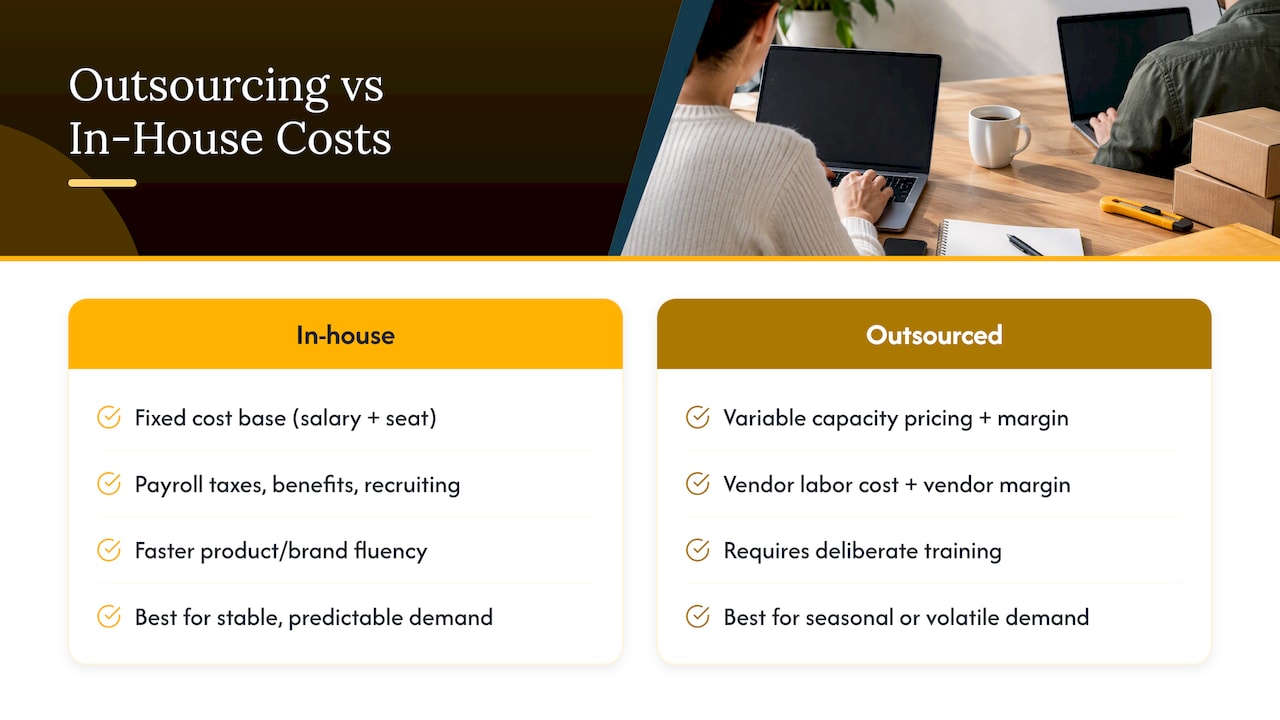
An in-house hire carries costs well beyond salary: payroll taxes, benefits, software licenses, recruiting time, training, and the office space or equipment that seat requires. Median wage data for customer service representatives gives a useful baseline for estimating that fully loaded in-house cost before comparing it against an outsourced quote.
Outsourcing trades that fixed cost structure for a variable one. You pay for capacity as you use it, which is a real advantage when demand swings seasonally, but it also means you’re paying a margin to the vendor on top of their own labor cost. The breakeven point depends almost entirely on volume stability: a brand with flat, predictable demand often does better building a small in-house team, while a brand with sharp seasonal swings usually comes out ahead outsourcing the peaks.
There’s also a quality-control trade-off that doesn’t show up in either column on a spreadsheet. In-house teams absorb your product knowledge and brand voice faster because they’re immersed in it daily. Outsourced teams need deliberate training investment to reach the same fluency, and that investment is part of the true cost of the outsourcing decision, not a one-time startup expense you can ignore after month one.
The honest answer for most ecommerce operators is a hybrid: core, brand-defining functions kept in-house, with variable or specialized functions, like overflow support or seasonal fulfillment, outsourced to absorb the swings an internal team can’t efficiently staff for.
How Volume and Scale Change Your Outsourcing Costs
Volume is the single biggest lever on your effective outsourcing rate, and it cuts in both directions depending on where you sit on the curve. At low volume, minimum monthly commitments dominate the math. A 3PL contract with a $2,000 monthly minimum costs the same whether you ship 50 orders or 500, which means your true per-order cost can be brutal below a certain threshold.
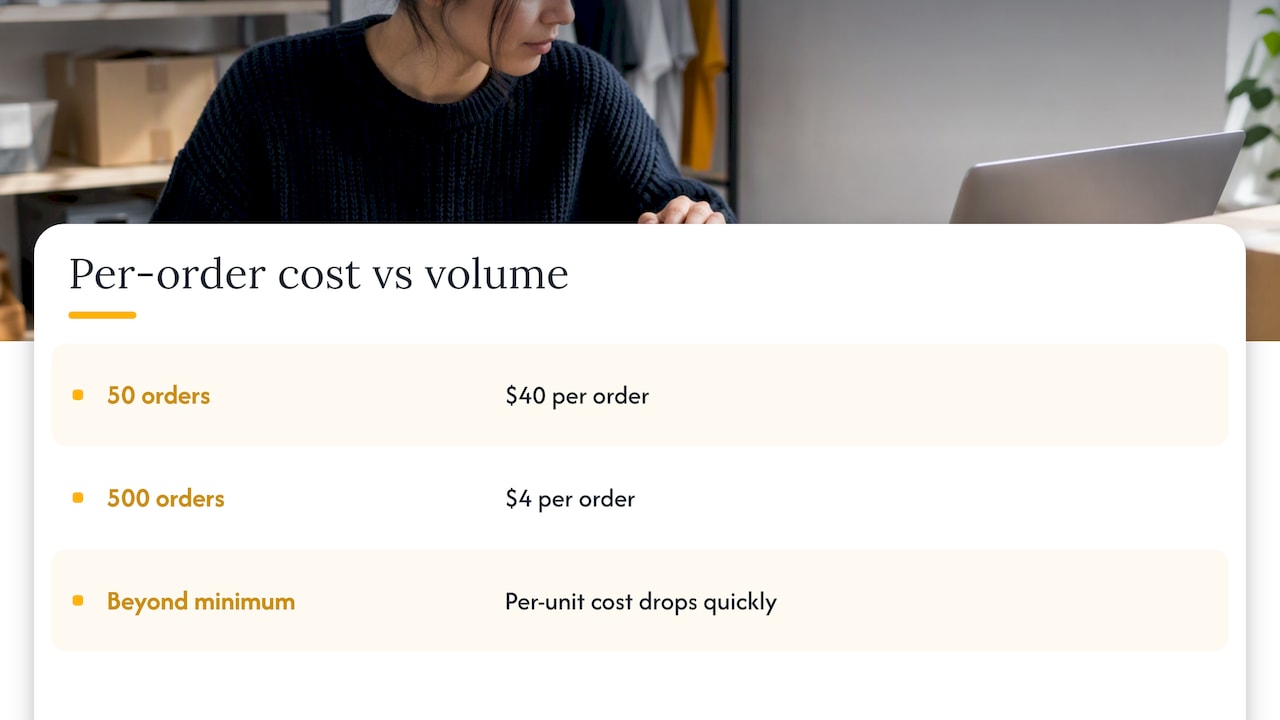
Once volume climbs past that minimum, your per-unit cost drops quickly, and this is where outsourcing starts to look genuinely efficient. Vendors with more volume to work with also gain negotiating room, since a steady, growing order flow gives them the ability to offer tiered discounts that a smaller account never sees.
Scaling up introduces a different kind of cost pressure: capacity. A vendor that handled your brand comfortably at 1,000 orders a month may need weeks of hiring and training to handle 10,000, and that ramp period often comes with a temporary dip in quality or response time. Build that transition cost into your planning before a growth spike hits, not after.
The practical takeaway is to negotiate volume tiers into your contract upfront rather than renegotiating from scratch every time you cross a threshold. A tiered rate structure tied to defined volume bands gives you cost predictability as you scale, instead of a flat rate that either overcharges you early or undercharges the vendor later, straining the relationship.
How Long Onboarding Takes and When You’ll See Results
Most ecommerce outsourcing engagements need somewhere between a few weeks and a couple of months before performance stabilizes, and that ramp period is where a lot of budget assumptions quietly fall apart. The timeline depends heavily on function complexity: a basic email support queue can ramp faster than a technical support role that requires deep product training.
Early weeks typically involve knowledge transfer: documenting your SOPs, training the vendor’s team on your product and brand voice, and setting up the integrations that connect their tools to yours. Expect quality to lag during this window. A reasonable vendor will flag this upfront rather than promising instant parity with an experienced in-house team.
A defined onboarding plan with milestones is the best signal that a vendor has done this before. Look for a written ramp schedule that specifies when training ends, when live performance monitoring begins, and when you’ll see your first full reporting cycle. Vendors who can’t articulate that timeline in specific weeks are often figuring it out as they go, at your expense.
Time-to-value also depends on how well you’ve scoped the engagement before day one. A clearly documented process with existing SOPs ramps faster than one where the vendor has to help you define the process from scratch. If your own documentation is thin, budget extra onboarding time and factor that delay into your first-quarter cost expectations rather than being surprised by it later.
Practical Mistakes to Avoid and Quick Wins
The biggest mistake we see is judging a proposal on its headline hourly rate alone. A cheaper rate that demands more of your management time rarely ends up cheaper. Start narrow: pilot one function with clear, measurable KPIs before expanding scope, so you catch problems while the stakes are still small.
Insist on predictable pricing and a written transition plan before signing anything, not after a problem forces the conversation. A vendor confident in their own performance will welcome that request rather than resist it.
Three mistakes worth naming directly: overweighting the rate card instead of total cost, ignoring onboarding time when budgeting the first quarter, and signing a contract with no defined exit path. Each one is avoidable with a few extra questions before you sign.
— Daniela
How Altiam CX Can Help You Budget for Managed Nearshore Support
If you’re weighing outsourcing against building in-house, a managed nearshore model gives you a middle path: lower cost exposure than a fully built internal team, with more predictability than a loosely coordinated vendor stack. We built Customer Experience and Managed Team Extension around that exact gap, pairing bilingual nearshore talent with structured performance reporting so cost and quality move together instead of trading off against each other.
We tend to be the right fit for ecommerce operators who need scalable support coverage without the overhead of managing multiple point vendors, and who want a defined ramp plan rather than vague promises about timelines. If that describes where you are, take a look at our Customer Experience and Managed Team Extension services to see how an engagement could be scoped for your volume and budget.
FAQ
How much should I pay for an ecommerce website?
Costs vary widely by scope: a project-based rebuild is typically quoted as a fixed fee tied to features and complexity, while ongoing maintenance is usually billed as a monthly retainer instead. Get itemized quotes for the build and the maintenance separately so you can compare vendors on each piece.
How much does it cost to outsource customer support?
Mid-market customer service outsourcing commonly runs $25 to $49 per hour, with basic call-center services sometimes available under $25 per hour and full project engagements often landing between $10,000 and $49,999. The right model, hourly, per-ticket, or dedicated seat, depends on how predictable your ticket volume is.
What are the four types of outsourcing?
The common categories are onshore, nearshore, offshore, and multisourcing, where a business splits work across several vendors or locations at once. Each trades off cost, timezone overlap, and cultural alignment differently, so the right choice depends on your budget and communication needs.
What are the main types of ecommerce?
Ecommerce is generally grouped by who’s transacting with whom: business-to-consumer, business-to-business, consumer-to-consumer, consumer-to-business, business-to-administration, consumer-to-administration, and administration-to-administration. Most outsourced ecommerce support work centers on the business-to-consumer and business-to-business categories, since those involve the highest transaction volume.
What’s a realistic monthly outsourcing budget for a small ecommerce brand?
For a small brand shipping a few hundred orders a month, budget primarily around minimum monthly commitments from support and fulfillment vendors rather than per-unit rates, since minimums tend to dominate costs at low volume. As order volume grows, per-unit costs typically drop and the minimums matter less.
Sources
- What is Business Process Outsourcing? Pros and Cons of BPO (2026) - Shopify
- The 2025 State of Fulfillment Report - Pattern
- Customer Service Representatives (BLS occupational employment statistics)