
Most small and mid-sized businesses pay a range of typical rates for outsourced back-office work, also incurring monthly costs for retained support that vary with function and volume. The number that actually predicts your bill is not the hourly rate advertised on a vendor’s homepage: it is the pricing model and unit of work behind it. Before requesting quotes, understand the models in the next section so you compare apples to apples.
TL;DR:
- Pricing models that align with your workload predict costs better than hourly rates, with per-transaction and per-seat options offering more stability for SMBs.
- Back-office functions like claims processing and legal intake cost more due to compliance needs, requiring trained staff and strict audit controls.
- Monthly support costs range from $1,500 to over $15,000 depending on scope, with fixed project quotes applicable for backlog or system migration tasks.
- You should compare vendor quotes based on consistent units of measure, including all fees, and run a pilot to validate volume and quality expectations before full commitment.
- Outsourcing becomes advantageous once processes are standardized, stable, and internal unit costs are understood, especially when error rates have plateaued despite internal improvements.
Table of Contents
- 1. Which back-office functions get outsourced and why price varies
- 2. Which pricing model fits your volume and quality needs
- 3. What should you expect to pay monthly or per project
- 4. What drives cost up or down and how to negotiate it
- 5. How to collect quotes you can actually compare
- 6. How to calculate ROI against your internal cost
- 7. What belongs in your contract before you sign
- 8. How Altiam CX prices nearshore back-office engagements
- 9. When outsourcing beats fixing the process yourself first
- 10. How to request a pilot or quote from Altiam CX
- FAQ
- Sources
1. Which back-office functions get outsourced and why price varies
Not every back-office task costs the same to hand off. Commodity work, the kind with clear rules and low judgment calls, prices lower because vendors can staff it with generalists and scale it quickly. Specialist or compliance-sensitive work costs more because it demands trained staff, audit trails, and sometimes licensure.
Businesses most commonly outsource:
- Bookkeeping and accounts payable or receivable processing
- Payroll administration and benefits data entry
- General data entry and document digitization
- Insurance or medical claims processing
- Appointment scheduling and client coordination
- HR administrative tasks like onboarding paperwork
- Legal intake and case communication
Bookkeeping and data entry sit at the commodity end: predictable, rules-based, and priced closer to the lower band. Claims processing and legal intake carry a price premium because errors have financial or legal consequences, and vendors need staff who understand the regulatory context, not just the data fields. Healthcare back-office work, including patient support and SOP-driven coordination, tends to cost noticeably more than general administrative tasks due to HIPAA-related training, access controls, and audit requirements that add overhead regardless of volume.
The practical takeaway: when a quote looks unusually cheap, check whether the vendor is pricing for a commodity workflow when your actual process has specialist requirements buried in it. A back-office outsourcing guide that ties labor cost to output quality is worth reviewing before you finalize scope, since the function you pick determines which pricing model will serve you best.
2. Which pricing model fits your volume and quality needs
Vendors typically quote one of four models, and each suits a different kind of business.
Hourly pricing charges for time worked regardless of output. It fits businesses with unpredictable or evolving workloads, like a startup still defining its intake process. Example: 80 hours a month at $18 per hour runs $1,440, but if productivity is low, you may pay for hours that produce less output than expected.
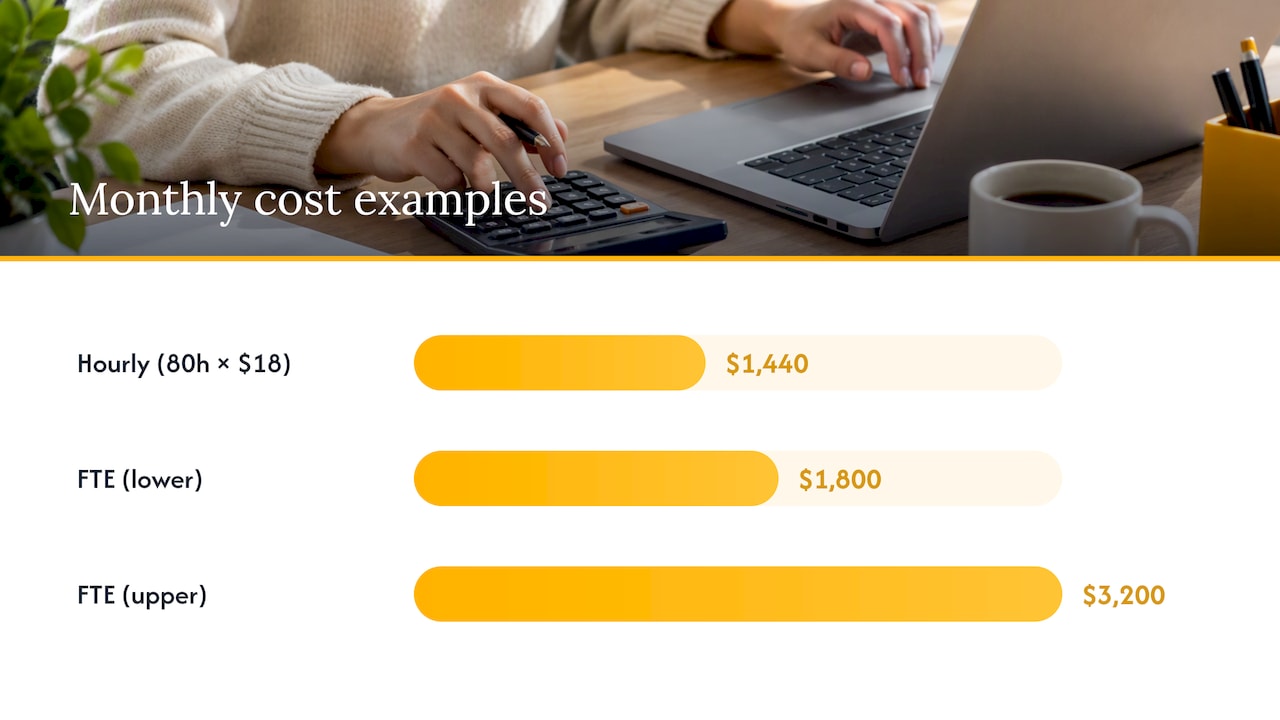
Per-seat or dedicated FTE pricing reserves a full-time or part-time agent exclusively for your account, usually billed monthly. This suits businesses with steady, ongoing volume, such as daily bookkeeping. A dedicated FTE might run $1,800 to $3,200 a month depending on the function and location.
Per-transaction pricing charges per invoice, claim, or record processed. It fits businesses with variable but countable volume, like claims processing. At $1.20 per invoice and 2,000 invoices a month, that is $2,400, scaling directly with activity.
Managed or outcome-based pricing ties fees to results, such as accuracy rates or turnaround time, rather than hours or units alone. It fits businesses that want to transfer quality risk to the vendor.
- Confirm minimum monthly commitments before signing
- Ask whether QA and supervision are included or billed separately
- Clarify whether software or platform fees are itemized apart from labor
For most SMBs, per-transaction or per-seat pricing gives the most predictable monthly budget, since hourly billing can swing with productivity and managed pricing can be harder to benchmark early on.
3. What should you expect to pay monthly or per project
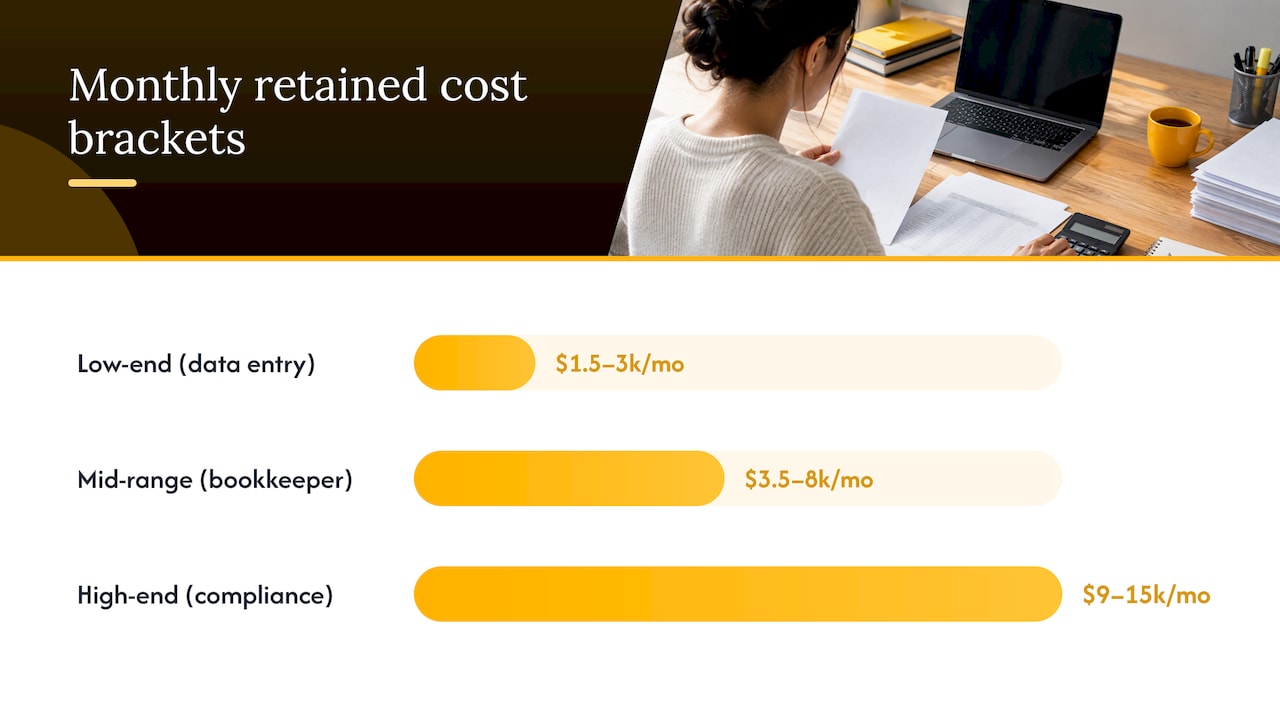
Retained monthly support for a single back-office function typically falls into three brackets. Low-end engagements, often basic data entry or light bookkeeping with a part-time resource, run $1,500 to $3,000 a month. Mid-range engagements, covering a dedicated bookkeeper or a small claims-processing team, run $3,500 to $8,000 a month. High-end engagements, involving compliance-heavy workflows like legal intake or healthcare patient support with supervisory layers, run $9,000 to $15,000 or more a month.
One-off projects, like a data migration or a backlog cleanup, are typically quoted as fixed-fee brackets:
- Small cleanup projects (under 5,000 records): $800 to $2,500
- Medium projects (5,000 to 20,000 records): $2,500 to $7,000
- Large or multi-system projects: $7,000 and up, scoped individually
Converting an hourly quote to a monthly figure matters more than the rate itself. A vendor quoting $15 per hour for 100 hours a month looks cheaper than one quoting $20 per hour for 60 hours, but the first costs $1,500 and the second costs $1,200. Similarly, a per-transaction quote of $0.90 per record at 3,000 records a month runs $2,700, which may beat an hourly arrangement producing the same output more slowly.
Headline hourly rates can mislead when productivity varies: a lower rate paired with slower output or more rework can cost more per finished unit than a higher rate from a faster, more accurate team.
4. What drives cost up or down and how to negotiate it
Four factors move price more than anything else: volume, complexity, service-level requirements, and location. Higher volume usually earns per-unit discounts, since fixed onboarding costs spread across more work. Complex workflows, those with many exception cases or approval steps, cost more because they require senior staff or more QA time. Security and compliance requirements, including HIPAA or financial-data handling, add cost through access controls, training, and audit logging.
Budget for these often-overlooked areas:
- Integration work to connect vendor systems with your software
- Initial training time before the vendor reaches full productivity
- Rework costs when error rates exceed agreed thresholds
- Currency fluctuation if contracts are priced in a foreign currency
Lower wages abroad do not automatically translate into lower total cost. As GAO’s overview of offshoring notes, realized savings depend on productivity, training, infrastructure reliability, and regulatory risk, not the quoted rate alone. A practical framework for cutting back-office costs without sacrificing output quality is a useful companion when weighing these tradeoffs.
Negotiation tactics that work: request tiered pricing that lowers per-unit cost as volume grows, propose a pilot-to-scale structure so rates improve once performance is proven, and build in a mid-term pricing review instead of locking a flat rate for the full contract term.
5. How to collect quotes you can actually compare
Vendor quotes are only useful when they share the same unit of measure. Follow this process to make comparisons fair.
- Define your baseline unit, such as cost per invoice, per case, or per record, since leading sourcing guidance recommends standard units of measure for benchmarking performance across vendors.
- Request the following line items from every vendor: minimum commitment, included QA and supervision, onboarding and SOP setup fees, software or platform charges, overtime premiums, rework rules, and escalation procedures for disputed cases.
- Ask how rate increases are handled in year two and beyond, since many contracts include automatic annual escalation.
- Run a small paid pilot, typically two to four weeks, before committing to a full contract, to validate the vendor’s claims against your actual volume and complexity.
The Clutch back-office pricing guide lists these same categories as standard items to confirm before signing. A checklist for back-office operations can help you gather baseline metrics before you request quotes, so vendors respond with numbers tied to your actual workload instead of generic estimates.
6. How to calculate ROI against your internal cost
Comparing a vendor quote to your current cost starts with knowing your true internal cost per hour, not just wages. BLS data puts average employer costs for employee compensation at $49.46 per hour for civilian workers as of June 2026, with benefits alone adding about $14.07 per hour for private-industry workers. Wages alone understate what an in-house employee actually costs you.
A simple three-step comparison:
- Calculate your current unit cost: total internal labor cost per month divided by units processed (say, $6,000 in loaded labor cost for 3,000 invoices equals $2.00 per invoice).
- Compare that to the vendor’s quoted unit cost, including any onboarding fee amortized over the contract’s first several months.
- Adjust for quality: add expected rework cost based on the vendor’s stated error rate, since a cheaper per-unit price that generates more rework can erase the savings.
Pro Tip: Always compare cost per correct unit, not cost per unit processed. A vendor that is 15% cheaper but has double the error rate can cost you more once rework is factored in.
A step-by-step guide to back-office optimization walks through baselining these numbers before you approach vendors.
7. What belongs in your contract before you sign
A strong contract protects your budget and your ability to course-correct. Before signing, confirm these items are addressed in writing.
- A mid-term repricing clause that lets either party revisit rates if volume or scope shifts significantly.
- SLA remedies, including service credits or penalties if turnaround or accuracy falls below agreed thresholds.
- Staff continuity commitments, since high turnover on the vendor’s side quietly erodes quality.
- Security requirements specific to your industry, documented rather than assumed.
- Clear transition and exit terms, including data handoff timelines if you leave the vendor.
- Holdback or penalty provisions tied to performance metrics during the first 90 days.
Structure your pilot period, typically 30 to 60 days, around three measurable metrics: volume handled, accuracy rate, and turnaround time. Include a renegotiation clause tied to a benchmarking review at the one-year mark, so pricing stays competitive as your volume grows.
8. How Altiam CX prices nearshore back-office engagements
Altiam CX builds pricing conversations around baseline metrics and unit-of-work data rather than a flat hourly number, starting with pilot volumes, accuracy targets, and turnaround expectations before quoting a scaled engagement. The firm positions its nearshore model as a way to combine cost efficiency with consistent output quality across customer experience and back-office roles.
To get a comparable, timely quote, prepare your current volume by function, your target SLA, and any compliance requirements tied to your industry. That groundwork lets a customer support and back-office cost conversation move quickly from scoping to a pilot structure instead of generic rate discussion.
9. When outsourcing beats fixing the process yourself first
Outsourcing makes sense once a function is well-documented, has stable volume, and your internal cost per unit is already known: moving an undefined or chaotic process offshore just scales the chaos. Run a pilot when error rates or turnaround times have plateaued despite internal fixes. Keep pilot scope narrow, one function, one month, so the comparison against your baseline stays clean.
— Daniela
10. How to request a pilot or quote from Altiam CX
If you have baseline metrics in hand, a conversation with Altiam CX can move straight to a pilot structure instead of a lengthy discovery phase. The firm’s nearshore model, built on scalable team deployment, is designed to let operations leaders test real volume and accuracy numbers before committing to a full engagement.

To get a fast, accurate quote, send your current monthly volume by task type, your target SLA, and any industry-specific compliance needs, whether that is healthcare documentation, legal intake, or general administrative support. Altiam CX’s services page outlines current offerings across managed team extension and back-office operations, and is the fastest starting point for scoping a pilot that fits your budget and timeline.
FAQ
What is the average cost of outsourcing back-office work?
Costs vary widely by function and pricing model, typically ranging from $8 per hour or $1,500 to $15,000 a month for retained support, depending on complexity and volume. The Clutch pricing guide outlines these models in detail, and the right comparison point is cost per unit of work, not just the hourly rate.
What are the four types of outsourcing?
Common categories include business process outsourcing (back-office and administrative tasks), IT outsourcing, knowledge process outsourcing for specialized analysis, and manufacturing outsourcing for production. Back-office functions like bookkeeping and claims processing generally fall under business process outsourcing.
Is outsourcing a dying concept?
No. Demand continues for back-office and customer experience functions, though buyers increasingly expect transparent, unit-based pricing and measurable performance rather than flat hourly rates. Automation is changing how some tasks get priced, but complex or compliance-sensitive work still depends on trained staff.
How much does outsourced bookkeeping typically cost?
Outsourced bookkeeping generally falls at the lower end of back-office pricing, often $1,500 to $3,000 a month for a small business with steady transaction volume, since it is a rules-based, commodity-type task. Costs rise with transaction volume, reconciliation complexity, or if specialized reporting is required.
How do I compare a vendor quote to my internal cost?
Calculate your fully loaded internal cost per hour, including benefits and overhead using BLS employer-cost data as a reference point, then divide by units processed to get your internal unit cost. Compare that figure to the vendor’s quoted unit cost, adjusted for onboarding fees and expected rework.
Sources
- GAO-06-5, Offshoring of Services: An Overview of the Issues
- Back Office Outsourcing Pricing Guide 2026
- Employer Costs for Employee Compensation (BLS)