
Yes, financial institutions can outsource GLBA-related functions, but accountability for GLBA compliance never leaves the institution. You must demonstrate that oversight through documented vendor due diligence, a written information security program, and a designated Qualified Individual who reports to your board.
TL;DR:
- Outsourcing GLBA-related functions requires documented oversight, including vendor due diligence, written security programs, and regular reporting to your board.
- The Safeguards Rule mandates a comprehensive written information security program and a designated Qualified Individual who oversees compliance and reports to the board.
- You can delegate operational tasks like monitoring and documentation support, but regulatory accountability for compliance remains your institution’s responsibility.
- Contract language must specify explicit security controls and breach notification timelines, avoiding vague confidentiality promises that regulators won’t accept.
- Ongoing vendor monitoring should include regular review of audit reports, incident notifications, and risk assessments to maintain exam compliance and identify potential security gaps.
Table of Contents
- What GLBA Covers and Why It Matters for Outsourcing Decisions
- Can You Outsource GLBA Compliance Tasks?
- Regulatory Must-Haves You Cannot Delegate Away
- Vendor Selection and Contracting: What to Require and Why
- Ongoing Monitoring That Satisfies Examiners
- A Step-by-Step Checklist for Outsourcing Safely
- Where Managed Operational Partners Fit Into This Picture
- What the Compliance Playbook Usually Gets Wrong
- A Managed Partner Option for the Operational Side of GLBA Work
- FAQ
- Sources
What GLBA Covers and Why It Matters for Outsourcing Decisions
The Gramm-Leach-Bliley Act rests on three pillars: the Privacy Rule, the Safeguards Rule, and the pretexting protections. The Privacy Rule governs how you disclose nonpublic personal information to third parties and what notices customers receive. The pretexting provisions prohibit obtaining customer information through false pretenses, which matters when vendors handle customer-facing verification or support.
The Safeguards Rule carries the heaviest weight for outsourcing decisions. It requires covered financial institutions to maintain a written information security program with administrative, technical, and physical safeguards, and it requires you to designate a Qualified Individual who reports directly to your board or governing body. That program has to address employee training, access controls, encryption, incident response, and vendor oversight specifically.
Regulators apply these obligations primarily to the institution, not the vendor, with one notable exception covered later in this piece. The FTC enforces the Safeguards Rule for most nonbank financial institutions, while banking regulators apply parallel expectations through examination procedures. Either way, the paper trail you keep about vendor selection, contract terms, and monitoring becomes the evidence examiners use to judge whether your program meets the standard. Outsourcing a task does not outsource that evidence requirement.
Can You Outsource GLBA Compliance Tasks?
You can outsource plenty of the operational work tied to GLBA compliance. Monitoring functions, vendor due diligence support, managed security services, call center processing of customer data, and documentation assembly are all commonly handled by outside partners. What you cannot outsource is the regulatory accountability for whether those tasks were done correctly.
The FFIEC’s guidance on outsourcing technology services states this plainly: outsourcing does not reduce your institution’s risk profile, it changes how that risk gets managed. Your institution still owns the outcome. A vendor that mishandles customer data under a service agreement creates a GLBA problem for you, not just for them.
There is one exception worth knowing. Some third parties qualify as “financial institutions” under GLBA in their own right, depending on how deeply they are engaged in financial activities. When a provider is significantly engaged in financial services, it can become directly subject to GLBA obligations rather than acting purely as your downstream vendor. That distinction rarely applies to general back-office or customer support partners, but it is worth confirming during due diligence.
Regulatory Must-Haves You Cannot Delegate Away
A handful of requirements sit squarely with your institution, regardless of who performs the underlying work.
Your written information security program has to be written, reviewed by your board, and kept current. The Safeguards Rule requires a designated Qualified Individual who oversees the program and reports to the board, even when vendors execute much of the daily work. That person needs to understand vendor performance well enough to explain it to your governing body, which means vendor reporting has to be built for human review, not just automated dashboards.
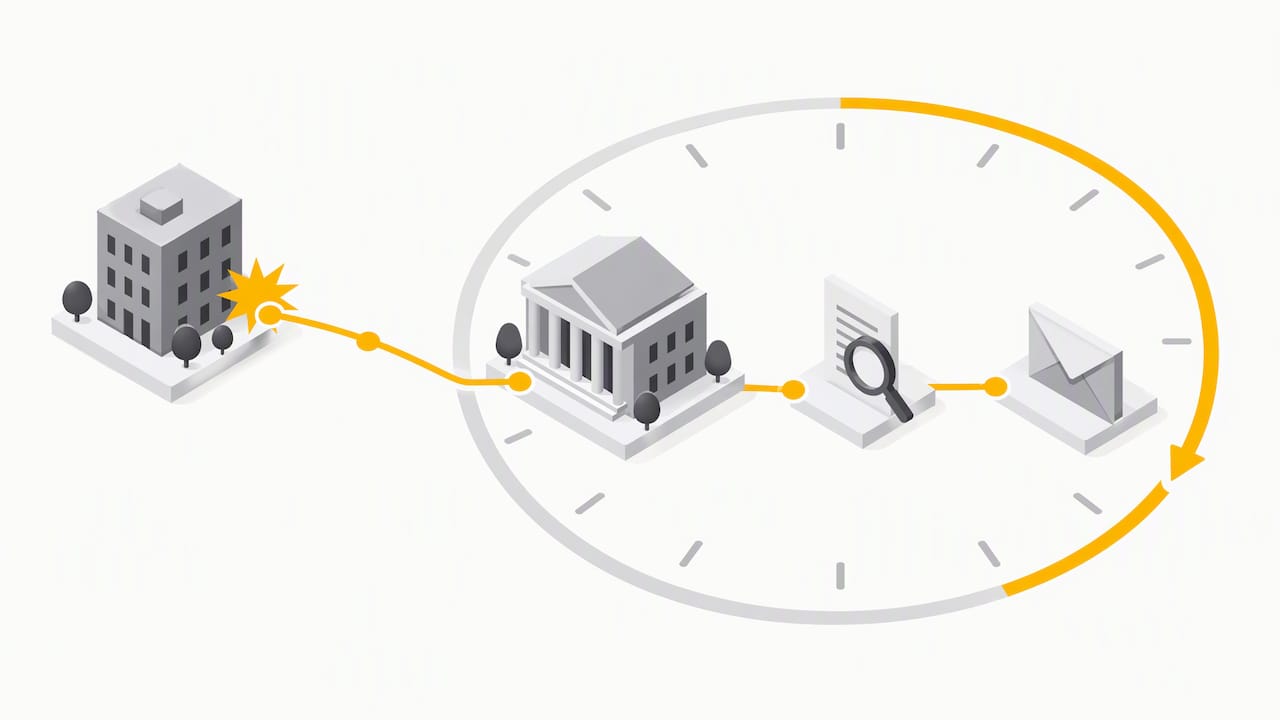
Breach notification timing is non-negotiable. Under the amended Safeguards Rule, a notification event affecting 500 or more consumers, or one where encryption keys were also compromised, has to be reported to the FTC as soon as possible and no later than 30 days after discovery. These notification requirements took effect in May 2024, and they apply regardless of whether the breach originated inside your institution or at a vendor processing your data. If your vendor discovers an incident, your clock is already running.
Examiners also look for contract language that goes beyond generic confidentiality promises. The Safeguards Rule’s contracting expectations, along with FFIEC exam procedures, call for specific references to the safeguards a vendor must maintain, not vague assurances of “reasonable care.” A common finding during exams is a contract that promises confidentiality but says nothing about encryption standards, access controls, or audit rights.
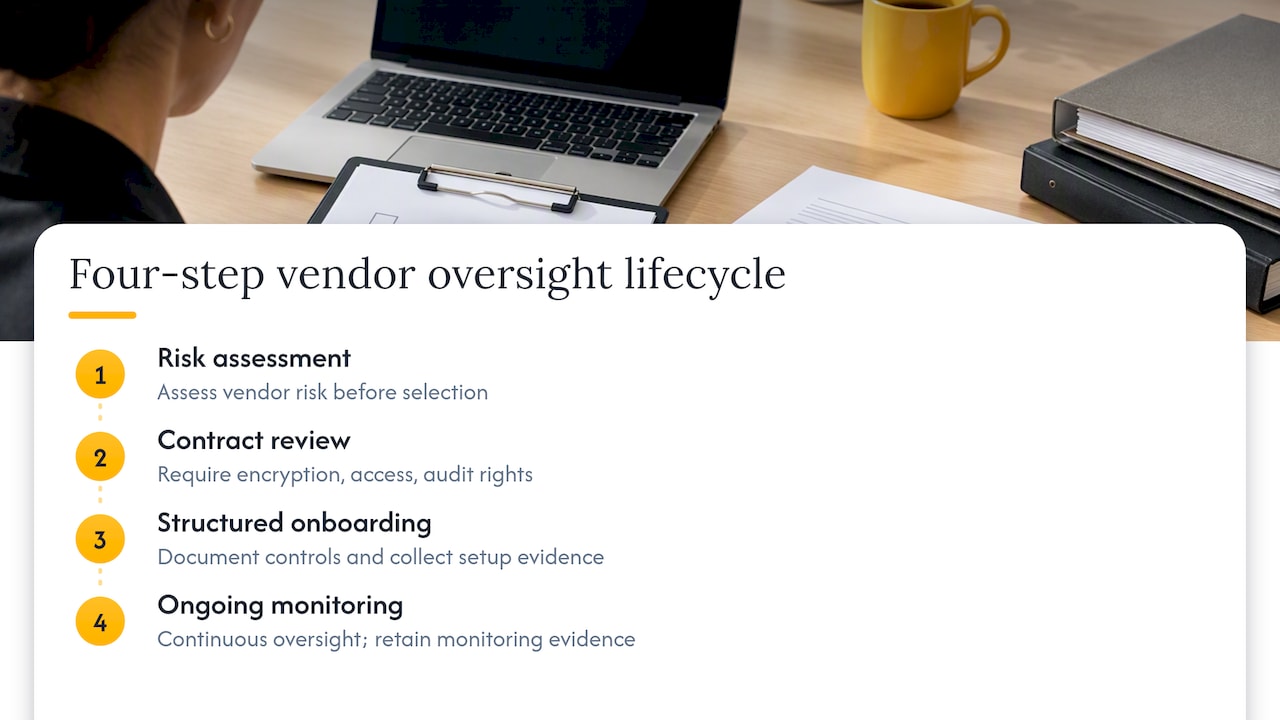
Federal examiners evaluate outsourced relationships by checking for a repeatable lifecycle: risk assessment before selection, contract review that documents security specifics, structured onboarding, and ongoing monitoring with evidence on file. If any stage is missing paperwork, that gap becomes the finding, even if the vendor itself performed well.
Vendor Selection and Contracting: What to Require and Why
Start by ranking prospective vendors by criticality, meaning how much damage a failure on their end could cause your institution and your customers. A vendor processing full account records carries different risk than one handling general inquiry routing, and your diligence should scale accordingly.
During due diligence, request:
- SOC 2 Type II reports or equivalent independent audit evidence covering the relevant period
- Recent penetration test results and remediation status
- A description of subcontractors and where customer data physically resides
- A documented incident response plan with defined notification timelines
- Evidence of financial stability sufficient to sustain the relationship
Contracts should specify permitted uses of customer data, the exact security controls the vendor must maintain, breach notification timing that aligns with your own 30-day obligation, your right to audit, and requirements for data return or destruction at contract end. Choice of law and regulatory access provisions matter too, particularly if any part of the vendor’s operation sits outside direct examiner reach.
The most common examination finding in this area is a contract that relies on broad confidentiality language instead of explicit security requirements. “Vendor will protect customer information” tells an examiner nothing. “Vendor will encrypt data at rest using AES-256 and provide quarterly SOC 2 attestations” tells them something they can verify.
Pro Tip: Score “regulatory exposure” as its own dimension during vendor ranking. A vendor serving other regulated clients, or moving data across borders, can create risk for you that has nothing to do with its day-to-day service quality.
Ongoing Monitoring That Satisfies Examiners
Signing a strong contract is only the starting point. Ongoing monitoring is where most institutions either build a defensible record or quietly fall behind.
- Track service level agreements and key performance indicators tied to security and data handling, not just service speed.
- Review audit reports and penetration test results on a schedule matched to vendor risk level.
- Require prompt notification of material changes, including subcontractor additions or infrastructure shifts.
- Check vendor financial health periodically, since financial distress often precedes service or security failures.
- Rank vendors by residual risk so your highest-exposure relationships get the closest attention.
Higher-risk vendors warrant quarterly reviews; lower-risk ones might only need annual checks. Combine periodic human review of SOC 2 and penetration test evidence with continuous telemetry where your vendor’s systems support it.
Examiners expect your file to show dates, names, and outcomes: when you last reviewed the vendor’s SOC report, who reviewed it, and what you did when you found a gap. A file that only contains the original contract tells examiners oversight stopped the day the ink dried.
A Step-by-Step Checklist for Outsourcing Safely
Before you sign anything, map exactly where nonpublic personal information will flow through the vendor’s systems and classify the vendor’s criticality based on that exposure. Request SOC reports and security policies before, not after, you select a finalist.
- Pre-engagement: Map data flows, assess criticality, and collect evidence from at least two candidates.
- Contracting: Insert explicit security obligations, breach notification timing, audit rights, and remediation SLAs.
- Onboarding: Configure least-privilege access, confirm encryption at rest and in transit, and test incident response communication between your team and theirs.
- Ongoing operation: Schedule periodic reviews, collect audit reports on schedule, run tabletop exercises, and update your WISP and board reporting to reflect the relationship.
A few habits separate institutions that pass exams smoothly from those that scramble:
- Never grant broader system access than the specific task requires.
- Document every review, not just the ones that surface a problem.
- Treat the WISP as a living document the vendor relationship feeds, not a file you update once a year.
Where Managed Operational Partners Fit Into This Picture
A nearshore managed services partner can take real weight off your compliance team’s shoulders. Teams built around managed team extension and back-office operations can staff monitoring functions, handle incident-response communications with customers, and assemble the audit evidence your Qualified Individual needs for the board, all without touching who owns the WISP.
The value shows up in capacity, not in shifting legal responsibility. A vendor supporting GLBA-adjacent work should hand you reporting built for board consumption: dated reviews, named reviewers, and clear outcomes you can fold into your own documentation. What you require from any managed partner stays consistent: current SOC evidence, a defined reporting cadence, and a direct line between their incident process and yours.
What the Compliance Playbook Usually Gets Wrong
Most outsourcing guidance treats vendor contracts as the finish line. In practice, the contract is the easy part. The failure mode we see most often is institutions that sign strong agreements and then stop paying attention, assuming the paperwork itself satisfies the regulator.
It does not. Examiners care about the living record: whether you actually reviewed that SOC 2 report, whether your Qualified Individual can explain a vendor’s security posture off the top of their head, whether your WISP reflects the vendor relationship as it exists today rather than as it was sketched during contracting.
The conventional advice also overstates how much outsourcing reduces your workload. It redistributes work, from doing the task to verifying the task was done well. If your compliance team treats vendor oversight as a lighter lift than the original work, you will find that out during an exam, not before one.
Prioritize building a monitoring rhythm before you prioritize finding the cheapest or fastest vendor. A mediocre vendor with airtight oversight is a safer bet than a great vendor with no documented review process behind it.
— Daniela
A Managed Partner Option for the Operational Side of GLBA Work
We built our nearshore teams around exactly the kind of operational load compliance officers are trying to offload responsibly: staffing for ongoing monitoring, handling customer-facing incident communications, and producing the documentation your Qualified Individual needs for board reporting.

When you evaluate us as part of your vendor selection, ask the same questions you would ask any provider: what audit evidence we can produce, how our reporting cadence lines up with your review schedule, and how our incident process hands off to yours. Our managed team extension and customer experience services are built to plug into that structure rather than replace it.
What we support includes staffing for routine monitoring and documentation tasks tied to vendor oversight, customer-facing incident response communication during a notification event, and audit-ready reporting formatted for board and Qualified Individual review.
Your institution keeps regulatory ownership of the WISP and the compliance outcome, full stop. We support the delivery and the evidence trail behind it. If you want to see how this looks in a regulated services context, our legal services back-office work shows the kind of operational support we bring to compliance-sensitive engagements.
FAQ
Is GLBA still in effect?
Yes, the Gramm-Leach-Bliley Act remains fully in effect, and the Safeguards Rule was substantially updated with new breach notification requirements that took effect in 2024. Financial institutions are still required to maintain a written information security program and a designated Qualified Individual.
Who is required to comply with GLBA?
GLBA applies to financial institutions as defined by the FTC, including many nonbank businesses that handle consumer financial data. In some cases, a third-party vendor can itself become subject to GLBA if it is significantly engaged in financial activities, not just acting as a processor for a covered institution.
What are the three main rules of GLBA?
GLBA centers on the Privacy Rule, which governs disclosure of nonpublic personal information, the Safeguards Rule, which requires a written security program with administrative, technical, and physical safeguards, and pretexting provisions that prohibit obtaining customer data through deceptive means. The Safeguards Rule carries the most weight for outsourcing decisions.
Which agency enforces GLBA?
The FTC enforces the Safeguards Rule for most nonbank financial institutions, while federal banking regulators apply parallel expectations to banks and credit unions through their own examination procedures. Both rely on similar standards around written programs, vendor oversight, and breach notification timing.
Does outsourcing change my breach notification deadline?
No, the 30-day notification deadline for incidents affecting 500 or more consumers applies regardless of whether the breach happened inside your institution or at a vendor. Your institution remains responsible for meeting that deadline even when a vendor discovers the incident first.
Sources
- FTC Safeguards Rule: What Your Business Needs to Know
- FFIEC IT Examination Handbook: Outsourcing Technology Services — Introduction
- How the Gramm-Leach-Bliley Act reaches third-party service providers