
Most outsourced customer support typically runs from low to mid tens of dollars per hour all-in, or a few thousand to several thousand dollars per agent per month depending on region and skill level. That headline rate is only the starting point: onboarding, quality assurance, technology fees, and after-hours premiums typically push total cost of ownership 15% to 40% higher than the quoted number. The models, benchmarks, and negotiation tactics below show you how to price a contract that actually holds up once you see the first invoice.
TL;DR:
- Per-hour rates vary from $11 to $45 depending on region and skill level, with total costs increasing 15 to 40 percent due to additional fees.
- Offshore support typically costs $1,300 to $3,000 per agent monthly, nearshore $2,200 to $4,500, and onshore $5,500 to $12,000, depending on quality and location.
- Complex technical support and higher SLAs significantly increase costs, especially for specialized, multilingual, or 24/7 coverage.
- Automated deflection and blended staffing strategies can reduce overall support costs by up to 60 percent while maintaining quality.
- Currency fluctuations can impact offshore costs unless rates are locked in USD, and transparent, bundled pricing generally results in lower total expenses.
Table of Contents
- What Does Customer Support Outsourcing Cost? Pricing Models Explained
- How Much Do Offshore, Nearshore, and Onshore Support Teams Cost?
- What Drives the Cost of Outsourced Customer Support?
- Real-World Cost Scenarios: What Outsourcing Actually Costs by Company Size
- How to Choose a Pricing Model and Negotiate Your Contract
- Practical Ways to Lower Your Customer Support Outsourcing Cost
- Budgeting Timeline: When Costs Hit Your Books
- How Currency Fluctuations Affect International Outsourcing Costs
- Why Transparent, Bundled Pricing Actually Lowers Your Total Cost
- Get a Transparent Cost Estimate for Your Support Operation
- Sources
What Does Customer Support Outsourcing Cost? Pricing Models Explained
Every outsourcing quote you receive boils down to one of six pricing structures, and the model a vendor pushes usually says more about their business than about what fits your volume. Converting each one into a comparable monthly figure is the only way to shop quotes honestly.
- Per-hour pricing. You pay a flat rate per agent hour, varying widely depending on geography and skill level. This is the most common structure for teams with steady, predictable ticket volume, since it’s easy to budget and easy to audit.
- Per-minute pricing. Billing ties directly to talk time or handle time. U.S. and Canada onshore rates for live agents commonly run $0.75 to $1.25 per minute, while AI-handled minutes drop to $0.06 to $0.15. This model rewards efficient call handling but can punish you on complex, slow-resolving tickets.
- Per-call or per-resolution pricing. You pay for each contact resolved, often $5 to $12 per call, with some vendors offering pay-per-resolution models averaging closer to $4 per resolution. This works well for transactional, short-cycle support like order status or password resets, and poorly for anything requiring multiple touches.
- Per-agent monthly (dedicated FTE). You pay a flat monthly fee per dedicated agent, generally $1,500 to $2,900 offshore and considerably more onshore. Dedicated staffing gives you consistency and product knowledge that shared-pool models can’t match.
- Performance-based or outcome pricing. Fees tie to resolved tickets, CSAT scores, or first-contact resolution rates instead of hours worked. This shifts risk toward the vendor, but it only works when both sides agree on clean, auditable metrics up front.
- Hybrid models. Most mature contracts blend a base per-agent or per-hour rate with performance bonuses or penalties layered on top, giving you predictability with an incentive structure attached.
When you’re comparing across models, do the math the same way every time: multiply hourly rates by projected monthly hours, and divide monthly FTE rates by expected ticket volume to get a comparable cost-per-contact. Watch for minimums (many vendors require a baseline monthly commitment regardless of volume) and overage fees that kick in once you exceed contracted hours. A quote that looks 20% cheaper on the surface can end up costing more once minimums and overages are factored in.
How Much Do Offshore, Nearshore, and Onshore Support Teams Cost?
Geography remains the single biggest lever on price, and the spread between regions is wide enough to change your entire staffing strategy. Here’s how the major regions stack up on hourly rates and typical monthly per-agent costs.
| Region | Hourly Range | Sample Monthly FTE Cost |
|---|---|---|
| Offshore (Philippines, India) | $11–$18/hr | $1,300–$3,000 |
| Nearshore (Latin America) | $18–$28/hr | $2,200–$4,500 |
| Onshore (U.S., Canada) | $35–$45/hr | $5,500–$12,000 |
These figures aren’t precise, and the overlap between bands is real. A highly skilled bilingual agent handling technical support in a nearshore market like Colombia or Mexico can command rates that creep into onshore territory, while a junior offshore hire doing basic tier-one triage sits at the floor of that range. What pushes a provider toward the top of its band is almost always skill level, language capability, and specialization, not just location on a map. Bilingual agents fluent in English and Spanish, for instance, routinely earn a premium over monolingual counterparts because they let you serve two markets from one headcount.
Blended staffing is the most practical way to control cost without sacrificing quality. Pairing offshore agents for high-volume, low-complexity tier-one work with nearshore or onshore staff for escalations and technical issues tends to deliver the best balance of cost and customer experience for North American brands. If your support volume spikes during U.S. business hours, nearshore Latin American teams offer a real advantage: overlapping time zones mean no after-hours premium, and cultural alignment with American customers tends to be stronger than with offshore alternatives half a world away.
What Drives the Cost of Outsourced Customer Support?
The rate a vendor quotes you is a function of a dozen or so variables, and understanding which ones you control changes how you negotiate. Complexity is the biggest multiplier: a tier-one agent answering “where’s my order” questions costs far less per hour than a tier-two technical specialist who needs to be trained on your product, your CRM, and often your industry’s compliance requirements. Tiered technical support structures, in particular, carry a meaningful premium over basic customer service because they demand longer ramp-up and lower agent-to-supervisor ratios.
Channel mix matters just as much. Voice support is generally the most expensive channel per contact because it’s synchronous and can’t be batched, while email and asynchronous chat let one agent handle multiple conversations at once, lowering effective cost per resolution. Social media support sits somewhere in between, often requiring specialized training on brand voice and public-facing tone that pushes per-hour rates up slightly.
Beyond the obvious line items, a handful of cost drivers rarely show up on the first quote:
- Language requirements. Multilingual or bilingual staffing commands a premium, often 10% to 20% over monolingual rates.
- Service level agreements. Tighter SLAs (faster response times, higher first-contact resolution targets) require more supervisors and more redundant staffing.
- Hours of coverage. 24/7 support costs meaningfully more than business-hours-only coverage due to overnight and weekend shift premiums.
- Training and ramp-up. New agent cohorts typically need two to six weeks of paid training before they’re fully productive.
- Technology and integrations. CRM licensing, telephony platforms, and QA software are sometimes bundled and sometimes billed separately.
- Attrition-driven replacement costs. High-turnover vendors pass the cost of constant retraining back to you in the form of inconsistent service quality and recurring ramp-up fees.
Pro Tip: Ask every vendor for a sample invoice before you sign anything. Vendors who show you a clean, itemized invoice up front, broken out by base rate, technology fee, and management overhead, are almost always more transparent partners than ones who quote a single bundled number and won’t break it down.
Real-World Cost Scenarios: What Outsourcing Actually Costs by Company Size
Numbers in the abstract don’t help you budget. Here’s how the math plays out across three common company profiles.
- Startup, shared-agent model. A startup handling 2,000 tickets per month through a shared offshore pool at $14/hour, roughly 300 agent hours monthly, lands around $4,200 per month before technology fees. Add a modest $300 to $500 monthly platform fee and you’re looking at an annual TCO near $54,000 to $56,400, assuming no ramp-up premium since shared pools skip dedicated onboarding.
- Mid-market, dedicated agents (20 to 50 seats). A mid-market operation with 30 dedicated nearshore agents at $2,400 per agent monthly runs a base of $72,000 per month. Layer in a management fee (commonly 10% to 15% of base), quality assurance staffing, technology licensing, and an after-hours premium for weekend coverage, and realistic monthly TCO lands closer to $85,000 to $92,000, or roughly $1.02 to $1.1 million annually.
- Enterprise, blended staffing (200+ seats). A 250-seat enterprise deployment blending offshore tier-one (150 seats at $1,700/month) with nearshore tier-two escalations (100 seats at $2,800/month) totals a base of $535,000 monthly. Volume tier discounts at this scale commonly shave 8% to 15% off the base rate, and automation deflecting routine tier-one contacts can cut required headcount further, since automated minutes cost a fraction of live-agent minutes.
Across all three scenarios, the pattern holds: headline rates undersell the real number. Clutch’s benchmarking data puts average project-based engagements between $10,000 and $49,999, but that range reflects base service fees only, before the management, tech, and QA layers that show up on the actual invoice.
How to Choose a Pricing Model and Negotiate Your Contract
Selecting a vendor and negotiating the contract terms are really the same exercise, since every selection criterion doubles as a point of leverage at the negotiating table. Start with the fundamentals: does the vendor have documented SLAs with penalty clauses attached, a defined QA methodology (not just “we monitor calls”), a real workforce management function, and security certifications appropriate to your industry, especially critical if you’re in healthcare or legal services where compliance failures carry regulatory risk.
Once you’ve narrowed your shortlist, the contract itself is where most of the real savings or overruns get locked in. Build your negotiation around this checklist:
- Minimums and volume commitments. Understand what you’re locked into paying even if volume drops below projections.
- Tiered pricing thresholds. Ask exactly what volume triggers a lower per-unit rate, and get it in writing.
- Ramp-up fee structure. Some vendors waive ramp-up costs for contracts above a certain size, but only if you ask.
- Included versus billed technology. Clarify which platforms are bundled into the base rate and which are pass-through costs.
- Termination clauses. Know your exit timeline and any penalties before you need them.
- Performance credits. Negotiate service credits for missed SLAs rather than accepting a flat “we’ll do better next month.”
Pro Tip: During vendor interviews, ask directly: “Walk me through your last invoice to a client my size.” A vendor who hesitates or gives you a vague answer is telling you something important about how they’ll bill you later. Reviewing a detailed outsourcing checklist before your first vendor call helps you catch missing line items before you’re locked into a contract.
Practical Ways to Lower Your Customer Support Outsourcing Cost
Cutting cost without gutting service quality comes down to a handful of proven levers, not a single silver bullet. Blended staffing remains the most reliable one: routing simple tier-one contacts to lower-cost offshore agents while reserving nearshore or onshore staff for escalations and technical issues cuts your blended rate substantially while keeping complex cases in skilled hands.

Automation is the second biggest lever. Deflecting routine, repetitive contacts, password resets, order status checks, basic FAQs, to a bot or self-service flow before they ever reach a human agent can reduce routine ticket volume by 30% to 60% depending on your use case, freeing human agents for higher-value work.
Beyond staffing and automation, a few contract-level tactics compound over time:
- Negotiate volume tiers up front so your per-unit cost drops automatically as you scale, rather than renegotiating every quarter.
- Bundle adjacent services (technical support plus back-office processing, for example) with one vendor to reduce management overhead.
- Push for outcome-based incentives on metrics you actually care about, like first-contact resolution, instead of paying flat rates regardless of quality.
- Ask about vendor-run workforce optimization programs that reduce attrition, since lower turnover means fewer retraining cycles billed back to you.
Budgeting Timeline: When Costs Hit Your Books
Outsourcing contracts rarely bill you a flat monthly number from day one, and building your budget around that assumption is one of the most common planning mistakes decision-makers make. The typical timeline runs in four phases. Weeks one through four cover contracting and setup, where you’ll often pay a one-time onboarding or implementation fee covering technology integration and initial hiring. Weeks four through eight are the ramp-up period, when new agent cohorts train on your product and processes; many vendors bill training hours at a reduced rate during this window, but a smaller group charge full rate from day one, so confirm this before signing.
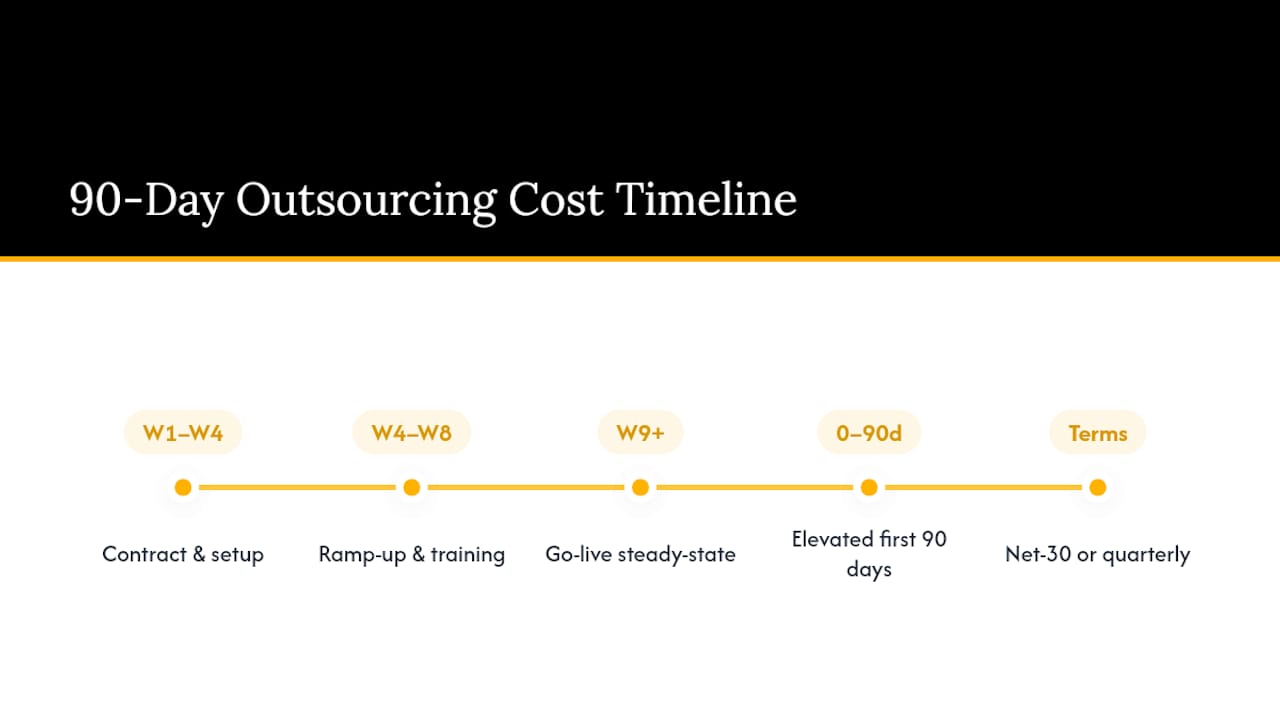
Once agents go live, you enter steady-state billing, typically monthly in arrears based on actual hours or seats staffed, though some vendors require a portion paid in advance. Build your first 90 days into your budget as a period of elevated cost relative to your steady-state run rate. Between onboarding fees and reduced initial productivity during ramp-up, your effective cost per resolved ticket in month one can run noticeably higher than it will by month four once agents hit full proficiency.
Payment cycles themselves vary by contract size: smaller engagements often bill monthly net-30, while enterprise contracts sometimes negotiate quarterly true-ups against actual volume, with adjustments credited or billed the following quarter. Building a 90-day cash buffer into your outsourcing budget, rather than assuming immediate steady-state costs, prevents an unpleasant surprise on your first two invoices.
How Currency Fluctuations Affect International Outsourcing Costs
When your vendor operates in a different currency than the one you’re budgeting in, exchange rate movement becomes a real, if often overlooked, cost variable. Most nearshore and offshore contracts are quoted and billed in U.S. dollars specifically to insulate American buyers from this risk, but not every vendor structures it that way, and it’s worth confirming explicitly before signing.
If your contract is denominated in the vendor’s local currency, a weakening dollar can quietly inflate your effective cost per agent month over month, even though the underlying rate never changed on paper. Conversely, a strengthening dollar works in your favor, but relying on favorable currency swings as part of your cost strategy is not a plan, it’s a gamble. Ask vendors directly whether pricing is USD-denominated and locked for the contract term, or whether it’s indexed to local currency with periodic adjustments. Contracts with nearshore Latin American providers, in particular, sometimes include a currency adjustment clause tied to significant devaluation events, since several regional currencies have experienced meaningful volatility in past cycles. If your vendor’s home currency is prone to swings, negotiate a cap on how much a currency adjustment can move your rate within a given quarter, and get that cap written into the contract rather than treated as a verbal understanding. Locking your rate in U.S. dollars remains the simplest way to keep your budget predictable across a multi-year engagement.
Why Transparent, Bundled Pricing Actually Lowers Your Total Cost
The vendors who quote you the lowest hourly rate are frequently the ones who cost you the most by month six, once ramp-up fees, technology add-ons, and management surcharges show up as separate line items you didn’t budget for. Bundled pricing that folds QA, workforce management, and technology into one predictable rate isn’t just easier to administer. It removes the incentive for a vendor to nickel-and-dime you on the categories that don’t show up in the sales pitch.
At Altiam CX, pricing is built around measurable outcomes rather than a headline number designed to win the first comparison. That philosophy exists because TCO surprises erode trust faster than almost anything else in an outsourcing relationship, and a partner who hides costs in the fine print rarely turns out to be a good long-term fit.
— Daniela
Get a Transparent Cost Estimate for Your Support Operation
Altiam CX builds nearshore managed teams around bundled, predictable pricing, so the rate you’re quoted is closer to the rate you actually pay. That means fewer surprise line items for technology, QA, or after-hours coverage, and a clearer path to comparing our number against any other vendor’s quote.
Our teams cover bilingual customer care, technical support, and back-office operations for healthcare, legal, ecommerce, and financial services organizations, with scalable staffing that adjusts as your volume shifts. One software platform client saw an 89% productivity improvement after migrating technical support to Altiam CX, a result of the same bundled, outcome-driven pricing model outlined above. If you’re evaluating vendors right now, request a pilot program or a detailed cost estimate from Altiam CX and compare it, line item by line item, against your current quotes.
Sources
- Customer support outsourcing pricing — Clutch
- Call Center Pricing Models: A 2026 Decision Framework
- You Price a Call Center in 2026 | Instadesk
- How Much Does BPO Cost? Pricing by Country and Service | HiveDesk