TL;DR:
- Nearshore managed partners that combine API-first automation with human oversight deliver faster ROI, better compliance, and more resilience. Operations leaders should prioritize this approach over software-only solutions and focus on clear KPIs, technical requirements, and trusted vendors to ensure successful scaling.
Operations leaders evaluating automated back-office solutions should prioritize nearshore managed partners that combine API-first automation platforms with human-in-the-loop oversight. That combination delivers faster ROI, stronger compliance, and resilience that pure software deployments rarely match on their own. Here is why this approach wins:
- ROI velocity: Managed nearshore teams activate faster than internal CoE builds, compressing time-to-value from quarters to weeks.
- Operational resilience: Human-in-the-loop controls catch exceptions that brittle bots miss, protecting accuracy on complex tasks.
- Compliance coverage: Bilingual, culturally aligned teams support audit-ready documentation and regulatory adherence across U.S. operations.
- Time to value: Pilots can go live within a few weeks when a managed partner handles staffing, tooling, and integration simultaneously.
Ready to evaluate a managed nearshore partner? Contact Altiamcx to request a discovery call or pilot proposal.
Table of Contents
- Which strategy fits your operating model: best-of-tower vs. single-platform?
- What technical criteria should you require from any platform?
- What operational criteria separate reliable nearshore partners?
- How do you move from pilot to full-scale deployment?
- Altiamcx delivers managed nearshore back-office operations built for scale
- Key Takeaways
- The procurement mistake most operations leaders make
- Take the next step with Altiamcx
- Useful sources and further reading
Which strategy fits your operating model: best-of-tower vs. single-platform?
The primary decision in any back-office automation solutions comparison is not which software to buy. It is whether your operating model gains more from deep automation in one function or broad, standardized coverage across multiple towers.
Best-of-tower concentrates automation depth in a single process area, such as accounts payable, order management, or HR onboarding. It fits organizations with high transaction volume in one function, mature Center of Excellence (CoE) governance, and existing ERP investments they want to extend. An AP-heavy GBS operation, for example, benefits from purpose-built intelligent document processing that handles format variation without template maintenance, rather than a general-purpose workflow tool stretched beyond its design.
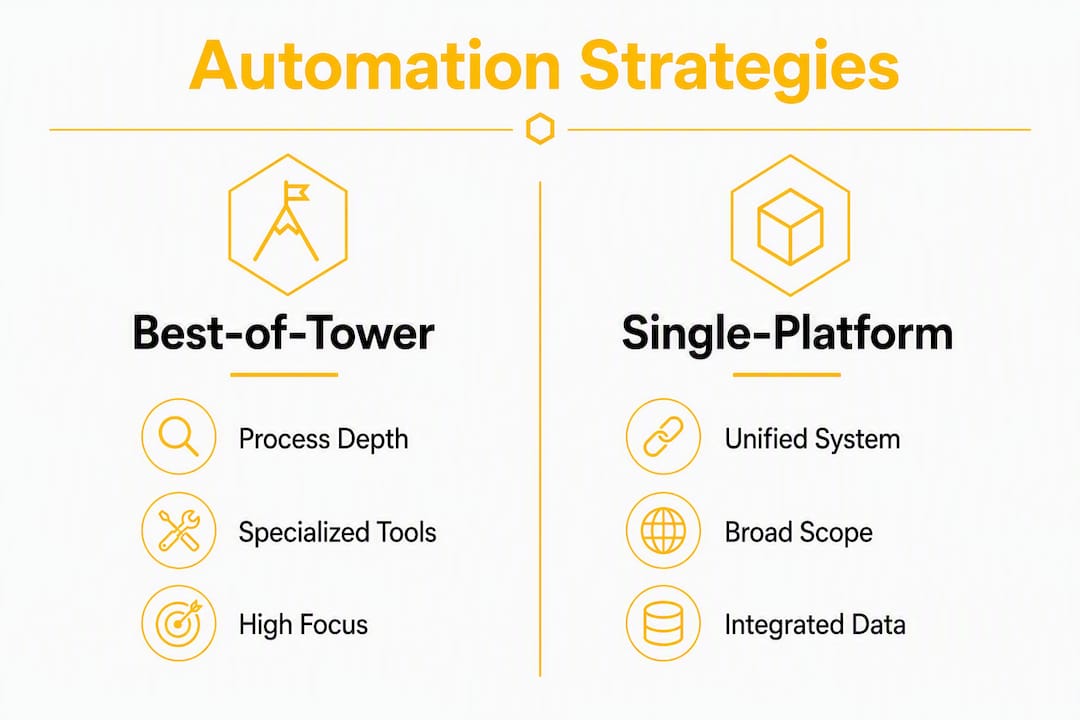
Single-platform trades depth for governance simplicity. It fits organizations that need cross-tower visibility, smaller integration overhead, and consistent RBAC and audit trails across HR, IT, and finance workflows. No single platform wins across all enterprise automation dimensions; the right choice depends on your existing stack, legacy desktop exposure, and CoE maturity.
Decision indicators to map before your RFP:
- High volume, low variance in one function: best-of-tower with a specialized agentic platform.
- Cross-tower governance priority with limited CoE staff: single-platform with native ERP connectors.
- Mixed environment (modern SaaS plus legacy desktops): hybrid architecture pairing cloud orchestration with desktop RPA.
- Existing Microsoft 365 footprint: Microsoft Power Automate as the workflow layer, with specialized agents for document-heavy processes.
Pro Tip: When a vendor claims 90%+ touchless or straight-through processing rates, test that claim against your actual production document mix, not a curated demo set. Run 50–100 live documents through their sandbox and measure exception rates yourself before signing.
What technical criteria should you require from any platform?
The non-negotiables in a technical evaluation are API-first integration, native ERP connectors, full audit trails, versioning, security certifications, and on-premises deployment options where your compliance posture requires them.
Why each item matters:
- API-first integration: API function calls are more resilient than UI-driven automation. When an ERP or SaaS tool updates its interface, a UI-based bot breaks. An API call does not.
- Native ERP connectors: Pre-built connectors to SAP S/4HANA, Oracle Fusion, Microsoft Dynamics 365, or NetSuite reduce integration build time and lower long-run maintenance cost.
- Audit trails and versioning: Compliance teams need a timestamped record of every automated action, approval, and exception. Without it, audit readiness collapses.
- Agentic document processing: Agentic platforms handle format variation without template maintenance, delivering touchless rates of roughly 85–92% in complex document environments versus 65–75% for UI-based RPA.
- Orchestration layer: A low-code orchestration tool that centralizes cross-system automation serves as the connective tissue between ERP, file systems, and cloud services.
Risk callouts to flag in vendor demos:
- Brittle UI-based RPA: Any bot that navigates screen elements will break on UI updates. Demand API alternatives before committing.
- Template-based IDP: Vendors that require a new template per document format create a maintenance burden that compounds as your document mix grows.
- Opaque error handling: If a platform cannot explain why an exception occurred, your team cannot fix the root cause or train the model.
Pro Tip: In any vendor POC, run a live integration test to your ERP via API or sandbox, not a recorded demo. If the vendor cannot connect to a sandbox environment within the POC window, that is a delivery risk signal.
What operational criteria separate reliable nearshore partners?
Choosing a managed nearshore partner is a different evaluation than choosing software. The criteria that matter most are staffing model transparency, bilingual capability, cultural alignment, tiered escalation, and measurable SLAs.
Operational criteria to require:
- Staffing model: Dedicated agents versus shared pools. Dedicated teams build process knowledge; shared pools introduce variability on complex tasks.
- Bilingual capability: For U.S. operations serving Spanish-speaking customers or processing Spanish-language documents, bilingual staffing is a functional requirement, not a differentiator.
- Cultural alignment: Time zone overlap, communication norms, and familiarity with U.S. regulatory context reduce escalation friction.
- Tiered escalation: A defined escalation path from agent to team lead to subject-matter expert keeps exceptions from stalling.
SLA metrics to request in writing:
- First-contact resolution (FCR) rate for back-office task queues.
- Processing accuracy rate (target: 99%+ for finance-critical tasks with human-in-the-loop).
- Turn time per transaction type (invoice, claim, order).
- SLA credit terms for missed accuracy or turn-time thresholds.
On pricing: per-seat models offer cost predictability; per-process or outcome-based models align vendor incentives with your throughput goals. Watch for hidden costs in data cleanup, exception handling queues, and one-time integration fees that do not appear in the base rate. Validate staffing claims through reference calls and a small paid pilot before committing to full-scale engagement. Nearshore operations can deliver significant efficiency gains when the staffing model is built for your specific process mix.
How do you move from pilot to full-scale deployment?

A confident timeline for most mid-sized operations is a few months for a scoped pilot and up to a year to reach full-scale depending on process complexity and ERP integration depth.
| Phase | Weeks | Key Milestones |
|---|---|---|
| Scoping and data mapping | several weeks | Process inventory, ERP sandbox access, exception taxonomy |
| POC build and testing | several weeks | Live document testing, API integration validation, accuracy baseline |
| Pilot cutover | several weeks | Limited production volume, human-in-the-loop monitoring, runbook finalization |
| Governance handoff | several weeks | SLA reporting live, escalation paths documented, scale plan approved |
Step-by-step checklist for the pilot phase:
- Audit source data quality in your ERP before automation begins. Poor master data is the most common bottleneck, not the automation tool.
- Map document types, exception categories, and approval hierarchies.
- Confirm sandbox ERP connectivity via API, not UI scraping.
- Define human-in-the-loop thresholds: which exception types require human review before posting.
- Build and test runbooks for every exception category identified in step 2.
- Run a parallel processing period where automated and manual outputs are compared.
- Establish 90-day KPI baselines: touchless rate (target: 85–92% for agentic platforms in complex document environments), exception volume, cycle time per transaction.
Risk mitigation: keep a documented fallback manual process for every automated workflow during the first 90 days. Data quality remediation often takes longer than expected; budget two to three weeks for ERP master data cleanup before the POC build starts. Change management for the operations team is as important as the technical build. Practical back-office optimization resources can help teams prepare for the transition.
Altiamcx delivers managed nearshore back-office operations built for scale
Altiamcx provides managed nearshore delivery that combines bilingual teams, scalable team extension, and integration with API-first automation platforms, giving operations leaders a single accountable partner for both the human and technology layers of back-office execution.
Capabilities Altiamcx brings to an engagement:
- Nearshore staffing with dedicated agents trained to your process and exception taxonomy.
- Bilingual (English/Spanish) capability for U.S. operations with multilingual document or customer volumes.
- Managed team extension that scales up or down without the overhead of direct hiring.
- Human-in-the-loop quality controls that combine AI agents with human expert oversight for accuracy on complex finance and operational tasks.
- Operational efficiency consulting to identify process gaps before automation begins.
Trust signals: Altiamcx’s nearshore team-extension case study demonstrates measurable outcomes for operations teams that needed scalable, accountable delivery. An orthodontic services provider achieved documented CX improvements through Altiamcx’s managed service model. Engagement models are available on a per-seat, managed service, or outcome-based basis, depending on your volume profile and risk preference.
To start a discovery conversation, request a pilot proposal, or review available case studies, visit Altiamcx and connect with the team directly.
Key Takeaways
Nearshore managed partners that pair API-first automation with human-in-the-loop oversight deliver faster time-to-value, stronger compliance, and lower maintenance cost than software-only deployments for most U.S. operations leaders.
| Point | Details |
|---|---|
| Best-of-tower vs. single-platform | Choose based on transaction volume concentration and CoE maturity, not vendor marketing. |
| API-first is non-negotiable | UI-based automation breaks on application updates; API integration reduces maintenance and failure risk. |
| Pilot timeline | Budget 8–16 weeks for a scoped pilot; data cleanup is the most common delay. |
| 90-day KPIs to track | Measure touchless rate (target: 85–92% for agentic platforms in complex document environments), exception volume, and cycle time reduction from day one of production. |
| Altiamcx as managed partner | Altiamcx combines bilingual nearshore staffing, human-in-the-loop controls, and scalable team extension for U.S. back-office operations. |
The procurement mistake most operations leaders make
The conventional wisdom in back-office automation procurement is to start with the platform. Pick the software, then figure out the people and process. After watching this play out across dozens of engagements, the evidence points the other way: the platform is rarely the bottleneck. The bottleneck is almost always data quality, exception governance, or the absence of a human layer that can handle what the automation cannot.
Operations leaders who shortlist managed nearshore partners before finalizing their platform choice consistently reach production faster. Why? Because a capable managed partner will tell you which platform fits your document mix and ERP environment, help you clean your master data before the POC starts, and absorb the exception volume that any automation will generate in its first 90 days. That is the sequence that actually works: people and process first, platform second.
The procurement mistake to avoid: signing a multi-year software license before running a live pilot with real production documents. Vendors will show you their best-case document set. Your production mix will be messier. A managed partner with human-in-the-loop controls gives you a safety net while the automation matures.
Take the next step with Altiamcx
Altiamcx offers a structured discovery process designed to give operations leaders a clear picture of what managed nearshore back-office delivery looks like for their specific environment. No generic proposals.
- Discovery call: Altiamcx scopes your process volume, exception taxonomy, and ERP environment to produce a concrete POC plan.
- Pilot proposal: Receive a scoped engagement with defined SLAs, staffing model, and 90-day KPI targets before committing to full scale.
- Case study review: Explore how Altiamcx has delivered measurable outcomes for operations teams across healthcare, legal, ecommerce, and financial services.
Connect with the Altiamcx team at altiamcx.com to request your discovery call today.
Useful sources and further reading
Technical and procurement teams should consult these resources before finalizing an RFP or platform shortlist.
- Enterprise guide to agentic AI for back-office automation — Covers agentic platform architecture, touchless rate benchmarks, and maintenance trade-offs versus template-based IDP. Recommended for: technical team and CoE leads.
- Narada AI on API-first automation — Explains why API function calls outperform UI automation for resilience and maintenance. Recommended for: technical architects and RFP teams.
- AI automation platform comparison — Compares platform strengths across Microsoft stack, legacy desktop, and SaaS connector environments. Recommended for: procurement and operations leaders.
- Altiamcx: back-office outsourcing and efficiency — Explains managed nearshore outsourcing models and the business case for team extension. Recommended for: operations leaders building an internal justification.
- Altiamcx: back-office operations checklist — A practical checklist for operational readiness and process governance. Recommended for: operations managers preparing for a pilot.
- Altiamcx: ROI and efficiency strategies — ROI framing and business-case guidance for nearshore managed automation. Recommended for: finance leaders and VPs building the investment case.