
Which boutique BPO alternatives to Altiam CX fit your SME best?
The best alternatives to altcx.com are boutique business process outsourcing (BPO) firms built specifically for small and mid-sized businesses. These providers deliver personalized, culturally aligned customer experience services across voice, chat, email, and in-app ticketing, with hands-on management that larger outsourcing firms rarely offer.
Here is a concise shortlist of boutique BPO categories worth evaluating:
- Nearshore CX specialists focused on English and Spanish-speaking markets with strong cultural proximity to US clients
- Multilingual support boutiques covering languages such as French, Mandarin, Portuguese, and German for businesses with international customer bases
- Back-office and team-extension providers offering scalable operational support without enterprise-scale minimums
- Industry-specific boutiques with deep specialization in tech support, e-commerce, or SaaS customer success
Each of these categories prioritizes cultural alignment and dedicated management over the volume-driven workflows that define large BPO enterprises.
Table of Contents
- How boutique BPOs differ from large BPO providers
- Key criteria for evaluating a boutique BPO partner
- What makes Altiam CX stand out for US SMEs
- Final considerations before you commit to a boutique BPO
- Detailed profiles of top Altiam CX alternatives for SME BPO
- What sets each type of alternative apart
- Pricing structures among boutique BPO alternatives
- Performance evidence from boutique BPO engagements
- Altiamcx: a nearshore CX partner built for SME scale
- Key Takeaways
How boutique BPOs differ from large BPO providers
The structural difference between a boutique BPO and a large provider comes down to who gets attention. Boutique BPOs provide more dedicated operational focus than large BPOs, which often treat smaller clients as an afterthought, routing them through standardized workflows designed for enterprise accounts.
What sets boutique firms apart:
- Low management-to-agent ratios that allow supervisors to coach agents closely, reducing turnover and shortening onboarding cycles
- Customized workflows built around your specific product, tone, and escalation logic rather than a generic playbook
- Agile terms that accommodate growth spurts, seasonal spikes, and scope changes without renegotiating a multi-year contract
- Intimate client experience where your account lead knows your business, not just your ticket volume
Large BPOs excel at scale. If you need 500 seats tomorrow, they can deliver. But for an SME running 10–50 agents, that infrastructure works against you. You become a rounding error in their revenue model, and service quality reflects it.
Key criteria for evaluating a boutique BPO partner
Choosing the right partner requires looking past the hourly rate. The true cost drivers in BPO partnerships are management ratios rather than just hourly fees. Effective management reduces turnover and improves performance, which means a slightly higher rate at a well-managed boutique often costs less over 12 months than a cheaper seat at a high-turnover operation.
Evaluation checklist:
- Management-to-agent ratio: Ask directly. A ratio of 1 supervisor per 8–12 agents signals genuine oversight. Anything above 1:20 is a red flag for SME accounts.
- Cultural alignment: Assess communication style, time zone overlap, and whether the team has direct experience serving US customers in your industry.
- Specialization fit: A boutique that has handled SaaS tech support for three years will outperform a generalist on day one.
- Scale thresholds: Boutique BPOs require minimum seat counts or monthly spend to maintain their service model. Confirm you meet their floor before investing time in a proposal.
- Direct provider vs. aggregator: Industry experts stress the need to distinguish boutique BPO firms from aggregators or marketplaces. An aggregator connects you to providers; a boutique BPO is your direct operational partner.
Pro Tip: Ask every candidate to share their current management-to-agent ratio and average agent tenure. Tenure above 18 months at a boutique is a strong indicator of operational stability.
Outsourcing back-office tasks for growth is a well-documented strategy for SMEs, and the benefits of outsourcing back-office operations compound quickly when the partner is well-matched to your scale.
What makes Altiam CX stand out for US SMEs
Altiamcx is a nearshore customer experience and operational services partner that covers voice, chat, email, in-app ticketing, and multilingual support across English, Spanish, French, Mandarin, Portuguese, and German. That breadth is unusual for a boutique, and it matters when your customer base spans multiple regions.
The core differentiators:
- Hands-on operational management with disciplined performance frameworks that track quality at the agent level, not just the aggregate
- Cultural proximity to US business norms, which reduces miscommunication and accelerates agent ramp time
- Scalable team-extension model that lets you add capacity without rebuilding your internal processes around a new vendor
- Back-office coverage including data entry, order processing, and administrative support alongside front-line CX
Productivity impact: A software platform that migrated its tech support operations to Altiamcx recorded an 89% improvement in productivity, demonstrating what disciplined execution and cultural alignment can deliver in practice.
Altiamcx combines that measurable performance focus with the flexibility SMEs need. You get a partner that treats your account as a priority, not a line item.
Final considerations before you commit to a boutique BPO
Before signing with any provider, run through this checklist:
- Cultural fit confirmed: Have you spoken with the actual team leads, not just the sales contact?
- Specialization verified: Does the provider have documented experience in your specific service category?
- Scale alignment checked: Do your seat requirements fall within the provider’s operational sweet spot?
- Performance frameworks in place: Will you receive regular reporting with defined KPIs, or just a monthly summary?
- Contract flexibility assessed: Can you scale up or down within a quarter without penalty?
- Client references available: Has the provider offered references from accounts similar in size and industry to yours?
Long-term partnership potential matters as much as the initial fit. A boutique BPO that grows with you, adjusts workflows as your product evolves, and maintains low agent turnover will deliver compounding value over time.
Detailed profiles of top Altiam CX alternatives for SME BPO
When evaluating top altcx.com substitutes, the providers that consistently serve US SMEs well fall into a few distinct operational models.

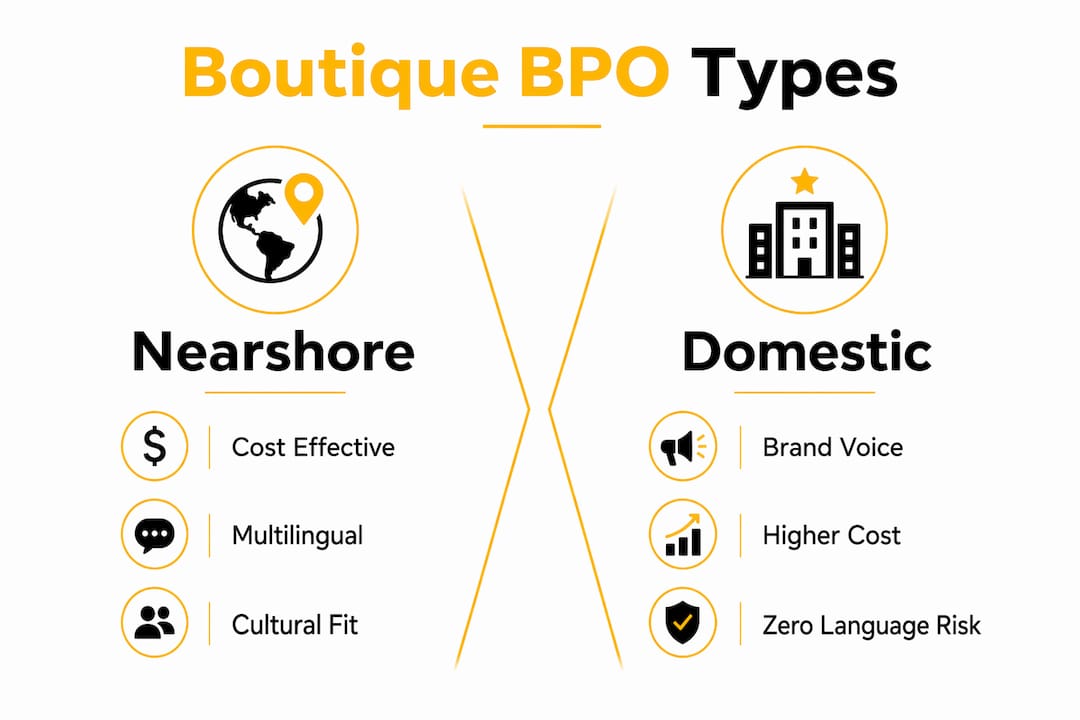
Nearshore multilingual boutiques operate from Latin America or the Caribbean, offering strong English and Spanish proficiency with US time zone alignment. They typically serve 10–100 seat accounts and specialize in customer care, technical support, and order management.
Domestic micro-BPOs based in the US offer zero language or cultural risk but carry higher per-seat costs. They suit businesses where regulatory sensitivity or brand voice consistency justifies the premium.
Hybrid team-extension providers like Altiamcx blend nearshore cost efficiency with US-aligned management oversight. This model works well for SaaS companies, e-commerce brands, and professional services firms that need both quality and cost control.
Back-office specialists focus on data processing, HR document management, and administrative workflows rather than customer-facing roles. For SMEs exploring outsourcing in HR document management, these providers offer a focused alternative to full-service BPOs.
What sets each type of alternative apart
The differentiating factor is not geography. It is the combination of specialization depth and management quality.
Nearshore boutiques win on cost-to-quality ratio for customer-facing roles. Domestic micro-BPOs win on brand voice fidelity and compliance sensitivity. Hybrid providers like Altiamcx win when you need both. Back-office specialists win when your operational bottleneck is administrative volume, not customer interaction.
The providers worth shortlisting for customer support outsourcing are those that can demonstrate agent tenure, management ratios, and client retention in your specific vertical.
Pricing structures among boutique BPO alternatives
Boutique BPO pricing typically follows one of three models:
- Per-seat monthly retainer: A fixed monthly fee per agent, usually covering management, training, and infrastructure. Common for dedicated team arrangements.
- Per-hour billing: Charged against actual agent hours worked. More flexible for variable-volume accounts but harder to budget precisely.
- Per-interaction or per-ticket: Tied directly to output volume. Works well for back-office tasks with predictable unit economics.
Nearshore boutiques generally price below domestic providers for equivalent service quality. The gap narrows when you factor in management overhead, onboarding costs, and turnover risk. A well-managed nearshore boutique with a 1:10 supervisor ratio often delivers better total cost of ownership than a cheaper provider with a 1:25 ratio and high churn.
Performance evidence from boutique BPO engagements
Published performance data from boutique BPO engagements is limited by confidentiality, but documented results do exist. Altiamcx’s case study with a software platform migrating its tech support operations recorded an 89% improvement in productivity, a figure that reflects what happens when cultural alignment, disciplined management, and purpose-built workflows converge.
Across the boutique BPO category, the consistent pattern in client outcomes is faster resolution times, lower repeat-contact rates, and reduced agent turnover compared to large-provider alternatives. These are the metrics that matter most to SMEs, where each customer interaction carries more weight than it does for an enterprise with millions of monthly contacts.
Altiamcx: a nearshore CX partner built for SME scale
If you have been evaluating similar sites to altcx.com and want a provider that combines nearshore cost efficiency with US-grade performance accountability, Altiamcx is worth a direct conversation. The difference from a generic outsourcing vendor is concrete: dedicated management, measurable KPIs from day one, and a team that understands US customer expectations without requiring months of cultural calibration.
Altiamcx serves businesses that need real operational coverage across voice, chat, email, and back-office functions, without the minimum seat counts that price SMEs out of enterprise BPO contracts. The nearshore model keeps costs competitive while the performance framework keeps quality consistent.
The next step is straightforward. Review the 89% productivity case study to see how Altiamcx delivers in practice, then reach out to discuss whether your operational scale and service requirements are a fit.
Key Takeaways
Boutique BPOs built for SMEs consistently outperform large providers on management quality, cultural alignment, and operational flexibility when the scale match is right.
| Point | Details |
|---|---|
| Management ratio matters most | A 1:10 supervisor-to-agent ratio signals genuine oversight; ratios above 1:20 increase turnover risk. |
| Scale fit is non-negotiable | Boutique BPOs set minimum seat thresholds; confirm your volume fits their model before engaging. |
| Boutiques vs. aggregators | Direct boutique BPO providers are your operational partner; aggregators only source and vet options. |
| Productivity gains are measurable | Altiamcx delivered an 89% improvement in productivity for a software platform migrating its tech support. |
| Altiamcx for US SMEs | Altiamcx offers nearshore CX, multilingual support, and back-office coverage with disciplined performance frameworks. |