
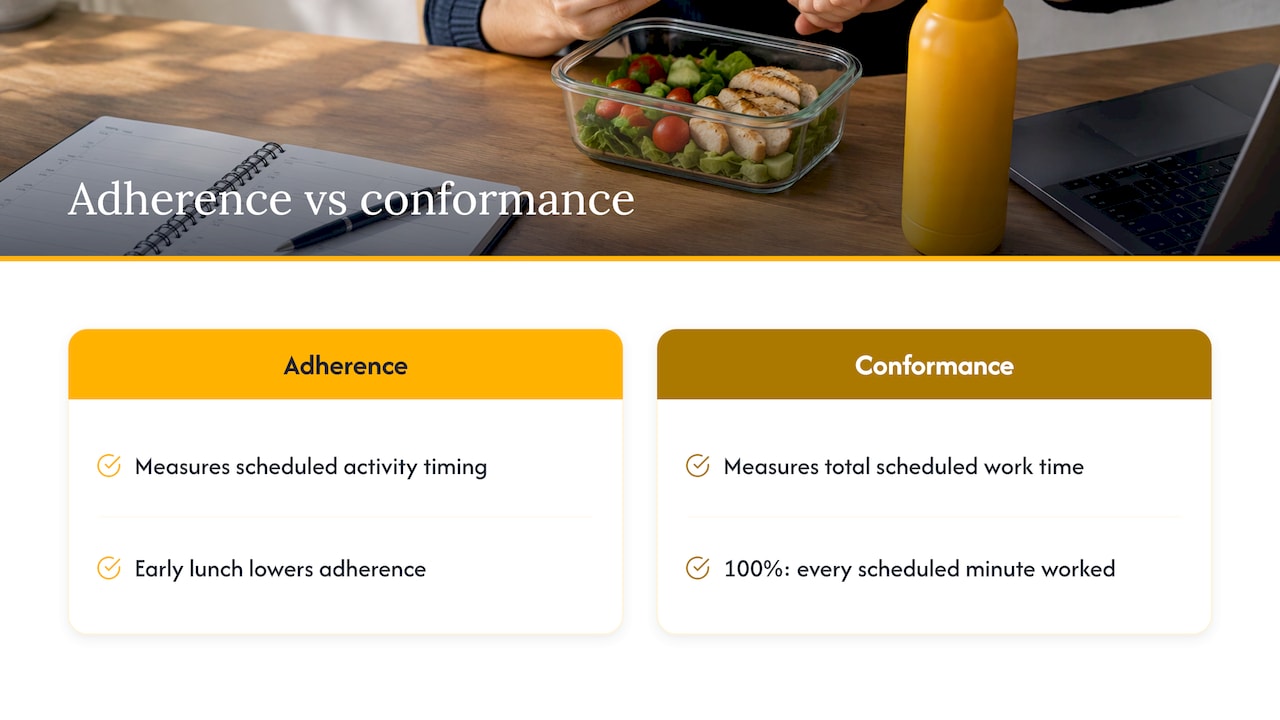
Adherence tells you whether an agent was in the right activity at the right time. Conformance tells you how much of the scheduled time the agent actually worked, whenever it happened. One WFM reference puts it in one line: adherence cares about when, conformance cares about how much. Operations leaders need both numbers, because each one explains a different kind of coverage gap. A managed nearshore team, such as the one we build at Altiam CX, is one way to keep both under control without adding scheduling work to your own bench.
TL;DR
- Adherence is a moment-by-moment check: the share of intervals where the agent’s actual activity matches the schedule.
- Conformance is a volume check: total time spent in scheduled activities as a share of scheduled time, regardless of timing.
- An agent who takes lunch 11:30 to 12:30 instead of 12:00 to 13:00 loses adherence but keeps 100% conformance.
- Use adherence for intraday coverage and conformance as your “lost time” input to staffing and shrinkage.
- Treat drift as a signal to investigate, not a reason for discipline. Targets pushed too high get gamed.
Table of Contents
- The difference in plain terms
- How adherence is calculated
- How conformance is calculated
- Side by side
- Why you need both
- Setting targets that make sense
- Improving both without squeezing agents
- Where a managed nearshore team fits
- Our perspective
- FAQ
- Sources
The difference in plain terms
A schedule makes two promises: when each person will be doing something, and how much work time you will get. Adherence audits the first promise. Conformance audits the second.
Take an agent scheduled for lunch from 12:00 to 13:00. She goes at 11:30 and returns at 12:30. The schedule said she would be on the phones from 11:30 to 12:00 and on break from 12:00 to 12:30. She did the reverse. Her adherence takes a hit for that hour. Her conformance stays at 100% because she still worked every scheduled minute of the day, as the WFM Labs example shows.
Why does that matter? Because your forecast did not staff for “7.5 hours of work somewhere in the day.” It staffed for specific intervals. A queue that fills at 11:45 does not care that the hours balance out by 5 p.m.
A note on vocabulary. Some documents use “compliance” for what this article calls conformance. The SWPP definitions sheet says compliance is sometimes referred to as conformance. Always check which formula sits behind a report label before comparing numbers across teams or vendors.
How adherence is calculated
The standard formula is:
Adherence % = time in adherence ÷ (time in adherence + time out of adherence) × 100
Or, equivalently, (scheduled time minus non-adherent time) ÷ scheduled time × 100.
Worked example. SWPP’s definitions give a simple case: an agent who is out of adherence for 25 minutes of a 480-minute shift is 5% out, so adherence is 95%.
What counts as adherent varies by operation. Monitask’s 2026 review of published definitions lists these as typically adherent: handling calls while on queue, scheduled after-call work, breaks and lunches taken at the scheduled time, scheduled meetings, coaching and training, and even a call that runs into a scheduled break. Typically non-adherent: late logins, extended breaks, unscheduled breaks, off-queue time with no assigned activity, and early logouts.
Two settings change the number more than agent behavior does:
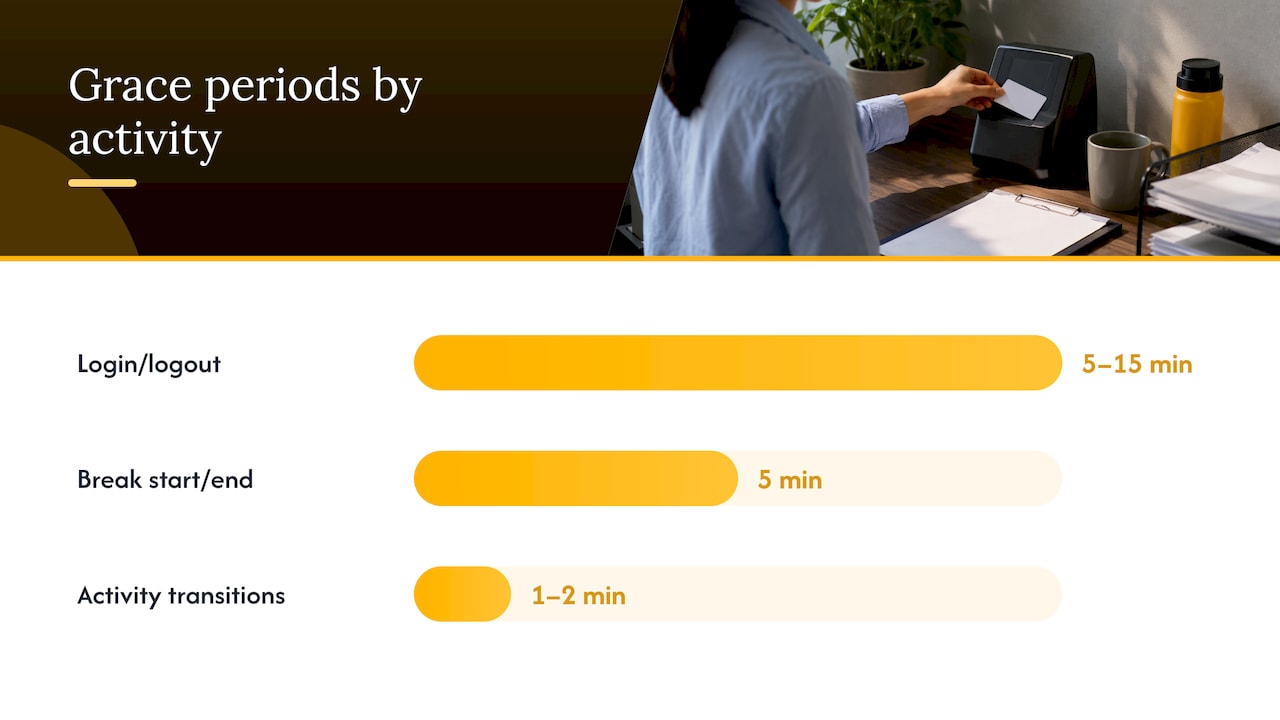
- Grace periods. Common tolerances run 5 to 15 minutes for login and logout, 5 minutes for break start and end, and 1 to 2 minutes for activity transitions.
- Exception rules. In Genesys Cloud’s documentation, a 60-minute scheduled agent who arrives 10 minutes late and works 10 minutes extra scores 71.4% when work outside the shift counts as an exception, and 82.4% when it does not. Same agent, same hour, two different scores.
That is why two reports with the same label can disagree. Fix the definition first, then set the target.
How conformance is calculated
The usual formula is:
Conformance % = actual hours ÷ scheduled hours × 100
SWPP’s example: an agent scheduled for 7.5 hours logs in at 8:15 instead of 8:00 but works until 4:45 instead of 4:30. She did not follow the exact times, yet she worked the full 7.5 hours, so the result is 100%.
The more precise version sums the lesser of scheduled and realized time for each activity, then divides by total scheduled time. The effect is that extra time in one activity cannot cover a shortfall in another. Platforms differ on the details. ServiceNow’s workforce documentation, for example, includes overtime in its conformance formula and uses default thresholds of adherence above 70 and conformance between 80 and 120. A conformance reading above 100% simply means more time worked than planned.
ICMI describes the same split as volume versus precision. Working 7.4 of 7.5 scheduled hours is 98.7% on volume. Working 7:15 to 11:15 when the schedule said 7:00 to 11:00 is 93.8% on precision. Precision is the harder number to hold, so its goal is lower.
Side by side
| Adherence | Conformance | |
|---|---|---|
| Question answered | Was the agent doing the right thing at the right time? | Did the agent work the scheduled amount of time? |
| Timing matters? | Yes, interval by interval | No |
| Typical formula | Time in adherence ÷ scheduled time | Actual hours ÷ scheduled hours |
| Common targets | 90 to 95% | Often 95% or higher |
| Best used for | Intraday coverage, real-time management | Shrinkage and staffing plans |
| Fails when | Schedules are unrealistic or exceptions are entered late | Hours balance out but peaks go uncovered |
One agent can post 100% conformance and 80% adherence on the same day. Neither number is wrong. They answer different questions.
Why you need both
Adherence alone punishes harmless shifts in timing. Conformance alone hides the moments when the queue was unattended. Together they separate two root causes:
- High conformance, low adherence: the hours are there, but in the wrong places. Look at schedule design, break placement, intraday communication and how exceptions get approved.
- Low conformance: the hours themselves are missing. That is lost time: lateness, absence, unplanned leave, system downtime. It belongs in your shrinkage plan, and our guide on fixing call center shrinkage covers how to size it.
Peopleware’s Charles Watson treats conformance as a shrinkage bucket: 95% conformance means 5% lost time, and he suggests keeping that loss under 5%. He also notes that adherence can work itself out across a day when conformance is strong. The risk is the tipping point, where a staffing drop builds a queue and damages service level.
What it costs when adherence slips
Adherence feeds directly into headcount. ICMI’s 2010 whitepaper modeled a center paying $35,000 a year in salary and benefits per agent. Dropping adherence from 92% to 90% to 88% raised required FTEs from 42.12 to 43.06 to 44.03. That is an extra $32,760, then $67,008 a year, to cover the same workload. The figures are from 2010 and your salary base will differ, but the mechanism is the same: lower adherence means more people on payroll for the same calls.
The same paper describes the human chain. When adherence drops, occupancy rises for agents still on the phones, which raises burnout and attrition risk and lowers service level, quality and first-call resolution. For how this ties to your headline service metric, see our explainer on the 80/20 service level.
Setting targets that make sense
One-size-fits-all goals are a common mistake. NICE’s whitepaper offers a buffer method based on handle time. For a 7.5-hour day (450 minutes) with four break stopping points and a 5-minute average handle time, the buffer is 20 minutes (5 × 4), or about 4% of scheduled time. That yields a 96% adherence goal. If the buffer exceeds 10% of scheduled hours, the same paper suggests conformance may be the fairer measure.
Other reference points:
- Immature adherence programs or long handle times can sit near 85%, while mature centers or short-call operations can target 95% or even 97%.
- For staffing math, ICMI advises adding the inverse of your adherence goal: at a 92% goal, add 8% to required staff.
- Healthcare and legal lines have long calls and sensitive conversations. Handle time buffers matter more there, so a flat 95% can be the wrong goal.
Our practical guide to schedule adherence walks through target setting in more detail, and the staffing model guide shows how interval-based forecasts turn these percentages into headcount.
Improving both without squeezing agents
Push the number too hard and the metric stops measuring work. WFM Labs warns that targets above 95% lead agents to skip bathroom breaks, skip lunch and rush after-call work. A more mature approach treats drift as a signal that prompts inquiry, not a violation that prompts discipline.
Practices that hold up:
- Fix the schedule first. Interval-level forecasting and schedule design come before any adherence campaign, per ICMI’s guidance.
- Measure daily. NICE lists weekly or monthly measurement as a not-so-best practice, since problems are old by the time anyone sees them.
- Enter exceptions in advance. After-the-fact entry removes management’s visibility into scheduled resources. Supervisors and departments are accountable for reporting exceptions, not only agents.
- Do not end calls to protect the metric. A call that runs into a break should be allowed to finish. Most platforms can count that as adherent.
- Exclude what agents cannot control. An agent whose computer fails for three hours scores 62.5% adherence, a number that describes an IT failure, not the agent.
- Keep adherence out of sole-input reviews and public rankings. The same guide also flags legal exposure in California when pressure undermines meal-break policies, so confirm your state rules with your employment counsel.
- Build buy-in. ICMI recommends agent-centric scheduling, shift trades, recognition and at least an hour of new-hire training on the “power of one” principle.
The point of all seven is the one NICE’s workforce team makes: adherence exists to give accurate visibility into coverage for intraday decisions and future staffing, not to police individuals.
Where a managed nearshore team fits
Every step above takes management time: schedule design, daily reporting, exception handling, coaching, backfilling absences. For many operations leaders in healthcare, legal, ecommerce and financial services, that is the part that never gets enough attention.
Altiam CX is a nearshore customer experience and operational services partner. We provide managed team extension, customer support, technical assistance and back-office operations, with bilingual agents, scalable team deployment and measurable performance frameworks. Because the team is built to extend yours, you can agree on the definitions that matter here, adherence rules, grace periods, exception handling and conformance targets, and measure the team against them from the start. Our nearshore locations in Latin America also keep agents in time zones aligned with U.S. coverage windows, which makes interval-level scheduling more practical.
For regulated lines, we offer Managed Customer Support and Patient Support & SOP Management for healthcare, and Legal Intake & Inquiry Handling, Appointment Scheduling & Coordination and Managed Legal Team Extension for law practices. Our broader Customer Experience and Managed Team Extension services cover other industries.

If you are sizing coverage, the related reading on call center workforce management and forecasting shows how these metrics feed the plan.
Our perspective
Most of the adherence conversations we see in operations come down to one mistake: treating the metric as the goal. Adherence is a coverage tool. Conformance is a lost-time tool. When leaders read them that way, the discussion changes from “who was late” to “where did we lose coverage, and what in the design caused it.”
That is how we think a managed team should work. Clear definitions up front. Targets set from handle time, not borrowed from a benchmark. Exceptions reported before the shift, not explained after it. Drift treated as a question to ask the process, not a charge against the agent.
Nearshore teams make this easier to run. Agents who share your time zone and your customers’ language and culture can be scheduled to your real intraday peaks, and a team that extends yours can follow your schedule logic instead of a generic template. The result we aim for is better service quality with less friction, and a team that stays steady because it is not being squeezed by a number.
Daniela
FAQ
Is conformance the same as adherence?
No. Adherence checks whether activity matched the schedule at each moment. Conformance checks how much scheduled time was worked, regardless of timing. An agent who takes a break 30 minutes late can have 100% conformance while losing adherence for that hour.
What is a good schedule adherence target?
Industry targets commonly fall between 90% and 95%, and mature centers sometimes aim higher. The better method is to calculate a buffer from your handle time and number of break stopping points, which produced a 96% goal in the NICE example above. Avoid pushing past 95% without checking for gaming.
How do you calculate schedule adherence in a BPO?
Divide time in adherence by scheduled time and multiply by 100. For a 480-minute shift with 24 minutes out of adherence, the result is 95%. Before you compare teams, agree on what counts as adherent: meetings, training, calls running into breaks and work outside the shift all change the score.
How is conformance different from compliance?
Some WFM documents use compliance as another word for conformance, meaning time worked against time scheduled. In a regulated industry, compliance more often means obeying laws or standards. Check the formula behind the label in any report you receive.
Sources
- Adherence and Conformance, WFM Labs
- Handy Definitions and Formulae, SWPP (2024)
- How Genesys Cloud calculates adherence and conformance
- Monitor schedule adherence, ServiceNow documentation
- Schedule Adherence and Real-Time Monitoring Respond to Kindness, ICMI (2019)
- Getting the Right People in the Right Place at the Right Time, ICMI (2010)
- How to master adherence and conformance in your call center, PeopleWare (2023)
- Schedule Adherence whitepaper, NICE
- Schedule Adherence: Formula, Targets and What It Actually Measures, Monitask (2026)
- Schedule Adherence: Definition, Formula, and Benchmarks, HiveDesk