
Redaction fails less often because of a missing tool than because of a missing process. A black box drawn over a Social Security number looks finished, yet the number can still sit in the file underneath. The practices that hold up are the same in every regulated setting: delete the content instead of covering it, define exactly what must go, assign trained people to do it, have a second person check it, and keep a record. That is a routine, and a routine needs dependable people to run it every day. For legal, healthcare and financial operations, that is why many teams put redaction inside a managed, documented back-office workflow rather than leaving it to whoever is free when the filing deadline arrives.
TL;DR
- Real redaction permanently deletes content from the file. Highlights, black rectangles and white text only hide it.
- Decide what must come out before anyone opens a document: use the rule that applies (federal court rules, HIPAA, SEC filer rules) and write it into a checklist.
- Name authorized redactors, train them, and require an independent second review of every redacted document.
- Verify the output: copy and paste, search, inspect metadata, check scanned layers, and log who did what.
- Treat redaction as a standing operation with owners, SOPs and audit records, not as a one-off task.
Table of Contents
- What real redaction removes, and what only looks like it
- Decide what must be redacted before you open the file
- A redaction workflow that survives volume and deadlines
- Verify that the information is really gone
- Paper and scanned records
- Roles, training and audit records
- Handling files in third-party tools
- Perspective
- Put the routine in the hands of a managed team
- FAQ
- Sources
What real redaction removes, and what only looks like it
The most common failure is cosmetic redaction. Drawing a shape over text, highlighting it black, or changing the font color to match the background leaves the original characters in the file. Apryse explains that true redaction permanently deletes marked text, image and vector content so it cannot be copied or found by search, while a visual overlay only covers it.
The PDF Association describes redaction as a two-step process with an optional third:
- Identify the content and place redaction marks (annotations).
- Review and apply the marks, which removes the content permanently.
- Sanitize the document, cleaning metadata, bookmarks, links and other hidden data that could still contain the content.
The third step is where many teams slip. A name deleted from page four may still appear in the author field, a comment bubble, a tracked change, a file name, a footnote or an invisible OCR layer under a scanned image. The international pharmaceutical regulators’ Points to Consider on redaction put it plainly: for electronic files, obscuring the rendered page is not enough, because search and copy tools can still find the information. It must be deleted from the file, with metadata considered.
One more point for anyone who handles records in volume: applying redactions is irreversible. That is the goal, but it means the original must be preserved separately and the redacted copy saved under a new name, so nobody overwrites the only complete version.
Decide what must be redacted before you open the file
The fastest way to create errors is to let each reviewer decide on the spot. Start with a written list tied to the rule that governs the document. Three U.S. examples show how the lists differ.
| Setting | What the rule targets | Source |
|---|---|---|
| Federal court filings | SSNs and taxpayer IDs and financial account numbers (last four digits allowed), birth dates (year only), minors’ names (initials only), and in criminal cases home addresses (city and state only) | Federal courts report on privacy rules |
| SEC filings | SSNs or TINs, financial account and card numbers, passport and driver’s license numbers, home addresses other than city and state, personal phone numbers, birth dates other than year, minor children’s names and initials, sensitive health information | SEC notice of redaction responsibility |
| HIPAA-covered records | 18 identifier categories, including patient names, medical record numbers, dates of service, ages, provider names, contact details, plan numbers and any other unique identifying characteristic | Activate Security verification guide |
A few details matter in practice. The SEC notice lets the last four digits of specified numbers remain and does not require redacting the home addresses and phone numbers of parties and persons filing with the Commission, or business phone numbers. In HIPAA work, a date that looks harmless can still be an identifier, so even a lone year reference deserves a check against your policy.
Courts may go beyond the minimum. The Northern District of Alabama notes that appropriate targets can also include medical information, trade secrets, informant names and sensitive security information. Your checklist should therefore list three buckets:
- Mandatory by rule: the identifiers the court, regulator or statute names.
- Privileged or confidential by judgment: counsel’s advice, other parties’ data, trade secrets, anything outside the scope of the request.
- Indirect identifiers: repeated names in headers, footers, file names and cross-references to a person you have already redacted elsewhere.
That last bucket is a common miss. A guide on HIPAA redaction from AI-Redact lists forgotten cross-references, inconsistent application across long documents and ignored metadata among the usual mistakes.
Know which rules are moving
Federal filers should watch the rules, not memorize them. The Judicial Conference’s 2026 report states that current rules (Civil Rule 5.2, Criminal Rule 49.1, Bankruptcy Rule 9037) allow the last four digits of SSNs and account numbers. It also reports that, after a Federal Judicial Center study, advisory committees voted in April 2026 and the Standing Committee approved in June 2026 proposed amendments for public comment. The proposals would require complete redaction of SSNs, ITINs, EINs and ATINs in civil and criminal cases and would extend redaction requirements to all filing documents, including exhibits and attachments. These are proposals, not final rules, so keep your checklist under version control and confirm the text in force on the federal courts’ site before each filing.
A redaction workflow that survives volume and deadlines
A routine only helps if it is the same every time. This sequence works for digital files, and each step shows where it usually goes wrong.
- Intake and triage. Log the document, the governing rule, the requester and the deadline. Where it fails: documents arrive by email, portal and shared drive with no single record, so nobody knows which version is final. For the wider document flow, see our legal document management process guide and the legal document indexing workflow.
- Preserve the original. Store the unredacted file in a restricted location and work on a copy. Where it fails: someone applies redactions to the only copy and saves over it.
- Identify. Apply the checklist, using search for patterns (nine-digit numbers, dates, medical record formats) and a human read for context. Automated detection finds patterns, not meaning. A nickname, a case reference that points to a person or a handwritten note will not match a pattern.
- Mark, then apply. Use a tool with true redaction, not a drawing tool. Review the marks before applying, because applying is permanent.
- Sanitize. Remove metadata, comments, hidden layers, bookmarks and attachments. Where it fails: teams redact the visible page and ship the file with its history intact.
- Independent review. A different person checks every document against the checklist and runs the verification tests below.
- Release and record. Release the file, log who redacted, who reviewed, when and by what method, and file the redaction reasons.
This is the shape federal teams use. The Department of Justice’s privacy assessment for its litigation support system, approved in 2024, describes temporary redactions during review that become permanent only in the final production package, audit trails, privilege wall-offs, free-form notes recording the reason for each redaction, and a final manual review of redacted and unredacted information before production.
Verify that the information is really gone
Assume every redacted file is guilty until tested. Activate Security’s guide prescribes layered checks that any trained reviewer can run in minutes:
- Copy and paste. Select the redacted area, paste into a plain text editor. If text appears, the redaction failed.
- Search. Search the file for terms that should be gone, including variants and misspellings.
- Properties and metadata. Confirm author, comments and revision history are removed, using a sanitize or hidden-information tool such as Acrobat’s Sanitize Document or Microsoft Office’s Document Inspector.
- OCR layers. In scanned documents, check that the invisible text layer under the image does not still hold the original words.
- Structure inspection. For high-risk files, use PDF forensics tools to inspect the internal structure.
- Second reviewer. Someone not involved in the original work spot-checks a sample using different tools.
For teams building a wider verification habit, these methods for verifying data integrity cover how to confirm that sensitive information cannot be recovered from a file.
The point of a second reviewer is not distrust. The person who made the marks sees what they meant to hide. A fresh reviewer sees what the file actually contains.
Paper and scanned records
Legal and healthcare operations still handle paper. For paper that will not be digitized, the TSA’s redaction directive is a useful model: make double-sided pages one-sided, cover content on both sides with permanent black marker, photocopy and visually inspect the copies, obtain a second authorized redactor’s review, and dispose of unneeded pages securely. The ICH guidance agrees that covering text on paper is not sufficient by itself and that the document should be copied for distribution.
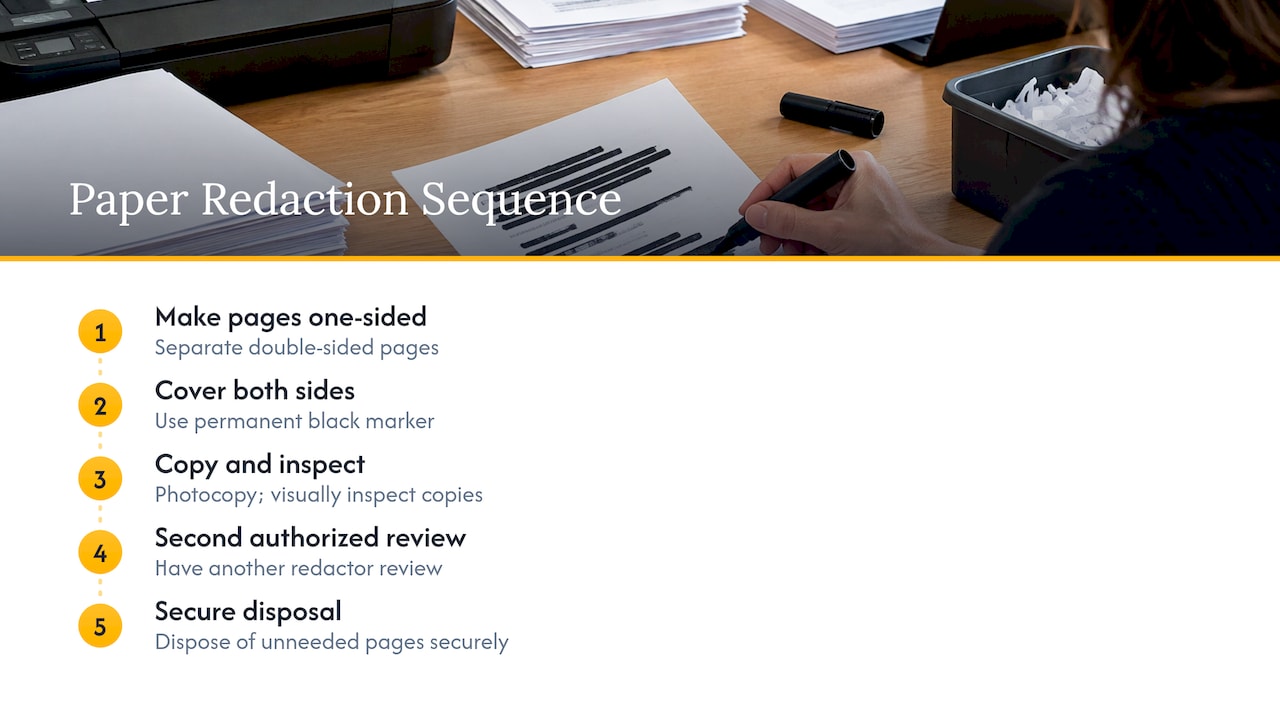
Paper that is headed for electronic use should be scanned to PDF and redacted electronically. Then the OCR layer becomes part of the job: if recognition text sits behind the image, it must be redacted with the image. If your operation is moving toward automated capture, our piece on intelligent document processing and where people fit explains why human review of low-confidence fields stays in the loop.
Roles, training and audit records
The strongest public examples of redaction governance are less about software and more about accountability.
- Designated redactors. TSA’s directive requires written designation of authorized redactors, mandatory training before they redact, and a standard tool for electronic work.
- Independent QA on every document. The same directive requires a quality review by a different authorized redactor who knows the subject matter.
- Documented actions. The IRS manual for redaction support (IRM 8.27.2, updated August 2025) requires the redaction specialist to record actions in case notes, redact other taxpayers’ information, privacy-protected information and counsel’s advice, and complete a documented second review before the case moves to formal review.
- SOPs. AI-Redact recommends written procedures naming authorized redactors and approved tools, second-person review before release, and audit trails of who redacted what, when and how.
Translate that into a one-page policy: who may redact, which tool, which checklist, who reviews, where logs live, how errors are escalated (for example, a released file found to contain protected data goes to your privacy or general counsel the same day), and how long records are kept. For customer-support teams, the same logic applies to screenshots, call notes and ticket attachments that carry personal data. Our article on contact center QA beyond 2% sampling covers how to review more than a thin sample.
A worked example
A law firm must produce 400 pages of medical and billing records in a personal injury matter. The checklist lists patient identifiers, account numbers, other patients’ data and privileged notes. Redactor A marks and applies, then sanitizes. Reviewer B pastes redacted regions into a text editor, searches 20 target terms, and checks properties. B finds a name left in a scanned page’s OCR layer, returns the file, and the log records the correction. Nothing leaves until B signs off. The extra twenty minutes is the cost of not releasing a name.
Handling files in third-party tools
Where files are processed matters as much as how. Many online tools upload your document to a remote server. AccountableHQ’s HIPAA guidance notes that third-party processing may retain content unless contracts restrict it, and for health data recommends business associate agreements, documented risk analysis, encryption in transit and at rest, multi-factor authentication and secure deletion of intermediate files. Decide before the first upload where files will be processed, who can access them, and how copies are deleted.
Retention is the other half. Redaction is often paired with disposal and records schedules, and document retention rules show how U.S. agencies’ requirements shape what you keep and for how long. Keep the unredacted original under the retention schedule that applies to it, and the redacted copy as the record of what was released.
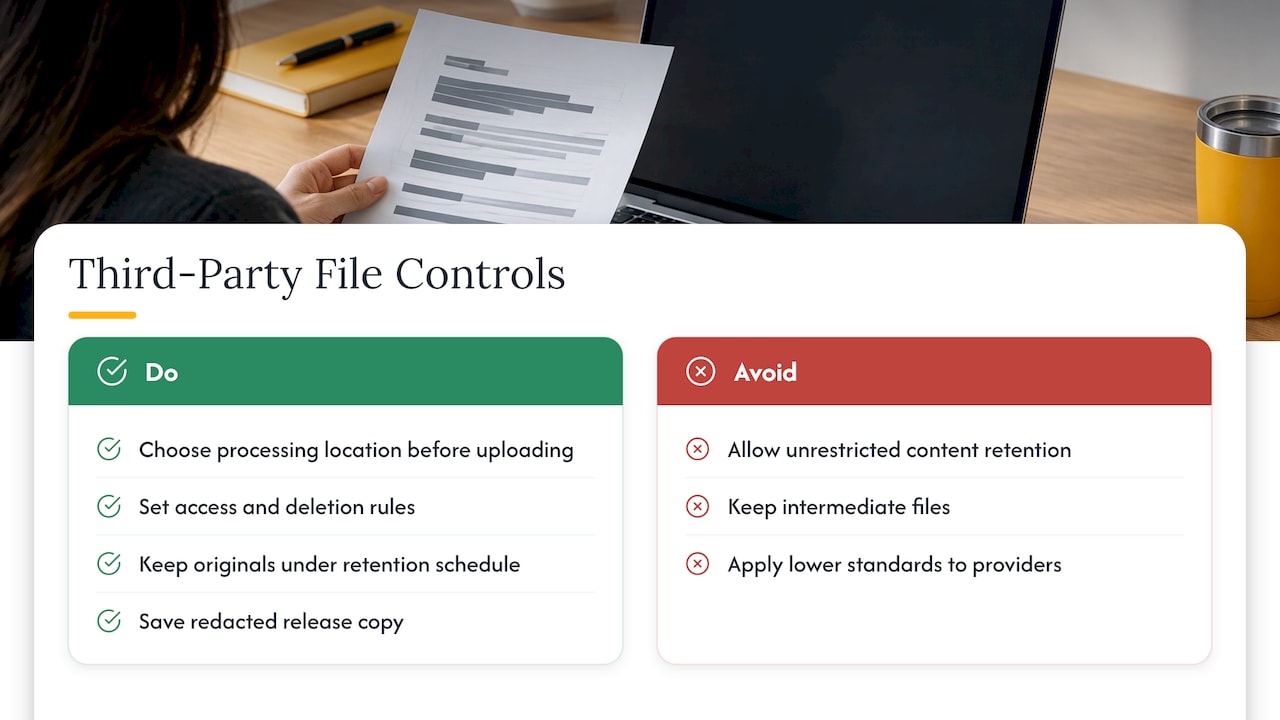
If you outsource any part of document handling, hold the provider to the same standard you hold your own staff to. Our guides to eDiscovery outsourcing risks and a BPO due diligence checklist list what counsel should control.
Perspective
Every redaction error we hear about from legal and healthcare operations leaders traces back to the same cause: the work was treated as a task for whoever had time, not as an operation with an owner.
Our view is that redaction belongs inside a documented workflow: a checklist the lawyer or privacy officer signs off on, trained people who do the marking, a different person who reviews, and a log that proves it. That is an operations design problem before it is a software problem.
This is the kind of work our Back-Office Legal Support and Managed Legal Team Extension services are meant for: dedicated, bilingual nearshore staff working in your processes, with your counsel setting the rules. In healthcare, our Patient Support & SOP Management service follows the same principle, that written procedures come first and people execute them consistently.
The result a firm should want is simple: fewer late-night filing scrambles, fewer exposed identifiers, and an audit trail it can show.
Daniela
Put the routine in the hands of a managed team
A redaction policy only protects you if someone runs it every day, including during surges. Altiam CX is a nearshore customer experience and operational services partner. For law firms, we offer Back-Office Legal Support, Managed Legal Team Extension, Legal Intake & Inquiry Handling and Client Follow-Ups & Case Communication. For healthcare organizations, we offer Managed Customer Support and Patient Support & SOP Management. These services are delivered by bilingual teams from Latin America.
See the legal practice services, the healthcare CX operations page, or talk to us through altiamcx.com about extending your team.

FAQ
Is a black box over text enough to redact a PDF?
No. A rectangle or highlight only covers the text, and the characters usually remain in the file where they can be copied or searched. Use a tool that applies redactions so the content is deleted, then sanitize metadata and test by copying and searching.
Who should review redacted documents?
A second person who did not do the original redaction. TSA’s directive requires an independent review by a different authorized redactor who knows the subject, and the IRS manual requires a documented second review. A fresh reviewer is far likelier to spot what the first person overlooked.
What do federal courts require filers to redact?
Unless a rule or court order says otherwise, current rules cover all but the last four digits of SSNs, taxpayer IDs and financial account numbers, birth dates other than the year, and minors’ names other than initials. Criminal cases add home addresses other than city and state. Amendments proposed in 2026 would tighten the rules for SSNs and similar numbers, so check the current rule text before filing.
Does redaction have to remove metadata too?
Yes. Author fields, comments, tracked changes, hidden rows, bookmarks and thumbnails can all carry the content you removed from the page. Sanitizing the file is the third step of the PDF Association’s process.
What should a redaction policy include?
It should name approved tools and authorized staff, require training, specify the checklist and the governing rule, mandate independent review, define the audit log, set escalation steps for errors, and state retention periods for originals and redacted copies.
Sources
- True Redaction vs Visual Masking, Apryse
- Is the Information You Just Redacted Really Gone?, PDF Association
- ICH Redaction: Points to Consider
- Notice of Redaction Responsibility, SEC
- Proper Redaction Techniques, U.S. District Court, Northern District of Alabama
- Verify Your Redaction Worked, Activate Security
- 2026 Report of the Judicial Conference on privacy rules
- Privacy Impact Assessment for the Litigation Support System, U.S. Department of Justice
- TSA Management Directive 1400.17, Document Redaction
- IRM 8.27.2 Redaction Support, Internal Revenue Service
- HIPAA Redaction guide, AI-Redact
- HIPAA and OCR compliance, AccountableHQ
- Data integrity verification methods
- Document retention rules