There is no single federal license for medical interpreters. What exists is a federal duty on healthcare organizations to provide a qualified interpreter to patients with limited English proficiency, a voluntary national certification that many employers treat as the benchmark, and a patchwork of state rules. If you run operations, patient experience or support for a healthcare organization, the practical question is how to meet that duty at the point of care and how to build bilingual patient support around it. This guide covers both. At Altiam CX we work on the second part: bilingual, managed patient support teams that keep scheduling, follow-ups and SOP-driven processes running in the patient’s language.
TL;DR
- Federal law (Section 1557, 45 CFR 92.201) requires covered healthcare entities to offer a qualified interpreter, free of charge, when interpretation is needed.
- National certification is not federally mandated, but organizations must assess an interpreter’s competencies before designating them as qualified.
- The most common national credential, the CMI, requires 40 hours of training, proof of language proficiency and two exams costing $190 and $300.
- Some states add their own rules, from response-time standards to state registries.
- Bilingual staff are not automatically qualified interpreters. Bilingual patient support teams complement interpreters in the front and back office.
Table of Contents
- What federal rules require of healthcare providers
- Is medical interpreter certification legally required?
- What a qualified interpreter must be able to do
- The certification path: what the CMI requires
- State rules add another layer
- Remote interpreting has its own standards
- Where bilingual patient support fits
- A language access checklist for operations leaders
- Perspective
- How Altiam CX supports the patient journey
- FAQ
- Sources
What federal rules require of healthcare providers
The core rule is 45 CFR 92.201, which implements Section 1557 of the Affordable Care Act. Covered entities must take reasonable steps to give meaningful access to people with limited English proficiency (LEP). Language assistance has to be free, accurate and timely. When interpretation is needed, the entity must offer a qualified interpreter. It may not require the patient to bring or pay for one.
Who is covered? HHS explains that the rule reaches any health program or activity receiving HHS funding, such as hospitals accepting Medicare and doctors receiving Medicaid, plus the Health Insurance Marketplaces and participating issuers. An LEP individual is someone whose primary language is not English and who has limited ability to read, write, speak or understand English.

When someone other than a qualified interpreter may be used
The exceptions are narrow:
- Emergencies: an unqualified adult or minor may be used temporarily when there is an imminent threat and no qualified interpreter is immediately available. A qualified interpreter who arrives later confirms or supplements the initial communication.
- Patient request: an adult may interpret if the patient privately asks for it with a qualified interpreter present, the adult agrees, the request and agreement are documented, and relying on that adult is appropriate.
Outside those cases, a family member, a passing bilingual employee or a child does not satisfy the rule.
The 2024 update and its timeline
HHS published the final Section 1557 rule on May 6, 2024, as summarized by a health law firm. The regulations in 45 CFR Part 92 took effect July 5, 2024, with staged compliance dates: 120 days for some provisions, one year for others, including the notice requirements, and plan-year timing for certain insurer provisions. Those dates have passed, so the working assumption for any covered organization today is that the rules apply in full.
The notice of language assistance
Under 45 CFR 92.11, a covered entity must publish a notice that language assistance is available, in English and at least the 15 languages most commonly spoken by LEP individuals in the relevant state or states. It goes out annually, on request, on the website, in clear physical locations in no smaller than 20-point sans serif type, and in specified electronic and written communications. This is a front-door obligation, and it often lands on patient experience and support teams.
Is medical interpreter certification legally required?
No, not at the federal level. As an AMA Journal of Ethics article notes, HHS does not require hospital staff serving as interpreters to hold national certification, but hospitals must assess competencies before designating someone a qualified interpreter. A Migration Policy Institute review of U.S. laws made the same point: no federal standards for health care interpreters exist, and state approaches vary.
That distinction matters when you write job descriptions and vendor requirements. The National Council on Interpreting in Health Care (NCIHC) separates two ideas in its FAQ:
- A qualified interpreter has been assessed for professional skills, shows a high level of proficiency in at least two languages, and has the training and experience to interpret accurately while following the NCIHC Code of Ethics and Standards of Practice.
- A certified interpreter has been certified as competent by a professional organization or government entity through rigorous testing on consistent criteria. A certificate of completion from a training program, or an agency screening test, is not certification.
The NCIHC also states that a bilingual employee without additional training is not a qualified interpreter. Certification is one strong way to evidence qualification. It is not the only legal route, but it gives auditors and compliance officers something concrete to point to.
What a qualified interpreter must be able to do
The federal definition in Subpart A of Part 92 is a useful checklist. A qualified interpreter:
- Has demonstrated proficiency in speaking and understanding both English and at least one other spoken language (two non-English languages for relay interpretation).
- Can interpret effectively, accurately and impartially, using specialized vocabulary, without changes, omissions or additions, while preserving tone and sentiment.
- Adheres to generally accepted interpreter ethics, including client confidentiality.
The NCIHC’s guide “What’s in a Word?” fills in the skills behind that definition: strong command of both working languages, familiarity with regionalisms, slang and idioms, the ability to work across registers, knowledge of anatomy, physiology and health care vocabulary, an understanding of confidentiality, informed consent and patients’ rights, and active listening and message conversion skills. It also stresses that being bilingual does not guarantee the ability to convert a message between languages.
An NCIHC working paper on initial assessment lists six components worth testing when you screen interpreters:
- Basic language skills in each working language
- Performance on ethical case studies
- Awareness of cultural issues
- Health care terminology: body, symptoms, illnesses, medications, specialties
- Integrated interpreting skills in a simulated cross-linguistic interview
- Translation of simple written material such as forms, signage or medication labels
The same paper explains why terminology testing matters: oral fluency does not ensure familiarity with health care terms, and misunderstanding them can contribute to misdiagnosis and poor outcomes.
The certification path: what the CMI requires
The credential most U.S. employers recognize is the Certified Medical Interpreter (CMI) from the National Board of Certification for Medical Interpreters. Based on its 2026 handbook, candidates need:
| Requirement | Detail |
|---|---|
| Age and education | At least 18, with a high school diploma or GED |
| Training | At least 40 hours of medical interpreter training (certificate of completion) or 3 college credit hours |
| English proficiency | A U.S. degree or diploma, or a test score such as TOEFL iBT 90+ or IELTS 7.0 |
| Target-language proficiency | A degree or diploma from a country where the language is spoken, 24+ semester credit hours, or an ACTFL Advanced Mid oral proficiency score |
| Application fee | $40, non-refundable, valid for one year |
| Written exam | $190, 51 multiple-choice questions, 75 minutes, in English |
| Oral exam | $300, 45 to 60 minutes: 12 mini scenarios and 2 sight-translation passages |
The written exam comes first, and passing it unlocks the oral exam. The CMI is offered in six languages: Spanish, Russian, Mandarin, Cantonese, Korean and Vietnamese. For other languages, the written exam earns a non-language-specific Hub-CMI, which expires after two years if a CMI becomes unavailable in the candidate’s language. The 40-hour training requirement cannot be waived, according to NBCMI’s prerequisites, whatever other experience a candidate has. Fees and rules change, so confirm them on the board’s page before budgeting for staff.
The New Hampshire Health & Educational Consortium notes that the NCIHC recommends at least 40 hours of training for a trained interpreter, which is why that figure shows up across programs.
State rules add another layer
Federal rules set the floor. Some states go further. A November 2026 review of statewide rules identifies eight states with their own requirements:
- California and Illinois: round-the-clock interpreter access for language groups making up at least 5% of a service area (Illinois to the extent possible).
- New York: interpreters available within 20 minutes for inpatients and outpatients and within 10 minutes in the emergency department.
- Oregon: publicly reimbursed providers must use the state’s Health Care Interpreter Registry.
- Washington: state testing and certification with a public database.
- Massachusetts and Rhode Island: competent interpreters in emergency care, and rules on who may interpret. The Migration Policy Institute notes both states prohibit hospitals from using children as interpreters.
- Minnesota: a voluntary roster.
That list covers statewide rules only. Other states may set requirements through licensing regulations, Medicaid contracts or program rules, so check with your compliance counsel or state health department for the states where you operate.
Remote interpreting has its own standards
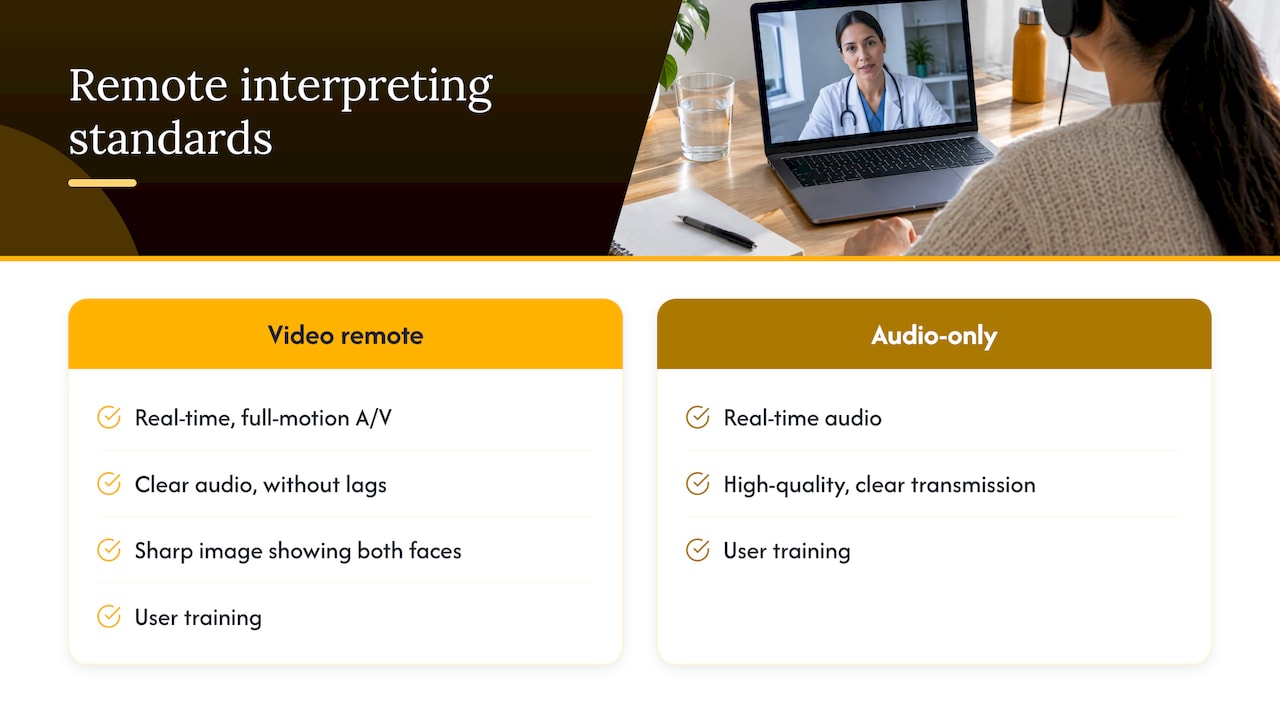
Many organizations meet demand through video or audio interpreting. Under 45 CFR 92.201, video remote interpreting must deliver real-time, full-motion video and audio without lags or choppy images, a sharp image large enough to show both faces, and clear audio, with training for users. Audio-only interpreting needs real-time, high-quality audio, clear transmission and user training. Staff training is part of compliance, not an afterthought.
Where bilingual patient support fits
Interpreting at the point of care and bilingual patient support are different jobs. The interpreter converts clinical communication between clinician and patient. Patient support covers everything around it: scheduling, reminders, eligibility questions, follow-up calls and answers about process. Both shape whether an LEP patient actually gets care, and the federal duty to provide meaningful access is measured across the patient’s experience, not only in the exam room. HHS frames the standard as flexible and context-specific, weighing the importance of the program and whether the entity has an effective language access plan.
A sensible division of work looks like this:
- Clinical encounters, consent, diagnoses, medication instructions: a qualified interpreter, as the rule requires.
- Phone and digital patient support: bilingual agents who are trained on your scripts, tone and escalation paths. Our guides on recruiting bilingual agents and what a strong bilingual training program covers explain how to hire and prepare them.
- Escalation: a clear SOP that moves any call that turns clinical to a qualified interpreter and a clinician rather than leaving an agent to improvise.
Patient data adds another requirement. Anyone supporting patients on your behalf handles protected health information, so HIPAA-compliant outsourcing belongs in the plan from day one. For contract terms, see our three priorities for Spanish and English support, and for the wider picture of language proficiency in nearshore teams.
A language access checklist for operations leaders
Use this to check where your organization stands:
- Define who qualifies. Write down your assessment criteria for interpreters, using the federal definition and the six NCIHC components, and keep the records.
- Remove ad hoc interpreting. Make sure no one defaults to family members, children or untrained bilingual staff outside the narrow exceptions, and document the exceptions when they occur.
- Publish the notice. Confirm the 92.11 notice is in the right languages, places and communications.
- Cover every channel. Check that in-person, video and phone interpreting all meet the technical and training standards.
- Map your state. Add any state response-time, registry or certification rules to your policy.
- Staff the surrounding journey. Make sure scheduling, billing and follow-up contacts are available in your patients’ languages, with a defined handoff to interpreters.
- Measure it. Track wait times, abandoned calls and complaint themes by language. Our overview of healthcare service quality shows which indicators administrators use.
Perspective
Most compliance conversations about language access stop at the exam room. We think that is only half of the patient’s experience. A patient who cannot book an appointment, understand a billing call or get a follow-up in their own language may never reach the interpreter at all.
That is why we design healthcare support around the full journey. Bilingual agents, clear SOPs and a defined escalation path to qualified interpreters let a clinical organization keep language access consistent from first call to follow-up. Our nearshore model, with teams in Latin America, is built around cultural alignment and disciplined execution, so patients hear the tone and clarity they expect.
The organizations that handle this well treat language access as an operating discipline with measurable standards, not a one-off purchase. That is the approach we bring to every healthcare team we support.
Daniela
How Altiam CX supports the patient journey
Our Managed Customer Support and Patient Support & SOP Management services give healthcare organizations bilingual, managed teams for the patient-facing work that surrounds clinical interpreting, from first contact to follow-up. If you are weighing how to scale that capacity, our healthcare team extension guide walks through the model, and our services page lists the full range.

FAQ
Do medical interpreters have to be certified in the U.S.?
Not under federal law. HHS does not require national certification, but covered organizations must assess an interpreter’s competencies before treating them as qualified. Some states add their own certification or registry rules, so check the state where you operate.
Can a bilingual employee act as a medical interpreter?
Only if they have been assessed and trained as a qualified interpreter. The NCIHC states that a bilingual employee without additional training is not qualified. Bilingual staff are valuable in patient support roles, with clinical interpreting handed to a qualified interpreter.
How long does it take to become a certified medical interpreter?
The fixed element is at least 40 hours of training, followed by proof of English and target-language proficiency and two exams. Total time depends on how fast a candidate completes training and schedules the written and oral exams, so there is no single figure. Check the current NBCMI handbook for the steps and fees.
Can a patient’s family member interpret instead?
Usually not. A patient may privately request that an adult interpret, but only with a qualified interpreter present, the adult’s agreement and documentation of both. Minors and unqualified adults may be used only briefly in an emergency with an imminent threat when no qualified interpreter is immediately available.
Who must follow the federal language access rules?
Health programs and activities that receive HHS funding, including hospitals accepting Medicare and doctors receiving Medicaid, along with the Health Insurance Marketplaces, participating issuers and HHS-administered programs. The regulations took effect July 5, 2024.
Sources
- 45 CFR 92.201, Meaningful access for individuals with limited English proficiency
- 45 CFR Part 92, Subpart A, General Provisions
- 45 CFR 92.11, Notice of availability of language assistance services
- HHS, Section 1557: Ensuring Meaningful Access for Individuals with Limited English Proficiency
- AMA Journal of Ethics, Clinicians’ Obligations to Use Qualified Medical Interpreters
- NCIHC, FAQ on translators and interpreters
- NCIHC, What’s in a Word? guide
- NCIHC, Guide to Initial Assessment of Interpreter Qualifications
- NBCMI, Certified Medical Interpreter handbook
- NBCMI, CMI Prerequisites
- Migration Policy Institute, The Medical Tongue: U.S. Laws
- SNHAHEC, Interpretation
- Medical Interpreter Laws: Federal Rule and 8 State Rules
- Holland & Hart, New ACA 1557 Non-Discrimination Rules