
TL;DR:
- Account servicing outsourcing involves transferring the management of customer financial accounts to an external provider for tasks like payments, compliance, and inquiries. It offers benefits such as cost savings, specialized expertise, scalability, and improved customer experience. Successful implementation requires clear scope definition, strong vendor relationships, and ongoing performance monitoring.
Account servicing outsourcing is defined as transferring the administrative management of customer financial accounts, loans, or records to an external third-party provider. This model covers payment collection, balance tracking, escrow handling, and inquiry resolution. For business leaders evaluating operational efficiency and customer experience, understanding what is account servicing outsourcing means knowing exactly which functions leave your organization and what you gain in return. The industry term for this practice is “account management outsourcing,” and it applies across financial services, lending, insurance, and any business that manages ongoing customer account relationships at scale.
What is account servicing outsourcing and what does it cover?
Account servicing outsourcing transfers day-to-day account management responsibilities to a specialized external provider. Account services cover managing customer financial accounts, including payments, compliance, and reporting. This is distinct from general customer service. The external provider takes ownership of defined operational tasks while your internal team retains strategic oversight and client relationships.

The scope varies by industry and contract, but the core functions remain consistent across sectors. Mortgage companies, credit card issuers, and loan originators were among the earliest adopters of this model. Today, the practice extends to subscription businesses, utilities, and any organization managing recurring account activity at volume.
Loan servicing includes collecting payments, managing escrow, processing statements, and handling borrower inquiries. These responsibilities extend throughout the life of the loan and may be transferred between servicers. That transferability is a defining feature of outsourced account servicing: the work is structured, documented, and portable.
What tasks and processes are included in account servicing outsourcing?
The operational scope of account management outsourcing divides into two clear categories: back-end processes and customer-facing services.
Back-end processes handle the infrastructure of account management:
- Payment processing and reconciliation
- Escrow account management and disbursements
- Billing, invoicing, and statement preparation
- Compliance monitoring and regulatory reporting
- Data entry, record maintenance, and audit trail management
- Transaction processing and error resolution
Customer-facing account services handle direct interactions:
- Inbound inquiry handling and account updates
- Refund processing and dispute resolution
- Account status communications and notifications
- Escalation management for complex account issues
Back-office account servicing includes compliance, reporting, and transaction processing tasks that underpin front-facing customer account activities. Effective back-office outsourcing improves overall efficiency and ensures regulatory adherence. These two layers work together. A breakdown in back-end reconciliation will surface as a customer-facing complaint within days.
Compliance is a particularly strong driver for outsourcing this function. Regulatory requirements in financial services, healthcare billing, and insurance change frequently. External providers who specialize in account servicing maintain dedicated compliance teams and updated technology platforms. Your organization benefits from that expertise without building it internally.
Pro Tip: When scoping an outsourcing engagement, map your current account servicing workflows before you approach vendors. Providers who see a documented process give you sharper proposals and more accurate SLA commitments.
What are the primary benefits of outsourcing account servicing?
The case for outsourcing account servicing rests on six measurable advantages that business leaders consistently cite when evaluating the model.
-
Cost efficiency. Building an in-house account servicing team requires hiring, training, technology investment, and ongoing management overhead. Outsourced accounting and servicing offers businesses broader coverage and specialized experience at a fraction of the cost of in-house teams. The savings compound when you factor in reduced turnover costs and eliminated technology licensing fees.
-
Access to specialized expertise. External providers hire and train specifically for account servicing functions. Your organization accesses that depth of knowledge immediately rather than building it over years.
-
Scalability around growth and seasonality. A mortgage servicer processing 500 loans per month and 5,000 loans per month needs very different staffing levels. Outsourced providers absorb that variability without requiring you to hire and lay off staff.
-
Improved customer experience. Account servicing outsourcing improves customer retention by ensuring timely payments, account accuracy, and effective communication. Professional servicing teams trained specifically for these interactions deliver more consistent outcomes than generalist staff handling account work as a secondary responsibility.
-
Risk reduction and compliance support. Outsourced financial services allow businesses to access higher-level financial expertise and manage compliance and operational risks. Providers carry that regulatory burden as a core competency, not an afterthought.
-
Management focus on core activities. When your leadership team stops managing payment reconciliation workflows, they redirect that attention to product development, sales, and customer growth. That reallocation of focus is often the most undervalued benefit of the model.
How does account servicing outsourcing compare to in-house management?
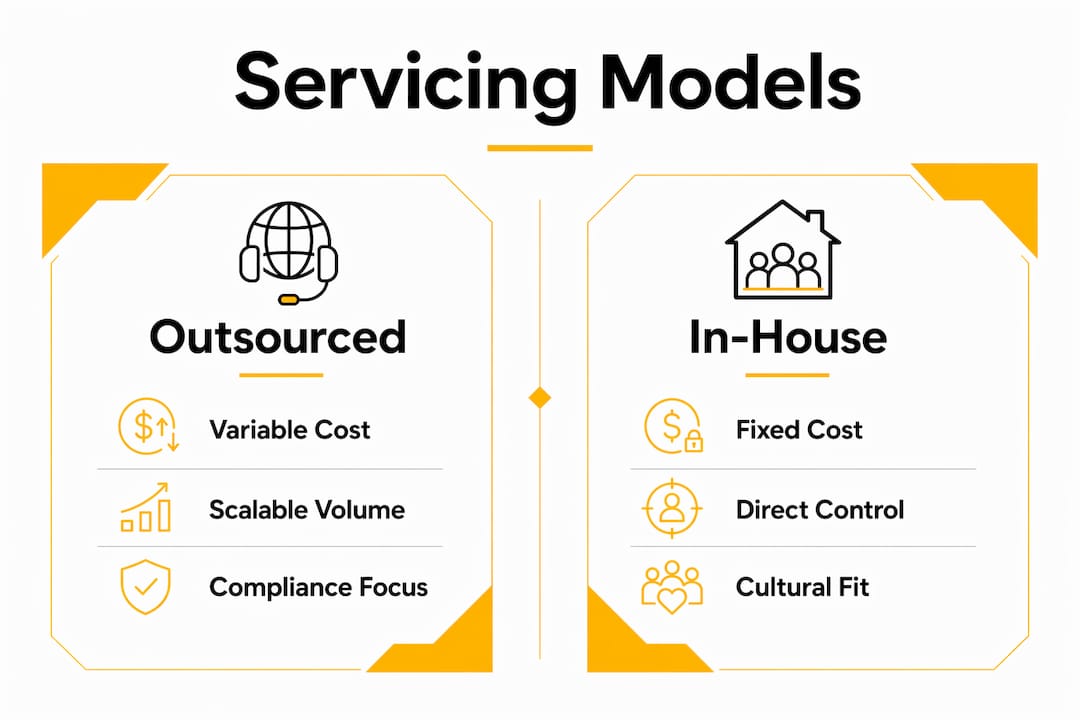
The outsourced versus in-house decision is not binary. Most organizations land on a hybrid model where high-volume, rules-based tasks go to an external provider while relationship-sensitive or strategically sensitive functions stay internal. The right split depends on your volume, risk tolerance, and growth trajectory.
| Criteria | Outsourced servicing | In-house servicing |
|---|---|---|
| Cost structure | Variable, scales with volume | Fixed, regardless of volume |
| Expertise depth | Specialized, immediately available | Built over time, dependent on retention |
| Flexibility | High, adjusts to seasonal demand | Low, constrained by headcount |
| Operational control | Governed by SLA and contract | Direct, real-time management |
| Compliance coverage | Provider maintains regulatory updates | Internal team must track changes |
| Technology access | Provider’s platform, often enterprise-grade | Internal investment required |
The hybrid model works well for organizations in growth phases. You outsource back-office operations like reconciliation and compliance reporting while keeping account relationship management internal. As volume grows, you expand the outsourced scope rather than hiring proportionally.
Long-term partnership orientation matters more than most leaders expect. Providers who understand your account structure, customer base, and compliance environment deliver better outcomes than those engaged on short project cycles. The onboarding investment pays off over time, not in the first quarter.
What best practices should business leaders follow when implementing account servicing outsourcing?
Successful implementation depends on decisions made before the contract is signed, not after.
-
Evaluate vendor expertise and technology. Ask providers to demonstrate their compliance tracking systems, data security certifications, and technology platforms. A vendor with outdated infrastructure creates risk, not efficiency.
-
Define scope and SLAs with precision. Vague service agreements produce vague results. Specify response times, error rates, escalation protocols, and reporting cadences in writing before work begins.
-
Establish data security and compliance protocols. Account servicing involves sensitive financial data. Confirm that your provider meets relevant standards such as SOC 2, PCI DSS, or applicable industry regulations before transferring any data.
-
Plan communication workflows from day one. Decide how your team and the provider will communicate daily, weekly, and during escalations. Undefined communication channels are the most common source of friction in outsourcing relationships.
-
Monitor performance continuously and adjust. Set a review cadence, quarterly at minimum, to assess SLA performance, error rates, and customer satisfaction metrics. Use that data to refine the engagement rather than waiting for problems to surface.
Outsourcing is a continuous operational relationship, not a one-time project. Viewing it as a project rather than an ongoing partnership leads to misalignment and data inconsistency. The organizations that extract the most value from account servicing outsourcing treat their provider as an extension of their operations team, not a vendor they check in with quarterly.
Pro Tip: Build a shared performance dashboard with your outsourcing partner from the start. When both teams see the same data in real time, accountability is automatic and disputes about performance become rare.
Nearshore outsourcing adds another dimension worth considering. Providers in geographically close regions with cultural alignment and overlapping time zones reduce the coordination friction that offshore arrangements often create. For nearshore advantages over offshore options, the combination of cost efficiency and operational proximity is a strong argument for business leaders managing complex account servicing programs.
Key takeaways
Account servicing outsourcing delivers the greatest value when treated as a continuous operational partnership, not a cost-cutting project, with clearly defined scope, performance metrics, and shared accountability from the start.
| Point | Details |
|---|---|
| Core definition | Account servicing outsourcing transfers payment, compliance, and inquiry management to a specialized external provider. |
| Two-layer scope | Back-end processes and customer-facing services must both be scoped clearly to avoid gaps in coverage. |
| Primary benefit | Cost efficiency and access to specialized expertise are the strongest drivers for most business leaders. |
| Outsourced vs. in-house | Hybrid models work best, outsourcing high-volume rules-based tasks while keeping relationship functions internal. |
| Implementation priority | Define SLAs, data security protocols, and communication workflows before the engagement begins. |
Why most leaders underestimate what account servicing outsourcing actually requires
The most common mistake I see business leaders make is treating account servicing outsourcing as a procurement decision rather than an operational one. They evaluate vendors on price and references, sign a contract, and then expect the results to manage themselves. That approach fails more often than it succeeds.
What actually works is treating the external provider as a team you manage differently, not a vendor you monitor from a distance. That means investing time in onboarding, building shared reporting, and reviewing performance data together. The providers who deliver consistently are the ones whose clients show up as genuine operational partners.
The nearshore model has changed this dynamic significantly. When your account servicing team operates in a similar time zone, speaks the same business language, and shares cultural context with your customers, the coordination overhead drops substantially. That proximity makes it easier to build the kind of working relationship that produces long-term results.
The other shift worth noting is technology integration. The best account servicing providers now bring enterprise-grade platforms that most mid-size businesses could not afford to build or license independently. That technology access is increasingly a primary reason to outsource, not just a secondary benefit. Business leaders who recognize this are making outsourcing decisions with a longer time horizon and getting proportionally better outcomes.
— Daniela
How Altiamcx supports your account servicing outsourcing goals
Altiamcx is a nearshore customer experience and operational services partner built for business leaders who need account servicing, back-office operations, and customer care delivered with measurable results.

Altiamcx combines cultural alignment, disciplined execution, and performance frameworks that produce outcomes you can track. One software platform partner improved productivity by 89% after migrating operations to Altiamcx. An orthodontic services provider saw measurable gains in customer experience outcomes through the same model. If you are evaluating account management outsourcing options for 2026, Altiamcx offers the operational depth and nearshore proximity to make that transition work from day one.
FAQ
What is the account servicing definition in financial services?
Account servicing refers to the ongoing administrative management of customer financial accounts, including payment collection, balance tracking, escrow handling, and inquiry resolution. It covers both back-end processing and customer-facing interactions throughout the life of an account.
How does account servicing outsourcing work in practice?
A business contracts a specialized third-party provider to handle defined account management tasks under a service-level agreement. The provider manages daily operations such as payment processing, compliance reporting, and customer inquiries while the business retains strategic oversight.
What is the difference between account servicing and general customer service?
Account servicing focuses specifically on the financial and administrative management of customer accounts, including compliance and transaction processing. General customer service handles broader inquiries and support interactions that are not tied to account-level financial management.
What are the biggest risks of account servicing outsourcing?
The primary risks are data security exposure, compliance gaps, and misaligned service expectations. These risks are mitigated by selecting providers with verified security certifications, defining precise SLAs, and treating the engagement as an ongoing operational relationship rather than a one-time project.
Is nearshore outsourcing better than offshore for account servicing?
Nearshore outsourcing offers time zone alignment, cultural proximity, and lower coordination friction compared to offshore arrangements. For account servicing functions that require real-time communication and compliance awareness, nearshore providers typically deliver more consistent results.