
TL;DR:
- Most CX leaders rely on satisfaction scores, but these do not reveal the underlying causes of service quality issues. Effective measurement requires understanding expectations versus perceptions through tools like the SERVQUAL model to identify true gaps. Combining perception, operational, and outcome metrics enables organizations to drive meaningful, ongoing service improvements rather than superficial fixes.
Most CX leaders believe they already have an answer to why measure service quality: collect satisfaction scores, track the trend, act when numbers drop. That assumption is where improvement programs stall. Satisfaction scores tell you how a customer felt in a single moment. They rarely explain why they felt that way, or what gap between what they expected and what they experienced actually drove the result. In healthcare, legal services, and e-commerce, where interactions are complex and stakes are high, surface-level measurement is not just insufficient. It actively misleads.
Table of Contents
- Understanding the true nature of service quality
- How measuring gaps between expectations and perceptions improves service
- The risks and nuances of relying on customer surveys and ratings
- Leveraging service quality measurement to align operations with customer expectations
- Building a culture of continuous service quality improvement through measurement
- The overlooked truth about what truly drives service quality measurement success
- How Altiam CX helps drive measurable service quality improvements
- Frequently asked questions
Understanding the true nature of service quality
To fully appreciate why measurement matters, you first need to grasp the complexities inherent in defining and perceiving service quality.
Unlike a product, a service cannot be inspected before delivery. A patient cannot evaluate a diagnosis before receiving it. A legal client cannot assess the quality of counsel before the advice is given. This is what makes service quality harder to measure than product quality: it depends on client cooperation, changing circumstances, and external factors outside provider control.
Service quality is ultimately a perception, shaped by what customers expected going in and what they experienced coming out. Three elements consistently influence that perception:
- Communication: Did the provider set clear, accurate expectations before and during service delivery?
- Responsiveness: Did the team address needs at the right time, with the right information?
- Empathy: Did customers feel heard, respected, and understood throughout the interaction?
When any of these fall short of expectation, a gap opens. That gap is what dissatisfaction actually measures. Understanding why improve service quality starts with recognizing that the service itself and the customer’s experience of it are two different things, and measurement must capture both.
The most common mistake leaders make is defining service quality by their internal standards alone. Your team may execute a process flawlessly and still leave the customer dissatisfied because the customer’s expectation was never accounted for. Measurement without a perception lens simply confirms your operations, not your outcomes.
How measuring gaps between expectations and perceptions improves service
Understanding what service quality entails sets the stage for how effective measurement uncovers the root causes of dissatisfaction.
The SERVQUAL model remains one of the most diagnostic tools available to CX leaders. Rather than asking “are customers happy,” it asks “where does what we deliver fall short of what customers expected?” The model compares expectations with perceptions across five specific dimensions, revealing gaps that guide targeted improvement rather than generic fixes.
The five SERVQUAL dimensions:
| Dimension | What it measures |
|---|---|
| Tangibles | Physical or digital environment, materials, appearance of personnel |
| Reliability | Ability to deliver promised service accurately and consistently |
| Responsiveness | Willingness to help and provide prompt service |
| Assurance | Knowledge, courtesy, and ability to inspire trust |
| Empathy | Individualized attention and genuine care for the customer |
The Gap Model built around these dimensions identifies five structural failures that explain why service quality breaks down. For CX leaders, the most actionable gaps are:
- The knowledge gap: Management misunderstands what customers actually expect.
- The standards gap: Internal standards do not reflect those expectations, even when leadership understands them.
- The delivery gap: Actual service delivery falls short of those internal standards.
- The communication gap: Marketing or intake processes promise more than the service can deliver.
- The perception gap: The final gap between what was delivered and what the customer believed they received.
Pro Tip: Run a SERVQUAL assessment annually, not just during a crisis. The gaps that matter most in regulated industries like healthcare often shift as patient or client expectations evolve faster than organizational standards do.
Applying service quality strategies grounded in this gap framework gives you a prioritization tool. Instead of trying to fix everything at once, you can direct resources at the specific dimension causing the largest expectation-to-perception mismatch in your context.
The risks and nuances of relying on customer surveys and ratings
With this diagnostic understanding, it is essential to recognize why conventional surveys alone can misrepresent true service quality and distort improvement efforts.

Here is an uncomfortable fact about post-service surveys: they capture only immediate impressions, which may encourage employees to optimize visible friendliness over technical competence. A warm, personable interaction scores well. A technically accurate but less warm interaction scores lower, even when the technical outcome was superior. In healthcare or legal settings, this is not a minor data quirk. It is a governance risk.
Consider what this means in practice for CX leaders:
- Agents or clinicians learn, consciously or not, which behaviors drive survey scores up.
- Those behaviors may not align with the actual quality of service being delivered.
- Leaders who tie performance management to survey results can inadvertently reward surface-level performance.
- True service failures in accuracy, compliance, or outcome can remain invisible to measurement systems built purely on perception.
“When credence quality, the type of quality that only becomes apparent after the service is over, is excluded from measurement, organizations risk building improvement programs on incomplete foundations.” — Adapted from Syracuse University Whitman School research, 2026.
Pro Tip: In healthcare and legal contexts, pair customer perception surveys with outcome metrics: readmission rates, case resolution quality reviews, or compliance audit results. Perception tells you how the experience felt. Outcome data tells you whether it worked.
The impact of service quality measurement depends entirely on what you choose to measure and how you use those findings. Customer experience management done well means building measurement systems that are honest about the difference between a good interaction and a good service.
Leveraging service quality measurement to align operations with customer expectations
Knowing survey pitfalls, CX leaders can turn to well-rounded measurement and operational metrics to govern service quality effectively.
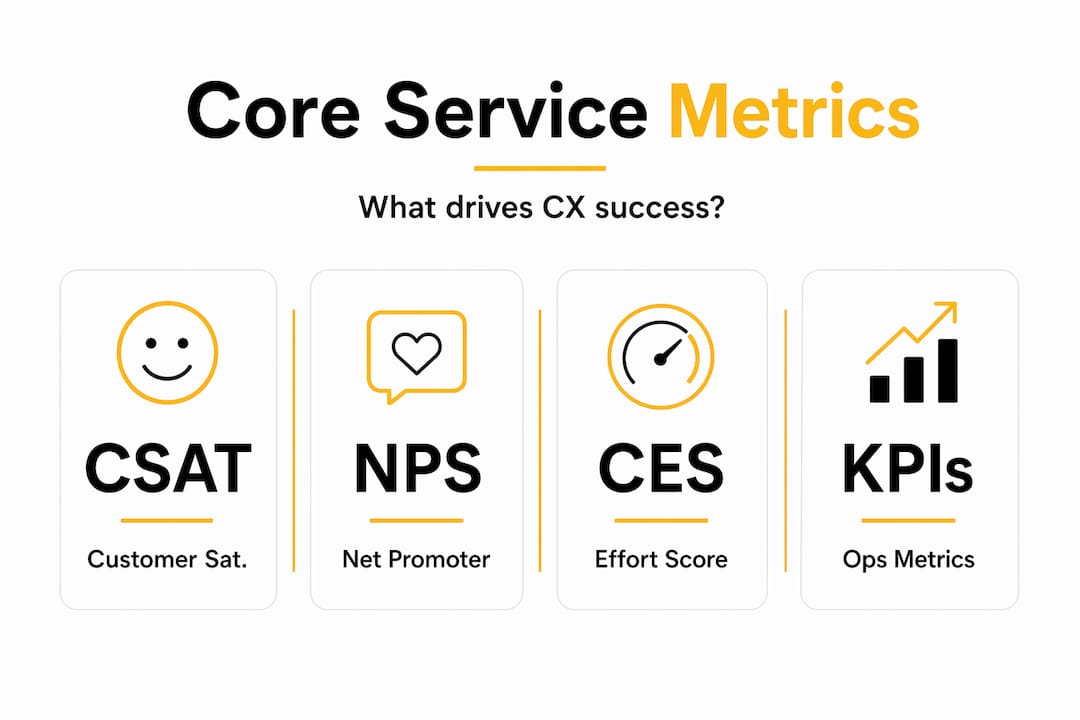
Targeted metrics like CSAT, NPS, CES, and operational KPIs drive better governance by revealing customer sentiment, business impact, and where friction is costing you both customers and revenue. The key is selecting metrics that map to your specific service model rather than defaulting to industry-wide benchmarks that may not reflect your customers’ priorities.
A practical framework for multi-dimensional measurement:
| Metric type | Examples | What it reveals |
|---|---|---|
| Perception metrics | CSAT, NPS, CES | How customers feel about the experience |
| Operational metrics | First contact resolution, handle time, error rate | Where process execution breaks down |
| Outcome metrics | Retention rate, repeat issue rate, compliance score | Whether the service actually delivered results |
| Volume metrics | Contact rate, escalation frequency | Where friction is concentrated in the journey |
In e-commerce specifically, contact volume and first contact resolution rates systematically reduce post-purchase friction and improve service consistency. When a spike in post-purchase contacts is tracked to a specific product category or fulfillment partner, that is not a customer satisfaction problem. It is an operational failure visible only through measurement.
Benefits of measuring service quality across operational and perception dimensions include:
- Pinpointing exactly where in the customer journey dissatisfaction originates
- Identifying service delivery inconsistencies across channels or teams
- Justifying resource investment in specific improvement areas with data
- Detecting early warning signs before they escalate into attrition
High-touch customer care strategies in healthcare, for instance, require a different measurement mix than a transactional e-commerce operation. Knowing how to assess service quality in your specific context is what separates measurement programs that drive change from those that generate dashboards no one acts on.
Research also confirms that organizations using customer feedback for revenue growth consistently outperform competitors who treat feedback as a compliance exercise rather than a strategic input.
Building a culture of continuous service quality improvement through measurement
Having operational governance in place, the final step is fostering a culture where measurement drives ongoing service quality enhancements.
Moving from reactive to proactive service management requires continuously analyzing quality, effectiveness, and performance to find meaningful improvement levers, not just generating periodic reports. That shift is cultural as much as it is technical.
Here is a four-step cycle that CX leaders in regulated industries consistently find effective:
- Collect across dimensions. Gather perception, operational, and outcome data simultaneously. No single source tells the complete story.
- Integrate across teams. Break down data silos between customer care, operations, compliance, and product. Service failures rarely have one owner.
- Prioritize by impact. Rank gaps by their effect on customer retention, regulatory exposure, or revenue, not by which are easiest to fix.
- Validate after action. After implementing a change, run the measurement cycle again to confirm the gap narrowed and did not simply shift to another dimension.
Common pitfalls that undermine measurement cultures include chasing vanity metrics (high survey volume with no improvement in outcomes), siloing data by department so patterns across the journey stay invisible, and failing to close the feedback loop with frontline teams who can actually act on the findings.
Pro Tip: Assign a single owner for each identified gap, not a committee. Collective accountability in measurement programs tends to produce collective inaction. One person responsible for closing a specific gap, with a deadline and defined success criteria for service quality assessment, moves the needle far faster.
Evidence-based service quality strategies build on exactly this loop: measure, diagnose, act, and measure again. Done consistently, this cycle transforms measurement from a reporting function into the engine of genuine service improvement.
The overlooked truth about what truly drives service quality measurement success
Most CX measurement programs are designed to surface problems. Fewer are designed to survive success. Here is what that means in practice: once a team knows which behaviors drive high scores, they will produce those behaviors. This is not cynicism. It is human nature responding to incentive systems.
The risk is what researchers from Syracuse University describe when they note that credence quality becomes visible only after surveys close, creating misaligned incentives toward superficial friendliness over core service competence. In plain terms: the qualities that actually determine service quality in healthcare, law, or complex e-commerce are often invisible to the customer until long after they filled out the survey.
This creates a genuine paradox. The better your survey scores, the more confident you may feel. But confidence built on experience quality metrics alone, rather than credence quality, can mask technical deterioration happening beneath the surface. Organizations that score well on friendliness while failing on accuracy or compliance are often the last to know.
The answer is not to stop measuring customer perception. It is to treat perception data as one signal among several, not as the final word. Leaders who protect against this trap build measurement systems that explicitly value what customers cannot easily evaluate: technical accuracy, regulatory compliance, the quality of advice given under pressure.
Improving service quality at a structural level requires the courage to measure things that may not look good on a dashboard, and to act on what you find even when your survey scores are trending upward. That is the discipline that separates organizations that genuinely improve from those that simply get better at appearing to.
How Altiam CX helps drive measurable service quality improvements
Understanding the criteria for service quality assessment is one thing. Executing a measurement-driven improvement program across a complex operation is another challenge entirely.

Altiam CX works with CX leaders in healthcare, legal, and e-commerce to implement performance frameworks that integrate customer perception data with operational and outcome metrics. Our approach includes gap analysis grounded in SERVQUAL principles, giving your team a diagnostic view rather than a score card. Case studies like our tech support productivity improvement, orthodontic CX transformation, and nearshore team extension work demonstrate what happens when measurement is paired with disciplined execution. If you are ready to move from dashboards to decisions, we can help you build the system that makes measurement count.
Frequently asked questions
Why is measuring service quality important for customer experience leaders?
Measuring service quality identifies gaps between expectations and perceptions, enabling leaders to target improvements that enhance satisfaction and loyalty rather than guessing at root causes.
Can customer surveys alone provide an accurate measure of service quality?
No. Surveys capture immediate impressions but frequently miss technical quality and long-term service outcomes, so perception data should always be paired with operational and outcome metrics.
What are some key metrics used to measure service quality?
Core metrics include CSAT, NPS, CES, and operational KPIs such as first contact resolution and error rates, used together to provide a complete picture of service performance.
How can measuring service quality improve operations in e-commerce?
Tracking contact volume and first contact resolution reveals where post-purchase friction is concentrated, enabling teams to address root causes systematically rather than responding to individual complaints.
What should leaders avoid when implementing service quality measurement?
Leaders should avoid measuring too many or the wrong metrics, relying exclusively on immediate customer ratings, and failing to connect measurement findings to specific, accountable improvement actions.