
TL;DR:
- Reducing customer friction improves loyalty by addressing obstacles that cause additional effort and dissatisfaction. Customer Effort Score (CES) effectively measures this effort, predicting loyalty better than satisfaction and guiding targeted improvements. Implementing continuous, cross-departmental friction management through technology and human connection fosters trust, minimizes costs, and enhances customer experience sustainability.
Most business leaders spend enormous energy trying to delight customers. The smarter move is to stop exhausting them. Understanding what is friction reduction in customer experience means recognizing that every obstacle a customer encounters — a confusing form, a repeat phone call, a blocked self-service portal — predicts churn far more reliably than a satisfaction survey ever will. Customer Effort Score (CES) outperforms satisfaction as a loyalty predictor, and that single insight should reshape how healthcare, legal, e-commerce, and finance organizations approach every customer interaction they design.
Table of Contents
- Understanding friction and its impact on customer experience
- How Customer Effort Score (CES) reveals friction’s effect on loyalty and costs
- Sector-specific friction challenges and benchmarks in healthcare, legal, e-commerce, and finance
- Proven friction reduction strategies and best practices for operational efficiency
- Balancing necessary friction and customer connection for trust and loyalty
- Why friction reduction is a discipline every business leader must master today
- Discover nearshore customer experience solutions to reduce friction and boost loyalty
- Frequently asked questions
Key Takeaways
| Point | Details |
|---|---|
| Friction defined | Friction includes any obstacle that increases customer effort and hurts loyalty in key sectors like healthcare and finance. |
| CES metric | Customer Effort Score quantifies effort and predicts loyalty better than satisfaction, guiding friction reduction. |
| Sector benchmarks | Healthcare, legal, e-commerce, and financial sectors have unique friction challenges that impact CES differently. |
| Effective strategies | Reducing form fields, improving self-service, and integrating behavioral data enable impactful friction reduction. |
| Balanced approach | Intentional friction and human touchpoints build trust beyond efficiency, enhancing customer loyalty. |
Understanding friction and its impact on customer experience
To grasp how friction reduction drives success, let’s define friction and its measurable impacts.
Friction describes any obstacle that slows, confuses, or discourages a customer on the way to completing a goal. These are not dramatic failures. They are the small, accumulated annoyances that quietly erode trust: a five-page intake form when two fields would do, a phone tree that never routes correctly, a digital portal that requires re-entering data the company already has.
The consequences are severe and measurable. 96% of high-effort customers are disloyal compared to just 9% of low-effort customers, and poor customer experiences put roughly $3 trillion in global sales at risk annually. Those numbers are not abstract — they represent patients who switch providers, clients who don’t renew retainers, and shoppers who abandon carts.
Common friction points across these sectors include:
- Healthcare: Appointment scheduling requiring multiple calls, patient portals with poor navigation, and referral processes that demand repeated documentation.
- Legal: Intake workflows that ask the same questions across multiple touchpoints, slow response windows for routine client updates, and opaque billing processes.
- E-commerce: Checkout forms with excessive required fields, unclear return policies, and limited payment options creating drop-off at the final step.
- Finance: Multi-step identity verification for routine transactions, siloed account views requiring customers to contact multiple departments, and call routing that fails to recognize existing relationships.
“The effort a customer expends to resolve an issue is one of the strongest predictors of whether they will stay or leave — stronger, in fact, than whether they left satisfied.”
Practicing minimizing obstacles in customer journeys is not about making things feel nice. It is about removing every requirement that does not directly serve the customer’s goal.

How Customer Effort Score (CES) reveals friction’s effect on loyalty and costs
With friction defined, we turn to CES as the key metric that reveals its deep impact.
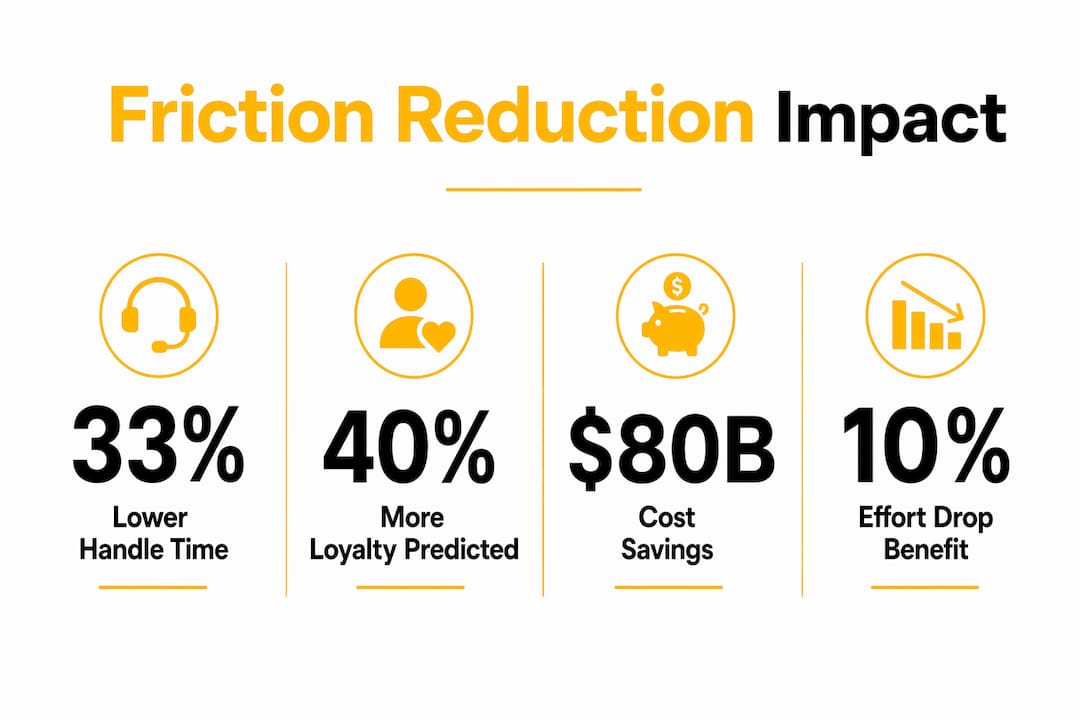
CES measures how much effort a customer must exert to resolve an issue or complete a transaction. Scores above 5 on a 7-point scale indicate low effort, and the metric predicts loyalty 40% better than satisfaction scores alone. That gap matters. A patient who rated their experience as satisfactory but had to call three times is far more likely to leave than one who resolved everything in a single interaction.
Here is how to use CES effectively as a friction detection tool:
- Measure at the interaction level. Send CES surveys immediately after specific touchpoints — a call, a checkout, a claims submission — rather than at the relationship level where the signal gets diluted.
- Segment by channel and journey stage. A high-effort score on your web portal tells you something different than a high-effort score after a live agent interaction. Segment to find where the friction lives.
- Connect CES to operational data. Repeat contact rates, average handle time, and escalation rates should move in correlation with CES. If they don’t, your measurement process needs calibration.
- Set targets by sector benchmark. Healthcare averages 4.8/7, financial services 5.2/7, and e-commerce 5.5/7. Knowing where you stand against your sector is essential context for prioritizing fixes.
- Track CES over time, not just at a point in time. Friction reduction is iterative. CES trending upward over six months is the leading indicator that your investments are working.
The financial case for using CES to improve loyalty is direct. Customer support AI reduces handle time by up to 33%, contributing to an estimated $80 billion in global contact center cost reduction. Pair that with first contact resolution improvements, and the operational savings compound quickly.
Pro Tip: Don’t rely solely on post-interaction surveys. Combine CES data with call recordings and session replay tools from AI-driven contact center solutions to watch friction happen in real time, then fix the root cause rather than the symptom.
Sector-specific friction challenges and benchmarks in healthcare, legal, e-commerce, and finance
To address friction effectively, consider the unique challenges each sector faces detailed next.
Friction does not look the same across industries, and neither do the consequences. The table below provides a reference point for where each sector currently stands and what is at stake:
| Sector | Average CES (out of 7) | Primary friction points | Impact of reducing effort by 10% |
|---|---|---|---|
| Healthcare | 4.8 | Appointment scheduling, portal navigation, referrals | 15% increase in repurchases/repurchase likelihood |
| Financial services | 5.2 | Identity verification, multi-department routing | 15% boost in return transactions |
| E-commerce | 5.5 | Checkout abandonment, return complexity | 15% rise in repeat purchases |
| Legal | Below sector average | Intake redundancy, billing opacity, slow updates | Significant retention improvement |
Source: CES benchmarks by sector
The healthcare sector’s lower CES benchmark reflects genuine structural complexity. Patients often interact across multiple care settings, each with its own system, staff, and communication style. The result is a journey that feels fragmented even when individual interactions are pleasant. Repeated contacts double perceived effort, and a 10% improvement in first contact resolution can cut total call volume by 30%, which benefits both patients and clinical staff who carry the burden of re-explaining situations.
For financial services, the friction most commonly reported by customers centers on verification. Multi-factor authentication and compliance-driven identity checks are necessary, but how they are implemented varies enormously in effort. Smart sequencing and pre-populated fields for known customers can preserve security while reducing perceived burden.
Key friction reduction priorities for each sector:
- Healthcare: Unified patient communication platforms, proactive appointment reminders, and portal usability improvements. Explore financial services friction solutions that translate equally well to health plan and billing workflows.
- Legal: Front-loading client communication with clear process explanations reduces inbound inquiry volume significantly. See how legal industry client care frameworks address this directly.
- E-commerce: Guest checkout options, address auto-complete, and single-page checkout flows are proven to lift conversion rates while reducing effort.
- Finance: Pre-authentication of known devices and relationship-based routing reduce verification friction for established customers.
Proven friction reduction strategies and best practices for operational efficiency
Now let’s explore actionable strategies to reduce friction and boost operational efficiency.
Friction analysis is the methodology that makes friction visible and fixable. It combines behavioral data, voice-of-customer feedback, and operational metrics to isolate where customers struggle most and quantify the business impact of fixing it. The advantage over gut-feel approaches is significant: you know exactly where to invest and can project the return before committing resources.
The friction reduction cycle in practice:
- Map the current-state journey. Document every touchpoint a customer encounters, including digital, phone, and in-person, noting where handoffs occur and where context gets lost.
- Identify high-effort moments. Use CES data, call drivers, and session recordings to find the consistent drop-off points and repeat contact triggers.
- Run root cause analysis. Most friction has a process cause, a technology cause, or a knowledge gap cause. Identifying which one determines the fix.
- Redesign with low-effort principles. Reducing form fields and using progressive disclosure — showing inputs incrementally rather than all at once — consistently raises form completion rates. Clear inline validation (telling users immediately when an entry is wrong) eliminates back-and-forth.
- Test before full deployment. Pilot changes with a subset of customers, measure the CES impact, and iterate before scaling.
- Institutionalize the feedback loop. Friction analysis is not a one-time audit. Monthly CES reviews tied to operational data keep the cycle running.
The case for embedding customer insights early in process design is compelling. Organizations that integrate friction analysis at the design stage eliminate rework, accelerate releases, and recover weeks of development time that would otherwise be spent correcting high-effort flows after launch.
A comparison of reactive versus proactive friction management makes the business case clear:
| Approach | Trigger | Cost implication | CX outcome |
|---|---|---|---|
| Reactive | Customer complaints or churn spike | High remediation costs | Delayed improvement |
| Proactive | Journey mapping and CES monitoring | Lower, targeted investment | Continuous improvement |
Pro Tip: The highest-value friction fixes are rarely the most technically complex. Start with the top three repeat contact drivers from your call center data. Resolving those through better self-service content or process simplification delivers faster ROI than most technology investments.
For business leaders looking at retention strategies for CX leaders and wondering where nearshoring fits in, the answer is straightforward: nearshore CX outsourcing provides trained teams who apply these frameworks daily without the overhead of building internal CX capability from scratch.
Balancing necessary friction and customer connection for trust and loyalty
Beyond removing friction, understanding where to keep it is vital to build trust and loyalty.
Not all friction is waste. This is one of the most important and underappreciated truths in customer experience optimization. Intentional friction, such as security verifications and human connection moments, can build trust and engagement in ways that pure efficiency never will. A completely frictionless experience can actually feel impersonal and transactional, particularly in sectors where relationships and trust are central to the value proposition.
Consider what intentional friction looks like across high-stakes industries:
- Legal: A brief onboarding call before a client submits their first matter creates a human relationship that makes the rest of the journey feel supported rather than automated.
- Healthcare: Having a nurse review a patient’s digital intake before their appointment communicates care and thoroughness, even though it adds a step.
- Finance: A personal call from a relationship manager when a customer opens a significant account creates loyalty that no automated workflow can replicate.
- E-commerce: A brief “confirm your order” moment with clear delivery estimates and easy modification options reduces returns and builds purchase confidence.
“Efficiency is necessary, but it is not sufficient. The businesses that build the deepest loyalty are those that know when to move fast and when to slow down and connect.”
Removing unnecessary friction is essential, but adding deliberate human moments drives loyalty beyond what efficiency alone can achieve. This balance is particularly critical for high-touch customer care models and in sectors like legal client care where complexity and emotional stakes are high.
The practical rule is simple: remove friction that serves your processes, keep friction that serves your customers’ trust.
Why friction reduction is a discipline every business leader must master today
Here is the uncomfortable truth about friction reduction: most organizations treat it as a project rather than a practice. They run a customer journey audit, fix the most obvious pain points, and move on. Six months later, friction has crept back in through process changes, new technology deployments, or team turnover. The improvement evaporates because no one owns it continuously.
Friction reduction is measurable, repeatable, and fixable only when it is institutionalized as an operating rhythm with clear ownership and performance targets. That means assigning a CES owner, tying it to operational reviews, and making it a standing agenda item rather than an annual initiative.
The other mistake we see consistently is the over-reliance on technology as a substitute for process thinking. Deploying a chatbot on top of a broken process creates a faster path to the same frustration. Technology amplifies whatever process it automates — good or bad. The discipline requires fixing the process first, then applying the tool.
Cross-functional ownership also matters more than most leaders expect. Friction rarely lives in one department. A customer calling repeatedly about a billing error in healthcare might trace back to a coding problem in the clinical documentation team, a gap in the patient portal’s payment section, and an understaffed billing support team. Solving it requires all three. Organizations that embed evidence-based service quality strategies into their operating model and use shared CES targets across departments close those gaps faster than those that silo CX within a single function.
The leaders who build a competitive advantage through friction reduction are not those with the biggest technology budgets. They are those who create the organizational discipline to measure effort, own the results, and improve continuously. Start there, and the tools follow naturally. For those focused on improving client retention, this is the foundation everything else is built on.
Discover nearshore customer experience solutions to reduce friction and boost loyalty
Understanding friction reduction is the first step. Operationalizing it at scale is where most organizations need a partner with proven execution capability.

Altiam CX delivers nearshore customer experience outsourcing built specifically for healthcare, legal, e-commerce, and finance organizations that need measurable friction reduction without building an entire internal CX function. Our teams combine CES-driven performance frameworks with culturally aligned, high-touch service to improve first contact resolution, reduce repeat contacts, and keep customers moving forward. Real outcomes include an orthodontic provider that improved CX quality through dedicated support teams, and a business that achieved cost efficiency through a nearshore team extension without sacrificing service quality. If reducing customer effort and improving loyalty are on your 2026 agenda, we are ready to build that with you.
Frequently asked questions
What does friction mean in customer experience?
Friction describes any obstacle that slows, confuses, or discourages customers from completing a goal, such as form abandonment or repeated contacts, increasing the effort required to get a resolution. The higher the effort, the greater the risk of churn.
Why is Customer Effort Score (CES) important for businesses?
CES predicts loyalty 40% better than satisfaction scores by measuring whether the process felt easy or burdensome, giving businesses a more accurate signal for identifying friction and reducing churn risk. It translates directly into actionable fixes rather than general sentiment.
Can some friction improve customer experience?
Yes. Intentional friction like security checks and human connection moments builds trust and emotional engagement, particularly in high-stakes sectors like healthcare and legal. The goal is removing friction that serves your operations and keeping friction that serves your customers.
How can reducing friction affect operational costs?
Conversational AI cuts contact center costs by $80 billion globally by reducing handle time up to 33%, and first contact resolution improvements reduce repeat call volume by as much as 30%. Lower effort means fewer contacts, which directly reduces cost per resolution.
What role do nearshore customer experience services play in friction reduction?
Nearshore CX services reduce customer effort by blending efficient digital tools with human escalation that preserves customer context across channels, eliminating the repeat-yourself frustration that drives high effort scores. They are particularly effective for organizations that need rapid deployment of trained CX capacity without the cost of building in-house.