
Wealth management client support is outsourced client-facing and back-office work for advisory firms, delivered by nearshore or managed teams that handle onboarding, account servicing, and operational workflows so advisors can focus on planning and relationships. It covers everything from answering a client’s balance question to reconciling a trade, and it’s typically staffed by a specialized partner rather than an internal hire.
The quick verdict: this model makes sense once your firm has enough volume that advisors are spending hours on tasks that don’t require a CFA, or once you need coverage resilience that a two-person ops team can’t provide alone. It gets risky when firms hand off judgment-heavy work without governance, or chase the cheapest vendor instead of the most integrated one. AssetMark’s advisor survey found advisors outsourcing at least 20% of assets saved an average of 9.1 hours per week, with 92% reporting improved client retention. EY’s nearshoring guidance frames the model as a resilience lever, not just a cost play, and providers like Altiamcx build their delivery around exactly that distinction.
Key Takeaways
Outsourced wealth management client support works when firms pair nearshore delivery with clear governance over where judgment sits, not just lower headcount costs.
| Point | Details |
|---|---|
| Define the scope clearly | Client support covers onboarding, servicing, billing, and reconciliation, not investment advice. |
| Nearshore high-volume, low-judgment work | Onboarding and billing nearshore well; complex correspondence stays onshore. |
| Guard against vendor sprawl | Choose one integrated provider with named ownership over coordination and escalation. |
| Govern with SLAs and KPIs | Track CSAT, response time, and error rate weekly, and review quarterly. |
| Pilot before scaling | Altiamcx and similar nearshore partners support staged pilots with SOC 2-aligned processes and flexible per-seat or managed pricing. |
Table of Contents
- What Tasks Does Wealth Management Client Support Actually Cover?
- Why Do Firms Outsource Client Support and Back-Office Work?
- What Are the Risks of Outsourcing Wealth Management Support?
- Which Tasks Should Move Nearshore and Which Stay Onshore?
- What Governance Structure Makes Nearshore Support Work?
- How Do You Roll Out a Nearshore Support Team?
- How Much Does Outsourced Client Support Cost?
- How Do You Measure Success With a Nearshore Support Partner?
- What Outcomes Have Firms Actually Seen From Nearshore Support?
- How Do You Choose the Right Nearshore Partner?
- When Does Nearshore Client Support Actually Make Sense?
- How Altiamcx Supports Wealth Firms With Nearshore Teams
- Frequently Asked Questions
- Sources
What Tasks Does Wealth Management Client Support Actually Cover?
The term gets used loosely, so it helps to break it into what actually crosses a nearshore team’s desk. Most engagements start narrow and expand once trust is established.
- Client intake and onboarding: gathering documents, running KYC checks, setting up custodial accounts. Low to medium judgment required.
- Account servicing and inquiries: balance questions, address changes, statement requests. Low judgment, high volume.
- Trade and transaction support: order entry confirmation, exception handling, reconciliation against custodian records. Medium judgment.
- Document processing and KYC file management: verifying identity documents, updating compliance files, flagging expirations. Medium judgment.
- Billing and fee administration: calculating advisory fees, processing invoices, resolving billing disputes. Medium judgment.
- Reporting and performance statements: generating and distributing quarterly reports, formatting custom client packages. Low to medium judgment.
- Scheduling and appointment support: coordinating advisor calendars, confirming client meetings, managing follow-ups. Low judgment.
Everest Group’s back-office research points to trade processing, accounting, reconciliation, fund administration, and billing as the areas seeing the most modernization investment right now, often through cloud-native reconciliation engines layered on top of the human workflow.
Why Do Firms Outsource Client Support and Back-Office Work?
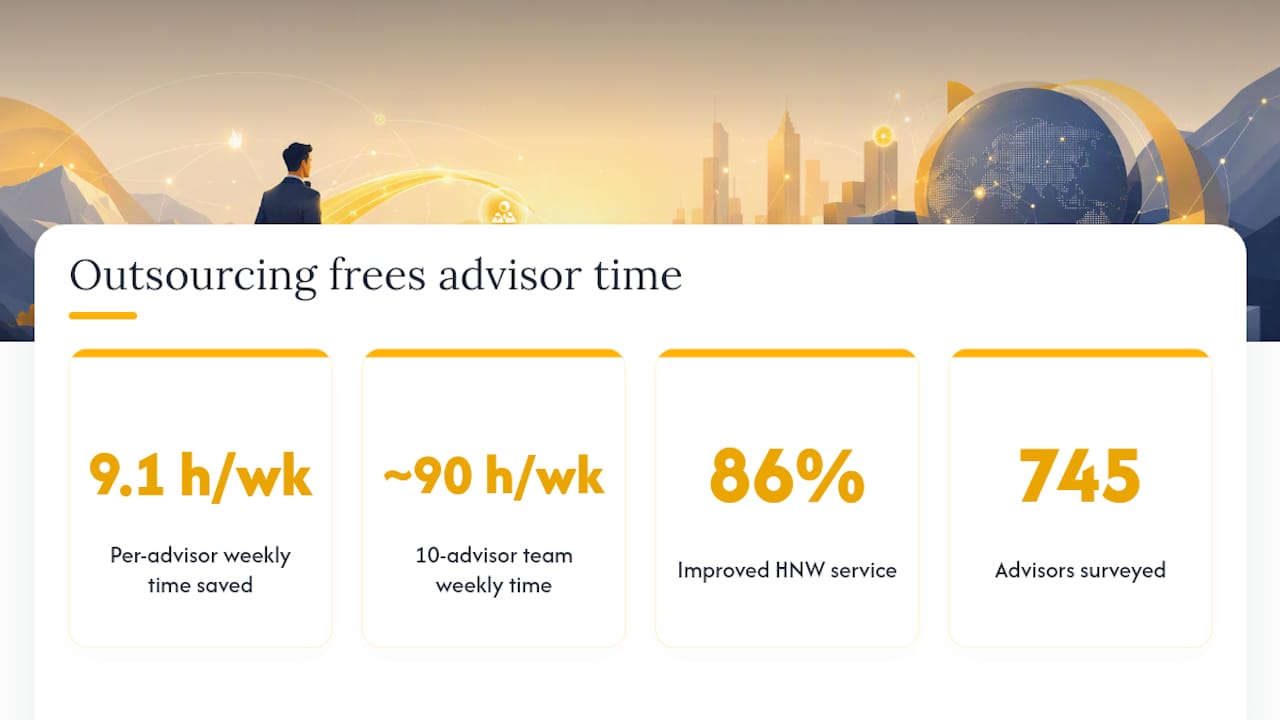
The case isn’t theoretical. Advisors who outsourced at least a fifth of their assets under management reported saving 9.1 hours per week, and 86% said outsourcing improved their ability to serve high-net-worth clients, according to the same AssetMark survey of 745 advisors.
Advisor time saved weekly: 9.1 hours. That’s not a rounding error. Multiplied across a ten-advisor team, it’s roughly 90 hours a week that can go back into financial planning, prospecting, or deeper coverage of top-tier households.
A client kept for an extra five years isn’t just five years of fees. It’s referrals, multi-generational accounts, and reduced acquisition cost.
The mechanism is straightforward: freeing advisor time from account servicing and paperwork doesn’t just reduce burnout, it redirects hours toward the relationship work that actually grows assets under management.
Outsourcing can improve advisor capacity and client outcomes when implemented to free advisor time for planning and relationship work, rather than simply shifting manual tasks elsewhere.
That distinction between “shifting work” and “freeing capacity” separates firms that outsource well from firms that just create a second inbox somewhere else.
What Are the Risks of Outsourcing Wealth Management Support?
Nothing here is free of risk, and pretending otherwise sets a firm up for a bad renewal conversation. The failure modes are predictable, and so are the fixes.
The biggest one: automating or outsourcing without clarity about where human judgment sits. FinTech Global’s analysis points out this ambiguity frequently creates redundant manual processes and control gaps, the opposite of what outsourcing is supposed to solve. Other recurring risks include data security gaps, erosion of fiduciary judgment when routine tasks quietly expand into advice-adjacent territory, weak escalation paths, and vendor sprawl, where compliance, IT, and CX each sit with a different siloed provider.
The controls that neutralize these risks are specific, not aspirational:
- Integrated SLAs that name response times, error thresholds, and remedies in the contract itself.
- Joint process ownership, so the provider and the firm both sign off on workflow changes.
- SOC 2 and audit-readiness evidence reviewed before signing, not after an incident.
- Formal escalation and quality loops with a named owner on both sides.
- A single automation governance policy that maps which decisions a bot or agent can make versus which require a person.
| Risk | Mitigation |
|---|---|
| Compliance/regulatory error | Documented decision-rights map; SOC 2 evidence review |
| Data security exposure | Encrypted handling protocols; access audits |
| Erosion of fiduciary judgment | High-judgment tasks stay onshore or senior-reviewed |
| Vendor sprawl | Single integrated provider with named responsibility owner |
| Escalation breakdown | Tiered escalation with defined response windows |
Pro Tip: Keep any task touching estate instructions, complex tax scenarios, or bespoke client correspondence onshore or routed through a senior nearshore reviewer. Cultural alignment reduces rework, but judgment calls still need a second set of experienced eyes.
Which Tasks Should Move Nearshore and Which Stay Onshore?
Not every function belongs in the same bucket. The right question isn’t “can this be outsourced” but “does this task need judgment, regulatory proximity, or client trust that only an internal advisor can provide.”
Five dimensions decide the answer: judgment intensity, client-facing sensitivity, regulatory proximity, automation potential, and volume or seasonality. High-volume, repeatable tasks nearshore well. High-judgment, low-volume tasks generally don’t.

| Task | Judgment intensity | Regulatory proximity | Volume | Recommended location |
|---|---|---|---|---|
| Onboarding document collection | Low | Medium | High | Nearshore |
| KYC file review (standard) | Medium | Medium | High | Nearshore |
| Complex advisor correspondence | High | High | Low | Onshore |
| Billing and fee administration | Medium | Low | High | Nearshore |
| Investment recommendations | High | High | Low | Onshore |
The decision rules fall out naturally once you see the pattern:
- Nearshore when the task is low-to-medium judgment and high volume, like onboarding or billing.
- Keep onshore when regulatory proximity or fiduciary judgment is central, like personalized investment guidance.
- Nearshore providers with strong timezone overlap, particularly LATAM-based teams, tend to reduce coordination friction and compliance rework versus offshore alternatives further afield.
What Governance Structure Makes Nearshore Support Work?
A nearshore engagement without governance is just an inbox with a different area code. The firms that get real value build a structure around it, and the structure has five recurring components: a single process owner on each side, integrated SLAs, shared dashboards, quarterly governance reviews, and standing SOC 2 evidence.
- Name one internal owner accountable for the relationship, not a rotating cast of ops staff.
- Build shared dashboards both teams check daily, not monthly reports nobody reads until a problem surfaces.
- Run quarterly governance reviews that revisit SLAs against actual performance, not just renewal terms.
Training matters as much as the metrics. Shadowing periods, role-based onboarding paths, and periodic calibration sessions keep quality consistent as the team scales, and a clear escalation flow, mapped from frontline agent to senior reviewer to advisor, prevents a stalled ticket from becoming a client complaint. Our guide to nearshore operational models walks through how to structure that ownership in more detail.
How Do You Roll Out a Nearshore Support Team?
Rollouts that succeed follow a predictable sequence, not a big-bang launch.
- Map internal processes to identify which workflows are candidates based on the decision matrix above.
- Run vendor due diligence, requesting SOC reports, financial stability evidence, and references from comparable US-based wealth firms.
- Scope a pilot around one high-volume, low-judgment workflow, such as onboarding documentation.
- Confirm data and connectivity, testing integrations with your CRM and custodial platforms before go-live.
- Build the training plan, including shadowing and calibration checkpoints.
- Negotiate SLAs with named remedies for missed targets.
- Stage the ramp, expanding scope only after pilot metrics hold steady for a full cycle.
A typical pilot runs 60 to 90 days, followed by a ramp period of two to four months before reaching steady-state cadence. During the pilot, validate ramp metrics like onboarding turnaround, error rate, and CSAT before adding scope. Client onboarding automation tends to deliver the fastest visible ROI, which is exactly why it’s the common starting point. Keep a copy of this checklist in your RFP template so vendors respond to the same criteria.
How Much Does Outsourced Client Support Cost?
Pricing generally falls into three models, and each shifts the cost driver in a different direction.
- Per-seat or hourly staffing: you pay for dedicated headcount at an agreed rate, which scales predictably with volume but requires you to manage workflow design internally.
- Per-transaction pricing: costs scale with activity, useful for firms with seasonal onboarding spikes or unpredictable trade volume.
- Managed-service fixed fee: the provider owns outcomes against SLAs for a flat monthly fee, shifting workflow design and quality assurance onto the vendor.
The main cost drivers behind any of these models are skill mix (bilingual staff and compliance-trained agents cost more than general support), SOC 2 and audit-readiness premiums, technology and integration fees for connecting to your CRM or custodial system, and volume variability. A directional comparison: a per-seat model often looks cheaper on paper for steady, predictable volume, but a managed-service fee tends to win when volume swings seasonally, because the provider absorbs the staffing risk rather than you.
How Do You Measure Success With a Nearshore Support Partner?
Measurement needs a rhythm, not just a dashboard. Weekly numbers catch operational drift, monthly numbers catch trends, and quarterly reviews catch whether the partnership is still delivering strategic value.
| Metric | What it monitors | Reporting cadence |
|---|---|---|
| CSAT | Service quality | Weekly |
| First response / handle time | Capacity and efficiency | Weekly |
| Onboarding turnaround | Capacity | Monthly |
| Error / rework rate | Compliance and quality | Monthly |
| Advisor time reclaimed | Strategic ROI | Quarterly |
Executive reviews should be built around these same metrics, using a shared template both sides sign off on rather than a report the provider generates unilaterally. Our client retention strategies guide breaks down how CX metrics like CSAT connect directly to retention outcomes over time.
What Outcomes Have Firms Actually Seen From Nearshore Support?
Those numbers came from advisors who outsourced meaningfully, not dabbled at the margins.
Altiamcx’s own nearshore team extension case study documents similar directional gains for a services client moving support functions to a managed nearshore team, and a separate software platform case study shows productivity improving by 89% after migrating tech support to a nearshore model.
The real risk is not automation itself but doing it without clear ownership of judgment; firms should map decision rights before moving processes offshore or automating them.
That single sentence explains most of the difference between outsourcing engagements that compound value and ones that just relocate the same friction to a new time zone.
How Do You Choose the Right Nearshore Partner?
Selection is where most of the risk in this whole model actually lives. A strong RFP asks specific, checkable questions rather than accepting a glossy capabilities deck.
- Can you provide current SOC 2 reports and recent audit results?
- What is your documented financial stability, and how long have you operated?
- Can you provide US-based wealth or financial-services client references?
- What SLA remedies apply when targets are missed?
- How is client data handled, encrypted, and segmented from other clients?
- What does your training and escalation protocol look like for judgment-sensitive cases?
- Which CRM and custodial platforms have you integrated with previously?
Red flags are usually easy to spot once you’re looking for them:
- No audit evidence offered, or evidence that’s more than a year old.
- Vague contractual language about data handling and breach notification.
- Evidence of vendor sprawl, where the provider subcontracts key functions to unnamed third parties.
- Slow or evasive reference checks, or references that dodge specifics about outcomes.
Weight quality, compliance readiness, and demonstrated experience above lowest price. The cheapest bid rarely survives its first compliance audit intact. Our outsourcing checklist for critical support functions walks through a fuller due-diligence sequence if you’re building a formal RFP.
When Does Nearshore Client Support Actually Make Sense?
If I’m advising an operations leader on this, the recommendation is narrower than most vendors will admit: nearshore client support earns its place when your team has enough repeatable volume, whether onboarding files or billing cycles, that advisor hours are being consumed by work that doesn’t require an advisor. It’s the wrong move if you’re chasing headcount reduction alone, with no plan for governance or escalation.
The integration challenge is the part most firms underestimate. Vendor sprawl, where compliance sits with one provider, IT with another, and CX with a third, quietly recreates the exact coordination burden outsourcing was supposed to eliminate. Treat your nearshore partner as an integrated extension of your operating model, not a line item you check on once a quarter.
My actual recommendation: pilot one high-volume, low-judgment workflow, likely onboarding, with three or four KPIs you already track internally. Measure it for a full cycle before expanding scope. That’s a smaller bet than most RFPs suggest, and it tells you more than any vendor’s case study will.
How Altiamcx Supports Wealth Firms With Nearshore Teams
Altiamcx is built for exactly the workflows this guide covers: onboarding support, account servicing, back-office reconciliation, and billing administration handled by bilingual nearshore teams trained specifically on financial-services processes.

The model runs on the same governance principles outlined above: SOC 2-aligned processes, integrated SLAs, and a single point of ownership so your firm isn’t managing five vendors to run one workflow. Altiamcx’s orthodontic services case study shows the same team-extension approach applied outside financial services, with measurable CX gains that translate directly to how a wealth-management back office runs day to day. Commercial terms flex to fit how you actually staff, whether per-seat, hourly, or a managed-service fee tied to outcomes rather than headcount.
If you’re weighing a pilot for onboarding, billing, or account servicing, start by reviewing Altiamcx’s nearshore solutions and scoping a discovery call around the one workflow costing your advisors the most hours right now.
Frequently Asked Questions
What is wealth management client support? It’s outsourced client-facing and back-office work for advisory firms, delivered by nearshore or managed teams handling onboarding, account servicing, billing, and reconciliation.
What do wealth managers do that shouldn’t be outsourced? Investment recommendations, complex advisor correspondence, and bespoke estate or tax guidance should stay onshore, since they require fiduciary judgment and direct client trust.
How long does a nearshore support pilot typically take? Most pilots run 60 to 90 days, followed by a two to four month ramp before reaching steady-state operating cadence.
What KPIs matter most for wealth advisory support? CSAT, first response time, onboarding turnaround, and error rate cover quality, capacity, and compliance in a single scorecard.
Is nearshore support secure enough for financial-services data? It can be, provided the partner maintains current SOC 2 evidence, documented data-handling protocols, and integrated SLAs with named remedies for breaches or missed targets.
Sources
- Multimedia Update - AssetMark Study Finds Investment Management Outsourcing Is Increasingly Linked to Stronger Advisor Growth Outcomes — AssetMark / GlobeNewswire
- Nearshoring as a resilience lever for mid-sized financial institutions — EY
- The hidden cost of manual processes in wealth management — FinTech Global
- Wealth management back office transformation — Everest Group