
TL;DR:
- Operational services provide significant cost savings and streamline non-core functions in regulated industries.
- Nearshore outsourcing balances cost, compliance, and communication, making it ideal for healthcare, legal, and eCommerce.
- Effective risk management, process discipline, and continuous improvement are essential for maximizing benefits.
Operational services can deliver up to 60% cost savings for back-office functions in sectors like healthcare, legal, and eCommerce. Yet many business leaders still treat back-office outsourcing as a last resort rather than a strategic lever. The assumption that outsourcing means sacrificing control or quality is one of the most persistent and costly misconceptions in modern operations. This guide cuts through that confusion. You will learn exactly what operational services cover, how they work in regulated industries, which delivery model fits your needs, and what measurable results organizations are actually achieving in 2026.
Table of Contents
- Defining operational services: What it is and what it covers
- Key components and mechanics of operational services
- Nearshore vs. offshore vs. in-house: Making the right choice
- Measuring the impact: Results from operational services in the real world
- Critical risks and compliance considerations for regulated sectors
- Why nearshore operational services are the overlooked engine for sustainable growth
- Take your operations further with expert nearshore services
- Frequently asked questions
Key Takeaways
| Point | Details |
|---|---|
| Define operational services | Operational services streamline non-core back-office work through expert external partners, especially in regulated industries. |
| Nearshore beats offshore | Nearshore outsourcing offers faster communication, better compliance, and major savings compared to offshore or in-house options. |
| Compliance is critical | Healthcare, legal, and eCommerce require operational partners who excel in data privacy, process mapping, and legal regulations. |
| Real-world results | Leaders report up to 75% faster cycles, 99% accuracy, and 60% cost savings with nearshore operational services. |
| Strategic opportunity | Intelligent, well-governed operational services drive ongoing efficiency and customer experience gains, not just short-term savings. |
Defining operational services: What it is and what it covers
Now that we have seen the dramatic savings possible, let’s clarify exactly what operational services are and what they are not. The term gets used loosely, but it has a precise meaning in a business context.
Operational services refer to outsourcing of non-core administrative and back-office functions, commonly nearshore. In plain terms, these are the essential but repeatable tasks that keep your organization running without directly generating revenue. Think of them as the infrastructure beneath your core product or service.
For healthcare, legal, and eCommerce organizations, operational services typically include:
- Medical billing and claims processing for healthcare providers seeking cleaner revenue cycles
- Document management and contract handling for legal teams managing high case volumes
- Customer support and CX operations across voice, chat, and email channels
- Scheduling and appointment coordination for patient-facing or client-facing workflows
- Data entry, validation, and records management across all three sectors
- Order fulfillment support and returns processing for eCommerce operations
What makes operational services distinct in regulated industries is the compliance layer. It is not enough to simply hand off a task. Every function must align with sector-specific rules, whether that is HIPAA in healthcare, privilege protections in legal, or consumer data regulations in eCommerce.
“The right operational services partner efficiency comes from combining process discipline with compliance rigor. Without both, outsourcing creates risk instead of reducing it.”
This is why choosing a nearshore partner with deep sector knowledge matters. Cultural alignment and regulatory fluency are not optional extras. They are the foundation of reliable operational services delivery.
Key components and mechanics of operational services
With the basics established, it is time to look at how these functions actually work in the real world.
Effective operational services do not run on goodwill. They run on structured systems. Best-practice methodologies include SOPs, SLAs, HIPAA compliance, RPA pilots, and EHR integration as core building blocks. Here is how a well-designed operational services engagement typically takes shape:
- Process mapping: Every task is documented, broken into steps, and assigned ownership before a single handoff occurs.
- SOP development: Standard operating procedures define exactly how each function is executed, ensuring consistency regardless of who is performing the work.
- SLA establishment: Service-level agreements set measurable performance expectations, including turnaround times, accuracy rates, and escalation protocols.
- Compliance integration: For healthcare and legal, this means HIPAA/BAA agreements, role-based data access, and audit trails built into every workflow.
- Technology enablement: Robotic process automation (RPA) handles high-volume, repetitive tasks. EHR integrations connect clinical and administrative data. AI-assisted quality checks reduce error rates.
- Continuous improvement loops: Performance data feeds back into process refinement, making the operation smarter over time.
This shift toward what practitioners call Intelligent Process Outsourcing (IPO) is where BPO growth strategies are heading. IPO combines human expertise with automation to handle complexity that pure technology cannot manage alone.
Pro Tip: Before signing any operational services agreement, ask your potential partner to walk you through their SOP documentation process. If they cannot show you a clear methodology, that is a red flag for execution quality.
| Component | Purpose | Regulated sector benefit |
|---|---|---|
| SOPs | Standardize execution | Reduces compliance gaps |
| SLAs | Define performance targets | Creates accountability |
| RPA | Automate repetitive tasks | Speeds cycle times |
| HIPAA/BAA tools | Protect sensitive data | Reduces legal exposure |
| EHR integration | Connect clinical workflows | Improves data accuracy |
Nearshore vs. offshore vs. in-house: Making the right choice
Choosing where and how to run your operational services is not a simple decision. Let’s break down your options.
Each delivery model carries real trade-offs. Understanding them is essential before committing resources.
In-house operations give you maximum control and direct oversight. But they come with high fixed costs, limited scalability during volume spikes, and the ongoing challenge of recruiting specialized talent in compliance-heavy roles.
Offshore outsourcing can cut costs significantly, but regulated industries often find the trade-offs unacceptable. Time zone gaps slow communication. Cultural misalignment affects CX quality. Compliance oversight becomes harder across greater geographic and regulatory distance.
Nearshore outsourcing hits the sweet spot for healthcare, legal, and eCommerce. Nearshore outsourcing offers 30 to 40% faster communication and 60% cost savings versus in-house. You get cost efficiency without sacrificing the oversight and collaboration that regulated work demands.

| Model | Cost savings | Communication speed | Compliance fit | Scalability |
|---|---|---|---|---|
| In-house | None | Highest | Easiest to control | Limited |
| Offshore | Up to 70% | Slowest | Hardest to manage | High |
| Nearshore | Up to 60% | Fast | Strong | High |
For sectors where a single compliance failure can trigger regulatory action or reputational damage, nearshore is the model that balances performance with protection. Key advantages include:
- Shared or overlapping time zones enabling real-time collaboration
- Cultural alignment that improves both CX quality and team integration
- Proximity for easier compliance audits and governance oversight
- Access to nearshore outsourcing benefits like bilingual talent pools and lower attrition rates
Learn more about how nearshore outsourcing explained in detail can help your organization make a confident decision.
Measuring the impact: Results from operational services in the real world
Understanding the differences is important, but how do these choices actually play out for real organizations?
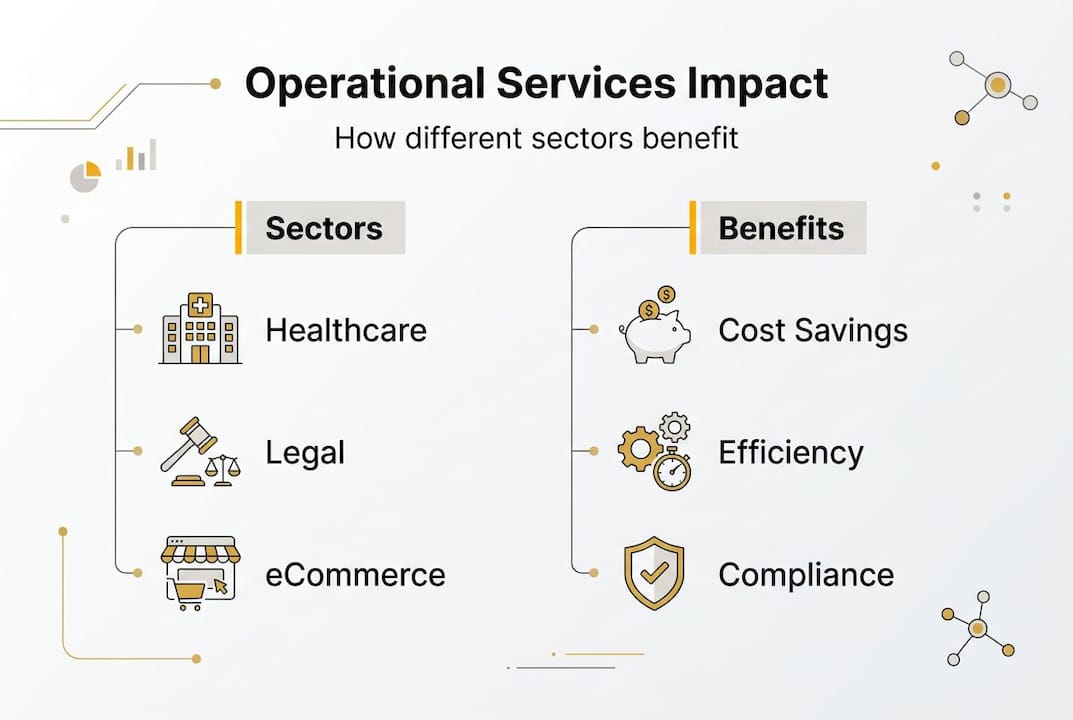
The numbers tell a compelling story. Across healthcare, legal, and eCommerce, organizations that have adopted nearshore operational services are reporting performance gains that go well beyond simple cost reduction.
“Legal document processing saw a 75% reduction in processing time and 99% accuracy rates, while healthcare BPO partnerships cut administrative time dramatically across billing and records functions.”
Breaking this down by sector makes the impact clearer.
Healthcare: Nearshore BPO partners with HIPAA/BAA agreements in place have helped providers reduce administrative burden on clinical staff, accelerate claims cycles, and improve billing accuracy. The result is faster reimbursement and fewer denied claims.
Legal: High-volume document review, contract management, and legal support nearshore benefits are reshaping how firms handle case loads. A 75% reduction in document processing time means attorneys spend more time on high-value work and less time on administrative tasks.
eCommerce: Seasonal volume spikes are a constant challenge. Nearshore operational services allow eCommerce businesses to scale customer support and fulfillment operations quickly without the overhead of permanent headcount. The superior CX nearshore model also supports bilingual customer interactions, which is increasingly critical for North American markets.
Pro Tip: When evaluating operational services ROI, look beyond cost savings. Track cycle time reduction, error rate improvement, and customer satisfaction scores. These metrics reveal the full value of a high-performing nearshore partnership.
Organizations that measure nearshore CX trust gains consistently report stronger client retention and higher satisfaction scores alongside the operational efficiency improvements.
Critical risks and compliance considerations for regulated sectors
No operational model is risk-free, especially in regulated industries facing mounting compliance burdens.
The benefits of operational services are real, but so are the risks if governance is handled carelessly. Healthcare BPOs must follow HIPAA/BAA requirements, and legal teams are increasingly overwhelmed by SOP volumes while facing mass arbitration risk. These are not theoretical concerns. They are active operational challenges in 2026.
Key compliance risks to address before outsourcing:
- PHI handling: Any partner processing protected health information must operate under a signed BAA and demonstrate documented HIPAA compliance protocols.
- Data access controls: Role-based permissions, audit logs, and encryption standards must be contractually defined and regularly audited.
- SOP volume management: Legal teams handling high-volume litigation or arbitration cases need partners with proven capacity to manage surges without accuracy degradation.
- Mass arbitration exposure: Firms involved in consumer-facing disputes face growing arbitration filings. Operational partners must understand the procedural requirements and timelines involved.
- Authority mapping: Clear governance structures must define who has decision-making authority within the outsourced function, preventing gaps that create liability.
- Vendor oversight protocols: Regular performance reviews and compliance audits are non-negotiable for back-office nearshoring arrangements in regulated sectors.
The organizations that manage these risks most effectively treat compliance not as a checkbox but as an ongoing operational discipline. They build it into their SLAs, their SOP frameworks, and their partner selection criteria from day one.
Why nearshore operational services are the overlooked engine for sustainable growth
Most conversations about operational services start and end with cost. That framing misses the bigger opportunity.
Traditional BPO relationships were designed for cost arbitrage. You moved a function offshore, saved money, and accepted the trade-offs. That model delivered short-term wins but created long-term rigidity. When your business needed to pivot, your outsourced functions could not keep up.
Nearshore operational services with thoughtful governance and BPO driving growth strategies built in change that equation. Real-time collaboration across compatible time zones means your nearshore team can adapt alongside your core business. AI-assisted workflows and proactive analytics turn your operational data into strategic insight rather than just cost reporting.
The overlooked opportunity here is continuity. Organizations that build nearshore partnerships with continuous improvement frameworks embedded from the start do not just save money. They build adaptive operational capacity that scales with demand, responds to regulatory change, and generates performance data that informs better decisions. That is not transactional outsourcing. That is a growth infrastructure.
Take your operations further with expert nearshore services
If you are ready to put these strategies to work in your organization, here is where you can start.
Altiam CX delivers nearshore customer experience services built specifically for healthcare, legal, and eCommerce organizations that need more than a vendor. You need a partner who understands compliance, executes with discipline, and scales with your growth.

From customer care and technical support to back-office operations and team extension solutions, Altiam CX brings the cultural alignment, performance frameworks, and sector expertise that regulated industries demand. Whether you are looking to reduce administrative overhead, improve CX quality, or build scalable operational capacity, the right nearshore partner makes the difference. Explore what Altiam CX can do for your organization and take the first step toward smarter, more resilient operations.
Frequently asked questions
What are the most commonly outsourced operational services in healthcare and legal?
Commonly outsourced services include billing, claims processing, document management, scheduling, and customer support, typically handled through a nearshore BPO partner with sector-specific compliance expertise.
Is nearshore outsourcing safer than offshore for regulated industries?
Nearshore outsourcing offers better timezone alignment, cultural fit, and compliance readiness, making it a stronger choice for sectors that require HIPAA protections or legal data privacy standards.
How do cost savings compare between in-house, nearshore, and offshore operational services?
Nearshore typically delivers 60% cost savings versus in-house operations while maintaining higher quality and compliance standards than offshore alternatives.
What compliance risks should healthcare and legal firms consider when outsourcing operations?
Key risks include HIPAA/BAA requirements in healthcare and rising SOP volumes in legal. Strong governance frameworks and contractually defined compliance protocols are essential to managing these risks effectively.