TL;DR:
- Hospital operational services significantly impact clinical outcomes, hospital capacity, and financial health beyond traditional support roles. High-performing hospitals adopt integrated models, real-time data, and proactive management to improve patient flow and reduce costs. Fostering shared accountability and strategic partnerships transforms operational functions into critical performance enablers.
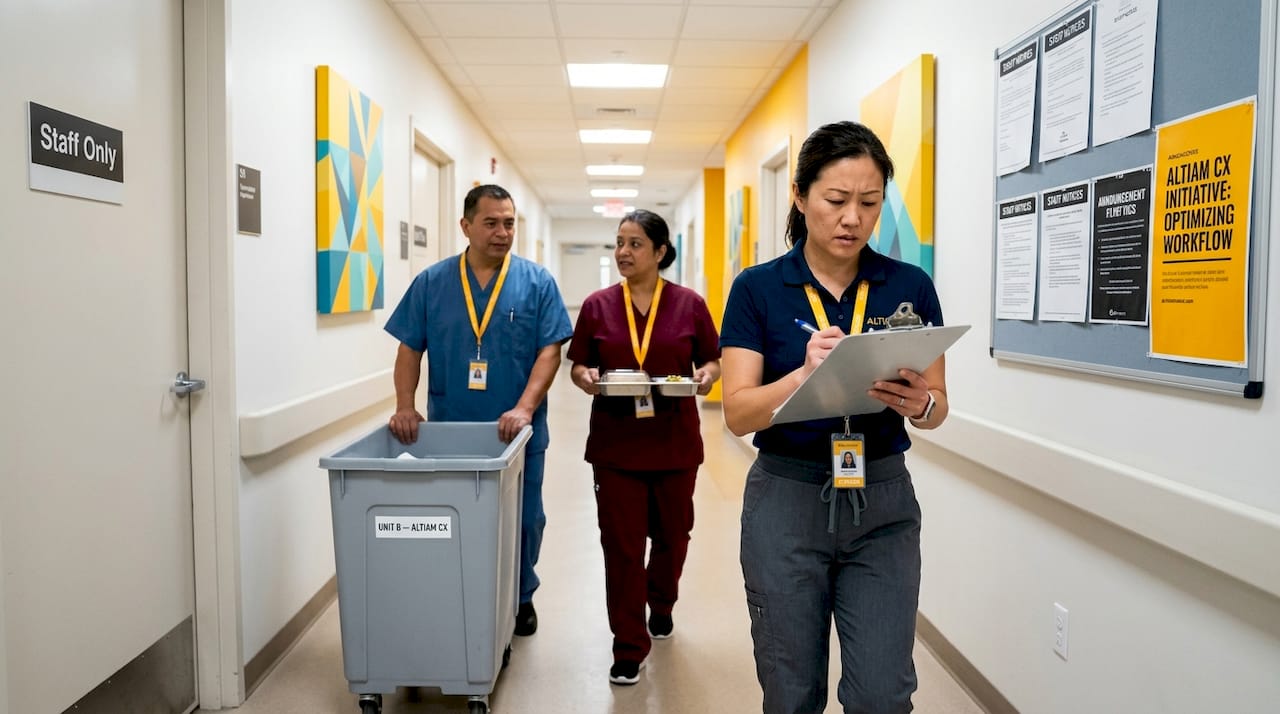
Most hospital leaders think about clinical excellence when they talk about improving patient care. Operational services rarely get the same strategic attention, yet they directly determine whether care delivery runs smoothly or breaks down. The role of operational services in hospitals extends far beyond food carts and clean floors. These functions shape capacity management, infection rates, discharge timing, and the financial health of the entire organization. This article breaks down what operational services actually cover, how they affect patient outcomes and hospital margins, where most teams go wrong, and what high-performing hospitals do differently.
Table of Contents
- Key takeaways
- The role of operational services in hospitals, defined
- How operations directly affect patient care
- Common challenges in managing hospital operational services
- Strategies for improving hospital operational services
- My perspective on operational services as strategic assets
- How Altiamcx supports hospital operational performance
- FAQ
Key takeaways
| Point | Details |
|---|---|
| Operations are strategic assets | Support services like transport, food, and environmental services directly affect capacity, infection rates, and patient experience. |
| OR inefficiency is costly | Operating room time costs $80 per minute, making perioperative operational alignment a top financial priority. |
| Silos undermine performance | Fragmented support departments limit clinical throughput and create avoidable inefficiencies across the entire hospital. |
| Data must drive decisions | Moving from static dashboards to real-time predictive systems is required for proactive operational management. |
| Integrated models outperform | Partnering across support functions with unified governance delivers higher efficiency than managing each department in isolation. |
The role of operational services in hospitals, defined
Operational services in a hospital setting cover every non-clinical function that keeps the facility running. That includes environmental services (housekeeping and sanitation), food and nutrition, patient transport, facilities maintenance, technology management, supply chain, and administrative back-office functions. These departments do not deliver direct medical care, but they create the conditions under which clinical care either thrives or suffers.
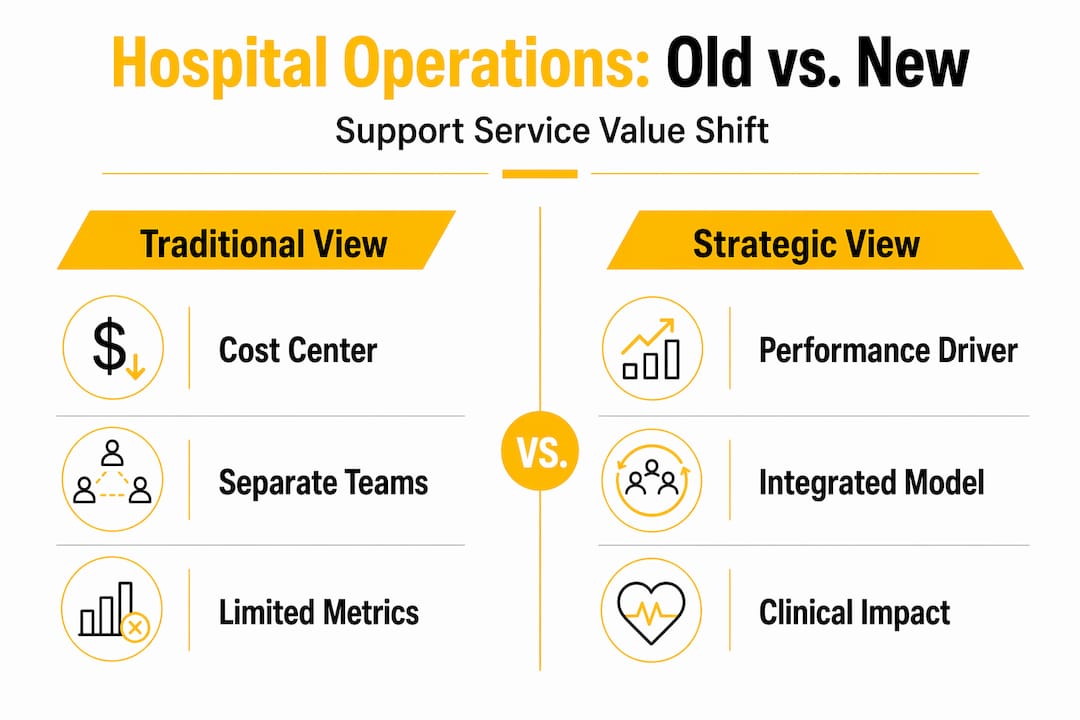
Most administrators still categorize these functions as overhead. That framing is outdated. Support services like food, cleaning, transport, and technology management directly affect capacity, infection rates, staff satisfaction, and patient experience. Treating them as cost centers misses the larger picture. They are performance multipliers.
Consider the financial scale. Hospital administrative costs consume about 25% of total revenue. That is roughly double the administrative burden seen in other developed nations. It signals a system where operational processes have historically been underoptimized. The opportunity for improvement is significant, and it starts with recognizing these functions as core to organizational performance, not peripheral to it.
Here is what operational services typically encompass in a hospital:
- Environmental services: Sanitation, infection control protocols, room turnaround
- Food and nutrition: Patient meal delivery, therapeutic diet management, catering for staff
- Patient transport: Internal movement of patients between departments and wards
- Facilities and maintenance: Physical infrastructure, equipment upkeep, safety compliance
- Technology management: IT systems, medical equipment support, digital infrastructure
- Back-office operations: Scheduling, billing support, documentation, regulatory reporting
| Traditional view | Strategic view |
|---|---|
| Cost center to be minimized | Performance driver tied to clinical outcomes |
| Managed in isolated departments | Integrated with clinical workflows and goals |
| Measured by budget compliance | Measured by impact on patient flow and experience |
| Reactive problem-solving | Proactive, data-informed management |
How operations directly affect patient care
The connection between operational services and patient outcomes is specific and measurable. It is not abstract. Room turnaround time, surgical flow, discharge timing, and infection prevention are all downstream results of how well operational services are managed.
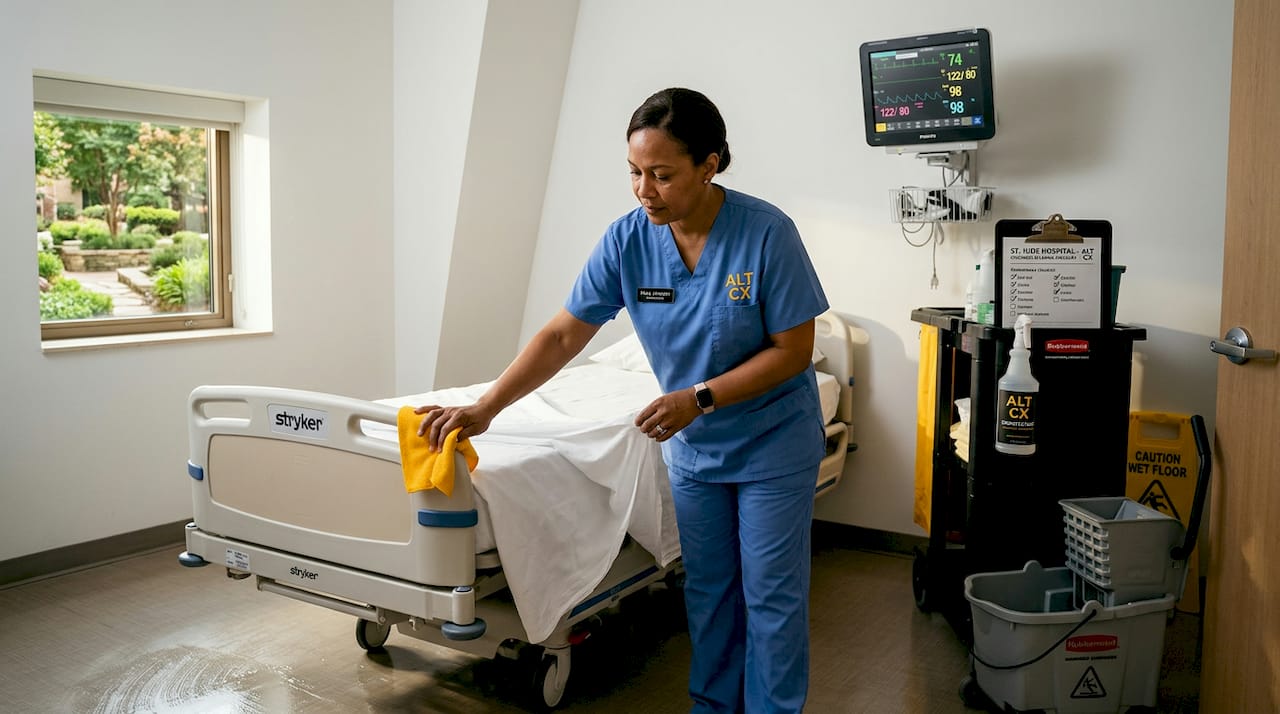
Start with the operating room. OR time costs approximately $80 per minute, and hospitals that apply structured governance and predictive scheduling have achieved utilization improvements exceeding 20%. That kind of gain does not come from clinical decisions alone. It comes from tightly coordinated pre-op preparation, equipment readiness, cleaning turnaround between cases, and accurate scheduling. Each of those is an operational function. The stakes are high because surgical services can represent up to 70% of a hospital’s total revenue.
Beyond surgical services, operational excellence shapes outcomes in three additional areas:
- Infection prevention: Environmental services protocols directly determine hospital-acquired infection rates. Substandard room cleaning between patients is not a minor lapse. It creates measurable clinical risk.
- Discharge management: Delayed discharges often result from operational inefficiencies, not clinical ones. Digital tools and aligned workflows reduce length of stay and free up critical beds.
- Patient nutrition: Therapeutic diets managed poorly lead to complications that extend stays and increase treatment costs. Nutrition is clinical in its impact even when managed operationally.
Pro Tip: Track room turnaround time and discharge delays as clinical performance indicators, not just operational metrics. When these numbers are reviewed alongside readmission rates and length-of-stay data, the link between operational performance and care quality becomes impossible to ignore.
Optimizing patient flow and efficiency requires collaborative governance, data analytics, and alignment of staffing with demand patterns. That is a cross-functional effort. It cannot be owned by a single department operating in isolation.
Common challenges in managing hospital operational services
Understanding the challenges in hospital operational services is not just useful background. It is where most improvement efforts stall. Three patterns come up repeatedly in hospitals that are underperforming operationally.
-
The silo effect. Fragmented support departments operate without shared goals or coordinated workflows. Environmental services, patient transport, and facilities management each optimize for their own metrics, but nobody is accountable for the combined impact on patient flow. This produces consistent friction at hand-off points between departments.
-
Dashboard fatigue. Most hospitals rely on static dashboards that report what already happened. That is a system of record, not a system of action. When a capacity crunch develops on a Tuesday afternoon, administrators need predictive signals hours earlier, not a report generated the following morning. Real-time data changes the decisions that are available to you.
-
Technology as a standalone fix. Many hospital leaders invest in new software expecting it to resolve operational problems. It rarely does on its own. Successful operations management requires integrating digital tools as decision supports combined with human expertise, not as substitutes for it. A scheduling platform without governance structures and trained staff behind it simply generates more data nobody acts on.
“The challenge is not a lack of information. It is a lack of integrated decision-making structures that allow operational leaders to act on that information in real time.” This is the gap that separates hospitals with strong hospital operational efficiency from those caught in reactive management cycles.
Pro Tip: Before investing in new operational technology, audit your current decision-making processes. If your team does not have clear ownership, escalation paths, and defined response protocols, new software will add complexity without adding performance.
Strategies for improving hospital operational services
What separates hospitals that improve from those that plateau? The answer usually comes down to model design, not effort. Here is how high-performing systems structure their operational services management.
Adopt integrated operational partnerships
Managing food, environmental services, transport, and technology in separate contracts with separate vendors creates natural fragmentation. Integrated operational partners who understand hospital systems deliver better performance by connecting these functions to shared clinical goals. When environmental services and patient transport are aligned with discharge timelines, turnaround times drop and capacity improves across the board.
Build a central operational command model
Some leading hospitals are adopting what practitioners call a Central Nervous System (CNS) approach to operations. This model integrates people, processes, and digital platforms for real-time decision-making and proactive problem-solving. Rather than waiting for a bed shortage to surface, the CNS model continuously senses signals across departments and initiates coordinated responses before problems escalate.
Implement structured case management for discharge
Delayed discharges are one of the most expensive and avoidable capacity problems in hospitals. Aligned policy, operational execution, and digital infrastructure are all required to scale discharge management improvements. Hospitals that assign dedicated case managers to coordinate between clinical teams and operational services consistently reduce average length of stay.
Balance reactive and planned operations
A common failure mode is over-indexing on urgent reactive tasks while letting planned maintenance and upgrades fall behind. This creates a compounding problem where deferred maintenance generates more emergencies, which crowd out planning time further. Effective operational strategies in hospitals build explicit protected time for planned improvements alongside responsive daily operations.
| Reactive model | Proactive model |
|---|---|
| Responds to problems after they occur | Anticipates issues using predictive data |
| Departments managed independently | Cross-functional coordination with shared KPIs |
| Technology reports history | Technology enables forward-looking decisions |
| Maintenance deferred under pressure | Planned maintenance protected from reactive crowding |
My perspective on operational services as strategic assets
I have worked alongside healthcare administrators navigating some genuinely difficult operational environments, and one pattern keeps coming up. The hospitals that struggle most are not underfunded or understaffed. They are undersighted. They have capable people running individual functions well, but nobody is accountable for the performance of the whole system.
In my experience, the most productive shift a hospital leader can make is this: stop measuring operational services by whether they stayed within budget, and start measuring them by whether they made clinical performance better or worse. That reframe changes hiring decisions, vendor selection, and how you structure reporting lines.
What I have also learned is that cultural change is harder than process change. You can install a new discharge coordination protocol in a week. Getting environmental services staff, transport teams, and nursing floors to operate as one accountable unit takes months of deliberate leadership. The hospitals that get there fastest are the ones that bring in partners who share accountability rather than vendors who only report metrics.
The data tools matter, but they are not the answer by themselves. I have seen hospitals with genuinely advanced analytics platforms still struggling because nobody translated the data into daily operational decisions. Human judgment, clearly defined roles, and a willingness to act on imperfect information in real time. That combination consistently outperforms technology alone.
— Daniela
How Altiamcx supports hospital operational performance

Operational complexity does not have to slow your organization down. Altiamcx works with healthcare organizations as a nearshore operational services partner, supporting back-office functions, technical assistance, and team-extension solutions designed to reduce friction and improve service quality at scale. Whether you need to offload administrative burden or build a more responsive operational model, Altiamcx delivers measurable results. One client saw productivity improve by 89% after migrating tech support operations. Another healthcare provider significantly improved patient experience through structured operational support. If you are ready to treat operational services as the strategic asset they are, Altiamcx is built to help you get there.
FAQ
What does “operational services” mean in a hospital?
Operational services in a hospital include all non-clinical functions that support care delivery: environmental services, patient transport, food and nutrition, facilities management, technology support, and back-office administration. These functions directly affect patient flow, infection rates, and discharge efficiency.
How do operational services affect patient outcomes?
Poorly managed operational services lead to longer room turnaround times, delayed discharges, and higher infection risks. Well-coordinated support functions improve capacity, reduce length of stay, and support better patient experience throughout the care episode.
Why do hospitals struggle with operational efficiency?
Most hospitals face fragmented department structures, reliance on static reporting dashboards, and a tendency to apply technology without the governance structures needed to act on data. These factors create reactive management patterns rather than proactive operational performance.
What is the financial impact of optimizing hospital operations?
The financial case is direct. OR time costs approximately $80 per minute, and surgical services can represent up to 70% of hospital revenue. Even modest improvements in perioperative scheduling and support service coordination translate into significant margin gains.
What is the best strategy for improving hospital operational services?
Integrated operational partnerships, real-time data systems that enable proactive decision-making, and structured discharge management programs consistently deliver the strongest results. The common thread is cross-functional accountability rather than siloed department management.