
Insurance CX operations are the teams, systems, and processes that orchestrate a policyholder’s entire journey, from the first quote request through renewals, servicing, and claims. This is the operational backbone that determines whether a customer waits three days or three hours for a claims update, and it directly shapes retention, cost-to-serve, and revenue.
The bottom line: insurers that run modern, well-orchestrated CX operations reduce cost-to-serve, resolve issues faster, and keep more policyholders from year to year. McKinsey’s survey of 8,500 insurance customers found CX leaders outperform peers on total shareholder return, revenue growth, and expense ratios. That is not a soft metric. It is a financial one.
What does that translate to operationally?
- Faster first-notice-of-loss (FNOL) handling and shorter claims cycle times
- Higher Net Promoter Scores tied directly to renewal likelihood
- Lower churn among policyholders who experience fewer handoffs and repeat contacts
Everest Group’s 2026 market report and JD Power’s digital experience study both point to the same conclusion from different angles: insurers who invest in orchestrated, tech-enabled CX operations pull ahead, and those who don’t are visibly falling behind on basic digital expectations.
Key Takeaways
Insurance CX operations succeed when insurers pair orchestrated technology across the customer lifecycle with measurable KPIs and disciplined, phased execution.
| Point | Details |
|---|---|
| Definition matters | Insurance CX operations span teams, systems, and processes across acquisition, servicing, renewals, and claims. |
| Financial stakes are real | CX leaders showed a 20 to 65 percentage-point TSR advantage over peers in McKinsey’s insurer research. |
| Legacy integration is the hidden cost | Middleware layers connecting legacy cores to modern CX tools often absorb more budget than the front-end tools themselves. |
| Roadmaps run 12 to 24 months | A phased diagnostic, pilot, and scale approach reduces risk versus a single big-launch rebuild. |
| Altiam CX accelerates staffing | Nearshore team extension lets insurers pilot claims and service functions in weeks, with documented productivity gains in comparable engagements. |
Table of Contents
- What Are the Core Components of Insurance CX Operations?
- Why Does CX Matter So Much in Insurance, and What Should You Measure?
- What Operational Barriers Block Better Insurance CX?
- How Do Insurers Modernize CX Operations?
- What Does a Realistic CX Modernization Roadmap Look Like?
- What Evidence Shows CX Modernization Actually Works?
- How Should Insurers Segment and Personalize CX?
- Why Do Legacy and Modern Systems Clash in CX Operations?
- How Are Insurers Using AI Beyond Agent Assist?
- What Data Privacy Rules Apply to Insurance CX Operations?
- How Altiam CX Helps Insurers Modernize CX Operations
- Sources
What Are the Core Components of Insurance CX Operations?
Insurance CX operations aren’t one department. They’re a set of interlocking functions that need to talk to each other constantly, or the customer feels every seam.
The core functions include:
- Contact center and agent networks: the human and voice layer handling inbound service, sales, and escalations
- Claims orchestration: the systems and workflows that move a claim from FNOL to settlement
- Policy servicing and billing: endorsements, payments, coverage changes, and account management
- Underwriting handoffs: the connective tissue between quote, bind, and policy issuance
- Back-office fulfillment: document processing, data entry, and administrative tasks that rarely touch the customer directly but shape how fast everything else moves
- Digital self-service: portals, apps, and chatbots that let policyholders solve simple problems without calling anyone
- Data and analytics: the layer that tells you where friction lives
- Partner and agency channels: independent agents and brokers who still originate a large share of policies
Here’s how it typically flows in practice: a customer reports a loss (FNOL), which triggers the orchestration layer to route the claim, pull policy data, and surface relevant history to an agent through an agent-assist tool. The claims administration system then tracks the file while status updates push back to the customer automatically. When any one of these components operates in isolation, the whole chain slows down.
IBM’s guidance on insurance CX makes a similar point: insurers need to gather data consistently across every client-facing process, not just claims, to actually reengineer the journey.
Pro Tip: Centralize ownership of the orchestration layer under one accountable team, even if the underlying functions stay distributed. A single team with visibility into the full journey catches breakdowns that siloed domain teams miss entirely.
Why Does CX Matter So Much in Insurance, and What Should You Measure?
Insurance is a low-frequency, high-stakes business. Most policyholders interact with their carrier rarely, and when they do, it’s often during a stressful event like a car accident or a home loss. That makes every touchpoint disproportionately important to retention.
The financial case is well documented. McKinsey’s research found CX leaders beat peers by wide margins on total shareholder return, revenue growth, and expense ratios, and Watermark Consulting’s ROI analysis links CX excellence to sustained stock outperformance over laggard carriers. This isn’t a coincidence. Better operations mean fewer repeat contacts, fewer escalations, and fewer customers shopping around at renewal.
The KPIs that actually matter fall into a few buckets:
- Experience metrics: NPS, CSAT, and complaint ratios
- Efficiency metrics: first contact resolution (FCR), average handle time (AHT), and cost-to-serve
- Claims metrics: claims cycle time and time-to-settle
- Growth metrics: quote-to-bind conversion and retention/churn rate
- Workforce metrics: agent productivity and adherence
JD Power’s 2026 study found that overall satisfaction with insurer websites and apps actually declined, largely because insurers aren’t offering the comparison tools and virtual assistants shoppers now expect. A carrier that shaves even a few days off claims cycle time typically sees a measurable drop in complaint volume and a bump in renewal intent. That’s the KPI-to-ROI link operations leaders should be tracking, not vanity satisfaction scores in isolation.
What Operational Barriers Block Better Insurance CX?
Most insurers know their CX has gaps. The harder part is diagnosing which gaps are technology problems and which are organizational ones.
Common barriers include:
- Legacy core systems that can’t share data in real time
- Siloed organizations where claims, service, and sales don’t share visibility into the same customer
- Complex product disclosures that confuse customers and generate avoidable calls
- Regulatory constraints that slow down process changes
- Inconsistent agent network performance across regions or partners
- Limited digital self-service that pushes simple requests into expensive phone channels
Watch for red flags: customers who switch channels repeatedly to get one issue resolved, escalation rates that climb quarter over quarter, or complaint ratios that outpace policy growth. These are signals, not noise.
As a rule of thumb, siloed data and inconsistent agent performance tend to be organizational fixes. Legacy system limitations and disclosure complexity usually require real technology investment. Mixing up the two is how transformation budgets get wasted on the wrong problem.
How Do Insurers Modernize CX Operations?
Modernization isn’t a single project. It’s a coordinated shift across operating model, technology, and people, usually built in layers rather than all at once.
The essential capability builds:
- Journey orchestration: a layer that tracks the customer across every channel and handoff
- Contact center as a service (CCaaS): cloud-based routing that connects voice, chat, and email into one queue
- CRM and order management (OMS): the system of record for customer and policy interactions
- Claims administration systems (CAS): the backbone for claims tracking and settlement
- RPA and workflow automation: removing manual, repetitive back-office tasks
- Analytics and customer data platforms (CDP): turning interaction data into predictive insight
- Agent-assist and agentic AI: real-time guidance that helps human agents resolve issues faster
The integration priority matters more than most insurers realize. Orchestration should sit at the center, feeding data to CRM and OMS, which connects to claims systems, which triggers RPA for the repetitive steps, all while analytics runs underneath and agent-assist surfaces the right information at the right moment. Build these in the wrong order and you end up automating a broken process instead of fixing it.
Everest Group’s PEAK Matrix assessment notes the market is shifting toward modular, AI-native CX services with outcome-based commercial models rather than flat headcount contracts. That shift matters because it changes how insurers should structure partner relationships, paying for results rather than seats alone.
Practical rollout advice: start with a narrow pilot, one line of business, one region, or one channel, with clearly defined success metrics before expanding. A pilot that improves FCR by even a few points gives you the evidence to justify scaling.
Pro Tip: Pilot new CX workflows with a nearshore partner team before committing to a full internal build. A nearshore team extension model like the ones outlined in Altiam CX’s team-extension approach lets you staff a pilot in weeks rather than the months a full hiring cycle takes, and you get real usage data before locking in a permanent operating model.
What Does a Realistic CX Modernization Roadmap Look Like?
Most insurance CX transformations run on a 12 to 24 month arc, broken into three stages rather than one big launch.
- Diagnostic and aspiration (3 to 6 months): map current journeys, identify the highest-friction touchpoints, and set target KPIs. Involve operations, IT, compliance, and frontline agent leads early, since each will flag different constraints.
- Pilot and build (6 to 12 months): stand up the orchestration layer or agent-assist tool in one segment, measure against baseline KPIs, and adjust before wider rollout.
- Scale and embed (6 to 12 months): extend the working model across lines of business, formalize governance, and build the measurement cadence into regular operating reviews.
On cost, insurers generally choose between building internal capability, buying a packaged platform, or partnering with a managed services provider for team extension. Nearshore partnership models tend to offer the fastest time to value because they avoid the lengthy hiring and training cycle that internal builds require. A conservative ROI example: if a carrier reduces claims cycle time by even a modest margin and lifts retention by a percentage point or two, the reduced cost-to-serve and preserved premium revenue typically cover the modernization spend within the first renewal cycle.
What Evidence Shows CX Modernization Actually Works?
The data backs up the urgency here. McKinsey’s benchmark study found CX leaders posted a 20-percentage-point advantage in total shareholder return among life insurers, and a 65-point advantage among P&C insurers, compared with peers who lagged on customer experience.
Beyond the benchmark data:
- Everest Group’s 2026 market report documents insurers moving away from voice-only outsourcing toward AI-enabled, omnichannel operations with hybrid human-AI workforces
- Altiam CX’s engagement history includes outcomes like an 89% productivity improvement after migrating technical support operations to a managed nearshore model
For readers who want the underlying research, the linked reports above go deeper into methodology and sample sizes than any single article can cover.
How Should Insurers Segment and Personalize CX?
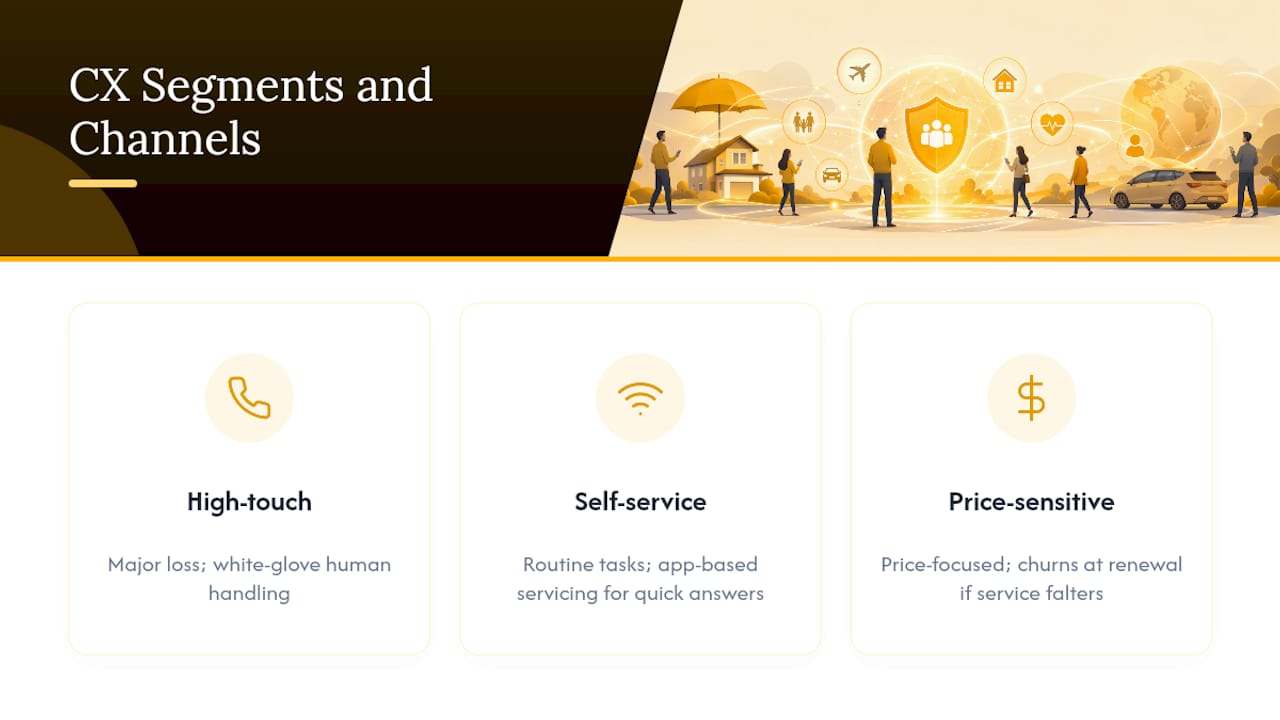
Segmentation in insurance CX goes well beyond demographics. The useful splits are behavioral and risk-based: high-touch claimants who need white-glove handling after a major loss, self-service-ready customers who just want quick digital answers, and price-sensitive shoppers who churn hard at renewal if service falters.
Personalization works best when it’s grounded in policy and interaction data rather than guesswork. A customer who has called three times about the same billing issue should never land with a fourth agent who has no visibility into that history. That’s not personalization, it’s a failure of basic data access. True personalization means the contact center, digital self-service tools, and claims team all draw from the same customer record, so tone and urgency match the customer’s actual situation.
Segmentation also shapes channel strategy. Younger, digitally native policyholders often prefer app-based servicing for routine tasks like payment updates, while claimants dealing with a major loss almost always want a human voice, regardless of age. Building rigid channel assumptions by age group is a common mistake. The smarter approach segments by task complexity and emotional stakes, not just customer profile.
Carriers that get this right typically see it show up in FCR and NPS simultaneously, because the customer feels recognized rather than processed. Getting there requires the data and analytics layer described earlier to actually feed segmentation logic in real time, not just in quarterly reports.
Why Do Legacy and Modern Systems Clash in CX Operations?
Most insurers are running CX ambitions on top of core policy administration systems that are decades old. These legacy platforms were built for batch processing and internal recordkeeping, not real-time customer interaction, and that mismatch creates friction at nearly every integration point.
The most common failure pattern: a carrier builds a modern orchestration layer or CRM, then discovers the core system can’t expose data in real time, so the new tool ends up polling for updates on a delay, sometimes hours, sometimes overnight. Customers see this as inconsistency. They get one answer from the app and a different one from the call center, because the two systems synced at different times.
Data structure mismatches compound the problem. Legacy systems often store policy and claims data in formats that don’t map cleanly to modern APIs, which means every integration project needs custom middleware rather than a plug-and-play connection. This is where many modernization budgets quietly balloon, since the “simple integration” turns into months of data mapping work.
The practical fix isn’t always a full core system replacement, which can take years and carries real risk. Many insurers instead build an integration layer, sometimes called an API gateway or middleware layer, that sits between legacy cores and modern CX tools, translating data in both directions. This lets the front-end experience modernize faster than the back-end core, without waiting for a multi-year core replacement project to finish first.
How Are Insurers Using AI Beyond Agent Assist?
Agent-assist tools get most of the attention, but predictive analytics is where AI is starting to change insurance CX operations more fundamentally.

Predictive models now flag which policyholders are likely to churn at renewal, based on interaction patterns like repeat complaints or slow claims resolution, giving retention teams a chance to intervene before the renewal notice even goes out. Similar models predict claims complexity at FNOL, routing straightforward claims to fast-track automated processing while flagging complex ones for experienced adjusters immediately, rather than after a slower manual triage.
Fraud detection is another area seeing real gains, with predictive models scanning claims patterns for anomalies far faster than manual review ever could. And on the acquisition side, predictive underwriting signals help price and route quotes more accurately, reducing the quote-to-bind friction that JD Power’s research flagged as a widespread weak point in digital insurance experiences.
The common thread across all of these applications: predictive analytics works best when it’s feeding decisions to human teams, not replacing judgment entirely. A model that flags a likely-to-churn customer still needs a retention specialist who knows how to have that conversation. Insurers that treat AI purely as a cost-cutting replacement for staff tend to see satisfaction scores drop, while those that treat it as a triage and prioritization tool tend to see both efficiency and satisfaction improve together.
What Data Privacy Rules Apply to Insurance CX Operations?
Insurance customer data carries unique sensitivity: health information tied to underwriting, financial details tied to billing, and personal details tied to claims investigations, often all in the same customer record. That combination means CX operations sit closer to regulatory scrutiny than most other industries’ service functions.
State insurance regulators enforce data handling and privacy requirements that vary by jurisdiction, and carriers operating across multiple states need CX systems that can apply the right rules automatically rather than relying on agents to remember which state’s requirements apply to which customer. Health-adjacent data used in underwriting or claims can also trigger additional handling obligations depending on the product line and the type of information involved.
This has direct operational implications. Every system in the CX stack, from the CRM to the agent-assist tool to any AI model handling claims data, needs access controls and audit trails that satisfy examiners, not just IT security teams. When insurers build the integration layer described earlier to connect legacy and modern systems, that layer also becomes the natural checkpoint for enforcing data access rules consistently across every tool that touches customer information.
Nearshore and outsourced CX partners need the same rigor. Any organization extending an insurer’s CX team should operate under the same data handling standards and contractual protections as an internal team, with clear audit rights built into the service agreement. Skipping this step to move faster on a pilot is one of the more common regrets operations leaders report after the fact.
Where should insurance CX leaders start?
Start with a diagnostic, not a technology purchase. Map your highest-friction journeys and set baseline KPIs before choosing any tool or partner. Governance and measurement discipline matter more early on than any single platform decision, because without a baseline you can’t prove a pilot worked.
How Altiam CX Helps Insurers Modernize CX Operations
If your CX transformation is stalling on staffing, not strategy, that’s usually the fastest problem to fix. Altiam CX provides nearshore customer experience and back-office teams built specifically for insurers who need bilingual agents, claims support staff, and technical assistance without the multi-month hiring cycle an internal build requires.

Engagements typically focus on measurable outcomes: productivity gains, faster resolution times, and cost containment that shows up in your expense ratio, not just a satisfaction survey. One recent software platform engagement saw an 89% productivity improvement after migrating technical support operations to a managed nearshore model, a pattern that translates directly to insurance servicing and claims support functions. Altiam CX combines cultural alignment with disciplined execution, so your team extension feels like an extension of your own operation rather than a disconnected vendor relationship.
If your organization is planning a pilot for claims support, policy servicing, or back-office operations, request an assessment from Altiam CX to scope staffing needs and timeline against your specific KPIs.