Many businesses treat customer care as a reactive cost center, deploying chatbots and scripted responses to minimize handling time. This approach backfires spectacularly. When customers face exceptions or emotional frustration, automation without empathy triggers rage and churn. True customer care builds trust through active listening, exception handling, and emotional validation. This guide reveals what customer care actually means in 2026, how it differs from basic support, and why nearshore solutions offer the strategic edge to transform interactions into lasting relationships that reduce friction and drive sustainable growth.
Table of Contents
- Understanding Customer Care: Beyond Basic Support
- Core Components of An Effective Customer Care Strategy
- Nearshore Support Solutions: Enhancing Customer Care Outcomes
- Measuring And Improving Customer Care In 2026
- How Altiam CX Can Transform Your Customer Care With Nearshore Expertise
- Frequently Asked Questions
Key takeaways
| Point | Details |
|---|---|
| Customer care is proactive relationship building | It goes beyond reactive support to foster trust through empathy and emotional validation. |
| Exception handling builds trust | Designing for edge cases and active listening prevents rage and churn better than scripted automation. |
| Nearshore support enhances quality | Cultural alignment and timezone proximity improve empathy training and responsiveness. |
| Measure emotional outcomes | CSAT alone misses critical trust signals; track emotional validation and exception success rates. |
| Strategic implementation drives growth | Combining human touch with digital tools reduces friction and improves long-term customer retention. |
Understanding customer care: beyond basic support
Customer care represents a strategic commitment to proactive, empathetic engagement that resolves issues while fostering loyalty. Unlike customer service, which typically addresses immediate problems reactively, customer care anticipates needs and builds emotional connections. Customer support often focuses narrowly on technical troubleshooting, whereas care encompasses the entire relationship lifecycle.
The psychology behind effective customer care reveals critical insights. Exception-first design and active listening build trust, while over-automation risks triggering customer rage and churn. When businesses measure only CSAT scores, they miss emotional validation signals that predict long-term loyalty. Customers remember how you handled their worst moments, not their routine transactions.
Active listening forms the cornerstone of exceptional care. This means acknowledging emotions, paraphrasing concerns to confirm understanding, and addressing root causes rather than symptoms. Exception-first design flips traditional thinking by optimizing for edge cases instead of average interactions. When your team handles exceptions well, routine cases become effortless.
Consider these foundational elements:
- Empathy training that teaches agents to recognize emotional cues
- Communication protocols for de-escalation and validation
- Authority to resolve exceptions without escalation loops
- Feedback systems that capture emotional context beyond scores
Over-automation creates a dangerous trap. Chatbots excel at routing simple requests but fail catastrophically when customers need genuine help. The frustration compounds when automated systems force customers through irrelevant menus or fail to recognize urgency. Smart businesses use automation to handle routine tasks while preserving human capacity for complex, emotional interactions.
True customer care recognizes that every interaction either builds or erodes trust, and trust determines whether customers stay or leave.
The shift from transactional support to relational care requires intentional design. Train teams to ask better questions, listen without interrupting, and validate feelings before solving problems. When you prioritize emotional outcomes alongside operational efficiency, you create experiences that customers remember and recommend. This foundation makes everything else in your customer care fundamentals more effective.
Core components of an effective customer care strategy
Building a robust customer care strategy requires integrating multiple elements that work together to create consistent, empathetic experiences. Training stands as the first critical component. Engagement strategies vary by direct and indirect influence and digital offerings, meaning your approach must adapt to different customer touchpoints. Direct interactions demand higher empathy skills, while indirect touchpoints benefit from clear communication and proactive guidance.

Empathy training goes beyond generic soft skills workshops. Effective programs teach agents to recognize emotional states through word choice and tone, respond with validation before solutions, and adapt communication styles to individual preferences. Role-playing exercises with real customer scenarios build muscle memory for high-stress situations. Regular coaching sessions reinforce these skills and address gaps revealed through quality monitoring.
Digital tools should amplify human capabilities, not replace them. CRM systems that surface customer history enable personalized conversations. Knowledge bases reduce research time so agents focus on listening. Sentiment analysis flags escalating frustration for supervisor intervention. The key is integration: tools must feel invisible to customers while empowering agents with context and efficiency.
Balancing automation with personal attention requires strategic thinking:
- Route simple, repetitive requests to self-service channels
- Reserve human agents for complex problems and emotional situations
- Design handoff protocols that preserve context when escalating from bot to person
- Monitor automation failure points and continuously refine decision trees
Pro Tip: Create an exception playbook that documents unusual scenarios and proven resolution paths, then train all agents on these edge cases to build confidence and consistency.
Measurement extends beyond traditional metrics. While CSAT and NPS provide directional signals, they miss emotional nuances that predict churn. Track first-contact resolution for efficiency, but also measure how often customers feel heard and validated. Monitor exception handling success rates to identify training gaps. Survey customers specifically about trust and emotional satisfaction, not just problem resolution.
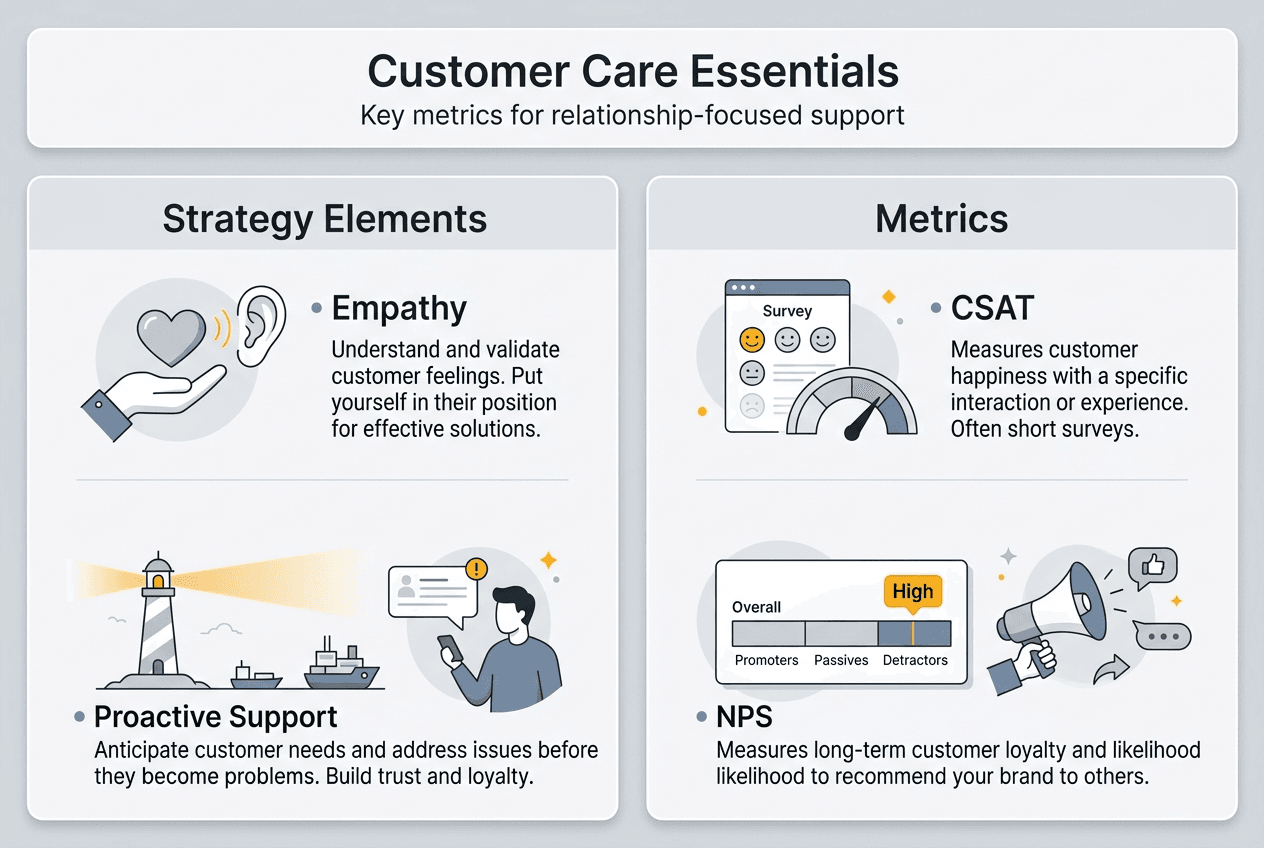
Your strategy must also account for different engagement contexts. Customers who interact directly with your brand expect immediate empathy and authority to resolve issues. Those influenced indirectly through reviews or social media need consistent messaging and proactive reputation management. Digital-first customers value speed and convenience but still require human backup for exceptions.
Continuous improvement cycles keep your strategy relevant. Analyze feedback patterns monthly to spot emerging issues. Conduct quarterly reviews of training effectiveness using quality scores and customer sentiment. Update playbooks and scripts based on successful exception resolutions. This iterative approach ensures your customer care evolves with changing expectations and business needs, as detailed in guides to improve customer care strategically.
Nearshore support solutions: enhancing customer care outcomes
Nearshore support refers to outsourcing customer care operations to geographically close countries, typically within the same or adjacent time zones. For North American businesses, this often means partnering with providers in Latin America. The strategic advantages include cultural alignment, real-time collaboration, and cost efficiency that offshore locations struggle to match while avoiding the premium costs of onshore teams.
Comparing nearshore, offshore, and onshore models reveals distinct tradeoffs:
| Model | Cost Efficiency | Cultural Alignment | Timezone Overlap | Scalability |
|---|---|---|---|---|
| Nearshore | High | Strong | Full | Excellent |
| Offshore | Highest | Variable | Limited | Good |
| Onshore | Low | Native | Full | Moderate |
Nearshore providers deliver cost savings of 30 to 50 percent compared to onshore teams while maintaining cultural affinity that offshore centers often lack. Engagement strategies vary by direct influence and digital context, making cultural understanding essential for authentic customer interactions. Shared language nuances, business etiquette, and communication styles reduce friction in training and daily operations.
Empathy training becomes more effective with nearshore teams due to cultural proximity. Agents understand regional references, humor, and social norms that shape customer expectations. This foundation accelerates onboarding and improves quality scores faster than offshore alternatives. Active listening skills translate more naturally when agents share cultural context with customers, reducing misunderstandings and building trust.
Scalability represents another nearshore advantage. Managed teams can expand or contract based on seasonal demand, product launches, or business growth without the hiring constraints of onshore markets. Providers maintain talent pipelines and training infrastructure, enabling rapid deployment of qualified agents. This flexibility supports business agility while maintaining service quality standards.
Timezone alignment eliminates the coordination headaches common with offshore operations. Real-time collaboration between your internal teams and nearshore partners enables quick issue resolution, seamless escalations, and synchronized strategy updates. Customers receive support during their active hours without forcing agents into graveyard shifts that degrade performance and increase turnover.
Pro Tip: When selecting nearshore providers, prioritize those with industry-specific experience and established quality frameworks, then verify their communication standards through pilot programs before full deployment.
The combination of cost efficiency, cultural alignment, and operational flexibility makes nearshore support particularly valuable for businesses scaling customer care operations. You gain access to trained talent pools without geographic constraints while maintaining the responsiveness and empathy that customers expect. This model supports the strategic customer care principles discussed earlier, enabling exception handling and emotional validation at scale. Explore how to optimize customer care with nearshore support or review nearshore customer experience outsourcing services that align with your business goals.
Measuring and improving customer care in 2026
Traditional metrics like CSAT and NPS provide limited visibility into customer care effectiveness. CSAT captures immediate satisfaction but misses whether the interaction built trust or merely resolved a symptom. NPS measures likelihood to recommend but fails to explain why customers feel that way. These scores become dangerous when teams optimize for the metric rather than the underlying relationship quality.
Emotional validation metrics offer deeper insights. Exception-first design and active listening measure beyond CSAT to emotional validation, tracking whether customers felt heard, respected, and valued during interactions. Survey questions like “Did the agent understand your frustration?” or “Do you trust us to handle similar issues in the future?” reveal relationship health that predicts retention better than satisfaction scores alone.
Implementing exception-first design requires systematic analysis:
- Collect verbatim feedback from customers who experienced exceptions or escalations
- Categorize edge cases by type, frequency, and emotional impact
- Document successful resolution paths that built trust despite initial problems
- Train all agents on these scenarios, not just average interactions
- Measure exception handling success rates as a core quality metric
- Iterate playbooks quarterly based on new exception patterns
This approach flips traditional quality assurance. Instead of penalizing agents for exceptions, you celebrate those who navigate them successfully and share their techniques across the team.
Technology reduces average handling time when deployed strategically. CRM integrations surface customer history instantly, eliminating research delays. Knowledge base search tools provide accurate answers without hold time. Automated note-taking frees agents to focus on listening rather than typing. The key is maintaining quality: faster resolutions only create value when they also satisfy emotional needs.
Consider these customer care performance indicators for 2026:
| Metric | What It Measures | Target Range |
|---|---|---|
| Emotional Validation Score | Customer felt heard and respected | 85 to 95 percent positive |
| Exception Resolution Rate | Edge cases resolved without escalation | 70 to 80 percent first contact |
| Trust Index | Confidence in future issue handling | 80 to 90 percent agreement |
| Quality-Adjusted Handle Time | Efficiency without sacrificing empathy | Baseline minus 15 to 20 percent |
Continuous improvement practices for 2026 customer care teams include:
- Weekly coaching sessions focused on recent exception cases and emotional outcomes
- Monthly calibration meetings where quality analysts align on scoring standards
- Quarterly playbook updates incorporating new exception patterns and solutions
- Biannual empathy training refreshers with role-playing exercises
- Real-time feedback loops where agents see customer sentiment immediately after interactions
- Cross-functional reviews with product and operations teams to address root causes
Analyzing customer feedback requires looking beyond scores to themes. Use text analytics to identify recurring frustration points, then trace them to process gaps or product issues. Share these insights with relevant teams to drive systemic improvements rather than just coaching individual agents. When you fix root causes, customer care becomes easier and more effective.
The balance between speed and quality remains critical. Reducing average handling time by 30 percent means nothing if trust scores drop and churn increases. Monitor both efficiency and emotional metrics together, investigating any divergence. The goal is sustainable performance that improves business outcomes, not gaming individual KPIs. Learn more about optimizing these tradeoffs in the customer care workflow guide for 2026.
How Altiam CX can transform your customer care with nearshore expertise
Altiam CX specializes in nearshore customer experience outsourcing that combines cultural alignment with disciplined execution frameworks. Our teams deliver the empathy training, exception handling capabilities, and emotional validation your customers expect while reducing operational costs and improving scalability. We focus on building trust through every interaction, not just resolving tickets.
Our approach integrates the strategic principles outlined in this guide. We train agents in active listening and exception-first design, measure emotional outcomes alongside efficiency metrics, and provide real-time collaboration through shared timezones. Case studies demonstrate measurable improvements: one nearshore team extension engagement increased productivity by 40 percent while improving customer satisfaction scores.

Whether you need to scale customer care operations, improve quality metrics, or reduce friction in complex interactions, Altiam CX offers tailored solutions that align with your business goals. Explore our customer care improvement guide to see how nearshore partnerships can transform your customer experience strategy in 2026.
Frequently asked questions
What is customer care and how is it different from customer service?
Customer care focuses on proactive, empathetic relationship building that extends beyond resolving immediate issues. Customer service typically refers to reactive support that addresses problems as they arise, often through transactional interactions. Care includes emotional validation, trust building, and anticipating needs, while service centers on problem resolution. Effective customer care encompasses communication training, strategic engagement, and exception handling that creates lasting loyalty. Learn more about these distinctions in customer care fundamentals for 2026.
How can nearshore support improve my business’s customer care?
Nearshore providers offer cultural affinity and timezone alignment that enhance empathy and responsiveness in customer interactions. Teams share language nuances and social norms with your customers, making emotional validation more authentic and effective. You gain cost-effective scalability without sacrificing quality, accessing trained talent pools that deploy quickly for seasonal demands or growth. This model supports the exception handling and active listening principles that build trust and reduce churn. Discover strategies to optimize customer care with nearshore support for your business.
What are the key metrics to measure customer care effectiveness?
Go beyond CSAT and NPS by tracking emotional validation scores that measure whether customers felt heard and respected. Monitor exception resolution rates to assess how well your team handles edge cases without escalation. Include trust index measurements that predict long-term loyalty better than satisfaction scores alone. Balance efficiency metrics like average handling time with quality indicators to avoid sacrificing empathy for speed. Review detailed approaches to these metrics in the customer care workflow guide for 2026.