
TL;DR:
- Effective CX KPIs must drive decisions by linking data to specific actions that improve customer satisfaction and business outcomes. Using a balanced scorecard approach helps reveal different aspects of customer experience, enabling more informed strategic and operational decisions. When KPIs are properly communicated, integrated into workflows, and connected to financial impact, they can significantly enhance customer loyalty and company growth.
Understanding the role of KPIs in CX separates organizations that grow loyal customers from those that lose them to competitors without knowing why. 75% of customers will spend more with companies that deliver a consistently positive experience. Yet most CX teams track a dozen metrics, report them upward, and watch nothing change. The problem is not a lack of data. It is a failure to connect KPIs to the decisions that actually move the needle on customer satisfaction, team behavior, and long-term revenue.
Table of Contents
- Key Takeaways
- The role of KPIs in CX and why it matters
- Core CX KPIs and what they actually reveal
- Why KPI programs fail in practice
- Strategies for driving CX improvements through KPIs
- My perspective on KPIs that actually move the needle
- See KPI-driven CX in action with Altiamcx
- FAQ
Key Takeaways
| Point | Details |
|---|---|
| KPIs must drive decisions | Tracking KPIs without linking them to specific actions wastes resources and limits CX impact. |
| Use a balanced scorecard | Combining NPS, CSAT, FCR, CLV, and churn gives leaders a fuller picture than any single metric. |
| Communication gaps cost results | Less than 33% of CX teams set realistic KPI targets, limiting executive buy-in and resource allocation. |
| Translate CX into financial terms | Connecting CX metrics to revenue and cost outcomes is what earns C-suite attention and investment. |
| Embed KPIs in daily workflows | KPIs only improve CX when they are built into team processes, not just reviewed in monthly reports. |
The role of KPIs in CX and why it matters
Before you can use KPIs effectively, you need to be clear on what they actually are. A metric is any data point you measure. A KPI is a metric tied to a specific objective. Tracking average handle time is a metric. Tracking average handle time with a defined target that connects to customer satisfaction scores is a KPI. That distinction matters more than most teams realize.
In the CX context, KPIs function as a feedback loop between what your customers experience and what your organization does in response. They tell you where the gaps are, how serious those gaps are, and whether the changes you make are working. Without them, CX improvement is guesswork dressed up as strategy.
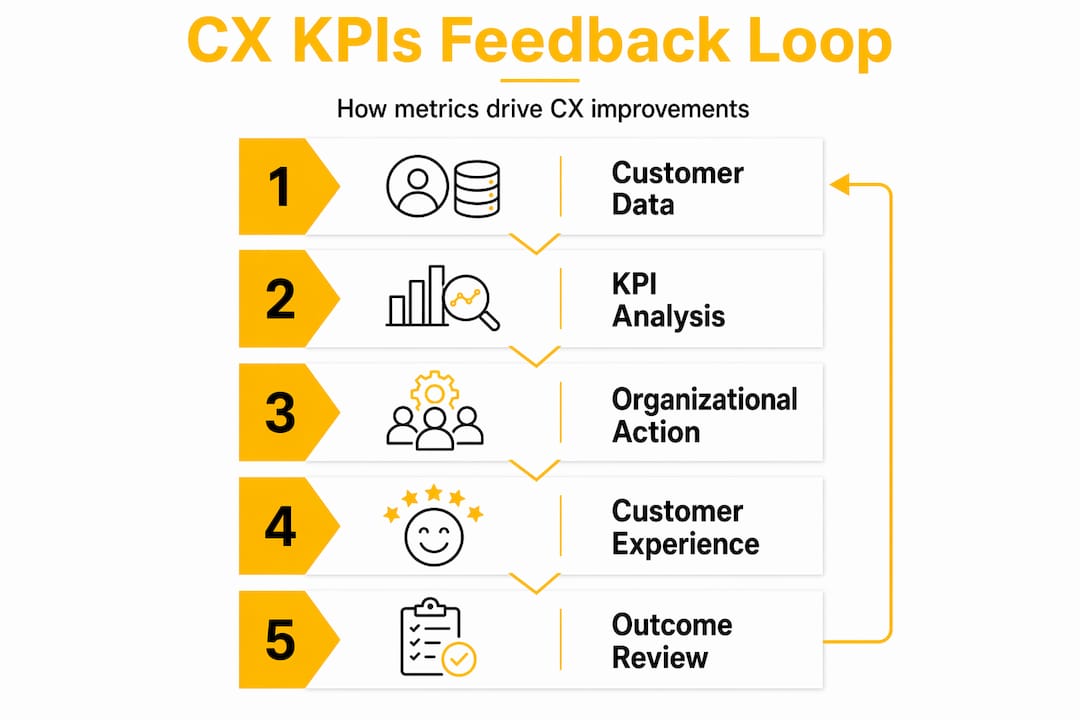
The importance of KPIs in customer service goes beyond operational oversight. 80% of customers consider experience as important as the actual product or service they buy. That means your KPIs are not administrative tools. They are performance levers tied directly to revenue, loyalty, and growth.
The most effective CX KPI programs share a few defining characteristics:
- They align to specific business objectives, not just departmental performance goals
- They inform decisions at multiple levels, from frontline agents to the executive team
- They create accountability by assigning ownership to specific teams or individuals
- They get reviewed on a regular cadence with clear processes for acting on the results
- They evolve as business priorities shift and customer expectations change
If your KPIs check those boxes, you have the foundation for measuring CX success in a way that drives real change, not just reporting cycles.
Core CX KPIs and what they actually reveal
Not all KPIs carry the same weight. Each one tells a different part of the customer story, and understanding what each reveals is what makes the difference between tracking and improving.
| KPI | What it measures | Primary value |
|---|---|---|
| NPS (Net Promoter Score) | Likelihood to recommend | Brand health and long-term loyalty |
| CSAT (Customer Satisfaction Score) | Satisfaction after a specific interaction | Immediate service quality feedback |
| CES (Customer Effort Score) | Ease of completing a task or resolution | Friction reduction and process efficiency |
| FCR (First Contact Resolution) | Issues resolved on first contact | Operational efficiency and service quality |
| Churn Rate | Customers lost over a period | Financial health and retention performance |
| CLV (Customer Lifetime Value) | Revenue generated over a customer relationship | Long-term growth and acquisition ROI |
The balanced scorecard approach is the most credible path forward. Use NPS for brand health, CSAT and FCR for day-to-day operational feedback, and CLV alongside churn for financial impact. Relying on a single KPI creates blind spots. A high NPS with rising churn, for example, often signals that satisfied customers are still leaving because of pricing or competitor offers. You need both signals to act correctly.

One trend reshaping KPI prioritization in 2026: AI agent deployment has pushed CSAT to the top of the performance stack. AI agent success is now measured primarily by customer satisfaction scores, surpassing efficiency metrics like handle time. That shift reflects a broader maturity in how organizations think about automation. Speed is no longer the goal. Satisfaction is.
Pro Tip: When selecting KPIs for AI-assisted service channels, weight CSAT and CES more heavily than efficiency metrics. Customers who feel helped, not just handled, are the ones who come back.
Personalization’s measurable impact on loyalty accounts for 21% of customer loyalty influence, which means KPIs for improving CX should increasingly include personalization-related data points. Track whether customers receive relevant recommendations, relevant service history references, and proactive outreach. These are no longer nice-to-haves. They are indicators of competitive performance.
Why KPI programs fail in practice
You can have the right KPIs and still see no improvement in customer experience. That outcome is more common than most leaders expect, and the cause is almost always one of three communication failures.
The first failure is measuring without acting. Only half of CX teams link their metrics to business outcomes, and fewer than 33% set realistic KPI targets. When KPIs exist in isolation, disconnected from decisions about staffing, process design, or technology investment, they become decoration.
The second failure is speaking the wrong language. CX teams often present metrics that make sense to their teams but mean little to CFOs or CEOs. A CSAT score of 4.2 is meaningful to a customer service director. It is abstract to a board member reviewing quarterly results. Translating CX metrics into financial terms is not just a communication preference. It is what unlocks budget, headcount, and strategic prioritization.
The third failure is data inconsistency. CRM gaps, inconsistent survey methodologies, and siloed reporting create numbers that different teams interpret differently. CRM inconsistencies are a documented challenge in AI-driven CX strategies, and they undermine the credibility of every KPI that depends on clean data.
“CX leaders must communicate metrics in terms CFOs and CEOs understand, linking them directly to financial outcomes. Until that happens, even the best KPI data sits unused.”
Consider a practical example. A CX team tracks First Contact Resolution at 72%. Internally, that is a meaningful number. But when they reframe it as “28% of contacts require a second call, adding $X in service costs per year,” the conversation with leadership changes immediately. The data is the same. The framing is what drives action.
AI analytics tools are beginning to close this gap by automatically surfacing financial correlations from CX data. Rather than manually connecting NPS trends to revenue at-risk, modern platforms can flag those relationships in real time. That is a meaningful shift for CX teams trying to earn a seat at the strategic table.
Strategies for driving CX improvements through KPIs
Knowing which KPIs to track is step one. Turning them into better customer experiences requires deliberate process design. Here is how high-performing CX organizations do it.
-
Align KPIs to strategic priorities first. Before selecting metrics, confirm what your organization is optimizing for. Retention, acquisition, service efficiency, and premium positioning each demand a different KPI mix. Starting with the business goal prevents the common mistake of tracking what is easy instead of what is meaningful. CX improvement for senior leaders begins with this alignment step.
-
Assign ownership at every level. Each KPI should have a named owner responsible for performance and accountable for explaining variance. Shared ownership dilutes accountability. An FCR target owned by the contact center director behaves differently than one owned by no one in particular.
-
Establish data governance before you scale. KPIs are only as reliable as the data behind them. Standardize how data is collected across channels, define survey trigger points consistently, and audit your CRM for gaps before drawing conclusions. KPI programs that integrate governance and data consistency deliver more operationally sustainable results.
-
Build KPI review into regular team rhythms. A weekly operational review that examines CSAT and FCR alongside staffing data creates the feedback loop that drives behavior change. Monthly or quarterly reviews are too slow to course-correct in real time. KPIs tied to speed and quality help teams act consistently on CX goals when reviewed frequently.
-
Use KPI trends to prioritize investment. Rising CES scores in a specific channel signal a friction point worth fixing. Declining CLV in a customer segment points to a retention risk worth addressing proactively. Let your KPI data tell you where resources will have the highest impact before committing budget.
Pro Tip: When presenting KPI trends to leadership, always pair the metric with a three-month trajectory and a specific recommendation. A number without a trend and a next step invites no decision.
Understanding how CX fuels business growth makes it easier to justify the governance and process investment that great KPI programs require. The return is not theoretical. It shows up in retention rates, repeat purchase frequency, and reduced service costs.
My perspective on KPIs that actually move the needle
I have seen organizations spend months debating which KPIs to include on their executive dashboard, only to make no operational changes once those dashboards go live. That is the pattern that frustrates me most. The debate is not the problem. The missing connection between what the dashboard shows and what the frontline actually does is where CX programs quietly stall.
In my experience, the most impactful KPIs are the ones that drive agent behavior, not the ones that look impressive in board presentations. An agent who understands how their FCR rate affects team performance and customer retention makes different decisions in every interaction. An agent who sees NPS on a slide once a quarter does not.
What I have learned is that embedding KPIs into culture requires repetition and context. Show agents how their individual scores roll into team performance. Show team leads how team performance connects to business outcomes. Make the chain visible at every level. When people understand why a number matters, they protect it without being told to.
The other thing I would push back on is the obsession with new metrics. Most organizations do not need more KPIs. They need to act more decisively on the ones they already have. Depth beats breadth every time.
— Daniela
See KPI-driven CX in action with Altiamcx

The gap between tracking CX metrics and actually improving customer outcomes is where most organizations get stuck. Altiamcx helps close that gap. As a nearshore CX and operational services partner, Altiamcx builds performance frameworks that connect KPIs to frontline behavior, executive reporting, and measurable business results. See how a leading orthodontic services provider improved CX by implementing disciplined KPI programs with Altiamcx, or explore how a software platform migrated tech support and improved productivity by 89%. When you are ready to build a smarter CX engine, Altiamcx is the partner to start with.
FAQ
What is the role of KPIs in CX?
KPIs in CX provide measurable targets that connect customer experience performance to business objectives, helping teams identify gaps, prioritize actions, and demonstrate the financial value of service improvements.
Which KPIs are most important for customer experience?
The most effective approach combines NPS for brand health, CSAT and FCR for operational feedback, and CLV alongside churn rate for financial impact. No single KPI tells the full story on its own.
Why do CX KPI programs often fail to drive improvement?
The most common causes are failing to link metrics to business outcomes, presenting data in ways executives do not find meaningful, and relying on inconsistent data sources that undermine credibility.
How can CX teams get leadership to act on KPI data?
Translate CX metrics into financial terms. Showing that a 5-point CSAT decline correlates with a measurable increase in churn or service costs is far more persuasive to a CFO than the score itself.
How often should CX KPIs be reviewed?
High-performing CX teams review operational KPIs like FCR and CSAT weekly to enable real-time course correction. Strategic KPIs like CLV and NPS are reviewed monthly or quarterly with executive stakeholders.