
TL;DR:
- Effective fulfillment relies on a coordinated process that begins with accurate inventory receiving and ends with fast returns management, impacting costs and customer loyalty. Properly integrated systems, optimized picking, and fast processing of returns are essential to minimize errors and improve customer satisfaction. Treating fulfillment as a connected system rather than siloed functions drives operational success and better profitability.
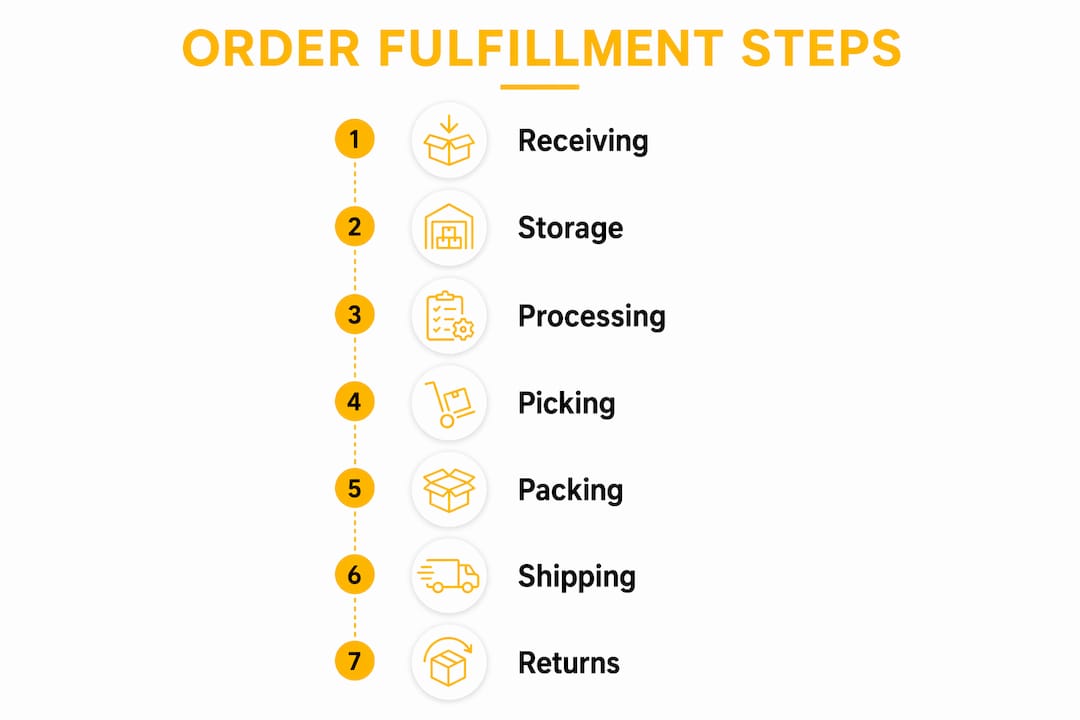
The step by step order fulfillment process is the sequence of coordinated tasks that moves products from inventory to the customer’s hands with speed and accuracy. Most e-commerce businesses treat fulfillment as a back-office function. The ones that win treat it as a competitive advantage. The standard fulfillment lifecycle covers seven core stages: receiving, storage, order processing, picking, packing, shipping, and returns management. Each stage directly affects your cost per order, your error rate, and whether customers come back. Getting any one of them wrong cascades into problems downstream.
What are the essential steps in the order fulfillment process?
The fulfillment cycle begins the moment inventory arrives at your warehouse and ends only after a return is resolved. Accurate receiving means verifying quantities against purchase orders, inspecting for damage, and logging every item into your inventory system. Errors at this stage do not stay contained. A miscounted shipment becomes a phantom stock problem that causes wrong shipments weeks later.

1. Receiving inventory
Receiving is the foundation of every fulfillment stage that follows. When a shipment arrives, your team checks quantities against the purchase order, flags damaged goods, and records each SKU in the inventory system. Skipping any of these checks creates inaccuracies that compound over time. A single unchecked discrepancy can result in selling stock you do not actually have.
2. Storage and putaway
Strategic putaway means placing products where they can be retrieved fastest. Fast-moving SKUs belong near packing stations. Bulky, slow-moving items go to remote rack locations. Proper receiving and putaway significantly reduce labor hours and physical strain on warehouse staff. The placement decision you make during putaway determines how long every future pick takes.
3. Order processing
Order processing is the validation step between a customer clicking “buy” and a picker receiving a task. Your Order Management System (OMS) confirms the order details, checks available stock, and generates a pick list. This is where errors get caught before they become shipments. A well-configured OMS flags address issues, payment holds, and out-of-stock conditions automatically.
4. Picking
Picking accounts for more than 50% of warehouse labor resources. That figure means picking is the single biggest cost lever in your entire fulfillment operation. Optimized pick paths reduce the distance a picker travels per order. Common methods include zone picking, batch picking, and wave picking, each suited to different order volumes and warehouse layouts.
Pro Tip: Map your pick paths quarterly. As your product catalog changes, your fastest-moving SKUs shift. An outdated pick path layout costs you labor hours every single day.
5. Packing
Packaging affects customer experience, dimensional weight charges, and product protection simultaneously. Selecting the right box size reduces void fill costs and prevents carriers from charging you for air. Branded inserts and protective materials add perceived value without significant cost. Packing is also the last internal checkpoint before a product leaves your control.
6. Shipping
Carriers are selected based on cost, speed, and destination. Shipping software automates label printing and tracking number generation, removing manual entry errors. Customers who receive accurate tracking updates report higher satisfaction scores. Integrating your shipping platform with your OMS keeps order status current without manual updates.
7. Returns management
E-commerce return rates exceed 20% for many categories as of 2026. That volume makes returns a core operational function, not an afterthought. Each returned item needs inspection, a restock or disposal decision, and an inventory update. Delays in processing returns create inaccurate stock counts and lost revenue opportunities.
- Inspect every return against the original order
- Decide immediately: restock, refurbish, or dispose
- Update inventory records before the item is physically moved
- Issue refunds or exchanges within your stated policy window
What tools and systems support efficient order fulfillment?
Technology does not replace a well-designed process. It amplifies one. The two systems every e-commerce operation needs are a Warehouse Management System (WMS) and an Order Management System (OMS). Without real-time WMS and OMS integration, sellers risk overselling, increased shipping costs, and poor customer service due to inaccurate inventory visibility. Real-time sync between these two systems is not optional at scale.
| Tool category | Primary function | Fulfillment stage supported |
|---|---|---|
| WMS | Inventory tracking, putaway, pick list generation | Receiving, storage, picking |
| OMS | Order validation, stock checks, status updates | Order processing, shipping |
| Shipping software | Carrier selection, label printing, tracking | Shipping |
| Barcode scanners | Scan-to-verify accuracy at each step | Picking, packing, receiving |
| Returns management platform | Inspection workflows, inventory updates | Returns |
Separating picking, packing, and shipping into discrete, trackable transactions reduces errors and increases flexibility for bulk orders. When each step is logged independently, you can identify exactly where a mistake occurred. That traceability is what turns a one-time error into a process improvement.
Inventory tracking methodologies like FIFO (First In, First Out) and FEFO (First Expired, First Out) prevent aged stock from sitting while newer stock ships. Batch control adds another layer of traceability for regulated or perishable goods. Pick-to-light systems guide pickers to the correct bin with visual signals, cutting pick errors without requiring additional training time.
Pro Tip: Before investing in automation hardware, audit your pick error rate by step. Most operations find that 80% of errors originate in two or three specific SKU locations. Fix those locations first.
How can e-commerce businesses reduce costs and improve customer satisfaction?
Operational efficiency in fulfillment comes from removing friction at each stage, not from working faster. Fast-moving SKU placement near packing stations is the single highest-return storage decision most warehouses can make. The goal is to minimize the distance between the most-picked items and the packing bench. You can learn more about ecommerce support services that complement these operational improvements.
Key practices that reduce cost and improve satisfaction:
- Place your top 20% of SKUs by volume within 10 feet of packing stations
- Use batch picking for orders with one or two items to cut travel time per unit
- Automate carrier selection rules based on weight, zone, and delivery speed
- Set packing standards by product category to reduce damage claims
- Send proactive tracking updates at label creation, departure, and out-for-delivery stages
- Build a returns SLA (service level agreement) that commits to processing within 48 hours
Efficient returns handling is vital for customer retention. A customer who receives a fast, frictionless return experience is more likely to reorder than one who never had a problem. Returns are not a cost center to minimize. They are a loyalty touchpoint to manage well. Retail operations managers who want to understand fast retail process roles will find that labor allocation decisions in fulfillment directly affect both speed and cost outcomes.
What are the most common order fulfillment challenges and how do you fix them?
Fulfillment problems follow predictable patterns. Knowing where they originate makes them preventable.
- Receiving errors. Unchecked discrepancies between purchase orders and actual shipments create phantom inventory. Fix: require a two-person verification for all inbound shipments above a set value threshold.
- Picking mistakes. Wrong items ship when pick lists are unclear or bin locations are mislabeled. Fix: implement scan-to-verify at the pick step so the system confirms the correct SKU before the item moves.
- Packaging failures. Undersized boxes cause damage. Oversized boxes inflate dimensional weight charges. Fix: create a packaging matrix that maps SKU dimensions to approved box sizes.
- Shipping delays. Carrier cutoff times missed due to late packing create next-day delays. Fix: set internal packing completion targets 90 minutes before carrier pickup.
- Returns backlogs. Unprocessed returns create ghost inventory and delay refunds. Fix: dedicate a returns processing station and set a daily clearance target.
“The fulfillment process is not complete until customer delivery and reverse logistics are resolved. Efficient returns handling is as important as shipping for overall fulfillment success. Businesses that treat returns as a core workflow, not an exception, protect both profitability and customer loyalty.”
Workflow audits help identify where errors concentrate across the fulfillment cycle. Most operations find that 80% of their errors trace back to two or three specific process gaps. Fixing those gaps delivers faster results than broad technology investments.
Key Takeaways
A well-executed order fulfillment workflow reduces cost per order, cuts error rates, and builds the customer loyalty that drives repeat revenue.
| Point | Details |
|---|---|
| Picking drives the most cost | Picking exceeds 50% of warehouse labor, making pick-path optimization the highest-return improvement. |
| WMS and OMS must sync in real time | Without live integration, overselling and split shipments erode both margins and customer trust. |
| Returns are a core fulfillment stage | Processing returns within 48 hours protects inventory accuracy and customer retention. |
| Receiving errors cascade downstream | A single unchecked inbound discrepancy creates stock problems that affect orders for weeks. |
| Packaging affects cost and experience | Right-sized packaging reduces dimensional weight charges and damage claims simultaneously. |
What I’ve learned from watching fulfillment operations succeed and fail
The businesses that struggle most with fulfillment share one trait: they treat each stage as independent. Receiving is “the warehouse team’s job.” Returns are “customer service’s problem.” Shipping is “logistics.” That siloed thinking is where costs hide and errors multiply.
The operations that run well treat fulfillment as a single connected system. When receiving is accurate, storage is faster. When storage is logical, picking is cheaper. When picking is reliable, packing is cleaner. Every stage feeds the next. The ROI on fixing receiving, which feels unglamorous, is often larger than the ROI on buying new picking technology.
Returns are the area I see most consistently underinvested. A 20%+ return rate means one in five orders comes back. If your team processes those returns in batches once a week, your inventory data is wrong most of the time. That inaccuracy costs you in oversells, in customer service contacts, and in lost restock revenue. A daily returns clearance discipline costs almost nothing and fixes all three problems.
The other lesson: automation works best after your process is clean. Automating a broken pick path just makes you wrong faster. Map the process first. Fix the gaps. Then automate what is already working.
— Daniela
How Altiamcx supports fulfillment and customer experience operations
Building a reliable fulfillment operation requires more than the right warehouse layout. It requires the right people handling customer contacts, returns inquiries, and order exceptions at every stage of the cycle.

Altiamcx delivers nearshore customer experience and back-office operational support that integrates directly with your fulfillment workflow. From managing order exception queues to handling returns communication, Altiamcx teams operate with cultural alignment and measurable performance frameworks. One software platform that migrated its tech support to Altiamcx improved productivity by 89%. If your fulfillment operation is growing and your customer experience team is not keeping pace, Altiamcx provides the operational depth to close that gap.
FAQ
What are the 7 steps in the order fulfillment process?
The seven steps are receiving inventory, storage and putaway, order processing, picking, packing, shipping, and returns management. Each stage must be completed accurately for the next to function without errors.
Why does picking cost so much in warehouse operations?
Picking accounts for more than 50% of warehouse labor resources, making it the largest single cost in most fulfillment operations. Optimizing pick paths and using batch or zone picking methods directly reduces that cost.
How do WMS and OMS systems work together in fulfillment?
A WMS tracks physical inventory locations and movements, while an OMS manages order validation and status. Real-time integration between the two prevents overselling, reduces split shipments, and keeps customer-facing order data accurate.
What is a realistic return rate for e-commerce businesses?
E-commerce return rates exceed 20% in many product categories as of 2026. Businesses that process returns within 48 hours maintain more accurate inventory data and higher customer retention rates.
How do I reduce picking errors in my warehouse?
Implement scan-to-verify at the pick step so the system confirms the correct SKU before the item moves to packing. Combining barcode scanning with clearly labeled bin locations eliminates the majority of picking mistakes.