
TL;DR:
- Effective client experience in law firms involves managing perceptions at every journey stage, from research to post-case follow-up. Focusing on operational systems and digital responsiveness increases client retention, referrals, and reduces acquisition costs. Treating CX as a structured process with clear ownership and measurable metrics drives scalable growth and long-term loyalty.
Client experience (CX) in law firms is defined as the complete perception a client forms across every interaction with the firm, from the first Google search to the final invoice. This goes far beyond legal competence. Firms that deliberately manage CX at every stage see measurable gains in retention, referrals, and signed retainers. Research confirms that CX management drives growth outcomes including a 15 to 25% increase in signed retainers and up to a 40% reduction in client acquisition costs. The role of CX in law firms is no longer a soft consideration. It is a core operational discipline that separates growing practices from stagnant ones.
What are the key stages in the law firm client journey?
The most widely applied framework for mapping client experience in legal services is Prodonovich’s 5Es model, which divides the client journey into five distinct stages: Entice, Enter, Engage, Exit, and Extend. Each stage represents a decision window where client perception is shaped and loyalty is either built or lost.
- Entice: The pre-contact phase where potential clients research the firm, read reviews, and assess digital presence. This stage sets the first impression before a single conversation occurs.
- Enter: The intake and onboarding phase. How quickly the firm responds, how clearly it explains the process, and how professionally it handles paperwork all signal what working with the firm will feel like.
- Engage: The active matter phase. This is where most firms invest the majority of their attention, focusing on legal delivery, case updates, and client communication.
- Exit: The matter close phase. How the firm wraps up the engagement, presents the final bill, and acknowledges the client’s outcome shapes the lasting memory of the relationship.
- Extend: The post-matter phase. This is where referrals, reviews, and repeat business originate. Most firms treat this stage as passive when it should be structured and deliberate.
The biggest mistake law firms make is over-investing in Engage while neglecting Entice and Extend. A client who receives excellent legal work but experiences a clunky intake or a silent post-matter period is unlikely to refer others. Empathy and structured feedback collection matter at every stage, not just during active representation.
Pro Tip: Assign a named owner to each of the 5Es stages within your firm. When no one is accountable for Extend, referral generation becomes accidental rather than systematic.

How does CX differ from traditional client service in legal practices?
Understanding this distinction is the foundation of any serious CX improvement effort. Client service is what the firm does. Client experience is what the client feels about what the firm does.
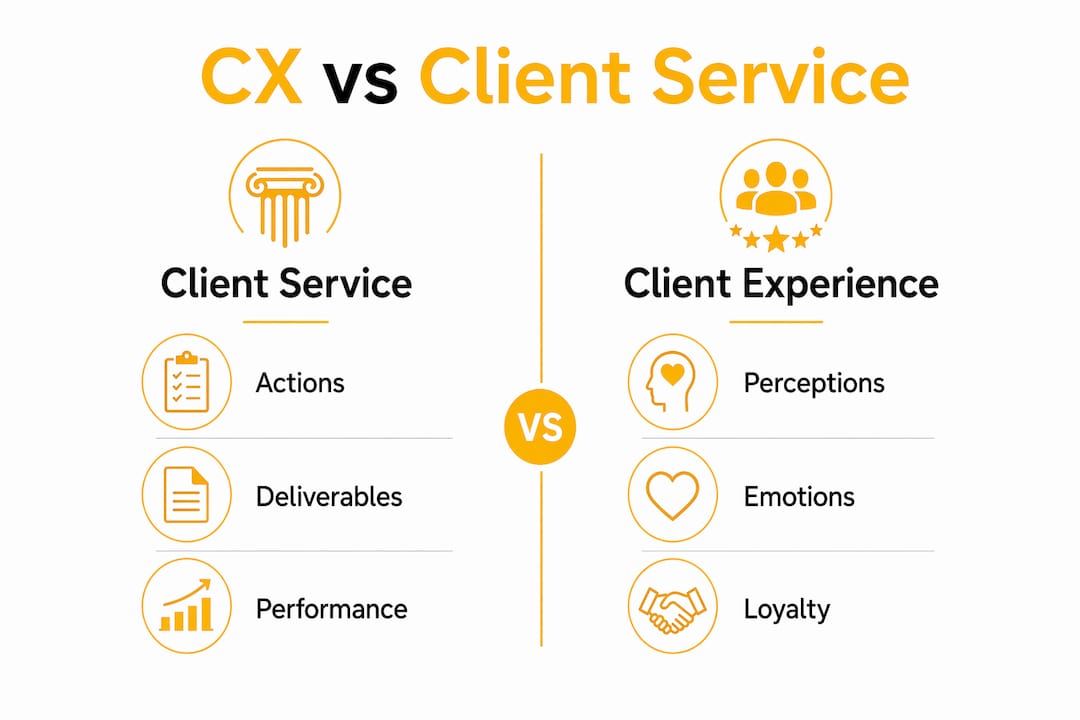
| Dimension | Client service | Client experience |
|---|---|---|
| Definition | Actions and deliverables the firm provides | Client’s emotional and perceptual response to those actions |
| Focus | Technical excellence, legal outcomes | Trust, clarity, ease, and emotional confidence |
| Measurement | Case outcomes, billing accuracy | NPS, satisfaction scores, referral rates, retention |
| Common failure | High quality work delivered poorly communicated | Client feels uninformed even when work is excellent |
A firm can win a case and still lose the client’s loyalty if the experience felt stressful, opaque, or impersonal. Law firms often focus on technical excellence while lacking the emotional engagement that client experience management (CXM) aims to close. This gap is where most firms lose referrals they never knew they were losing.
Measuring the CX gap requires tracking perception, not just performance. Post-matter surveys, Net Promoter Score (NPS) tracking, and review monitoring on platforms like Google Business Profile and Avvo reveal how clients actually felt, not just what the firm delivered. The firms that act on this data consistently outperform those that rely on legal reputation alone.
Pro Tip: Send a two-question post-matter survey within 48 hours of matter close: “How likely are you to refer us?” and “What could we have done better?” The response rate and content will tell you more than any internal review.
What CX metrics should law firms track to drive growth?
Tracking the right metrics transforms CX from a vague aspiration into a measurable growth system. The importance of CX for law firms becomes concrete when you connect specific data points to revenue outcomes.
The most predictive metrics fall into four categories:
Intake and responsiveness metrics
- Speed-to-first-touch: the time between a prospect’s initial inquiry and the firm’s first substantive response
- Onboarding completion rate: the percentage of new clients who complete intake paperwork within 48 hours
- Intake-to-retainer conversion rate: the share of consultations that result in signed agreements
Communication and engagement metrics
- Update frequency: how often clients receive proactive case status communications
- Client-initiated contact rate: a high rate signals that clients are not receiving enough proactive updates
Billing and financial metrics
- Invoice dispute rate: the percentage of invoices that generate a question or complaint
- Time-to-payment: how quickly clients pay after receiving an invoice, which correlates with billing clarity
Advocacy metrics
- Review request conversion rate: the share of clients who leave a review when asked
- Referral rate: the percentage of new clients who cite an existing client as their source
Tracking speed-to-first-touch and communication cadence during intake provides leading indicators for CX improvement before reputation metrics shift. This matters because reputation metrics like Google ratings lag actual client experience by weeks or months. By the time your rating drops, dozens of clients have already had a poor experience. Intake funnel metrics catch problems early, when they are still correctable.
Firms that connect these metrics to law firm revenue optimization find that even modest improvements in response time and update frequency produce compounding gains in retention and referral volume.
How can law firms operationalize CX to create predictable referrals?
Referrals are not a marketing outcome. They are an operational outcome. When you treat the client journey as a series of structured conversion points rather than a passive service delivery, referrals become predictable rather than accidental.
Here is a practical sequence for embedding CX as firm infrastructure:
-
Design intake as a conversion point. Respond to every new inquiry within one business hour. Use a standardized intake script that acknowledges the client’s situation before discussing fees. First impressions at Enter set the emotional tone for the entire matter.
-
Build a communication cadence into every matter. Set a default of weekly updates for active matters, even when there is no substantive news. Clients who feel informed are far less likely to call in anxiously, and far more likely to refer. Operationalizing communication as a conversion point drives retention and predictable referrals.
-
Make billing transparent before it becomes a dispute. Send itemized billing summaries mid-matter, not just at close. Clients who understand what they are paying for and why are less likely to dispute invoices. Clear billing also connects to retainer transparency, which reduces friction at the financial stage of the relationship.
-
Automate post-matter advocacy requests. Automated 30 and 90-day check-ins after matter close multiply reviews and referral introductions by 3 to 5 times compared to passive or ad hoc approaches. A simple sequence asking for a Google review at 30 days and a referral introduction at 90 days requires minimal effort and produces outsized results.
-
Assign ownership to each CX stage. Effective CX system design treats the matter lifecycle as separate decision windows with assigned ownership. When no one owns Extend, post-matter advocacy simply does not happen.
Pro Tip: Use your practice management software, whether Clio, MyCase, or a similar platform, to trigger automated post-matter check-in emails. The sequence takes less than two hours to set up and runs indefinitely.
What role does digital technology play in modern law firm CX?
Digital responsiveness is now a primary CX driver, not a secondary convenience. Clients form opinions about your firm before they ever speak to anyone there.
Research from Martindale-Avvo shows that 92.4% of legal consumers research firms before making contact, and 47.6% cite responsiveness as the key factor in their hiring decision. That means your digital presence and response speed are doing more selling than your attorneys are.
Client expectations for digital access are specific and measurable:
- 88% of clients value direct contact details for their attorney
- 85% expect weekly case updates
- 83% want same-day responses to inquiries
- 81% want access to an online client account
- 67% of clients aged 18 to 29 want online chat availability
- 75% of younger clients expect 24/7 digital access to their case information
These numbers define the minimum viable digital CX standard for 2026. Firms that fall below this threshold are not just inconveniencing clients. They are actively losing them to competitors who meet these expectations. AI-driven research journeys now merge marketing and client service, which means your intake process and digital clarity are part of the same conversion funnel. Slow responses and fragmented communication channels do not just frustrate clients. They signal that the firm is not organized enough to handle their matter well.
The solution is not to replace human service with technology. It is to use technology to make human service faster, more consistent, and more accessible. A client loyalty framework that integrates digital touchpoints with personal attorney relationships outperforms either approach alone.
Key takeaways
Firms that treat CX as an operational system, not a service attitude, convert more prospects, retain more clients, and generate referrals at a predictable rate.
| Point | Details |
|---|---|
| CX spans the full journey | Managing all 5Es stages, not just Engage, builds trust and generates referrals. |
| Service and experience differ | Technical excellence alone does not create loyalty; emotional perception drives retention. |
| Metrics predict growth | Tracking speed-to-first-touch and update frequency reveals CX problems before reputation suffers. |
| Automation multiplies advocacy | Structured post-matter check-ins generate 3 to 5 times more reviews and referrals than passive requests. |
| Digital responsiveness is non-negotiable | 83% of clients expect same-day responses; slow intake directly suppresses conversion rates. |
Why law firms must stop treating CX as a soft skill
I have worked with professional services organizations long enough to recognize a pattern. The firms that struggle with growth are rarely struggling because of poor legal work. They are struggling because they have never separated what they deliver from how clients experience that delivery.
The most common mistake I see is assigning CX responsibility to no one in particular. Everyone assumes the attorneys handle it. The attorneys assume the support staff handles it. The result is a client journey full of gaps that no one notices until a client does not return or does not refer.
What actually works is treating each stage of the client journey as its own operational function with a named owner, a defined process, and a measurable outcome. This is not a cultural initiative. It is a systems design problem. When you solve it with structure, the results show up in your intake conversion rate, your review count, and your referral volume within 90 days.
The firms I respect most in this space have stopped asking “did we do good legal work?” and started asking “did the client feel confident, informed, and valued at every stage?” Those are different questions with different answers. The second question is the one that builds a practice.
— Daniela
How Altiamcx helps law firms build a smarter CX engine
Law firms that want to improve client satisfaction and scale their practice need more than strategy. They need execution capacity.

Altiamcx delivers nearshore client intake support, back-office operations, and communication management designed to close the gaps in your client journey. Whether your firm needs faster first-touch response, structured onboarding support, or a post-matter advocacy system, Altiamcx provides the operational infrastructure to make it work. A recent productivity case study documents an 89% productivity improvement after migrating support operations to Altiamcx. Explore how law practice intake solutions from Altiamcx can help your firm convert more prospects and retain more clients starting today.
FAQ
What is the role of CX in law firms?
CX in law firms is the management of every client interaction across the full matter lifecycle, from initial research to post-matter follow-up. Firms that manage CX deliberately see higher retention, more referrals, and lower client acquisition costs.
How does CX differ from client service in legal practices?
Client service refers to the legal work and actions the firm performs. Client experience is the perception and emotional response the client has to those actions. A firm can deliver excellent legal work and still produce a poor client experience through slow communication or opaque billing.
What CX metrics matter most for law firm growth?
Speed-to-first-touch, onboarding completion rate, update frequency, invoice dispute rate, and referral rate are the most predictive CX metrics for law firm scalability. These leading indicators reveal problems before they appear in online reviews or retention data.
How can law firms generate more referrals through CX?
Automated post-matter check-ins at 30 and 90 days after matter close generate 3 to 5 times more reviews and referral introductions than passive or ad hoc requests. Treating referrals as an operational outcome rather than a marketing hope is the key shift.
Why do younger clients have higher digital CX expectations?
Clients aged 18 to 29 expect online chat availability and 24/7 access to case information at significantly higher rates than older clients. This reflects broader consumer behavior shaped by digital-first service experiences, and law firms that do not meet these expectations lose this demographic to more digitally accessible competitors.